
This movie has a lot going for it: big names like Evan Rachel Wood, Vincent D’Onofrio, Aubrey Plaza, Rupert Grint, Mads Mikkelsen, Melissa Leo. And also Shia LaBeouf. Okay, truth be told, it’s a lot of LaBeouf. Mostly LaBeouf. And I realize he’s not exactly anyone’s idea of Hollywood’s It kid right now.
What happened to Shia LaBeouf? Admit it – his eagerness and enthusiasm in his first Transformers performance was contagious. He was instantly a star, ranking #6 on The 25 Hottest Actors Under 25 and earning studios a very impressive $160 for every $1 paid to 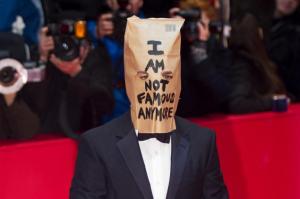 him. But as quickly as his star rose, so began his descent. The very next year he was arrested on a DUI at the scene of an accident where luckily the only injury was his own (he required extensive hand surgery which forced a pause in production of Transformers 2). And then: bar fights, drunkenness, badmouthing movies and costars, boasting about conquests that put other people’s relationships in jeopardy, headbutting strangers, chasing the homeless, making fans cry, live-tweeting LSD trips. He dropped out of a Broadway play starring Alec Baldwin and then trolled him from the front row during a performance. I mean, who else would even try to out-Baldwin a Baldwin? He got caught plagiarizing, then attempted to apologize for it by hiring a skywriter far away from where the victim lived. These were bad years, and there wasn’t a single person who didn’t distance themselves from him. Heck, even the
  Transformers franchise was handed over to Marky Mark, and Indiana Jones given back to a septuagenarian. But then came even worse years,the paper bag years. In an effort to insist he “wasn’t famous anymore”, he wore paper bags over his head to red carpet events and on talk shows. In an effort to reframe his erratic behaviour as “performance art”, he staged increasingly bizarre events – during one “show” he lived in an art gallery for 5 days during which people lined up to spend 1 hour alone in a room with him while he sat in perfect silence, often soaking the paper bag on his head with tears. He would later claim that a woman raped him during her hour and he did nothing to stop it in order to preserve the integrity of the piece. Then he live-streamed himself watching
  all 29 of his movies back to back in a Manhattan theatre (he cried then too). And just this February he spent 24 hours in an elevator. Because, duh, it’s art. Meanwhile, I’m wondering where the hell his mother is. This man is clearly suffering and Hollywood is not known for coming to anyone’s rescue. In fact, this tabloid culture in which we are living feeds off of young people’s breakdowns.
Shia, if you’re reading: I’m sorry you’re hurting. I can’t pretend to know what it does to a person’s head to have so much power and money and fame. You need a break, and we have a spare bedroom. I’m a therapist, and so are 3 of my 4 dogs. Come have a rest.
To the rest of you: Charlie Countryman is plagued, but not by Shia LaBeouf. He’s clearly giving it everything he’s got, but it’s not enough to save this mess. He plays a young,  grieving guy who flies to Bucharest to shakes his blues but instead finds himself drawn to a woman with an intoxicating accent. She’s bad news, as evidenced by the many iterations of the film’s title – you may find it called Kill Charlie Countryman, or The Necessary Death of Charlie Countryman. Either way, you know she’s going to get him killed, but she’s beautiful, aloof, and dangerous, so how can he resist?
The director tries to be kinetic and offbeat but it’s overcooked and comes off more as emo. It’s like the director was pretty sure this is the only film he’d ever get his grubby little hands on, so he used up every trick in his bag, and his bag was a student backpack. Charlie  Countryman is watchable, but it would be hard to mistake it as good.
Shia LaBeouf, on the other hand, is likely a good person going through a hard time. Looking at his rap sheet, it’s easy to mistake tragedy for comedy, but it’s clear his spiral is still trending downward and that he’s unable to save himself. The big sister in me just wants to give him a hug and a cookie and say “Shia, eneouf is eneouf.”
 serious bank helping to make those foreclosures happen, then buying up those empty homes for real cheap and repackaging them for new buyers. The money is staggering. Dennis is dazzled by it. He’s never made this kind of cash before, and mid-recession, he’s not likely to find even a fraction of it anywhere else. But it means working for the bad guys and evicting people, nice people, just like him.
 doesn’t bail out the losers. America was built by bailing out winners. By rigging a nation of the winners, for the winners, by the winners.” Fucking ouch, eh?
 homes. In fact, when Andrew Garfield is pounding on people’s doors, those are, more often than not, real evictees answering them, often standing in their own foreclosed homes. Jason Reitman went for a similar effect in Up In the Air, interviewing real victims of downsizing on camera. Both these movies are symptoms of the same dirty disease, and it’s heartbreaking. And I can’t help but wonder if any of these homeless people are comforted by being portrayed, however compassionately, by Hollywood millionaires.
 take forever to make. Both The New World (2005) and The Tree of Life (2011) were based on scripts that he started back in the 70s. They also take forever to edit. He reportedly shot over a million feet of film for The New World, which of course had to be edited down to a concise 135 minutes. Knight of Cups, shot during the summer of 2012, spent nearly four years in post-production. Both Christian Bale and Natalie Portman have said that they spent more time recording their voiceovers than they did in front of the camera.
 Tony Curtis and Jack Lemmon are dubious women but the disguises prove necessary when the very gangster they’re trying to avoid shows up uncomfortably close. The disguise is a further hindrance when Joe starts to fall for a fellow musician, the band’s fox ukulele player, Sugar Kane (Marilyn Monroe).
 correct: “It’s me, Sugar.” She kept saying “Sugar, it’s me” or “It’s Sugar, me” which is harder to forgive. After the 30th take Wilder had the line written on a blackboard but one still wonders why a further 17 were required beyond that. Another difficult 3-word line perplexed her further still. “Where’s the bourbon” often came out “Where’s the whiskey?” or “Where’s the bottle?” so Wilder had it written into the drawer she rummaged through. Then she couldn’t find the right drawer so he had it written in all the drawers. 59 takes
  later, she says the line with her back to the camera so you can judge for yourself whether she EVER got it right. Meanwhile, Tony and Jack had to stand around in painful high heels while she flubbed line after line, which can’t have earned any goodwill.
 Decency. Kansas went one better though – the state banned the film from being shown there, explaining that cross-dressing was “too disturbing for Kansans”. Luckily Vancouverites are made from heartier stock. As long as you aren’t pregnant and don’t have any pre-existing heart conditions, why don’t you check the film out at the
  It’s actually a visit from a despicable old roof rat that seems to prod her toward new experiences, inviting two men into her life (Sam Elliott, Martin Starr) who stir up all kinds of feelings, old and new.
 Danner is the Carrie of her group, inevitably, and is suitably attired, every outfit classy, understated, elegant. In their 60s, 70s, and beyond, these ladies still turn heads.
 irrelevant to the movie, which makes the insult all the more infuriating.
 use the person who came up with this expression has never seen a man with a simple head cold? To “man up” implies a manly scenario, and a failure of a certain man to fulfill his obligations or responsibilities as a man. In the movie’s case, Pegg has an unfaithful ex-wife, and a charming if slightly mendacious new flame. How exactly do either of those scenarios require testicles in particular? And what would become of this movie if “man up” didn’t mean create a big, Hollywood-style hullabaloo where you declare your undying love for a woman you just met in front of a crowd of rowdy strangers, but instead “man up” meant, admit your fears, communicate
  honestly, be flexible, be vulnerable. Or what if being this kind of bold and brave didn’t require a Y chromosome and it could be Lake Bell, in all her ovarian glory, reaching across the void? The phrase “man up” implies such a rigid view of masculinity it punishes both the sexes (and all the sexes in between) and leaves us all sitting in painful little boxes having to watch insipid little romcoms the world could do wi
 thout.
 art on the street, and selling pencils. That van of hers is a neighbourhood nuisance; the people live in fear of when she might exercise her “Christian parking” principles beside their little bit of curb.
 happened, and what just makes for a nicer story. In fact, Bennett has conveniently split himself in two, the one who goes out and lives, and the one who stays home and writes.
 contents had to be deep-cleaned before they could be made suitably grimy again for production). They filmed in the very driveway of the very home where Bennett lived at the time.
 It was 1991 when Paul Reubens, the man behind the tiny red bowtie and obnoxious laugh who streamed his playhouse antics directly into your family room to mesmerized kids, was arrested for masturbating in an “adult movie theatre.” His arrest was widely covered, Reubens terribly ridiculed, even when wholesome famous friends like Bill Cosby spoke up on his behalf, saying “Whatever (Reubens has) done, this is being blown all out of
  proportion” (I guess he was hoping people would remember this sentiment when it came turn for his own shit to hit the fan).
 doing a skit on SNL. Since nobody showed up to burn him on a stake, it seemed the way was clear for Netflix to greenlight a movie he’d been waiting a quarter century to make.
 Hartman created the anti-comic character, a weird, manic, effeminate,ambiguous “boy” who got by on enthusiasm and catchphrases like “I know you are but what am I?” Pee-wee Herman was born, but was initially aimed at adults, appearing on The Dating Game, and in a Cheech and Chong movie. Eventually Reubens toned down the
 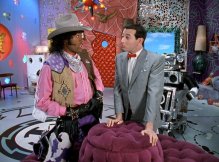 innuendo and became a childhood icon (although you only have to look as far as Cowboy Curtis, played by a young Laurence Fishburne, to know it was still there).
 wish-fulfillment. A longtime Pee-wee fan, this was a film he thought people wanted to see. “I just think there are very few characters in comedy history as strong and hilarious as Pee-wee Herman. The first moment you’re sitting in a room with Paul Reubens and he starts pitching you things Pee-wee might say or do, you think to yourself, ‘This can’t be happening.’ The first time he put on the suit, I thought I was going to pass out.”
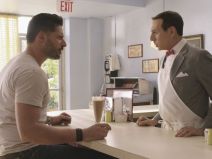 Pee-wee’s Big Holiday, which is nearly plotless, is this: Pee-wee has never left the small town he lives in, but one day a big, handsome movie star named Joe Manganiello drives through town on his sexy hog and the two hit it off as only two rootbeer-barrel-loving-boys can. Joe invites Pee-wee to his birthday party in NYC, and Pee-wee embarks on an epic adventure across the country. Or something like that.
 Reubens, now 63, hardly looks as though he’s aged a day underneath the familiar pancake makeup. Pee-wee’s Big Holiday isn’t likely to win any new converts though. It’s a silly little thing, a very small fluff on some pretty major wind, but yes: it is in fact a movie. And you can watch it now on Netflix.
 ASSHOLES WATCHING MOVIES