
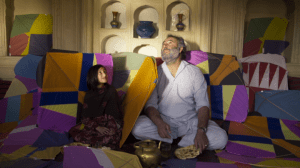
 Afghanistan is the last place I’d expect to find a kid flying a kite. After watching Black Kite and seeing kites be such a prominent part of life, bringing a tiny bit of joy to those who are trapped in this war-torn land, it seems strange that I ever had a presumption on kites one way or the other. The smallest of assumptions, something taken for granted without basis, led me to think I knew more about another’s circumstances than I do. Being wrong about kites reminded me that actually, I know absolutely nothing about what it’s like to live in Afghanistan! I have Black Kite’s writer/director Tarique Qayumi, a Canadian who came from Afghanistan as an eight-year old refugee, for brilliantly and effortlessly challenging my preconceptions.
Black Kite follows Arian, an Afghan man who has been captured by the Taliban and convicted of the highest crime. Through a series of flashbacks, we learn how Arian came to be imprisoned and sentenced to death. Kites feature prominently in his story, from childhood, through adolescence, to adulthood. There’s a remarkable contrast between the bright coloured kites and Arian’s drab, washed out existence, not only in the prison but throughout most of his life as Afghanistan is oppressed by one ruling body after another.
There are some absolutely beautiful shots of the desert and sky, and some very poignant animation that conveys a lot about what these kites represent: freedom, a means of expression and communication, and a marker of milestones in a man’s life, both good and bad.
Another assumption that Black Kite dispels is that freedom is free. Freedom is a foreign concept for Arian, not the inherent right that I treat it as. Arian and his family constantly live in fear, under the boot of one regime or another, with seemingly arbitrary rules that have the sole purpose of keeping them down. The rulers may change but the rules remain more or less the same, so Arian and his compatriots are denied even the simplest pleasures. It hurts to experience these denials second hand, making the first hand experience all the more difficult for my privileged mind to imagine.
Black Kite is a wonderful film and a timely one. It showed me how much can be stripped away from individuals, and reminded me that the little freedoms are as important as the big ones. If those little freedoms were preserved for all, this small world would be a much better place. There is no easy solution but we should spend our energy searching for ways to help people less fortunate than us. Instead, we spend our time arguing over how many refugees we should accept from war-torn countries like Afghanistan, places where every day could be your last and little freedoms, like flying a kite, cannot ever be taken for granted.
By the way, the answer to how many refugees we should accept is: as many as we can fit. And we’ve got plenty of room.
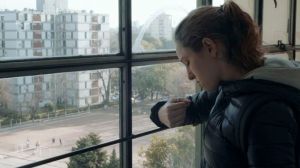 way, why do movies always make this seem so peaceful? If you’ve ever rested your forehead on a bus window in real life, you’ll know it feels more like going through the wash with a bunch of rocks, but whatever, don’t mind my grumbling, that’s neither here nor there]. The point is: looooooooong shots with little to no action, little to no dialogue, little to no plot. The whole movie can be summed up as: She’s pregnant. Oh jeez. How to get an abortion in a country where abortion is illegal? It’s only 87 minutes long but it feels more like 87 hours. Case in point: Sean fell dead asleep.
 Director Eli Craig clearly has some fondness for the genre, and little odes to other possessed-kid movies pop up from time to time. Another thing that pops up is Craig’s own mother, Sally Field, as a social worker who thinks Gary just isn’t trying hard enough. It’s a small but terrific role for her – possibly the kind of role only her son could ask her to play.
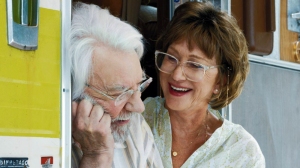 beloved RV, and this road trip is designed to trigger memories of happier times – their young family at play, their former selves in love. It’s obvious that the ‘in love’ part has never really faded for Ella and John, and maybe this is why it’s so hard for her to cope when he can’t remember who she is.
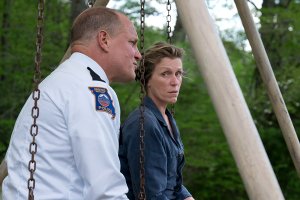 McDonagh uses lyrical language peppered with inspired cursewords; his heavy-weight cast punches it up with a surprising mixture of gravitas and black comedy.
 solitary existences up until Addie gets up the courage to ring Louis’s doorbell and invites herself in for a chat and a little proposal. Why not sleep together, she suggests. No, not sex. Sex doesn’t interest her. But the nights are long. Very long. Couldn’t they come to some arrangement? After thinking on it, he agrees, so off he goes in his best blue plaid shirt, to have a platonic sleepover with a neighbour he’s lived alongside for decades but never really known.
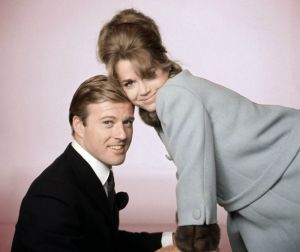 Venice Film Festival, in a ceremony preceding the screening of their new film. They’ve co-starred in movies before: The Chase (1966), Barefoot in the Park (1967), and The Electric Horseman (1979); this is their first in 38 years. To mark the occasion, Fonda said “It was fun to kiss him in my 20s and then to kiss him again in my almost-80s.” I have to say, it was fun for the audience, too. Yes, it’s great to see mature faces getting meaty roles, but you’re also getting a masterclass in acting. These two make it look easy. Their chemistry feels effortless.
 Of course, if you’re looking for classic, cheesy romance, this isn’t it. Louis and Addie are too wise for that. They have responsibilities, baggage, obligations. Kent Haruf, who wrote the novel upon which this film is based, knew a little about that. He wrote his book under a death sentence: he was 71, and he finished it just months before he died of lung cancer. The novel was published posthumously, so Louis and Addie are his legacy. Fonda and Redford would have made him proud.
 was curious about Darren Aronofsky’s latest project. Afterward, I was just tired and dreading this review.
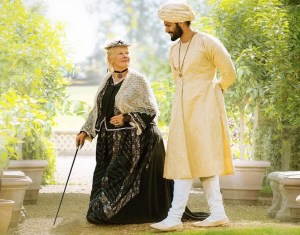 Is there anything more awkward than finding out the guy you recruited as a token Hindu is actually Muslim? There is, actually – it’s far more awkward when the guy you literally shipped from India as a parlour trick starts getting special attention from the Queen, more attention than you and all your fellow white sycophants combined. The worst part? He doesn’t even seem to be trying to play your game, yet he’s still beating all of you at it.
 are safe, the schools are good, it’s a great place to raise a family. Except if you’re the Meyerses, who just moved in. They’re not welcome (being black and all). They’re apparently the very people all these “nice” white folk have moved away from the cities to avoid. The Meyers don’t do a darn thing to incur the slightest ill will, except have a darker skin tone, but still the wrath of the townspeople is rained down upon them. Determined to force them out, their white neighbours harass them and abuse them and generally make such a ruckus that no one notices the neighbours directly behind them.
 ASSHOLES WATCHING MOVIES