Yearly Archives: 2017

Method Acting 101

There was a time when “committed” actors swore by method acting for really nailing roles, really living in the skin of the characters they portrayed. It’s a technique wherein the actor aims for total emotional identification with the part, and once they’re in the zone, they don’t leave it. They don’t break character when the director yells cut. If the character is angry and volatile, the actor will be angry and volatile for the whole 4 months. If the character is needy and vulnerable, then so will be the actor. You can understand why it’s difficult to work with such an actor – it must feel like working with a toddler, one who doesn’t take naps and won’t be sent to time out.

Lots of actors have taking method acting so far it makes my eyes roll around in their sockets but it was Jared Leto’s method approach to the Joker in Suicide Squad that led

jaredletojokerhqAngelica Jade Bastien of The Atlantic to declare “Method acting is over.” Thanks to its overuse in Oscar-baity screeners by those actively seeking accolades, the method has lost its appeal, but Leto’s over-the-top zeal revealed the “technique” as more marketing tool than anything else and the prestige is all but gone. Jared Leto sent his fellow costars screwy gifts of used condoms, dead pigs, and live rats, apparently because he felt that’s the kind of thoughtful gesture the Joker would make, or at least that it would play well as an anecdote on Jimmy Kimmell. He also watched footage of brutal crimes online because apparently pretending to be a bad person isn’t enough, one must actually become reprehensible.

Going “method” is really just a new way for an actor to show off; it makes the creation of a character more visible and signals to the Academy “I’d like my Oscar now.” This identity branding is indulged by Hollywood but often divisive if not downright disruptive on set.

Practiced by Hollywood heavyweights like Paul Newman, Montgomery Clift, Dustin Hoffman, and Jack Nicholson, method acting was revolutionary in its time, and idealized in the performances of Marlon Brando. James Franco recently wrote that “Brando’s performances revolutionized American acting precisely because he didn’t seem to be ‘performing,’ in the sense that he wasn’t putting something on as much as he was being.” But Brando never took it to the extremes that we see today.

Leonardo DiCaprio has used method acting to rebrand himself as a “serious actor” after being mistaken for a hearthrob in his early career. His recent Oscar campaign for The the_revenant2Revenant emphasized the grueling ordeal he went through, including eating bison liver (despite being vegetarian), risking hypothermia by striding into freezing rivers, and sleeping in an animal carcass. But doesn’t this sound more like an episode of Fear Factor? Isn’t acting really about pretending? The Revenant isn’t a documentary about frontiersmen. I’m sure it would have played just as well had he shot the scene in a lukewarm stream instead. CGI in some breath clouds and it’s all the same to me.

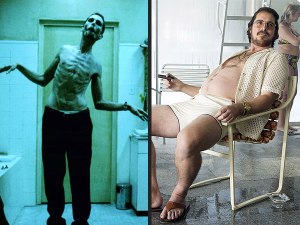
Christian Bale seems to be a practitioner of the method in order to add machismo to his a99013_christian-600x450work. “I have a very sissy job, where I go to work and get my hair done, and people do my makeup, and I go and say lines and people spoil me rotten. This is just not something to be quite as proud of as many people would have you believe.” So Bale counters this by really losing himself in a role. For The Machinist, he lost 70lbs and got down to a very unhealthy 120 (on a 6′ frame), and then turned around and gained 100lbs to play Batman just 4 months later.He went on to stay in Bruce Wayne’s American accent not just for the duration of the filming, but for all the press as well.
Shia LaBeouf went 4 months without washing on the set of Fury, where he played a soldier in the trenches (this got him banished to a bed and breakfast far away from the hotel where the other cast and crew stayed). He also cut his own face with a knife, and pulled his own tooth. His co-star, Brad Pitt, non-Method, injects roles with his natural charisma rather than stunts and overly-studied contrivances. Whose performances do you prefer?

Daniel Day-Lewis may be the most over-the-top Method actor of his time. While filming My Left Foot, he refused to get out of his wheelchair, forcing crew to carry him around, and spoon-feed him dinner. He lived in the wild while shooting Last of the Mohicans, and ate only what he shot himself. He insisted that everyone address him as “Mr President” on the set of Lincoln, and forbade people from speaking to him unless it was in language (and accents) from the time period. He refused a winter coat on the set of Gangs of New York, and when he inevitably caught pneumonia, he refused “modern day” medical treatment.

DeNiro got a real cab license while filming Taxi Driver, and picked up fares around NYC 100-male-film-oliviergngk-thumb-500x250-153952between takes. Pacino made an actual citizen’s arrest while filming Serpico. Adrien Brody starved himself and sold his apartment to feel “lost” while playing a Holocaust survivor in The Pianist. If you’re getting the feeling that this so-called Method is about ego more than art, you’re not alone. And I wonder if you’re seeing the other pattern here…that all the names on this list are men.
There are plenty of Method actresses as well: Marilyn Monroe, Ellyn Burstyne, and Jane Fonda all studied the technique. They just never adopted the crazy stunts. Gena Rowlands is probably the best Method actor you’ll ever come across, but she does it without resorting to tricks. Sadly, when we hear a woman is “immersed” in a role, it almost always means she’s altered her physical appearance. So it’s pretty obvious that not only is method acting obnoxious and ridiculous, it’s also pretty sexist. But what else is new?


Bringing Movies to Life in a Whole New Way

vrAs you will have seen on Twitter (@assholemovies), I got a PlayStation Pro and Virtual Reality headset for Christmas.  Jay picked it up after I said it sounded neat but I wasn’t sure I wanted to wear a helmet to play games.  As usual, she made the right choice.  It is the greatest thing ever!  Being able to look around inside the game is amazingly immersive and I can’t get enough of it.

Currently, my gaming options include a couple of movie-themed options, namely Batman: Arkham VR and Star Wars Battlefront’s Rogue One: X-Wing VR mission.  As well, I have a few unofficial options that feel like movies you’ve already seen, like London Heist (reminiscent of every Bbatman-arkham-vrritish gangster movie) and Ocean Descent (reminiscent of every shark attack movie), both of which are included on the PlayStation VR Worlds disc.

So far, Batman: Arkham VR is the one that sucked me in the most, to the point that I punched the ceiling trying to fire my grappling hook at the Batwing.  It felt like I was right in the middle of everything, and I am amazed at how well everything links together, so that when I move, the game responds accordingly.  The motion controllers make a huge difference in that regard, as then my hand movements are displayed right in the game.  Bonus points for letting me put on Batman’s mask myself and then look in a mirror.  That was amazing, and the overall VR experience was so fun that even the inclusion of Batman’s alley origin felt fresh.xwing-vr2

There’s no shame in placing second to a game that lets you step into Batman’s shoes, and flying an X-Wing was a ton of fun.  It was especially great to be able to look left and right and see the laser cannons right there on the wings, and then to move them into attack position with the press of a button so I could take out a few cannons on a nearby Star Destroyer.

Even smoking a virtual cigar in a seedy pub was a memorable experience, especially because the game seems to know when you’re exhaling.  VR is finally here and it’s wonderful.  I’m super excited for Star Trek: Bridge Crew and can’t wait to see what other movie scenes I’ll get to experience from a first-person view in 2017 .

What movies would you like to be able to play through virtually?

Don’t Think Twice

Don’t Think Twice is a comedy about an improv troupe, written and directed by a very talented stand-up comic named Mike Birbiglia. His previous film, Sleepwalk With Me, was ripped right from a popular stand-up routine of his, but Don’t Think Twice is really its own story, and while Birbiglia plays a role, he also shares screen time with a talented cast.

The improv troupe, who call themselves The Commune, consists of Matt (Birbiglia), Sam (Gillian Jacobs), Allison (Kate Micucci), Lindsay (Tami Sagher), Bill (Chris Gethard) , and DON'T THINK TWICE, back, from left: Tami Sagher, Mike Birbiglia, Chris Gethard, Kate Micucci, 2016.Jack (Keegan-Michael Key). They’re a really solid group who perform really well together, but their NYC theatre is struggling to stay open, and everyone’s chasing their own dream of performing on Weekend Live (an exact replica of SNL).

The movie is quite smartly written. Sam and Jack, a couple, are chosen by Weekend Live’s people to come in for an audition. Their friends, filled with achy jealousy, do their best to support and congratulate their luck. But how long can that tenuous brave face hold, especially if one of them is actually cast, and realizes the one thing that every one of them has been yearning for?  Don’t Think Twice is bittersweet. It’s about pursuing your dreams, but also about the cost of actually having them come true.

The cast really sells this stuff. They trained in improv together (Gillian Jacobs was a complete noob) for weeks in order to then be filmed in front of audiences. The result is spontaneous and often quite funny. But the movie itself is not full of “jokes” but finds it laughs in the webbing of the characters.

Chris Gethard is an improv junkie, a member of the Upright Citizens Brigade since 2000, and as an offshoot of that, the host of his own show, aptly named The Chris Gethard Show, which is wildly chaotic and fun. He was a guest writer on SNL for one episode.

After performing with legendary improv troupe Second City (Chicago), Keegan-Michael Key appeared on MADtv, cast against Jordan Peele with the intention that FOX would choose between them and only have one (token) black cast member. Both were riotous and proved their worth, and so they both stayed on, creating a lasting partnership. They produced Key & Peele sketches for Comedy  Central for 5 seasons, and wrote a movie together this year, called Keanu.

Tami Sagher was also a member of Chicago’s Second City. She’s been nominated for 4 dont-think-twice-99ddb592-9a20-4056-aa36-ced9ae9ea4dfWriters Guild of America Awards; 3 for MADtv, and 1 for 30 Rock. She’s also written for Psych, How I Met Your Mother, and Inside Amy Schumer, and produced for Bored to Death, Girls, and The Michael J. Fox Show.

Kate Micucci you  may recognize as one half of the musical-comedy duo Garfunkel and Oates (she’s Oates, if that’s not obvious). They perform everywhere, including regularly on your television (and on Netflix!), and the Upright Citizens Brigade Theatre in L.A. (beginning to see a theme here?). She’s been on Scrubs and The Big Bang Theory.

Gillian Jacobs is along for the ride. You may have a softer spot for her if you watched her on Community, but I know her from the Netflix original series Love, where she played the world’s most obnoxious character (or possibly the second most – the guy she plays opposite is just as bad and I could never decide who was worse), and I continue to hate her for it to this day.

Together though, they coalesce into a strong unit that makes this movie feel real. Birbiglia is showing aptitude in his direction, and the writing backs up a talented cast. There’s an intimacy here that can’t be faked, and a truth that elevates this film from just laugh-out-loud funny to heartfelt honesty at times, and biting satire at others. Don’t Think Twice currently enjoys a 99% approval rating from Rotten Tomatoes, which makes this movie higher rated than La La Land (93%), Fences (95%),  Manchester by the Sea (97%), or Moonlight (98%). Is it actually better than those movies? No. But it’s well done, funnier than most big-release comedies this year, and it’s made with a clear love of a uniquely American art form.

Passengers

passengersImagine being stranded on a deserted island. Would you wish for company, even though you knew that that person would then be stranded too? What if you discovered that you had the power to make that dream come true?
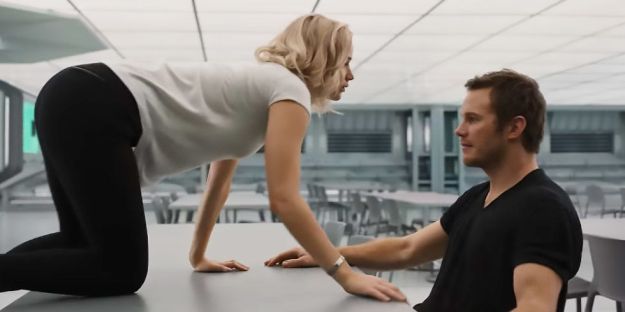
Jim (Chris Pratt) faces a futuristic version of this very dilemma in Passengers, director Morten Tyldum’s follow-up to The Imitation Game. Jim, along with 5,000 others, has chosen to leave his life on Earth to start fresh by colonizing a distant planet. When his hibernation pod malfunctions, Jim finds that he has somehow woken up 90 years before the ship is scheduled to reach its destination. Meaning that he will almost certainly die of old age long before he’ll get the chance to even speak to another person.

passengers-2

The loneliness is palpable but becomes downright excruciating once he discovers that he’s figured out how to wake another passenger. One sleeping beauty in particular has caught his eye. Aurora (Jennifer Lawrence), as Jim discovers through extensive research of the ship’s files, is smart, pretty, and funny and seems like the perfect companion for this 90 year voyage.

It’s quite an interesting predicament. What if Tom Hanks had gotten so lonely in Cast Away that he was able to magically sentence Helen Hunt to life on the island with him? Or if James Franco had been able to trap his buddy Seth Rogen under that rock so that he would have some company? Obviously, it’s a pretty shitty thing to do to someone and Jim knows it. He doesn’t take the decision lightly and it’s a tribute to Pratt’s talent that we can feel his struggle enough to forgive him.

Passengers begins to unravel though once Aurora wakes up. A brief meditation on what isolation can do to a person quickly becomes a typical romantic comedy with an atypical setting. Boy meets girl based on a lie. Everything seems to be going great until girl discovers lie. Girl makes up with boy. If you think the fact that Jim’s deception is somewhat more serious than a How to Lose a Guy in 10 Days article (“He murdered me,” as Aurora puts it) would alter this formula in any way, unfortunately you’d be disappointed.

passengers-3

It’s also worth commenting that Jim chooses Aurora for her looks and charm. Yes, she’s actually quite bright but she’s a journalist. Out of 5,000 passengers, you’d think he could have found someone more qualified to help maintain a spaceship for 90 years and maybe even help him figure out how to get back to sleep. She’s clever and tough but still pretty useless once the ship starts to fall apart and Jim the mechanic needs to figure out how to save her and everyone else on board, thus winning back her heart. The cop-out is downright insulting.  Besides, as cinema, watching someone fix a broken spaceship is neither as suspenseful or exciting as you might think.

What many critics panning Passengers won’t tell you is that the first 20-30 minutes are actually quite gripping. From there on it’s pretty much as bad as they say.

Nocturnal Animals

As the film opens, Susan (Amy Adams) feels guilty for not being happy, despite having ‘everything’ – Armie Hammer plays her current husband, but apparently they were maybe never truly supposed to be together.

A successful art gallery owner, Susan’s home is perfectly styled, filled with lacquered objets, 18nocturnal1-master768-v2beautiful things, much like herself, impeccably dressed, heavily made up. Her “bare” (movie bare, of course) face comes as a shock when she curls into bed to read a manuscript that has arrived that earlier that day, a surprise from the ex-husband she hasn’t heard from in 20 years.

She’s immediately engrossed in the story, which we see recreated as a movie within a movie. Jake Gyllenhaal and Isla Fisher play two halves of a couple travelling down a remote road at night. Aaron Taylor-Johnson plays a sinister man threatening them. It’s immediately tense. Disturbing. Distraught, Susan slams the book shut.

But that’s not the end, is it? No, she keeps going. And things get darker, and trickier. Director Tom Ford pulls a nasty trick on us: in casting Isla Fisher, he is intentionally making her a very easy substitute for Amy Adams (Isla Fisher once sent Christmas cards to friends and family with Amy Adams photo-shopped in her place, and no one noticed). But we’re not the only ones to notice the similarities: Susan starts to feel a little unsettled too.

This is only Tom Ford’s second film; I was blown away by his first effort, A Single Man. He has a distinctive style, he’s incredibly visual, but the story in A Single Man held up. More than that: it crawled right into my soul and crushed it, just a tiny bit. Colin Firth was robbed when he didn’t maxresdefault-6win an Oscar for it (well, he lost to Jeff Bridges for Crazy Heart, and that was certainly deserved as well; luckily Firth one the very next year for The King’s Speech). You may know that Tom Ford is a fashion designer, but that’s clearly not the only trick up his sleeve. His direction is not a gimmick (it likely helps that he leaves the costuming to someone else, and that no Tom Ford suits appear in the film). Maybe it’s little more style than substance, but it’s not without substance, or merit, or worth. Nocturnal Animals is dark and moody and horrible. It is sometimes graphic, and psychologically tortured, and stunning.

It’s the kind of movie that will haunt you for days. There are lots of performances worth talking about: Amy Adams, and the sadness she can convey in her downturned eyes; Jake Gyllenhaal’s fire, and his anguish. Aaron Taylor-Johnson was nominated for a Golden Globe for his supporting skeevy work here, but I think it’s Michael Shannon who maybe deserved the nomination, mustache and all. Can this man do any wrong? Oh wait

Most people bill Nocturnal Animals as a work of revenge, but I feel it’s more about regret. I suppose your interpretation may rest on the ending, which is intentionally vague, but I believe an indictment on Susan’s character. What did you think?


La La Land: Discussion

If you’re looking for a spoiler-free review of the film, please check it out over here. I wrote it all the way back in September, fresh from seeing it at TIFF, and I’ve been waiting all this bloody time just to talk about what for me is the best film of the year. I was absolutely giddy for this movie, how it made me feel, how it made me think, how it whisked me away into something both surreal and familiar. We exited the theatre from La La Land and rushed on to the next (I think it must have been Lion) but between the two, I wept. I wept for heartbreak, and for beauty, because La La Land  is brimming with both.

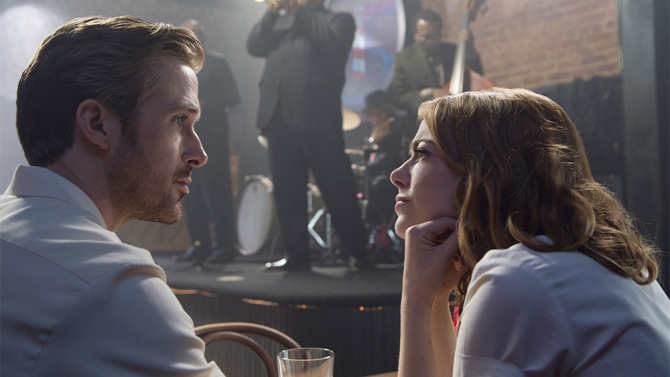
If you’ve kept reading, then you know by now that La La Land, for all of its romance, does not have a traditionally happy ending. But are the characters unhappy? Mia and Seb separate in part because their ambitions overshadow their love. Was this the right move? Do they have regrets? Certainly they’ve both gone on to achieve the success they so coveted. Mia is married, la-la-land-1with children. When she sits in Seb’s club at the end, we are treated to an alternate version of events in which they manage to stay together. Do they wish that this was so? Do they still love each other? Have they moved on?

One of Chazelle’s unspoken themes must be “Is it worth it?” – is it?

During their courtship, the movie takes cliches about love and makes them true: love lifts them, they dance on air, they sing from rooftops. Did this feel organic to you in the movie? I often felt that when things felt intense to them, they broke out into song as a metaphor for feelings that are too fervent to verbalize. When words fail, they’d sing, or dance, which is often the way we feel in our excited little hearts when we’re first falling in love (reminds me of a certain scene in 500 Day of Summer).

Sean noticed that when the relationship got rocky, the movie got a little more ordinary, and frankly, a little repetitive. The songs are reused. But in time he felt like that was sort of the point: that the newness and wonder of the relationship had worn off, that they were beyond the first crush and settling into patterns and habits and less passion. The film itself reflects it. Did you find new meaning in songs as they were revisited? During the second half of the film, during the relationship’s demise, there is noticeably less music, which means less joy, less intensity. Their world goes a little drab when the shine has worn off. Did you miss the music when it was gone? Certainly when it returns in that final scene, it’s a heart breaker.

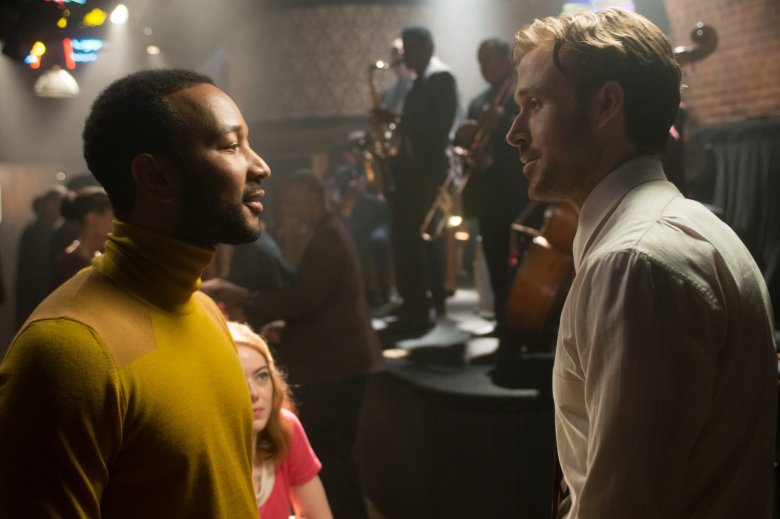
Originally Chazelle imagined that Miles Teller and Emma Watson would fulfill the lead roles. I can’t picture Teller ever being right for the part. Watson left the project so she could do another musical, Beauty and the Beast. Ryan Gosling ended up turning down the opportunity to play the Beast so he could do this instead, with frequent collaborator, Emma Stone. Chazelle has stated they were hired together intentionally, because they’re a modern-day version of an old-Hollywood couple, frequently working together and already having an established chemistry. Do you think anyone else could have pulled off these roles? Do you think either of them has a legit chance at an Oscar?

Seb states that jazz has to be experienced. He’s disgusted by people who use it as ‘background music.’ It’s a special language that he teaches her and she comes to appreciate. He takes full advantage in the final scene, telling her he still loves her using only his music, and he plays so passionately that she can see how he wishes things had been different. However, there’s an interesting part in the movie, the “sellout” phase where Seb is playing jazz in the background during a scene. Is this where it all went downhill? What would you say was their final straw?

Chazelle has deliberately taken this musical off the backlots and grounded it in modern-day Los Angeles. The opening number helps set the tone. This is the world in which they live, but both are outsiders amongst that set. At the end of the number, Gosling gives Stone the finger before driving off. The offramp used in this number is the same one they used in Speed, where they had to jump the gap. Lots of real locations were used in the film – even Seb’s apartment is an actual apartment, not a set. Let’s not forget that the movie isn’t called Mia or Seb, it’s called La La Land: the city is also a character. City of stars, city of dreams. Did the locations help give the movie a sense of reality to you?

The one criticism I’ve heard of this movie is that it never addresses the true roots of jazz: does La La Land “whitesplain” jazz? Is it racist in its portrayal? Did Damien Chazelle fail us by casting white actors in a movie about jazz? Then I wondered – wouldn’t Whiplash have faced the same controversy? It’s another movie about jazz starring two white dudes, but I don’t recall hearing any hooplah over it [turns out the criticism was there all along]. Of course it’s not for me to say, but I can understand how it might sting a little to have an art form that was “invented” by African-Americans, music by Black people for Black people, be told by white people. Not to say that jazz belongs to any one people, but if these are the only stories being told about jazz, then maybe the stories belong to the people who truly wrote them. And it does feel regressive in 2016 to see a white man play jazz, and a white woman dance to it, while people of colour make up the blurry background characters surrounding them, out of focus, besides the point. What do you think – is there cultural misappropriation going on here? Is Ryan Gosling a “white man saviour” in his quest to save jazz?

Mia and her friends are resplendent in primary colours because they’re young, and they dream in technicolour. She’s dressed in emerald, saphire, yellow. At the end of the movie though, she’s wearing white. She’s supposedly made her dreams come true, but she’s leached of colour. What’s that about?