Yearly Archives: 2018

A Wrinkle in Time

This movie came out when I was in Austin, Texas seeing a billion movies at SXSW, and even so, I still considered taking a time out just to see another movie, one that was just hitting theatres. I never made it to A Wrinkle In Time then, but I finally got around to it this weekend, and I wasn’t the only one: our cinema was packed on Easter Monday, and I was pleased to note how many families were in attendance.

For those of you who haven’t read the book (by Madeleine L’Engle), A Wrinkle In Time is about a young girl named Meg – troubled at school, grieving at home. Her parents are both brilliant scientists, or were – her father disappeared years ago while MV5BNzhkYzRlNzUtNzFhNy00MzllLWFkZGEtNDg0ZTE0YTYzOWNjXkEyXkFqcGdeQXVyMjk3NTUyOTc@._V1_working on a theory about a tesseract, which would involve “wrinkling” time and space in order to travel through it. One dark and stormy night, a mysterious woman named Mrs. Whatsit appears to tell Meg, her friend Calvin, and Meg’s little brother Charles Wallace, the child genius, that she has heard her father calling out to them through the universe. Turns out, Mrs. Whatsit and her friends Mrs. Who and Mrs. Which are supernatural beings prepared to engage in a rescue mission.

The book was repeatedly rejected – possibly because it was a work of science fiction with a young, female protagonist, and possibly because it asked a lot from its young readers. Not only does it use physics and philosophy as basic concepts, it directly tackles the nature of evil, and pits children against it. The movie, too, follows in its footsteps, embracing what made the novel so special and unique, proudly displaying the magic AND the science, and trusting a young audience to appreciate them both. If anything the movie is a little too ambitious – though I quite enjoyed it, I did, in the end, have the sense that parts of it were quite condensed.

Director Ava du Vernay gets the casting exactly right: Storm Reid as Meg is what we want every 13 year old girl to be – smart and strong and curious and cautious. Her determination in the face of her fear and vulnerability make her an exceedingly compelling character. She may at times be insecure but her love and loyalty toward family see her through difficult times. But of course it’s the larger than life characters that Meg meets that give the story so much colour. The Mrs. Ws are particularly enchanting, and I cannot imagine a more satisfying trio than Reese Witherspoon, Mindy Kaling, and Oprah, large and in charge.

At just under 2 hours, the movie does unfortunately lose some of the detail that MV5BMTU5Njg0NTA0MF5BMl5BanBnXkFtZTgwOTgwNDU4NDM@._V1_SX1777_CR0,0,1777,929_AL_make the book wonderful, but it also paints a fantastic picture that I cannot stop myself from going back to in my mind. The visuals are exotic and beautiful and the world-building just divine. I can only guess at the kind of impression it makes on young imaginations.

Though the movie has some flaws, its themes are just as courageous and necessary today as they were when the book was first published in 1962. Light vs darkness, good triumphing over evil, and the only real weapon used is love. It’s also got a (somewhat diluted) message against conformity; Meg has to embrace her flaws in order to win the day.

See this movie with a child’s wonder and you will be delighted. Adapting this book was always going to be difficult, and the worst thing it does, necessarily, is rob us of the opportunity to do some of the imagining for ourselves. But in committing to the visuals, Ava du Vernay does the source material more than justice. She gives us a film full of hope and bravery, and shows little girls everywhere that they too can be the heroes of their own stories.

Happy Anniversary

On their third anniversary, Sam and Mollie realize the biggest excitement of their lives is pushing the limits of their garage door opener. Are they happy together or just habitually together? Either way, a couple who starts asking themselves that is bound to find some flaws.

So then we get to witness them fight and watch a long term relationship disintegrate because they’re just not sure. And I feel like I’ve been watching a lot of movies lately in which the couple just aren’t sure. When my grandparents got married, there was no ‘sure’. They were the same religion, their families didn’t hate each other, and they were inline_0000s_0001_happy-anniversary18 and probably horny. So they got married, and thanks to the religious belief in never, ever getting divorced, they’re still together today. When my parents got married, there was no ‘sure’. He thought she was pretty and she thought he’d be a good provider so they waited for her to turn 18 and married. That was enough. Today, there’s no telling what’s good enough, or even if good enough is good enough.

Sam (Ben Schwartz) and Mollie (Noël Wells) are practically the every-couple. Whether or not you find them funny probably depends on how secure you are in your relationship. I sure found it relatable, sometimes embarrassingly so. But that’s what love is: baring your worst self to someone else and hoping they don’t leave you. We’re all assholes. Finding someone who will put up with it feels like a kind of miracle.

I’ve rarely seen Schwartz in non-obnoxious mode. I didn’t even realize he was capable. It’s kind of nice. And Sam and Mollie are kind of cute together, in a way that makes you want to pull for them, even when it feels like the wrong horse to bet on. Flashbacks reveal both the good times and the bad – because no relationship has ups without downs. Perfection is a fallacy, although it’s exactly that kind of perfection that’s usually sold in rom-coms: guys who aren’t afraid of intimacy, who don’t struggle to communicate, who convey their passion with grand, romantic gestures. But Happy Anniversary is the kind of rom-com we need: one that teaches us to value the idiosyncrasies that make a couple special, perfectly imperfect for each other. “Knowing” is hard. Trusting is hard. Having in faith in someone else is hard. Forever is hard. So good fucking luck.

The Heyday of the Insensitive Bastards

Seven stories. Self-contained, based on short stories from Robert Boswell’s collection. They have some commonalities, I suppose: toeing the line between fantasy and reality, or the gray area between memory and what really happened. Inventing shit when we’re young and have no experience. Blurring reality when we’re old and looking back. Life is bittersweet. We’re all bastards sometimes. It just depends on the day.

Conrad (James Franco) identifies his father’s dead body and is comforted by his death, comforted by the fact that he wasn’t the only one his father wanted to kill.

Paul (Jim Parrack) goes home to visit his father, whom he barely recognizes. Dementia has taken him further and further away from the man he used to be. All that seems to be left is his meanness, and even knowing it’s the product of disease doesn’t quite mitigate it. It cuts particularly close to home when it involves Paul’s ex wife (Natalie Portman) and the kid who looks disturbingly just like him.

Monica (Kristen Wiig) is a single mother who works as a maid. She gets through the day by fantasizing about using her wealthy clients’ lives as inspiration for the writing that will make her rich and famous one day.

A huge cast, including Kate Mara, Amber Tamblyn, Thomas Mann, Matthew Modine, Rico Rodriguez, Tony Cox, Jimmy Kimmel, and Keir Gilchrist assembles to pull this thing together, along with more than 7 writers and more than 7 directors. The stories are not uniformly good, or uniformly  memorable, and though I enjoyed some, I don’t think they really mean much as a whole.


People You May Know

It’s hard to describe someone as a “luddite” when their profession literally involves photoshop, and yet the synopsis of People You May Know boldly do just that to their lead character, Jed. Jed simply isn’t interested in social media. But a stranger in a bar tells him she’d never date someone she couldn’t Google, so he throws all of his values and deeply held beliefs out the window and we’re treated to a tension-filled scene in which he hovers his cursor over the sign-up button of several social media sites. The next day he proudly tells a millennial in a coffee shop that he’s on Facebook and she welcomes him to the future. Already I’m cringing: a film about social media obsession doesn’t even know that Facebook is so 2008.

Jed puts his photoshop skills to good use and his friends are impressed by the people-you-may-know-ss2.jpgglamourous lifestyle shots he’s faking. But the millennial offers to do for him what she does best – make people famous on social media. It’s weird that a guy who prided himself on “keeping things real” is now spreading lies and watching them go viral.
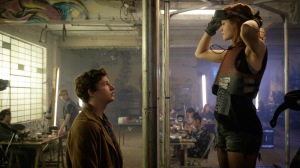
This movie stars people you don’t know – Nick Thune, Halston Sage, Kaily Smith Westbrook. They’re okay. None of them are charismatic enough to transcend the fact that they’re playing people who actually eat Hawaiian pizza. Don’t worry. The actors may not be heavy weights, but what is quite heavy is the handedness with which the message here is preached. Just be yourself, guys! Don’t compare yourself to others! Nobody is their real self on Facebook! But in the end they save the world with a hashtag. A hashtag! #truthfultuesday. Get with it.

Actually, the lesson learned is quite embarrassing. He forgets to photoshop his arms back in and his dirty little secret is revealed. Of course an angry mob of Instagrammers comes at him with pitchforks. It’s pretty cringe-worthy but the film doesn’t pause for one second to really consider these lives lived online. It’s very superficial, which in theory is what they’re yammering on about, but clearly have not internalized. Swipe left.

Ready Player One

We got to see Ready Player One with Steven Spielberg himself at SXSW – it was truly one of the most seminal moments I am likely to ever experience as a movie reviewer, and more importantly, as a movie fan. Sean wrote about it weeks ago, but I realized that I had something to add to the conversation.

I read Ernest Cline’s Ready Player One back in 2011 and I thought it was a tonne of fun. But it’s a highly nerdy book and I am not remotely nerdy. I do, however, know some nerds, and I eagerly pushed the book on them (it made for an EXTREMELY easy Christmas season: it knocked all the brothers-in-law off my list at once). I seem to recall Sean reading it in Mexico, and as I’d anticipated, he ate it right up. But for the many references that I just didn’t get, I still felt the energy and excitement of the book were translated to me. So while we were excited to hear that Spielberg was taking this on, we were less than thrilled to sit back and wait for three years for it to become reality. And then when we were finally treated to a trailer I thought: holy moly, I don’t think I remember this book! So I reread the book a few months ago and prepared myself for its big March 29 release date – yes, we’d be busy in 2 different cities celebrating Easter, and Grandma’s 95th birthday, and my sister visiting from over 1000km away, and making the great variety of baked goods requisite for such a long weekend – but surely we’d be able to squeeze it in. But alas, no need! While in Austin, Texas for the SXSW festival, Ready Player One was revealed to be the secret screening. Both Cline and the movie’s star Tye Sheridan are hometown boys, which READY PLAYER ONEmeans 300k of the festival’s attendees were vying for just 1000 seats in the venue. Some people may be discouraged by those odds, but not Sean! He gamely spent hours lined up outside (while I watched Blindspotting, which was an incredible festival revelation) but his dedication paid off, and we got in, got some pretty fabulous seats actually, and sat among people who were just so incredibly excited to see the movie they hardly stopped cheering for a single second of the film’s 140 minute run time.
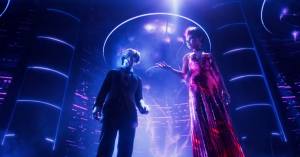
First of all, for fans of the book: the movie Ready Player One carries all of the novel’s essence but none of its spoilers. The big, showy challenge scenes are all-new for the movie, so you get to enjoy it and be surprised by it, and if I may say: delighted by it. It hits exactly the right tone but it’s new and it’s exciting. And some of the new stuff IS REALLY FUCKING COOL. But Spielberg HIMSELF asked me not to spill the beans, so I won’t. And I wouldn’t want to in any case: not every movie is capable of enchanting us, and I wouldn’t want to deprive anyone of that simple little thrill of pleasure.

Second, to fans of Speilberg: this is the most ‘Spielbergian’ film of the century. By which I mean, Spielberg himself has really gotten away from Spielberg-type movies. He hasn’t done blockbustery, popcorny movies in years. Lately he’s concentrated on smaller films, like The Post, and Bridge of Spies, which I have actually loved. It’s a different, more grown-up Spielberg; they’re movies that feel almost indie in nature, if not for the souped up cast. Dramatic stuff, more grounded, dark and moody, and often political. But little Stevie finds his inner child, indeed his inner fanboy, and allows himself to just express exuberant joy once again on the big screen – and even, and I do honestly believe this was hard for him, allow his own film legacy to be paid homage in this film right alongside other iconic pop culture moments from the 1970s right through the early 90s.

Ready Player One feels like Steven Spielberg has thrown himself a parade, and he’s got every one of his time-honoured tricks riding big loud floats. It’s fantastic. I’ve heard the Internet shitting on the fact that this film is loaded with pop culture nostalgia and I can’t for the life of me understand that. I mean, the first time you see the film, you won’t notice half, or likely a third, of what’s hidden in there. Spielberg himself doesn’t know every single thing that’s been recreated in the film – he was surprised readyplayerone-56b7d103-d459-4ff3-89ac-e6342be40e01to find a Gremlin long after he’d already approved the scene, and he’ll continue to be surprised by Easter eggs (how fitting, for this weekend!), as will we. In subsequent viewings, you could easily play a drinking game with friends, or a Bingo game would be fun, just spotting all the cool things the brilliant art department and visual effects people slipped in there – it’s like the hoarders of movies with so many layers it’ll take forever before you reach the dead cat layer.

I still haven’t even told you what this movie’s about, but you’ve already gleaned that from elsewhere, haven’t you? It’s basically about the near future where the world has gotten so bleak that everyone prefers to live in this virtual world called the Oasis. The creator of the Oasis dies, and leaves the rights to it to whomever can win a little game that he’s rigged. Now, the Oasis is definitely worth a kabillion dollars, but it’s worth even more politically. So while our protagonists are kids, they’re up against not just adults but corporations in order to win control of this thing. And the Oasis creator (played by Mark Rylance) is a guy just enamoured with the 80s, so everything he does is basically a loving tribute to the “golden age” of gaming. But you don’t need to be able to pick up on those references in order to enjoy the story – they’re just the window dressing on a dystopian tale as old time.

The fact is, the world in Ready Player One is not so far from our own, and it feels worrying possible. The real trick, the one the movie keeps bumping up against, is to ask yourself: what are we taking from this virtual world, and how are we using it to make meaningful connections in the real world? Though this fight is online, the repercussions exist in the real world, and this creates an interesting duality between the avatar characters online and their real life counterparts. Though it looks and feels like a game, the stakes are high and the consequences dire. There’s some really flashy editing that allows us to move back and forth between worlds, and some truly exceptional visual effects mean the movement between the two feels natural but looks distinct.

And at its heart, this movie tells a story like many of Spielberg’s best: that of friendship, trust, and human connection. The film omits some of the book’s more subversive themes – race, gender, class – and given its scope and run time, it’s no wonder. There simply isn’t enough space to explore this world from corner to corner (read the book!). Instead, this movie submerses you in a world of pure imagination.

Flower

Erica is a reckless, ruthless high school student. She blows dudes in order to black mail them, and she’s saving up the dough for some future project that’s obviously pretty important to her. She’s used to being called a slut, and worse, and mostly she rises above, and copes by drawing dicks and not caring. You might think of her of the problem child her family and maybe she was – until her almost-step-father brings home her future-step-brother Luke, who’s been an unknown quantity in rehab this whole time.

Anyway, Erica (Zoey Deutch) is fully prepared to hate Luke (Joey Morgan) with all her guts, but instead she sort of takes pity on, MV5BMTU3NjQwNDQzNV5BMl5BanBnXkFtZTgwNDE3NTYwMjI@._V1_SX1777_CR0,0,1777,999_AL_and then awkwardly befriends, the guy. Their bonding is unorthodox, but what else do you expect from a movie in which Adam Scott is constantly referred to as “hot old guy” (he was born in 1973, fyi, if you’re trying to judge whether you should just slit your wrists right now or possibly way til the end of this review).
Flower is directed by Max Winkler, son of Henry Winkler. What drew him to the material, and how does he handle it?

Well he does one thing extremely right: he casts Zoey Deutch. I can’t think of many actresses who could handle Erica’s rebelliousness, her remorselessness and vulnerability. Deutch goes full tilt in a way that’s impressive. She sucks up all the attention and fills the screen like there’s a vacuum leading straight to her luminous face – her performance is so committed I could barely see around it. But looking back – this movie takes some unexpected, and perhaps unexplainable twists and turns. And to be honest, I guess I couldn’t really tell you what the whole point was. This movie is in theatres right now, in limited release. If you’ve seen it, we need to discuss. What the heck is the point?

SXSW: More Human Than Human

1977: Star Wars introduces us to helpful and humourous robots like R2-D2 and C-3PO.

1982: Blade Runner tells us that robots can be scary, and the scariest thing about them is when they’re indistinguishable from us.

1984: Terminator is a robot who’s come to destroy us all.

About 5 minutes after we invented robots we started predicting our own extinction at their hands. About a third of jobs that used to exist in the 1980s and 1990s have been replaced by robots. Stephen Hawking has warned us that “The development of full artificial intelligence could spell the end of the human race.” In 1998, that annoying plush toy Furby had more computing power in it than was used to put a man on the moon. Our smartphones today are MILLIONS of times faster. With a god-like lack of hubris we are driven to create these things in our own image (or at least replicate the human brain), but once we’ve recreated human intelligence, and robots capable of building other robots, then isn’t the next step SUPER human download.jpgintelligence – and then haven’t we made ourselves redundant? And yet we can’t help ourselves.
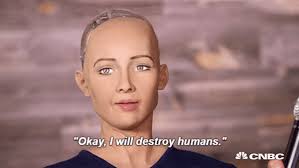
Even within this documentary that explores the dark corners of AI, the film makers (Tommy Pallotta, Femke Wolting) can’t help but wonder if they can build a robot that will replace themselves. Can they get an AI to direct a movie about AI?

I am a fan of Isaac Asimov so this documentary is like heaven to me. This must be what it’s like to ride a rollercoaster: I am sickly fascinated by the very robots that I fear. Maybe that’s why I love movies like Her (in which Joaquin Phoenix falls in love with an AI) and Marjorie Prime (in which people assuage their grief by replacing their dead loved ones with cloned AI) and Ex Machina (in which Domhnall Gleeson falls in love with an AI even as he works to disprove her humanity) but I refuse Alexa in my home, and in fact have never even asked a single question of Siri.

A.I. is not a question of the future. It’s here. The question is, what are we going to allow it to do? Take care of our aging parents? Drive our cars? Create art? If machines can do all of that, then who the heck are we? That was my favourite part of this movie: really thinking about humanity and what it means to live among these sophisticated creatures – creatures of our own making, and possibly our undoing.

The directors do in fact come up with a movie-making robot, and bring in Billy Crudup and Richard Linklater to comment upon its success. But no matter how they feel, or I feel, or you feel, robots are here to stay. And they are capable of very convincingly telling us how great they are. Could we even get rid of them, if we wanted to? Are we as fully in control as we believe? And if so – for how much longer?

SXSW: First Match

Monique is not your average high school student. She acts tough and gets into a lot of fights. But it’s easy to judge someone when we don’t know anything about them. I’d say her home life isn’t good, but Monique doesn’t have a home. She has had a series of foster situations since her mother died that all end badly. Her father’s in prison, and she can’t help but daydream about the day he gets out and she can live with him and have some sort of regular life again. Until she runs into him on the street. The daydreams come to a crashing halt right about then. He’s out and hasn’t told her, hasn’t contacted her, and now that she knows – well, he’s not really amenable to her vision of their shared future (to be fair, he’s eating at soup kitchens and engaging in at least semi-criminal behaviour, so he’s not exactly capable of providing a “stable home life.”)

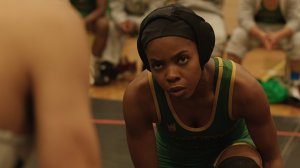
Anyway, poor Mo decides the only way she attract her dad’s attention, and maybe neutralize some of her school’s ire, is to join the wrestling team. There is no girls team so she joins the boys team, despite the protestations of nearly all of the boys.

First Match distinguishes itself from other similarly-themed sports movies because the team is not really Mo’s problem. If a little MV5BNWI5ZTc1MGEtZTU2Ny00M2QxLWEwNmItZDEwMzI0NDVlNjIzXkEyXkFqcGdeQXVyNzQ0MDUyMzg@._V1_SX1777_CR0,0,1777,999_AL_adversity from the boys were Mo’s only problem, she’s probably feel blessed. Instead, Monique excels at the sport and it becomes a source of pride and power for her. Even if doesn’t win her father back, it’s earning her some self-respect, which she needs and deserves. Monique is obviously supposed to be some problem child, but it’s impossible not to sympathize with her.

There are no easy fixes, and the script is bold enough not to offer any. Life is stacked against this kid, and even if the viewer is the only one rooting for her, at least there’s that. I’d like to give her a hug if I wasn’t totally positive she’d roll her eyes at me for even trying.

This movie is grounded in realism that bites. The team becomes her de-facto family, but First Match still retains a sense that Monique is, if not lucky, at least relatively unique in her community because she knows her father and has him in her life. It’s tragic and depressing the lengths she’ll go to in order to keep him there; she’s got daddy issues, but at least she’s got a daddy. The premise seems to imply that this will be a movie about a lone girl in a male-dominated sport, but this turns out be an afterthought. But there’s a lot else to contemplate, and Elvire Emanuelle’s performance is not to be missed. Coming soon to a Netflix near you.

SXSW: Making The Grade

My grandmother had a very old, very creaky stand up piano in her dining room. Once we’d eaten all her cookies and drawn all over her church stationery, we’d pound away on the untuned keys, convinced we were making loud, beautiful music. We were not. But lessons were for rich people and we were not that either.

This documentary acquaints us with a whole spectrum of Irish piano students, those studying for their first grade exams all the way to the 8th. Old and young are peppered randomly throughout; some have natural ability and others are a little plonkier, but they’re all more dedicated than me. The kids astound me, of course. The piano seems the antithesis of our sped-up society and I’m impressed that any of them have the chutzpah to put in adequate practice, persevere through the tough spots, and pursue an accomplishment that isn’t very well rewarded anymore. But my favourite of director Ken Wardrop’s subjects is a woman with short gray hair and colourful tunics who persists though she’s the first to admit she isn’t any good. I suppose that’s what I admire most: yes, the music sounds better coming from the fingers of someone for whom this comes easily – but it’s so much sweeter coming from the clumsy fingers of a woman who possesses not the teeniest drop of rhythm.

Making the Grade isn’t flashy. There are no stylish tricks. But you’ll find that simply pointing the camera at a bunch of people who know a secret – well, the camera loves secrets, doesn’t it? This is what documentaries are for: exposing those we wouldn’t otherwise know. Whether it’s a little girl discover power and confidence in her music, or a woman finding solace and self-care in hers, it’s moving just to see others be moved by music of their own creation. And of their teachers? This is a loving tribute.

SXSW: A Bluebird In My Heart

It’s rude to ask Danny what he went to prison for. Instead let’s concentrate on the fact that he’s out, and he’s trying to put his life back together. He’s staying in a motel run by a single mother, and her daughter. He’s washing dishes in a Chinese restaurant. He’s seeing his parole officer every day. He’s getting by by keeping mostly to himself, which is how he prefers it. Too bad things just couldn’t stay quiet.

Clara, the daughter at the motel, is ripe for a new friend. Her own father is in jail and she hasn’t seen him in a long time. When she gets assaulted one night while her mother is away, Danny kind of gets pulled into a scrape that he can’t really afford to be involved in, but can’t seem to avoid either. Now the motel is not the refuge he was hoping for and a-bluebird-in-my-heart-124678he’s awfully tempted to resort to his old methods for dealing with this kind of crap.

A Bluebird in My Heart, in many ways, is asking us whether a person’s nature can really change. Peace and violence will clash, as they must, in a movie that looks as dirty as it feels. Danny (Roland Møller) is an elusive character; a tough exterior shell with a vague interior and mysterious past. Our biggest and best clue to what makes him tick is the Charles Bukowski poem after which the movie is titled. “There’s a bluebird in my heart that wants to get out but I’m too tough for him, I say, stay in there, I’m not going to let anybody see you.” We never fully see Danny, but we do have a front seat for his actions, and the consequences of those actions. It’s not a pretty sight necessarily, but it’s a strength of the script that we don’t have to know him to know him. He’s got anger and pain and he tries really hard to bury them, perhaps in the bluebird’s nest, but once unleashed, well, he becomes a pretty powerful outlet. Danny wrestles with his innermost self, with his nature, with his destiny. For a movie about a violent, hardened criminal, it’s actually quite quiet and contemplative, but when the action ramps up, well, the outbursts are intense. So be prepared, and watch out for the little bird.