Monthly Archives: August 2018

SPF-18

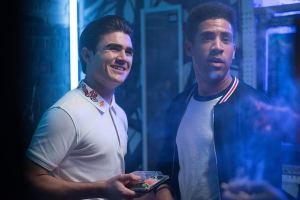
The first half of SPF-18 is about virginity, or the loss thereof. Penny (Carson Meyer) needs a prom do-over, and when her boyfriend Johnny (Noah Centineo) house sits for Keanu, she brings her cousin Camilla (Bianca Santos) and a pack of condoms and and the deflowering is on.

The second half of SPF-18 is about surfing, and using it to somehow honour one’s dead father.

MV5BZjVhMmFmYTQtYTMwNC00Y2JiLTg1MDAtOGM3ZGM3Y2I0YWMyXkEyXkFqcGdeQXVyNTQ3MjE4NTU@._V1_SX1777_CR0,0,1777,999_AL_There’s a very thin line between these two halves where SPF-18 could have crossed over with The Meg, and had these vapid teenagers been devoured by a megalodon, I might have hated this a little less. As it was, just thinking of them as shark poop helped get me through.

In reality, a Christian country artist wannabe named Ash (Jackson White) baptizes himself in the nude in front of the girls, thus cementing himself in their hearts. And even though her virginity is still freshly smeared all over Keanu’s sheets, Penny’s heart goes the way of her hymen – torn.

And then Johnny’s dead dad’s surfing protegee resurfaces, guilt-ridden about his drug usage which may or may not have contributed to his mentor’s untimely death. This story really doesn’t need to be here, but the film is already a scant 75 minutes, so I guess it added some flesh to the bare bones. The rest is just redistributing the lovers. Ash has a soulful voice but Johnny has abs worth praying about.

You should be able to deduce that the script is bad but that really doesn’t do it justice. IT’S HORRENDOUS. The dialogue is embarrassing and cringe-worthy, but it’s not the worst part. The worst part are the disparate ideas strung together to make a movie. They’re so random I don’t even know how they decided which order to put them in (Evil studio executives! The benefits of pilates! Illegal doping scandals! Greek mythology! Animated meditation! High school superlatives! Unnecessary narrators! Intellectual property law! Unexplained lip lesions!). Can you hodge podge these together to make a film? No you can’t, you definitely can’t, but that’s not stopping anyone.

I don’t know anything about director Alex Israel, but I can guess that he’s an 80s kid. He certainly reveres the decade. Why else would you give a millennial rom-com a power ballad-filled soundtrack? And how else to explain small roles for Pamela Anderson, Goldie Hawn, and Molly Ringwald? This movie was painful for me, and not just because SPF-18 may as well be bacon grease (I like a nice hard 50 myself) for all the good it does. It feels like this may have been made and edited in the drunk tank by people with double vision and shaky hands and very, very poor judgment. I literally cannot believe this is a movie and I definitely cannot warn you away vehemently enough.
Extract

Chances are, every pantry has a little bottle of pricey vanilla extract on its shelves. It’s practically ubiquitous in baking. Just try to make a cookie without it. But have you ever wondered where it comes from? No. And neither have I. But that’s not going to stop Jason Bateman from trying to tell us.

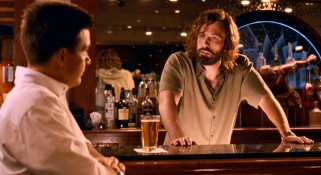
Joel (Bateman) is one of those classically sad, back-boneless middle aged men who aren’t particularly effective at home or at work. He owns the extract company, but it’s barely profitable and the employees bully him. At home, his wife Suzie (Kristen Wiig) dons her sweatpants in a nightly ritual to thwart his bedtime advances. They’re going through a dry spell. So when Cindy (Mila Kunis), an alluring young woman, comes looking for a job at the factory, can we blame Joel for wanting to give her something else? I mean, yes. We absolutely can. And even Joel is a bit wishy-washy on the whole thing, so it takes the bad influence of his best friend (Ben extract-02.jpgAffleck) to come up with this convoluted plan: they’ll hire a teenage gigolo to seduce Suzie, leaving Joel free to have an affair guilt-free. That’s a legit loophole in the vows, right?


Anyway, turns out Cindy’s a conwoman who’s trying to influence a former employee (Clifton Collins Jr.) to sue Joel for the loss of his testicle. So who, exactly is going to get a happily ever after?

From the mind of writer-director Mike Judge, I expected a lot better from Extract, and I probably shouldn’t have. I mean, it’s funny. And there are a lot of great cast members really selling their parts (David Koechner is a scene-stealer in a part that will infuriate you). None of these things add up to anything significant, but if you can live with some ridiculous, and often ridiculously funny, bits and pieces, you might be able to make this work for you. It’s no Office Space; like the extract itself, a little goes a long way, but if you’ve got a hankering for some ethical flavouring, Extract has the essence.

Love After Love

Warning: do not ask your spouse (or your friend or your kid or your brother) if they’re happy unless you’re really, truly prepared to hear the answer. Unless you’re certain the relationship, and your heart, can survive honesty. Happiness is a tricky thing, perhaps overvalued, perhaps not, but certainly contentious, perhaps elusive, always sought-after.

Brothers Nicholas (Chris O’Dowd) and Chris (James Adomian) are dealing with the death of their father, which was a rough one (or are they all?). Grief never exists in a vacuum. Death doesn’t wait for marriage, divorce, career, or even nervous breakdowns. It doesn’t wait to be convenient. Grief gets woven into the pastiche of life and it’s hard to watch these two mostly lovable guys flail about. But in some ways it’s even harder to watch their mother (Andie MacDowell. Andie MacDowell!) try to cope. She’s too young to be a widow and too vibrant to just curl in on herself. And too concerned about her children to not say what’s on her mind. Grief doesn’t make you a better person.

hero_Love-After-Love-2018-2

Love After Love is a bold movie that refuses to put on a brave face. There are no easy answers and no Hollywood endings. Grief changes a person, distorts a family dynamic. It can be ugly and it can be cruel, and director Russell Harbaugh savours those moments like they’re precious, and I suppose in some essential way, they are. The film feels loose and untethered; a series of family gatherings reveal their struggle to return to stasis. It’s as messy as they are, and seeing these emotions portrayed so honestly and unflinchingly is bleak of course but refreshing – I almost felt a sense of relief to not have to buy into the normal Hollywood tropes.

The cast is wonderful because they’re fearless. I have loved Chris O’Dowd since I first laid eyes on him and in the past few years he’s shown incredible range (though I tend to believe that if you can do comedy, you can do anything – not true in reverse). But I’m also super glad to see Andie MacDowell because we never get enough and she’s as underrated as they come. Together, the three of them reflect an authentic experience that can be hard to watch because it feels personal. This kind of unraveling is meant to be private, or at least that’s what the death rites in North American tell us, and it makes us uncomfortable to witness it. This film delivers some very raw performances and if you can maneuver around the emotional minefield, I think you’ll be quite pleased that you did.


Zoe

Got your fill of rom-coms? How about a sci-fi romance for a change?. Ewan McGregor plays Cole, an artificial intelligence engineer who creates a beautiful and highly realistic synthetic “woman” named Zoe (Lea Seydoux). Cole’s lab isn’t just making convincing companions, it’s also revolutionizing love. “The Machine” is a highly complex algorithm that can predict whether a relationship will ultimately work out. It has also synthesized a drug that can mimic the feeling of falling in love. But all of these things together don’t exactly mean a world full of meaningful relationships: humans will always exploit emotions. And Cole is lonelier than most.

MV5BZDZjOTUyNTctM2E0Zi00MGIwLWEyZmYtYTIzNDg2MmZiN2FmXkEyXkFqcGdeQXVyNzk3NjQ1MTc@._V1_SX1777_CR0,0,1777,999_AL_Zoe doesn’t understand that she’s synthetic at first, and it’s a little heartbreaking when Cole has to tell her. Then she questions everything. Like these unrequited feelings she has for him – was she programmed to have them? She was not. But as the two grow closer, and become a couple, she senses things are still unequal. Knowing who she is, what she is, has him holding something back.
Zoe is a movie about the complexities of love, and what happens when technology disrupts it. Men are eager to visit synthetic brothels (Christina Aguilera plays a robot hooker, for some reason) but will they ever trust synthetics to have real feelings? Of course, in a world where those feelings can be manufactured and manipulated with a pill, I wonder if they haven’t been sufficiently devalued that synthetic or not, it shouldn’t really matter anymore.

At any rate, there are some really interesting ideas here, they just aren’t executed all that well. The movie opens up this delicious Pandora’s box but then offers almost no social commentary, and its protagonist’s navel-gazing is immature and insensitive. There are no glaring problems with any of the movie’s moving parts, it’s just that they don’t add up to anything all that gripping or compelling (except for the soundtrack, which was the only notable standout). With themes of authenticity of both personhood and emotion, Zoe pales in comparison to Ex Machina and even Her, and you can’t quite forgive its shortcomings. I suppose movies are a little like robots in that, if you can’t make it better, why bother making it at all?

The Happytime Murders

It’s not a total bag of shit. But it is a mixed bag, and I suppose we must allow that there is some shit in that mix.

I have a certain admiration, and perhaps a higher tolerance, for movies that take risks and push buttons. But a movie like this is going to test even my boundaries, flimsy as they are.

It’s set in a Los Angeles where humans and puppets live together, though not exactly peacefully. The puppets are treated like second-class citizens. And despite the fact that they’re called puppets, there’s no acknowledgement that traditionally that word has referred to an object animated by a human hand up the puppet’s bum. These puppets are people, and their plight is a very interesting allegory for the African American experience. Unfortunately, the film makers keep up that thread for maybe 10 minutes before they drop it in favour of shock-factor antics.

And I get it. Who can resist making puppets do rude things? I LOVE Avenue Q, but MV5BMjEyMjg5NDMwNl5BMl5BanBnXkFtZTgwNjQ4OTMwNjM@._V1_SX1500_CR0,0,1500,999_AL_Avenue Q has a message and a point. It’s well-written and cleverly delivered. The Happytime Murders derails itself with its lewd antics, and if they get a laugh, they also take away from the plot, which is thin to begin with.
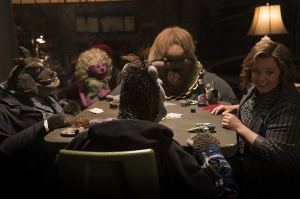
The gist: The Happytime Gang was a TV show, and now someone’s murdering its cast one by one. Detective Connie Edwards (Melissa McCarthy) and her ex-partner, puppet Phil Philips (Bill Barretta) have to overcome their history and a massive grudge to work together to save their friends.

But then: porn! So much puppet porn. And not the tasteful or vanilla, either. Puppets are in to some crazy stuff. Not to judge. But there were buckets of jizz, and puppet pubes, depraved bunnies, thirsty cows, and literal horn dogs. The murders are so much more sedate in comparison, puddles of stuffing rather than blood. It’s amazing, though, that something that sets out to be so shocking can so quickly become rather dull. One Sharon Stone-inspired puppet pussy shot is brilliant; repeating it can only reveal your lack of material.

The saddest thing, though, is the movie’s complete waste of funny ladies Melissa McCarthy and Elizabeth Banks. The script asks very little of them. McCarthy is relegated to sidekick status, and though she seems at ease among puppet costars, she doesn’t really get a chance to shine. If anyone, it’s Maya Rudolph who kind of steals the show as Philips’ long-suffering secretary, Bubbles, although it must be said that the puppetry is top-notch, and between you and I, I think I would have 100% enjoyed a documentary about the making of this movie better than the actual movie.

The Happytimes Murders is frequently disgusting, and often crude, but it’s not always bad. It’s not meant for everyone, but there was one woman in my screening who laughed like a hyena for the entire 91 minutes, so it does have its audience, it just may not be you. Or me. It goes out of its way to be ludicrous. If director Brian Henson (Jim Henson’s son) could hide in the theatre and poke you with a big puppet penis, he probably would. The movie was clearly made with glee and abandon, even if it isn’t always received that way by audiences. Personally, I just think it confuses lewd and dirty with entertaining a little too often, and for me that joke wore thin. But I won’t pretend I didn’t laugh occasionally – it was just usually the kind of laugh where you hide your own eyes in shame and hope that Grandpa isn’t watching from Heaven.


The After Party

Owen (Kyle Harvey) is known as Oh! when he’s rapping, and he’s hoping that as his high school career wraps up, his rap career will take off. For now, he’s working at his dad’s burrito shop. His best friend Jeff (Harrison Holzer) is acting as his “manager”, getting whatever amateur\talent show gigs for his bud that he can. But then something amazing happens: Wiz Khalifa turns up at one of his shows, and brings party favours. Which seems like the best thing ever until Oh! projectile-vomits on Wiz during the show, and collapses into a seizure on stage. It’s 2018 so that shit goes viral, and pretty soon Oh! is still a nobody but “Seizure Boy” becomes a laughing stock, even sparking a (very insensitive) dance craze.

MV5BNDgxMjE5Mzk0M15BMl5BanBnXkFtZTgwODQxNzYwNjM@._V1_SY1000_CR0,0,1499,1000_AL_Discouraged, Owen decides to join the Marines, and Jeff has one last night, a French Montana concert and its after party, to get Oh! in front of the right executive and secure him the deal that will save him from his broken dreams.

I have a feeling The After Party is supposed to be a fun ride but oh my god I hated it. Possibly because of Jeff, who was often in the driver’s seat. What a terrible human being. Casual narcissism and misogyny aren’t much fun to watch, especially when no one acknowledges his flaws. His $800 jeans are allowed to stand in lieu of personality. But Jeff isn’t my only beef, he’s just the beefiest.

There’s also a cheesy, contrived plot that relies on this friendship when the script makes it awfully hard to believe in. And makes it hard to root for these two knuckleheads. And I often found myself wondering who this movie is for – there are eye-rolling and probably already out-dated references to dubstep and Venmo meant to establish some youth cred, but alongside  cameos from Rakim and DMX, it feels like maybe the film makers aren’t sure which demographic they’re trying to appeal to. Frankly, when we have Donald Glover’s rapper-manager dynamic in Atlanta for comparison, The After Party just doesn’t stack up. It feels forced, superficial, and not particularly grounded in reality. Despite some recognizable rap faces, The After Party is just another annoying, uninspired, raunchy teen comedy in a  hip-hop costume. If this was on a mix tape, you’d have a free pass to fast forward through it every time. Hard skip.

You Were Never Really Here

Joe (Joaquin Phoenix) is a troubled war veteran and basically a hired gun, specializing in the finding and retrieving of missing and trafficked young girls. He lives with his elderly mother (Judith Roberts), who is the only person left in his life. And once you start seeing what’s in his head, you’ll understand why. He’s haunted by flashbacks, riddled with PTSD. It’s rough stuff, and it’s hard to keep straight. It actually appears hard for him to keep straight, and as he grapples with thoughts of suicide and questions of sanity, it seems his past might be catching up with him.

But the present’s not much better. His next job is to rescue Nina, a 13 year old girl MV5BNDQwOGQyYTMtNTc2MS00Nzg3LTgyMjctOWFmM2YzZWE3YTBlXkEyXkFqcGdeQXVyNjUwNzk3NDc@._V1_being held in a brothel. Her father works for the government and doesn’t want to get police involved. And if Joe could, you know, fuck up the men who did this to her, he’d be pleased. But walking a mile in Joe’s boots is never straight forward. He’s plagued by violent images, by death, by his own abusive childhood.

Once the killing starts, it doesn’t end, and Joe is basically a zombie, barely evading death, and barely caring. Writer-director Lynne Ramsay keeps us off kilter with static-y flashbacks. We’re as unbalanced as Joe is, and we’re unable to really trust everything we see. It’s disorienting and clever, unhinged and a little scary since we never know what we’re walking into. It’s gory, or course, likely enough blood to fill an Olympic-sized swimming pool, but we start to feel anesthetized to it because Joe barely registers it. Joaquin Phoenix really sells it. He sells a man who stopped caring about himself a long time ago. Who doesn’t trust his own reality, and isn’t particularly bothered by it. He suffers from these violent memories but nothing really jolts him from his stupor. It’s a great performance. And Ramsay somehow manages to evoke sympathy for this wounded soldier. She makes this action movie something special, something worth watching, even if the finished product is rather like a nightmare.

Book Club

Four smart and accomplished ladies have a friendly book club to “stimulate their minds.” But this month, frisky businesswoman Vivian (Jane Fonda) is suggesting Fifty Shades of Grey, which promises to stimulate something else. Sharon (Candice Bergen), a judge and voice of reason doubts it even qualifies as a book, but she is overruled and pretty soon they, along with Diane (Diane Keaton), recently widowed, and Carol (Mary Steenburgen), the only one who is happily married (or married at all, I suppose) are actually reading this month’s selection, which is apparently a pretty rare thing (sorry, Wild).

Fifty Shades of Grey offends me on many levels. Likely not on a prurient one. I can’t be sure though, since I’ve never read it. It offends me because it started out as porn fan fiction about Twilight, which is a book that already offends me for infantilizing MV5BMTU2MjYzMjY2MV5BMl5BanBnXkFtZTgwNTYyNjM0NTM@._V1_SX1777_CR0,0,1777,743_AL_literature. But fan fiction should likely stay in the darkest corners of the internet, where it belongs. Instead, easily titillated people with low standards encouraged the author to change the names and publish it as a “book,” which I avoided on principle. Ditto when the movie(s) came out, and you know there aren’t many I miss reviewing, even the stinkers.
When I first heard about this one, I loved it immediately for the terrific ensemble cast, but I was really disappointed about the subject of their book club.  I think older women, and indeed all women, should be free to explore and own their sexuality, but it’s insulting and belittling that it’s come to this. Luckily, the toxic erotica is only the jumping off point, followed by a pretty harmless rom-com. Not a great one, but thanks to fabulous leading ladies, it can’t go completely wrong can it?

And it’s sort of nice to see these ladies getting to live, getting to flirt and travel and nurture friendships, getting to be things others than mothers and grandmothers, which are wonderful things of course but not the only thing. Aging is a sin in Hollywood, and women over 40 are largely viewed by the camera’s lens as sexless. Producers routinely cast young actresses in “old” roles (ie, a 28 year old Angelina Jolie playing 27 year old Colin Farrell’s mother). The year Meryl Streep turned 40 she was offered THREE different roles for a witch. In The First Wives Club, Goldie Hawn’s character explains “There are only three ages for women in Hollywood; ‘Babe’, ‘District Attorney’, and ‘Driving Ms. Daisy.'” In real life, women continue to be interesting, complex human beings at every age, and the stories we tell should reflect that. Book Club is not the answer we really need; it feels more like an extended sitcom episode. But I won’t deny that Bergen, Keaton, Steenburgen, and Fonda are thrilling to watch; they remain magnetic as ever. If I have to put up with a “lethargic pussy” joke I will, but I will continue to hope for better next time. Like maybe a little less glaring whiteness, for starters.

Risk

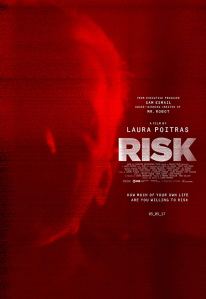
Julian Assange, as you may know, is the founder of WikiLeaks, a website that publishes secret information contributed by anonymous sources in the name of truth. Laura Poitras is the Oscar-winning director of Citizenfour, the documentary about another famous leaker, Edward Snowden. Filmed over a period of 6 years, Risk is Poitras’ documentary about Julian Assange.

Early on in the documentary, WikiLeaks is attempting to contact Hillary Clinton regarding some secret documents that are about to get leaked – not intentionally by them, but because their password got “exposed.” This is the least of their trouble. As MV5BMzIzNzYzMDM0NF5BMl5BanBnXkFtZTgwNzA1OTgwMjI@._V1_SY1000_CR0,0,687,1000_AL_you may know, they go on to publish a document dump leaked by Chelsea Manning, which earns them a criminal investigation by the American government. Shortly afterward, Sweden issues an arrest warrant for Assange over allegations of sexual assault and rape. He denies guilt but is more concerned that he’ll be extradited to the U.S. So, he breaches bail and flees to Ecuador where he’s been living at the embassy ever since

I didn’t really love Citizenfour and I think I like Risk even less. Laura Poitras has a knack for inserting herself into documentaries, and going easy on her subjects. I feel like I didn’t learn much about Julian Assange, though this documentary isn’t much more than a character portrait. He does say some crazy stuff about women that reminds us that though he’s got high and mighty principles when it comes to freedom of information, his morals to do extend to people, or their freedom to say no.

My takeaway from Risk is that if we’re looking to Assange for a saviour, we’re fucked. Dude is not a good guy. His ego and self-righteousness are astounding. Poitras comes off as being cowed in his presence, and fails to temper his own unreliable narration with any counterbalance. It’s uneven, and frustrating in that it lacks any meaningful commentary on more contemporary events. After all, WikiLeaks worked hand in hand with Russia to release the info they hacked which shaped the U.S. presidential election. And Assange has admitted that a Trump win was his preference. So while WikiLeaks pretend to be about ‘freedom of information’ it’s actually about curating that information in false and misleading and one-sided ways, for their own benefit or for others. And while Edward Snowden did what he did at least in part because he believes that every individual’s privacy is something to hold dear, WikiLeaks has destroyed personal privacy, releasing social security numbers, medical history, and credit card numbers of private citizens.

I wish this documentary had the balls to paint this dubious hero as the true villain that he is, but Poitras doesn’t quite commit. The finished work feels compromised. And as usual, I find her work to be without point of view. Risk feels like a bunch of footage, some of it revealing, some of it interesting, some of it randomly and inexplicably featuring Lady Gaga, but it never really comes together. Is there a movie in there somewhere, I wonder? But mostly I don’t care.

First Reformed

The Reverend Ernst Toller is the minister at First Reformed church, a small congregation in upstate New York. Mary, a young woman in the community, asks him to counsel her husband, who is struggling with her pregnancy. Michael is an environmental activist who is gripped by despair and hopelessness – he cannot imagine bringing a child into this world. Ernst (Ethan Hawke) takes him on, but it’s a tough case, and he relates more to the wife (Amanda Seyfried) than to the husband, who seems unreachable.

But the truth is, the Reverend is in no condition to counsel anyone. He’s messed up. MV5BYjA3OTJlODAtZjNlNi00ZTE1LTkxNzctNzJlNjQ5NjQxZTcyXkEyXkFqcGdeQXVyNDkzNTM2ODg@._V1_SX750_CR0,0,750,999_AL_And Michael’s question “Can God forgive us for what we’ve done to this world?” messes him up even more. He defends god, but struggles privately. He takes up Michael’s obsession but continues to pollute his own body, as we watch his physical and mental health spiral downward.

The first half of the movie is a lot of Ernst feverishly and guiltily Googling, while also drinking himself to death. It’s is not overly compelling stuff. But it’s super jarring when there’s suddenly a scene that feels like a complete divergence from everything that came before it. It’s almost like director Paul Schrader is shaking things up to allow room for the spiritual. He reminds us that we’re not in charge. We may think we know what’s happening, but we don’t.

And that’s true. I was very caught off guard by the ending, and there’s not many stories in the world that I don’t see coming a mile away. I mean, we know this dude is having a breakdown in a major way. But things get extreme, and, um, open to interpretation? This movie is getting a lot of love from the critics, but it does boil down to: 90% boring, 2% omg wtf, and I guess 8% wrapping your head around Cedric the Entertainer’s casting. It’s one you’ll have to see for yourself.

Ethan Hawke is quite good, and he has to be because this character embodies so many conflicts – faith & science, love & fear, strength & despair, consecration & desecration. It’s hard to really put this one into words, which I think is kind of the point. Schrader tackles the inexpressible, he goes there, and treats spirituality with more seriousness than I’ve seen from a movie in a long, long time. It does not make for fun viewing. Can you hack that? Is that how you want to spend 108 minutes?