
The title promises “bad times” and that’s exactly what this film delivers. In saying that I am not criticizing Bad Times at the El Royale. It’s a well-made variation on the multiple perspective crime genre (think Pulp Fiction) and it will keep you guessing until the end as each character is introduced and additional information is gained from each new perspective. But while Quentin Tarantino mixed a fair bit of humour into Pulp Ficton’s dark brew, writer-director Drew Goddard’s El Royale is a long row of tequila shots without a chaser. It starts slowly but even then, right from the start, the tense atmosphere tells you that a lot of bad shit is coming.
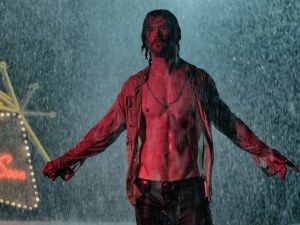 The main events in Bad Times at the El Royale unfold over the course of one rainy night on the Nevada-California border. The El Royale is literally split in half by the state line, so the first challenge for each guest is to decide in which state they’d like to stay. Unfortunately, things have gone downhill at the El Royale ever since it lost its Nevada gaming licence, so the hotel is essentially deserted. Ringing the bell doesn’t summon the desk clerk; it takes several seconds of beating on the “staff only” door to wake him. Once he’s up, the guests are able to check in – there are four at first, and two more will show up before the night is done. Hardly any of the guests are what they seem, and only a couple of them will live long enough to check out in the morning.
While the movie doesn’t quite reach “classic” status, the solid premise and excellent cast still make this film worth watching. It’s absolutely packed with talent, as demonstrated by the always-excellent Nick Offerman being relegated to a blink-and-you’ll-miss it role (though he does get to do some woodworking, of sorts, so that was probably reason enough for him to sign on). Bad Times at the El Royale gave me a tense, suspenseful night chock full of hardboiled twists and turns, and that’s all I could have asked for before the sunrise.
 recognizable, following in steeply descending order by Becky G, Josh Peck, and Tara Strong, if those names mean anything to you. The animation is okay, but let’s just point out the elephant in the room: there’s already an animated franchise wherein garden gnomes come to life. Not only does this stink of plagiarism, it’s just annoyingly unoriginal. This is animation, people. You can draw anything. You could have made a retro Tupperware set come to life, or some grubby fridge magnets, or discarded winter parkas.
 class, wherein they dissect a human cadaver for the first time. We get to know a handful of students – who they are, how they got here, what inspired them. We get appreciate their differing cultural and religious backgrounds, and how that influences how they view science, medicine, human remains, life beyond death. Curiouser still, we get to know the cadavers in some way. Their human identities remain anonymous but their bodies become a tree of learning, a gift to the thousands of patients each of these future doctors will one day encounter.

 40 years later, as MacAdams’ work is being exhibited, film maker Johanna Demetrakas tracks down many of the women featured in the work, including Jane Fonda, Funmilola Fagbamila, Gloria Steinem, Lily Tomlin, Margaret Prescod, Phyllis Chesler, and Judy Chicago and asks them about our continued need for change. Personally, seeing all these knowing eyes staring out at me, I feel galvanized.
 serious child, and then a teenager with no patience for small talk. She learned some valuable lessons from her mother before losing her at a tender age. She went to Harvard Law, where she had to justify taking a seat away from a man. She met her husband, Marty, who admired her intelligence during a time when men were meant to dominate their spouses. She finished law school as a mother and a caretaker to her husband, who was stricken with cancer. Long before she was known to her country, she was known to friends and family as dedicated, hard-working, and tough.
 In North America, the nutria’s only predators were humans. Without hunting, the nutria have multiplied terribly. Now this invasive species has overrun the land, its destructive eating and burrowing habits eroding coastline and eating up swamp land valuable for its protection against hurricanes.
 Smog obscures the screen as a trench-coated silhouette walks down a path illuminated only by neon light: is this a recycled set from Sin City or are you just happy to see me? There’s really nothing new to see here and the whole thing is just a bit uninspired – or, well, inspired rather obviously by other, familiar things. Luckily for Terminal, I can’t keep my eyes off Margot Robbie. She’s an exceptionally eye-catching woman, but as her past few films have indicated, she’s also quite an actress. So while she’s the only reason to watch this film, it’s also a shame how badly it wastes her. The movie wants to be cleverer than it is. It wants to throw some real curve balls at you, but it has simply cut and pasted the Wikipedia entry for curve balls and put it on the screen. Yes, Robbie is sexy as hell, and sure, many men, and most women, would follow her down the depths of hell without too many questions. But she deserves to be a real character, flesh and blood, with machinations and motivations. Instead, Stein fails to ground this movie in anything solid – what are the rules of this universe? Where have these people come from? Why should we care? It’s all smoke and mirrors, it lives for the atmosphere but once the smoke clears, there’s just not much there, except Mike Myers being a distraction, acting like he’s in an SNL sketch.
 ASSHOLES WATCHING MOVIES