I’m not what you might call a Dora stan. I have nothing against her, and I even have a measure of respect for intrepid young women who are curious and resourceful. But I’m a billion and a half light years too old to be watching her show – though I believe I did about 700 million years ago as a babysitter. Had Dora been on TV that long, or is she just living an extended life on Netflix?
No matter.
The movie doesn’t ask you to know much about the Dora universe; you could easily jump right in and be the 5th wheel on her trek through the jungle. If you do know the show, you’ll be delighted by several in-jokes; the movie is not afraid to poke fun of its origins, and those little touches separate Dora and The Lost City of Gold from others in its genre.
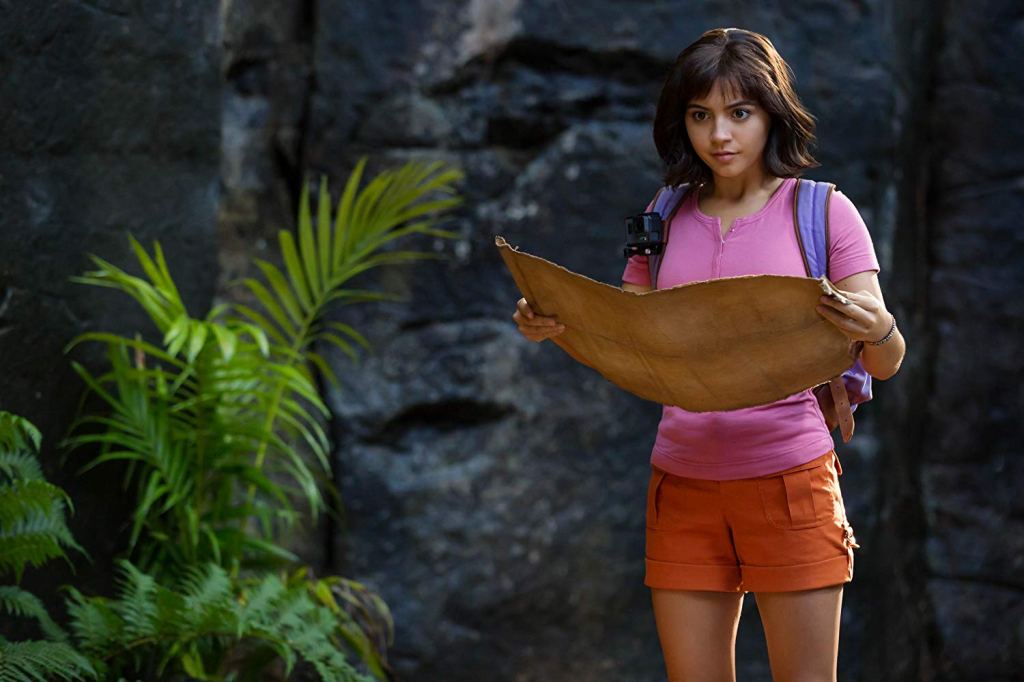
In the cartoon, Dora is a 6 year old, but the movie, unwilling to imperil a small child, instead chooses to imperil a slightly larger one, aging her up a decade, but keeping her innocence and hair band intact, though neither of those things makes her very popular in high school.
Little Dora was raised in the jungle by her professor/explorer parents, Elena (Eva Longoria) and Cole (Michael Pena). But when they’re preparing an epic and intensive search for Parapata (a lost Incan civilization, the film’s titular city of gold), they send Dora (Isabella Moner) away, to a proper big city with actual schools, and worse, peers. High school turns out to be an even more dangerous place. And while she’s happy to reconnect with cousin Diego (Jeff Wahlberg, nephew to Mark and Donnie), it doesn’t last long because she and a small group of students are kidnapped by mercenaries trying to find her parents, and not incidentally, all that lost gold.
Thus ensues an epic adventure, the kind only Dora could have, which is to say: filled with monkeys who may or may not wear boots, foxes who may or may not swipe, and songs that may or may not be about pooping. So even though Dora has boobs, she’s still a youthful, fun-loving gal who embraces the absurd (adorably, her grown-up back pack is designed in such a way that it appears to have a smiling face). There’s some very common denominator humour in here that had the kids in our screening spitting out their popcorn in delight. Truly, there was a variety of hoots the likes of which I have possibly never experienced before in a theatre. Moner is winning and lovable in the role, and what more could you ask for? It ticks all the boxes, occasionally manages to surprise and delight, and if I’m being honest, it exceeded my modest expectations, so I’m chalking this up as a win.
Netflix sees a swarm of streaming around Christmastime of those sappy, romantic holiday movies. It’s not a Netflix phenomenon by any means – those movies are all imported from poor-quality television channels that have low budgets and even lower standards. Generally, it shows, and generally, it doesn’t matter. But people are starting to wonder why the bump in ratings has to wait for Christmas. The Hallmark Channel recently hosted a Christmas in July. Netflix, on the other hand, is turning out non-Christmas movies that follow the same basic principle.
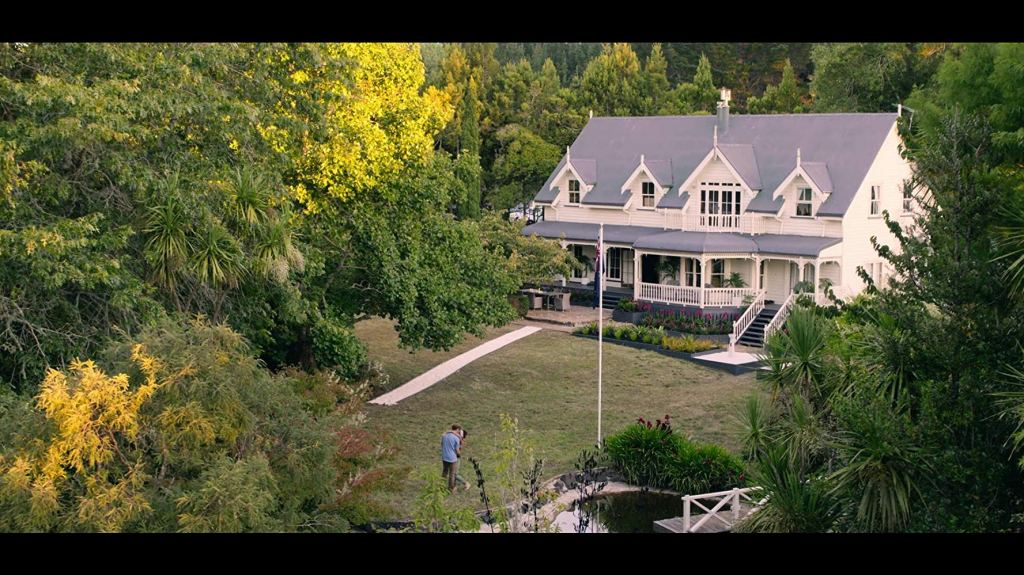
They’re cheesy as hell, but if you’re choosing to watch, you know what you’re getting, and you must like it. This particular one, though I have not yet forgiven it for the terrible pun in the title, is about a hard-working city-slicker named Gabriela (Christina Milian) who is going through a turbulent time of transition; in just a few days she loses her job and her boyfriend. But her luck’s not all bad: a “win an inn” contest she entered has borne fruit! So this San Franciscan packs her bags and heads to New Zealand to claim her praise.
The catch? The inn, though pristine in press photos, is derelict. The movie might have turned into a money pit situation were it not for a hot young widower carpenter, Jake (Adam Demos), who likes helping out beautiful Americans almost as much as he likes whipping off his shirt with little to no provocation.
Demos is actually Australian, not a New Zealander, but surprisingly, much of the other cast is in fact Kiwi, and the production seems to have actually filmed there.
Of course, the couple in question MUST start off on the wrong foot. Gabriela intends only to fix and flip the inn, and she’s obsessed with making everything eco-friendly, putting her at odds with Jake, who feels a special attachment to each and every one of the inn’s original fixtures, even the rotted, crumbly ones. But she keeps endearing herself to the locals and he, the handyman-cum-firefighter-cum-beekeeper remains tantalizingly unavailable, what with the tragic dead wife and all.
And then there’s the fun stuff, like the inn being haunted by a goat, and a rival innkeeper getting her knickers in a jealous twist, and controlling ex-boyfriends showing up unannounced. It’s not just renovation porn, but it is that too.
So if you like your romance uncomplicated, Netflix has your back.
Sarah (Diane Lane) comes from a big family, and they’ve all gathered in her kitchen to humiliate her. And by humiliate her, I mean that they’re throwing an intervention. That makes it sound like a party, I suppose, and it is most decidedly not. Nor is it quite as serious as it sounds. They’re not trying to send her to rehab. They’re trying to relaunch her back into the dating world after a devastating divorce. It doesn’t work – at least, not until she accidentally answers her own father’s personal ad. That’s a new low, as you can imagine. So maybe now she’s open to it. Ish. Her sister makes her a dating profile with quasi-consent (a good time to remind you that this movie was released in 2005).
Meanwhile, across town, a boat builder named Jake (John Cusack) is also newly on the market with a bruised heart that’s still trickling blood. He’s also got a friend/divorce attorney pushing him into the internet dating thing, and that’s how they wind up meeting – at a dog park, each with a borrowed canine friend. The date is shaky; Jake is so nervous he can’t stop insulting Sarah. Their next date has crazy beautiful moments of connection and chemistry, and then terrible lows that radiate awkwardness. So there’s wiggle room for a guy like Bobby (Dermot Mulroney) to enter the picture and sweep Sarah off her feet with his smooth technique. Dramaaaaa!
Anyway, it’s nice to see a rom-com for the middle aged. For the sad-sacks post divorce. For the cynics and the chronically depressed. And yet it still manages to charm. Of course, you might hope for a little more from two grown-ups who have loved and lost. You’d hope they’d have grown, that they’d have some insights. That they’d be better at this. And they’re really not.
Must Love Dogs should have Loved Rewrites. There’s nothing in here that you haven’t seen before. It’s not just that you see things coming from miles away – it’s that they’ve literally just traced a rom-com road map and hit up each and every landmark and rest stop along the way. And yet Lane and Cusack are just so good together. Never underestimate the likability of your leads.
I never got to write myself a dating profile, but even if I had, it probably wouldn’t have occurred to me to write Must Love Dogs, even though that’s obviously true. And thank goodness I wasn’t able to cock-block myself, because Sean never would have answered such an ad. He grew up with cats. But my little puppy Herbie won him over. No surprise there: Herbie is a stud, he wins over everyone he meets. Sean is a harder sell, and yet he was surprisingly able to win over Herbie, which was the more important part of the equation. I’d only had Herbie about 4 months when I met Sean, but Herbie had already been subjected to quite a few gentlemen callers and let me tell you – he wasn’t impressed. He’d scowl and growl and generally do his best to look ornery and intimidating (he was a four pound fluff ball but in his mind he was a full-fledged hell hound). He kept his eye on Sean for a bit, but he made it clear they were friends. That said, Herbie will never let Sean forget that it’s me and Herbie who are the original members of this household, and Sean’s just lucky we let him in the club. Now we have 3 more dogs because we can’t get enough. And this movie definitely put me in the mood for more. I mean, a gentle wind can put me in the mood for more. I Do Love Dogs! But I live in a city where the bylaws actually state that acquiring a fifth animal would force me to declare myself a farm. And as much as I Super Duper Love Dogs, it seems like a lot of hassle. Or…is it maybe a little bit of hassle and an excellent tax write off? Or a medium amount of hassle and a whole lot more love in my life? Or quite a bit of hassle but a good excuse to buy cute cowboy boots? Or a heck of a lot of hassle that I can offload on Sean, and simply reap the rewards of puppy love while outsourcing the work?
Don’t even try to tell me you’re not charmed by Notting Hill. Don’t. Even.
Directed by Roger Michell from Richard Curtis’s script, it’s really just about a girl, standing in front of a boy, asking him to play it cool, goddammit.
Mega superstar and talented actress Anna Scott (Julia Roberts) walks into a cute neighbourhood (travel) book store and meets bumbling store owner Will (Hugh Grant) and though their worlds are both geographically and metaphorically miles apart, they somehow allow a mutual attraction to play out.
Endearingly, their first real date is a group thing, a dinner party thrown in honour of Will’s little sister’s birthday. The friends assembled are a notable bunch of kooks. The birthday girl, Honey (Emma Chambers), has no chill at all; having always fantasized a famous bestie, she immediately gloms on to Anna. Host and cook Max (Tim McInnerny) will be mortified he’s just served meat to a vegetarian. His wife Bella (Gina McKee) is just so happy that Will’s brought a girl that she can’t help but embarrass him over and over. And hopeless Bernie (Hugh Bonneville) is sweetly clueless, not even recognizing the fame monster in their midst, and benignly quizzing her as to whether she’s able to get by on a working actor’s wages (she is). They’re a bunch of nuts, but they’re quite delightful as a group, and Anna is made to feel welcome and not too conspicuous. Will is a door to a quieter, humbler way of life. Not always enamoured with the trappings of fame – though clearly tied to them financially – it’s a wonderful respite for Anna. But is that enough?
No one recites a Richard Cutis line quite as well as Hugh, and no one twinkles half as hard as Julia. They were perhaps not the best of mates on set but it’s a testament to their talent that they are nothing but fireworks on screen.
The cool thing about this movie is that it was actually filmed on the streets of Notting Hill. There really was a house with a blue door (Curtis lived there for a time himself). And there really was a travel book shop, though it was too narrow to film in, so they confiscated an antiques store around the corner and outfitted it with books. Notting Hill has since been overrun with tourists, and not just the kind who come to snap a few pictures and leave. Many have been enticed to buy property there; prices in the area went up by 66% in the 5 years since the movie was released, double the growth rate elsewhere in London.
Anyway, this film isn’t deep, and perhaps not altogether realistic, either. But it’s so filled with good cheer you don’t mind. And of course you know exactly where it’s going practically before it even starts, but the fun is in the getting there because you get to ride along with such an oddball cast of characters, plus a couple of romantic leads at their peak, floppy haired cuteness.
This year I discovered that I really like listening to podcasts on long drives, and we drive a lot. One that I’ve particularly enjoyed is Fortune Feimster’s Sincerely Fortune, which she does with her fiancee Jax, and sometimes her mother, Ginger. Although I love Fortune’s standup, the podcast is consciously a more sincere and authentic discussion. Occasionally she has friends on, and one day, she had her good friend and former improv classmate Jillian Bell on the show. You may not know her name, but you would almost certainly recognize her. I had a heck of a time proving to Sean that he knew her, what with roles like “clingy friend” in Rough Night and “pregnant wife” in The Night Before being not super memorable or easy to point to. But this film is Bell’s first chance at a starring role and boy did she ride it for all it’s worth. Fortune was expansive with praise, clearly proud of her friend, and not only did I find it a moving testament to female friendship, it made me incredibly interested in the movie.
I’m happy to say I was not disappointed.
Ostensibly, Brittany Runs A Marathon is about a woman, perhaps an unlikely runner, who trains for the NYC Marathon. Her life is kind of a mess and her health could use improvement, so she takes up training as a means to exert a little more control on a life she sees as perhaps moving on without her, perhaps unsalvageable.
While we are experiencing Brittany’s transformation in miles traversed and pounds lost, this movie isn’t really about the running, and certainly not about the weight loss. It’s really about learning to grow, to being open to it. It’s about reawakening old dreams and letting go of old, toxic relationships. Brittany doesn’t become a better person when she becomes a thinner person. In fact, she might be at her most nasty. What saves her is showing herself what she can do – that her stagnant life can be nourished, that the dead ends are in fact just cul-de-sacs.
Jillian Bell in the lead role lives up to every aspect of her character. She undertook the same transformation as her character, Brittany, and you can tell how closely she relates to the material in the film. The supporting cast, including Micah Stock, Lil Rel Howery, Michaela Watkins, and Utkarsh Ambudkar, is extremely strong. There’s a lot of great chemistry and everyone has the benefit of a good, solid script from writer-director Paul Downs Colaizzo.
Because Jillian Bell is slightly wider than a No. 2 pencil, she’s often relegated to playing the out-of-control pal who’s very physical and quite obnoxious. In Brittany Runs A Marathon, she gets to go beyond just her fearless talent for physical comedy and flex the rest of her acting muscles as well. It’s terrific to see her in a role that’s worthy of her and I hope this means there are many more to come. It turns out that Brittany really didn’t need to transform her body. It was her head that needed the makeover – new confidence, more agency, bigger ambitions. Her salvation wasn’t found on a bathroom scale, it was in accomplishing her goals and widening her circle of support. Her trajectory isn’t straight. Her ups and downs sometimes push us away, make her hard to root for. But she’s an exceptionally real character who feels authentic and relatable and she’s exactly the kind of woman we need to celebrate.
As the trade war between the US and China escalates, American Factory arrives on Netflix and shows why this war is one that China is likely to win. The US is at a severe disadvantage in this war that it started, because the American Dream now belongs more to China than to the endangered American middle class, and because idyllic post-war America was built in large part on cheap imports from China and now the pendulum is swinging the other way.
American Factory is the first Netflix film from the Obamas’ production studio, and its release is perfectly timed. China and the US continue to threaten each other higher and higher tariffs, announcing another round of increases to take effect this fall. Of course, these threats are not really to the countries themselves; they are threats to consumers, who will inevitably bear all these increases in the form of higher priced goods.
While American Factory isn’t really about tariffs, the tariffs are still an important part of the story. That’s because the tariffs were instigated by the US in order to bring manufacturing back to the American heartland, which has been decimated by the loss of factory jobs as more and more of those jobs elsewhere to take advantage of cheaper labour and lower safety standards.
One of those shuttered factories is a former GM plant in Dayton, Ohio. Its closure in 2008 put thousands out of work, but in 2015 Fuyao Glass America, a Chinese-backed company, reopened the plant and brought hope back to Dayton. However, we quickly see that the reality is not quite as rosy as the fantasy, because the workers have taken a 30% pay cut, safety standards are not enforced, and management uses every dirty trick in the book to prevent the workers from unionizing.
Chinese workers are brought in to show the Americans how to operate the plant, and managers from the US are trained in China to help them better motivate the workers. American Factory captures the remarkable contrast between the workers’ attitudes in the two nations, and the attitudes of the nations as a whole. The Chinese are willing to work harder for less, sacrificing their bodies and family lives for the benefit of the company. The Americans, on the other hand, feel entitled to earn more money than their Chinese counterparts without making any of the same sacrifices.
Something has to give there. In both the Fuyao factory and in the larger trade war, the Americans can’t possibly get everything they want but are oblivious to that reality. Working-class Americans seem not to have realized that their consumer-centric society only exists because of other countries’ cheap labour, and that unskilled labourers will never again be “middle class”. If these American factory workers want to achieve their desired standard of living, they need to acquire marketable skills. Labour is no longer marketable on its own, and China and the rest of the world are eager to live the American Dream. China and the rest of the world also clearly want to realize that dream so much more than the Americans do, so in any head-to-head battle the Americans are going to lose out. The only question is whether the Americans will realize that before it’s too late.
Proudly brought to you by Nintendo, Vision Street Wear, and young Fred Savage, the Wizard is a movie I somehow avoided for 30 years until Netflix shoved it in my face last night. Even in 1989 there was really no reason for me to see it since I had already played Super Mario 3 at my friend Justin’s house (he somehow imported it from Japan). And revealing that new game was the Wizard’s raison d’être.
Jimmy Woods (Luke Edwards) is a non-verbal kid who’s been stowed away in a care home by his mom and step-dad. Until Jimmy’s half-brother Corey (Savage) busts him out and stows him away on a delivery truck faster than you can say “tanooki suit”, destination California. After the two boys meet tween runaway Haley (Jenny Lewis) at a bus station, their destination becomes more specific. They’re off to Video Armageddon, a world championship of gaming featuring only 8-bit Nintendo games because Jimmy is secretly a wizard at Double Dragon. But will Jimmy be able to beat his Power-Glove-wielding rival Lucas (Jackey Vinson) at a new Super Mario game that no one has played yet? You’re damn right he will.
At the time, Super Mario 3 was the next great Nintendo game. But now, countless Super Marios later, Super Mario 3 is an ancient relic, rather than a selling point like it was in 1989 (because it had not yet been released in North America. The one point of interest for today’s audience is seeing a very young Tobey Maguire make his very first film appearance (blink and you’ll miss it). In hindsight it’s clear that Maguire isn’t really acting here in his non-speaking role as Lucas’ tiniest sidekick, and that he was always destined to become one of the biggest assholes in Hollywood.
Otherwise, the Wizard is unforgivably forgettable. It’s not a good movie (and it never tries to be) but it’s also not an enjoyably bad one. Savage does his precocious tween thing, Christian Slater does his precocious teen thing, Beau Bridges does his earnest dad thing, and a bunch of other people presumably do their best acting which was not good enough for them to ever get any other major movie roles. Maybe if I had seen it as a kid I’d be more nostalgic, but without the benefit of nostalgia the Wizard is nothing more than a 96 minute commercial for 30 year old Nintendo games.
Before I say anything else, understand that my mind is busily chewing over a fact that makes me very uncomfortable, namely, the near-uniform whiteness of Wes Anderson’s movies. I love Wes Anderson. I love his movies. But I do not love monochromatic casting. But in thinking on this quite a bit in the past few months, I’ve come to realize that it’s not that he doesn’t hire people of colour, it’s that he doesn’t hire African Americans, rather specifically. In fact, The Royal Tenenbaums may be the only time he’s every hired a black actor for a role of substance (Courtney B. Vance got to narrate Isle of Dogs), and it’s really only to service a racist character, ie, Danny Glover’s only there so that Gene Hackman can call him a long list of slurs. And though Wes Anderson’s worlds are so often populated by the same faces, Glover’s has never reappeared. Hiring someone just to be a target seems particularly cruel. However, Kumar Pallana, an Indian actor, had appeared in 4 of Anderson’s films (he died in 2013 – and was originally a barista in Anderson’s favourite Dallas coffee shop). Waris Ahluwalia, an Indian-born, American Sikh, has been in three. Tony Revolori, the terrific breakout bellboy from The Grand Budapest Hotel, is of Guatemalan descent, though so far he’s appeared in more Spider-man movies than he has in the Wes Anderson universe. There was a smattering of Japanese voice actors in Isle of Dogs, though surprisingly and relatively few considering the whole film takes place in Japan. This isn’t exactly an exhaustive list, but it’s as close as it is short, and between you and I, the minute you start putting together a list of non-white actors, you’ve already lost. That’s 9 terrific, talky, thinky, inventive pieces of cinema with incredible ensemble casts and insane attention to detail and just 1 solitary black man, necessary to the script to be the recipient of a grumpy old man’s careless racist remarks. It’s a terrible tally.
And it’s too bad that Anderson’s movies have this problem because otherwise they’d be 100% my jam.
The Tenenbaums are a fascinatingly dysfuntional family. Matriarch Etheline (Anjelica Huston) raised her 3 children to be exceptional after her lousy husband Royal (Gene Hackman) left. Chas Tenenbaum was a prodigy investor, successfully running businesses out of his childhood bedroom. Now he’s a recent widower and fresh trauma has him raising his own sons in a constant state of terror. Margot Tenenbaum was a prodigy playwright, earning prizes and praise as a child for her mature writing. Today she’s literally soaking in depression as her husband Raleigh (Bill Murray) knocks helplessly on the bathroom door. Richie Tenenbaum (Luke Wilson) was a tennis prodigy hopelessly in love with his sister, Margot. He had a career-ending meltdown when Margot married Raleigh, and he’s spent the time since sailing the world, keeping oceans between himself and his family. Eli (Owen Wilson) is the boy next door who grew up gazing upon the relative privilege of the Tenenbaum family, wishing to belong to them. And of course Henry Sherman (Glover) is Etheline’s new suitor and the family’s disruptor.
Broke, homeless, with hackles raised about the new man prowling about, Royal Tenenbaum decides to home after decades away. They won’t have him of course. He spent years disappointing his family before being completely estranged from them. So his only move is to fake cancer as a ploy to gain sympathy – and even that’s a tough sell. But it gets him back in the family home, and one by one the grown children all return to orbit around him. They’re all fucked up in their own ways, but they’ve also got an extremely fucked up dynamic together. They’re a bunch of fire starters just waiting for a match, and Royal is a goddamned flame thrower. Whoosh.
It’s a movie full of quirks that still manages to be cohesive and sell a cogent story about a family full of tragedies. Betrayal lurks in every closet, disaster through every doorway. And even though it contains perhaps Anderson’s bleakest scene ever (set to Elliott Smith’s Needle in the Hay), it’s not all doom and gloom. There are plenty of laughs, but also some actual heartfelt moments. The movie is an act of forgiveness, a representation of forgiveness being a gift you give yourself, to set yourself free from the past and the pain it causes you. Royal may be irredeemable but his family is not. They’re deeply flawed and chronically eccentric, but the script searches authenticity and finds it in abundance.
Fun Facts:
Though the role of Royal was written with Hackman in mind, it was offered to Gene Wilder, who turned it down.
Danny Glover’s look in the film was modeled after U.N. Secretary General Kofi Annan, which is possibly my favourite sentence in the world.
There is no such thing as Dalmatian mice; the spots were drawn on with Sharpies.
Anjelica Huston wears Wes Anderson’s mother’s glasses in the film.
The hand that is seen with the BB lodged between its knuckles is not Ben Stiller’s, it’s Andrew Wilson’s (yes, brother to Luke and Owen). It’s no trick, he really has a BB stuck in there and has since childhood. Can you guess which one of his brothers shot him?
I turned to Sean at one point to say that there were a lot of Beatles songs in the film. In fact, Ruby Tuesday was playing at the moment, which is by the Stones, as I’m sure you’re aware, and as I myself am normally aware, though my brain was clearly existing in some alternate reality at the time. There is a Beatles song, and a John Lennon one, and four from the Stones. Brain fart.
Detective Spooner (Will Smith) hates technology generally and robots specifically. In 2035, he immerses himself in vintage clothes, “antique” furnishings, and “oldies” music (most of which is from the 80s). When a brilliant robotics scientist (James Cromwell) is killed, and a robot is the apparent suspect, Spooner is either the worst man for the job, or the best.
Sonny (Alan Tudyk) is the homicidal robot in question, and this murder investigation is immediately making waves. Lawrence Robertson (Bruce Greenwood) is particularly motivated to cover up the crime. Robots are subject to 3 ironclad laws that should make harming a human impossible. Robertson’s company is about to inundate the market with robots for personal use. If the public gets whiff of this, it would destroy their appetite for keeping robots in their homes (understandably). So Robertson’s trying to put a lid on this thing, Spooner’s trying to blow the lid off it, and the hordes of robots are starting to feel more and more sinister.
I, Robot is inspired by the work of Isaac Asimov, a sci-fi writer with a curious and probing mind. He teases out the possibilities and then follows them to their logical, if uncomfortable conclusion. The movie is full of flashy embellishments that of course already look dated. 2004’s vision of 2035 already looks pretty shitty to us folk in 2019. Its original script (then called Hardwired) was a lot more Asimov, but once Will Smith came on board, it was quickly converted into yet another summer blockbuster in which Smith saves the world – with jokes inserted that even Will Smith found dubious. Anyway, it’s been robbed of the subversive Asimov element and turned into 96% action and 4% sci-fi, which, for the record, is officially the saddest ratio in the world. It’s like director Alex Proyas shoved in so many self-driving cars and futuristic guns that the brain just fell out. No room at the inn for critical thought or Important Questions or lingering doubt. Just expensive destruction and robots with unnerving eyes.
It’s not just the role Will Smith was born to play, it’s the role Will Smith has already played literally half a dozen times. He’s quite good at it – the chip on the shoulder, the slow-motion last minute saves. It’s rote, but it has a nice gloss on it. Nobody’s bothering to dig underneath the surface in this film, but it’s decent entertainment if you’re just looking for an excuse to shovel popcorn into face.
Fun Facts
The motorcycle that Smith rides in the movie is a 2004 MV Agusta F4-SPR, one of only 300 produced worldwide, capable of reaching in excess of 175 mph. He wrecked it during filming.
Will Wheaton and Emilion Estevez both tried out to play Sonny (the robot).
The most expensive CGI shot in the whole movie is when they digitally removed Will Smith’s penis from the shower scenes when producers suddenly got cold feet.
In The Royal Tenenbaums, Eli Cash, played by Owen Wilson, writes a book and describes it thusly: “Well, everyone knows Custer died at Little Bighorn. What this book presupposes is… maybe he didn’t.” It’s a great line. It kills me. And Owen Wilson passes it off so well.
Quentin Tarantino seems to have had a similar bug up his bum when he wrote Once Upon A Time In…Hollywood.
This review is a little…late, and while, yes, we were happily at the cottage when it came out, we have not been in a hurry to see it since we got home either, and in fact only saw it this past weekend because it was playing in the right time slot. Had Dora been playing at that time, I would have happily-ish seen that instead. The truth is, I’m kind of over Quentin Tarantino. I just don’t feel like racism is the price I want to pay to see his films. $12? Fine. Gratuitous use of the n-word? No thanks.
And while it’s impossible to say this film is racism-free (it isn’t), it’s not the film’s biggest problem. Sean and I just found it…boring.
Leonardo DiCaprio plays Rick Dalton, a washed up TV star struggling to stay relevant. Dalton is a fictional amalgam of several stars of that era. He was a big star on a western television series a decade ago but now he’s lucky to guest star as the heavy on single, sporadic episodes. He drowns his sorrows in a pitcher of whiskey sours. His one time stunt double Cliff Booth (Brad Pitt) is now mostly his driver…and sometime handyman. He seems pretty content with his lot, his laid-back surfer dude persona disguising his continued ability to kick some serious ass.
Rick Dalton just happens to be living slightly beyond his means next to Roman Polanski in the Benedict Canyon neighbourhood of Los Angeles. Polanski is off filming a movie, leaving behind his 8 months pregnant wife Sharon Tate (Margot Robbie), and several houseguests…including the man who continued to love her despite her recent marriage to someone else, Jay Sebring (Emile Hirsch).
Sharon Tate bops around town while Quentin Tarantino fixates on her legs…and eventually, her dirty feet. Margot Robbie is the picture of youth and health and vitality and promise. But other than as a symbol, she has little to do in the movie. She was few lines and little screen time. Once Upon A Time In…Hollywood is only tangentially about the Manson Family murders. It’s mostly Tarantino’s love letter to old Hollywood, and in that respect, it’s a good one. There’s lots of period cars and neon lights and references to old-timey movies and actors (Damian Lewis appears as Steve McQueen). But the movie acts mostly as a vehicle for DiCaprio and Pitt, indulging in lengthy scenes that are great testaments to their acting abilities…but don’t really serve a greater story. One flashback scene is so long and absorbing, Sean literally forgot it was a flashback scene, and then the story just spits us back out where we belong – it’s interesting, sure, but it corroborates a single, throw-away detail, which makes it totally irrelevant. This film is 161 minutes long…it didn’t exactly need any padding. I would normally suggest the story needed some good editing, but I think the real problem is that Tarantino isn’t sure exactly where the story is. He’s got a series of good ideas but no cohesive narrative into which he can plug them.
DiCaprio and Pitt are acting their little tushies off though. Pitt in particular. He steals every scene he’s in. When he, a 55 year old man, takes off his shirt, revealing an extremely fit physique, it earns whistles and applause in nearly every theatre it screens in. Arguably, old man abs are not exactly acting…but he backs them up charm and dynamism.
This puzzle had many attractive pieces. But some puzzles, when you finish them, you spackle them with glue to frame and hang on your wall. Others you merely break apart and put back into the box…where it will collect dust until you sell it in a yard sale, usually at least one piece short. Once Upon A Time In…Hollwood is the second kind of puzzle. It’s fine. It’s just not great.




 this fall. Of course, these threats are not really to the countries themselves; they are threats to consumers, who will inevitably bear all these increases in the form of higher priced goods.

 ASSHOLES WATCHING MOVIES