Author Archives: Sean

Unknown's avatar

About Sean

I'm an asshole! assholeswatchingmovies.com

The Prestige

prestigeChristopher Nolan’s bad movies are better than most people’s good ones.  I count three of them (Memento, Inception and The Dark Knight) among my all-time favourites, and I have enjoyed everything else of his that I’ve seen (Batman Begins, The Dark Knight Rises, and Interstellar).  Noticeably absent from that list, until this week, was The Prestige, which usually appears near the top of critics’ “best of Nolan” lists.  So when The Prestige popped up on Netflix’s “recently added” row, I dove in immediately.

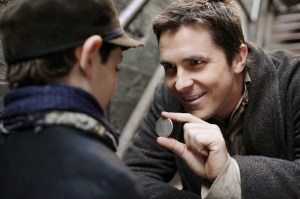
The Prestige is a tale of the ever-escalating war between two rival magicians, played by Christian Bale and Hugh Jackman.  Bale is the purer magician while Jackman is the larger commercial success.  As the stakes get ratcheted up, Bale is arrested for Jackman’s murder.  But in a battle of illusionists, can we really believe what we see?

Structurally, The Prestige is as complex as anything that Nolan has thrown at us.  This movie shouldn’t work as well as it does.  There are flashbacks within flashbacks but I knew at all times where/when a scene fit in with the rest of the film.  We’ve got enough examples by now of Nolan’s capabilities, but The Prestige is yet another display of his narrative mastery.  Basing the film on the three parts of a magic trick works very well, keeping the viewer on edge until the big reveal.

The reveal itself, though, left me disappointed.  It was a huge stretch that went completely against the movie’s prior suggestions that the secret of magic is setting up the trick and selling it to the audience.   I found the reveal of both Bale and Jackman’s methods problematic, in different ways, but Jackman’s big surprise was what really took the air out of the film for me.

Because of that, on my list The Prestige gets relegated to the lower tier of Nolan films, somewhere in Interstellar territory.   Make no mistake, though, that’s due to Nolan having made so many great films as opposed to The Prestige being a bad movie.  It’s still pretty damn good!
OIAF: Cafard

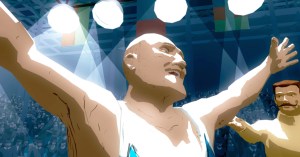
cafardCafard is the French word for cockroach.  But make no mistake, the animated film Cafard is not the French version of A Bug’s Life.  It’s a bleak, adult tale about the horrors of the first World War, from the perspective of a world champion wrestler who enlists in the Belgian army in 1914 after his daughter is raped by German soldiers.  Unfortunately for all involved, that terrible event is only the start of the awfulness.

Cafard’s story is told well but it didn’t thoroughly draw me in, and I wonder whether that is because I never related to the protagonist.  While well-meaning, his brute force approach did not translate from wrestling to the rest of his life, and his journey is unsatisfying as a result.

The film’s subject matter was likely a cause of my detachment as well.  This is a movie that is difficult to get close to, because it does not sugarcafardcoat any aspect of war’s horrors.  While that approach is commendable, it is that much more difficult to embrace Cafard.  I would have liked for the film to have offered something to offset its harsh subject matter, but there is no joy to be found in this world.  Any hint of happiness feels fleeting, like a consolation prize at best.
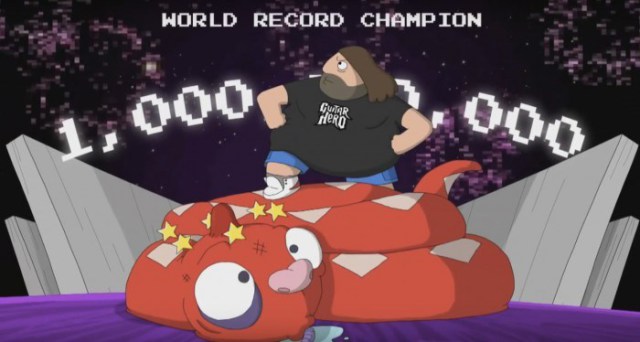
Fittingly, Cafard’s motion capture animation is harsh and eerily realistic, just like its storytelling approach.  The visuals fit the movie tonally but are at times distracting, particularly because Cafard by and large is almost photorealistic but there are occasionally very roughly drawn scenes that seem like they contain animation errors.  It is too bad because those moments are few and far between but that made them even more jarring when they appeared.

Despite those minor complaints, from an artistic perspective the film consistently reflects Cafard’s sad subject matter, and tells its story effectively and with purpose.  That is an achievement deserving of mention.  The film is thematically consistent and demonstrates the futility of war from start to finish.  Cafard hammers home that theme and I left the theatre feeling that the filmmakers might even be satisfied that I found the film so difficult to enjoy.  War is hell, after all, and Cafard delivers exactly that.


NHFF: Hunter Gatherer

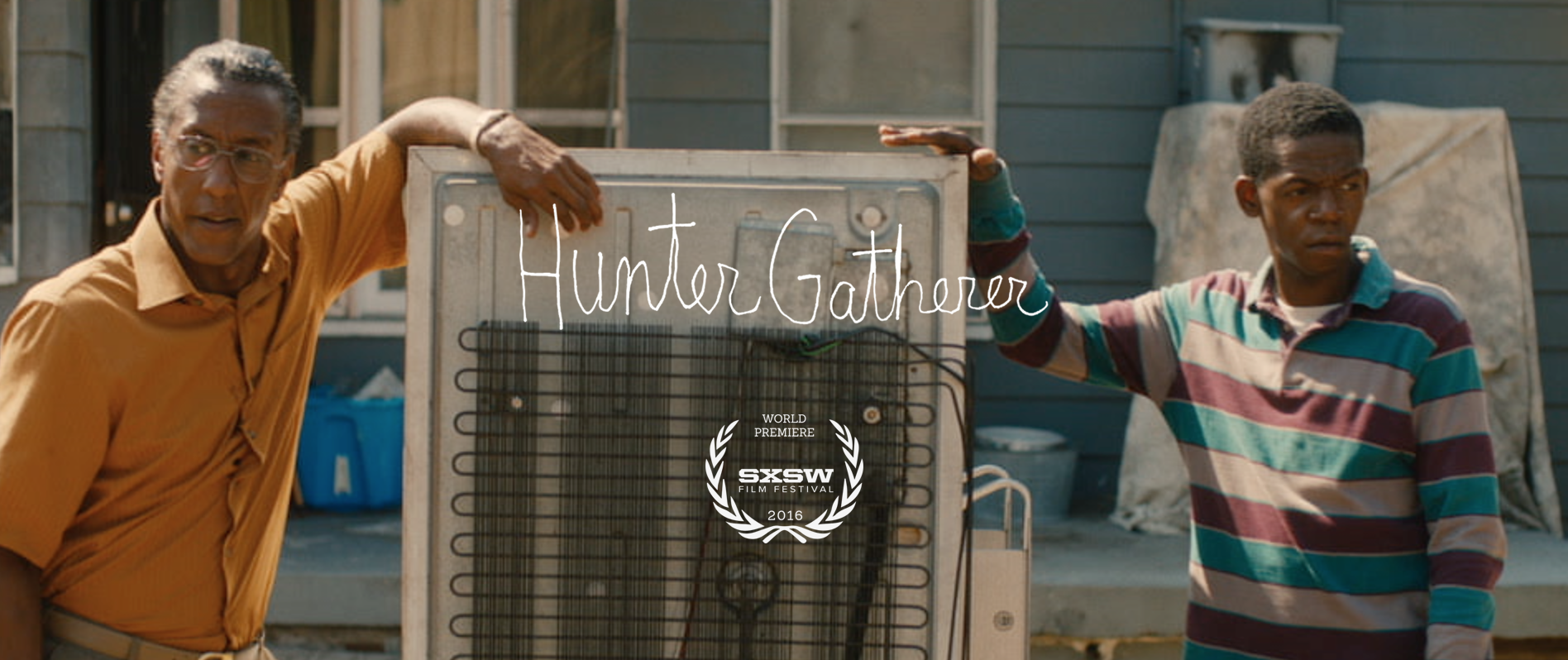
Hunter Gatherer is a little film that demonstrates the value of fully-realized characters.  It is not a flashy film or a high concept one, but it is powerful in its own way.  Through the misadventures of a man just released from prison, Hunter Gatherer illustrates the constant struggle we all face as we try to find our way in this crazy world.  The characters are a little exaggerated but not to the point of farce, and the film succeeds in large part because there is something real at their core.hunter-gatherer

The two protagonists are particularly memorable.  Andre Royo and George Sample III play off each other well and their actions, while often nonsensical to the viewer, have a certain logic that makes their antics believable.  Given the bizarre schemes these characters are involved in, writer/director Joshua Locy deserves a lot of credit for making the characters convincing.

Locy’s efforts pay off because as things turn for the worse, we feel these characters’ pain and understand their responses even if we would have done things very differently.  And we would have done things differently, because if either of these characters made even slightly rational decisions then the movie’s whole course, including its starting point, would have been completely different.  That it could have been avoided with a little common sense makes Hunter Gatherer’s ending all the more heartbreaking.

Like so many small indie films, Hunter Gatherer is unlikely to get a wide release, but it is making the rounds on the festival circuit.  If you have the chance to see it at one of those festivals, I would recommend that you take advantage of the opportunity.   As an aside, we do our best to post release information on our Twitter feed (@AssholeMovies) for all the films we review.  So if you’re not already following us there, now is a good time to start!

Saint Amour

Gerard Depardieu and Benoit Poelvoorde play a father and son, respectively, attending a livestock show.  Luckily for Poelvoorde, the fair also features a wine exhibition and he makes it his mission to sample everything.  Since there are a few days before the main event (the cattle competition), Depardieu suggests they widen the scope of the wine tour.   Poelvoode is all for it so the two hit the road with the help of cabbie Vincent Lacoste.

Saint Amour had me at “French wine tour”.  If anyone ever wants to organize a French road trip, count me in.  Jay will definitely come too.  There’s a joyous feeling as the characters move to the countryside and get their drink on.  The experience feels like it should, and as a viewer I wished I was more actively involved in the adventure.

Even Vincent Lacoste, who I instantly recognized as the title character in Lolo (likely the most detestable character I saw on screen in 2015), is entertaining as the cabbie/third wheel.  The beating heart of the movie, though, is the interplay between Depardieu and Poelvoorde.  They are both funny and surprisingly sweet as they try (and often fail) to reconnect over bottle after bottle of what I am sure was excellent wine.  Neither of them has a lot to say to the other, but as the story progresses we see it’s not for lack of trying.

Then the film swerves in the last ten minutes, leaving us with an ending I did not see coming, not even a little bit.  It’s not the worst ending but it’s quite bizarre, mainly because it didn’t fit with my feel for the father and son duo and left me feeling a bit flat.  On the other hand, the swerve was believable for Lacoste’s character but that could be my Lolo hatred resurfacing.  Me, I would rather have finished the wine tour.

Even with the bumpy landing, Saint Amour is an entertaining ride that goes down smooth.  Now to start dropping hints to Jay about a real-life tour of France’s wine regions, sans compromis.

Man vs Snake: The Long and Twisted Tale of Nibbler

I am too young to remember Nibbler from the arcade but it was on my computer at some point during university, along with Solitaire, Hearts, and Free Cell.  In Nibbler, the player controls a snake with the goal of eating all the dots on the board.  But every dot you eat makes your snake get longer (in a very non-sexual way), and if you let the snake run into itself then it dies (I guess because it is super poisonous?). All in all, a pretty simple concept, but like most 80s games, you can playmanvssnake-cartoon-billionpoints-700x374 the game forever doing the exact same thing over and over, just a little faster each time.

As a natural-born procrastinator, I played a few rounds of Nibbler while avoiding writing research papers.   Is it just me or has YouTube/Facebook/Twitter made all those games obsolete?  Anyway, back in the day I became quite good at Free Cell but mastery over Nibbler always eluded me.  Part of it was that I found the game extremely boring (possibly more boring than writing the paper I was trying to avoid), so I’d only last one or two games and then I’d move on to something else.

Unlike me, there are 40+ year olds who seem not to get bored by Nibbler, and who play that game for marathon sessions, 30 hours or more, in order to score a billion points.  Nibbler’s claim to fame is that the developer had the foresight to display a score nine digits long instead of the usual six, so Nibbler’s whirring numbers went that much higher than its contemporaries before flipping back to zero (which may be part of why we feared Y2K so much, because in all these games you could lose everything by playing just a bit too long).  Nibbler focuses primarily on the first player to hit a billion in the game, the unfortunately named Tim McVey.  He hit the high score back in 1983 and promptly moved on to other games because after playing the game for 40 hours straight he couldn’t bear to touch a Nibbler machine ever again, but hemanvssnake_1280-720x405 returns to the competitive Nibbler arena in his 40s when he learns he might not actually have held the world record all those years.

We’ve reviewed some very good documentaries on Netflix recently (like Ava DuVernay’s excellent 13th).  Man vs Snake does not come close to those heights.  It is unlikely to inspire you or educate you or show you anything worthwhile.  This lifelong quest for high scores in a dull, repetitive game is led by people who like dull, repetitive things and inevitably are stuck in the past due to their nature.  Certainly, the gameplay footage, which features prominently in a whodunit-type post-mortem of one marathon attempt, is going to hurt your eyes because it’s painfully archaic.  I don’t know how I ever stared at any of those screens.  It’s impossible for me to stare at them now or hear the incessant beeping that was a staple of the arcade experience back then, the equivalent of the bells on a slot machine, over and over and over.

While it is interesting to peek inside these people’s lives for a few minutes, my interest faded long before the movie wrapped up.  At its core, Man vs Snake is a dull, repetitive experience, much like Nibbler itself.  It’s a decent time-waster that you will likely get bored of before it ends, and you may want your quarter back.  There are much better documentaries to be found in the Netflix arcade.

Hacksaw Ridge

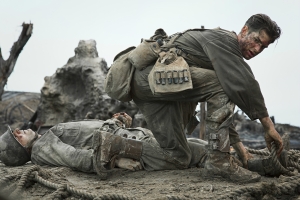
hacksaw-ridge-2016-andrew-garfieldThere are two main takeaways from Hacksaw Ridge: (1) even American acting jobs are now going overseas, as aside from Vince Vaughn every American soldier in this movie seems to be played by an Australian (included in that tally is Andrew Garfield, who I have since learned is British, not Australian, but still…); and (2) if the Japanese had just prayed harder they might have won the Second World War.
The Australian angle is natural since this movie is brought to you by “the director of Braveheart”. A similar thing is happening right now to Ben Affleck, now known as the artist who formerly directed Argo and the Town. Is this going to be a thing? Because I find it annoying that their actual names aren’t mentioned in the promotion of these movies at all. If the reference to their past movies means anything to you then you know who’s being referred to, so let’s say their name already and move on! Conversely, if the reference to the movie doesn’t mean anything to you then it’s unlikely to be a selling point. Either way, it’s wasted trailer time that could be better spent on spoiling more of the plot.

hacksaw_ridgeIncidentally, if the intent behind not putting Mel Gibson’s name up front in the marketing was to create some separation from those all-too-frequent racist comments in Mel’s past, it might also have been a good idea to cast at least one non-white guy. Just saying.
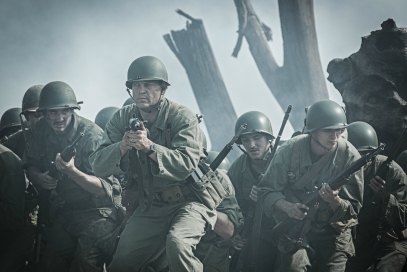
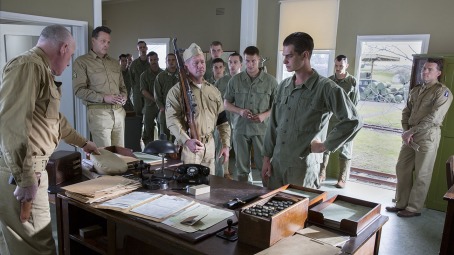
The prayer angle refers to Desmond Doss, a devout Seventh Day Adventist who was the first American conscientious objector to receive the Medal of Honor. Doss doesn’t want to kill anyone or even hold a gun, but he still enlists during WWII to serve his country as a medic. In typically American fashion, his refusal to carry a gun while training to march into a hail of bullets is viewed as a sign of cowardice rather than bravery (or insanity, or a mix of both). His objection is based on religious grounds as well as a bad childhood, and due to his objection every soldier he comes across in basic training looks down on him and tries to force him out. Fortunately for them,hacksaw-ridge-2016-ryan-corr-vince-vaughn he doesn’t hold a grudge, and hauls 75 of them off the Okinawa battlefield even after they made his life so rough.

Doss’ story is an incredible one and Mel Gibson’s direction does it justice. It’s a bit over the top at times, and you may get tired of the battleground shots being blurred or showing just the barrel of a firing gun or being in slow motion complete with matching audio. Despite that, the movie shines at the important moments, naturally displaying Doss winning over his detractors and putting the audience at Doss’ side as he sneaks through enemy territory looking for one more wounded soldier to save. Though the characters are largely one-dimensional, the cast led by Andrew Garfield, Vince Vaughn and Sam Worthington deliver quite a few memorable moments, including some well-timed humour amongst the horrors of war.

Hacksaw Ridge is cheesy and over-the-top in a mostly good way, and the sum of its parts is enough to overcome some significant flaws. Its unusual perspective and celebration of a dogged outlier makes it a worthy addition to the bloated catalogue of WWII movies.  Hacksaw Ridge earns a score of eight cringe-inducing battle wounds out of ten.

Equity

equity-is-such-a-good-wall-street-movie-you-almost-forget-that-all-the-characters-are-womenEquity is a cold, unblinking look at Wall Street’s backrooms, through the eyes of a female dealmaker who’s trying to recover from a failed transaction. Her client’s shares traded too low during the initial public offering, and now she’s got a target on her back. Equity throws us into the immediate aftermath and we watch her as she tries to save her career by putting together a bigger, better deal.

Anna Gunn (Breaking Bad) is well cast as the investment banker protagonist. She is cold, smart, and driven, a shark among fish. She never backs down from anyone, and gets us to root for her character without being particularly endearing or warm. That is Equity’s strongest trait: it gets us to respect both Gunn’s character and her antagonist, federal prosecutor Alysia Reiner, without resorting to familiar gender stereotypes for wither character.

equity-2If you have at least a passing interest in finance, Equity’s story will draw you in and keep your attention until the end, avoiding most cliches throughout, at least when it comes to the main females. The male supportung characters fare less well, as they are all thinly sketched stereotypes (e.g., sexist boss, backstabbing boyfriend, and frat boy internet sensation). It is refreshing, though, for women to be the most compelling and realistic characters for a change.
Equity is no more or less than a Wall Street drama. It is a well-done addition to the genre, but feels somewhat constrained by its chosen niche. With that said, I appreciated that Equity unapologetically shows that women can be just as ruthless as men and shouldn’t be held to a higher standard based on outdated conceptions of femininity or motherhood. I also liked that the writers did not force a tidy resolution on the audience (which may be tied to the fact that a spun-off TV show is in development).

In the end Equity intentionally leaves the audience cold, but the challenge to gender stereotypes sticks even as the story beats start to fade from memory. I’d count Equity as a success thematically, and it’s entertaining to boot. In financial terms, it’s not a career defining deal but it’s still one that deserves handshakes and high fives all around on closing.

Doctor Strange: IMAX 3D Sneak Peek

Last night I got to see what amounted to an extended trailer for Doctor Strange, in IMAX 3D.  At one time not too long ago, 3D movies were a real draw to me.  I remember dragging Jay to several 3D re-releases of movies we’d seen a million times before (but only in boring old 2D).  After intensive therapy (mainly arm punches from Jay), I’m mostly over that phase.

strangeeye

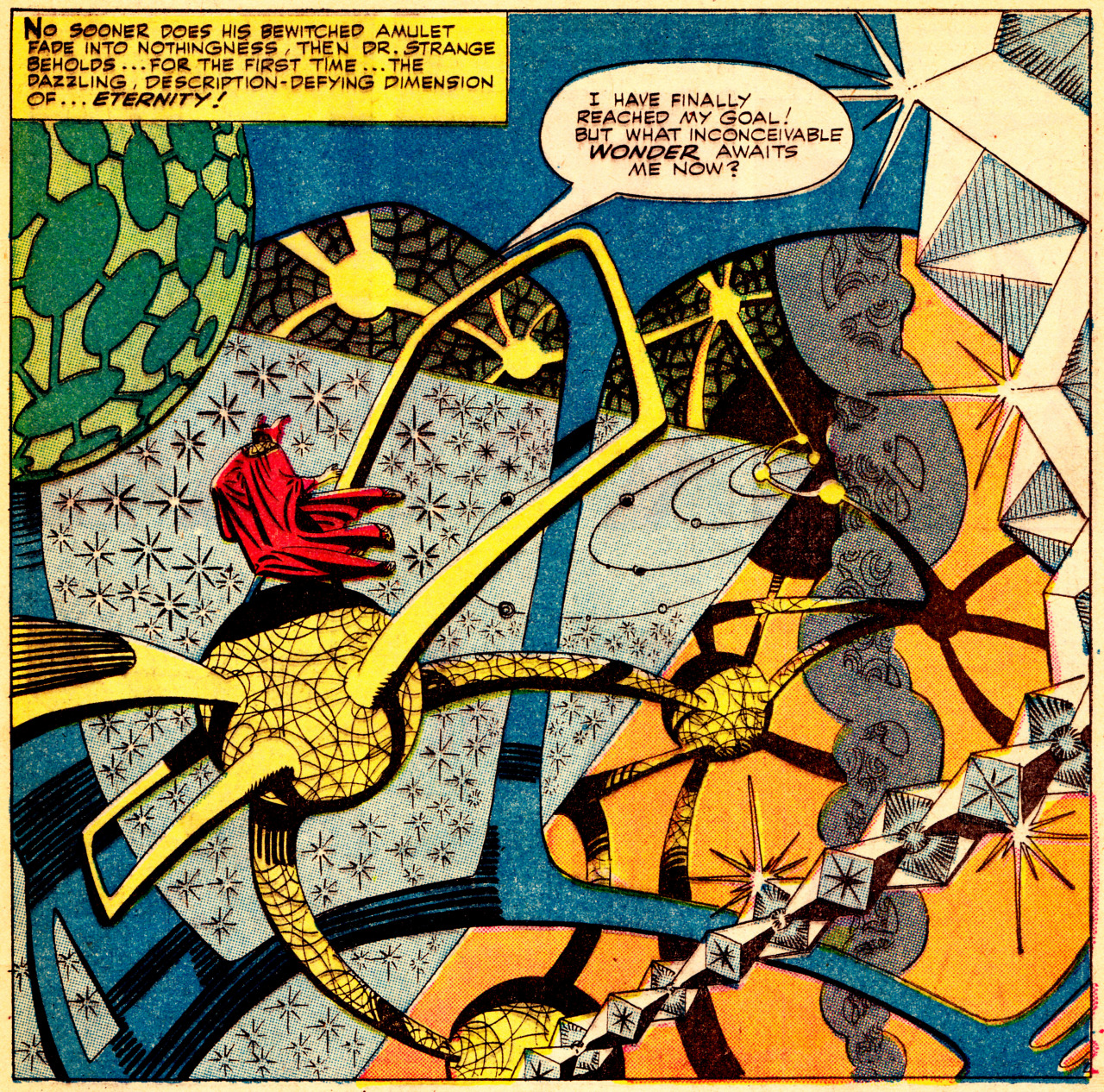
Nowadays, I usually see movies without the dopey extra glasses, but after last night’s sneak peek I am convinced that I should see Doctor Strange in 3D, punching be damned.  The visuals are trippy enough to live up to Steve Ditko’s acid trip 60s backgrounds, depicting all the crazy dimensions that Doctor Strange passed through on his adventures, and that’s a high bar!

The preview’s centrepiece was an absolutely incredible city chase sequence, with gravity changing constantly, New York City collapsing onto itself, and destruction raining down on all sides as copies of buildings collide with each other.   Other scenes included nightmare dimensions full of grabby baby hands, fractal patterns expanding and contracting as Doctor Strange plummets through them, and a bunch of other stuff I can’t even begin to describe.  doctor-strange-comic

Marvel has done a great job of translating its characters to the screen while retaining the soul of the comic, particularly for second tier characters (with Iron Man and Guardians of the Galaxy being the best examples).  Doctor Strange seems set to follow that same path and with those other movies having paved the way, seems destined to depart at least a bit from the tried and true formula that we have seen way too often.

Whether the movie actually ends up being worthwhile is yet to be determined, but with a stellar cast (including Benedict Cumberbatch, Tilda Swinton, Chiwetel Ejiofor and Mads Mikkelson), an hour of IMAX-specific footage, the report that Marvel had to adapt the visuals to make the 2D version make sense, and the amazing effects in the preview, IMAX 3D is the clear platform of choice to view Doctor Strange’s adventures when the film opens November 4th.


13th

13th

(1) Neither slavery nor involuntary servitude, except as a punishment for crime whereof the party shall have been duly convicted, shall exist within the United States, or any place subject to their jurisdiction.

(2) Congress shall have power to enforce this article by appropriate legislation.

That’s the Thirteenth Amendment to the Constitution of the United States of America.  You may have seen a few movies dealing with it.  As a Canadian, I don’t know the ins and outs of the U.S. Constitution, so it’s always interesting to learn a little about how the U.S. system works.  Yesterday I learned that the U.S. system has an extremely dodgy concept of freedom from slavery.  13th is a documentary from Ava DuVernay that sheds some light on the systematic oppression of black people using the gigantic loophole in the middle of the Thirteenth Amendment.

The Thirteenth Amendment clearly states that slavery is allowed as punishment for crime.  Not coincidentally, once slavery became illegal, former slaves were rounded up, arrested for petty offences, and imprisoned.  As these methods slowly fell out of favour, the tactics to oppress former slaves became a little less obvious.  For example, Richard Nixon’s “law and order” methodology was designed to target black civil rights activists in order to gain white support in the south.  Guess what?  The plan worked exactly as intended, quelling the movement for equality by killing or imprisoning tons of black leaders.

Similar results were obtained through Ronald Reagan’s “war on drugs” (which imposed harsher penalties on crack than cocaine in powder form) and Bill Clinton’s 1994 “tough-on-crime” legislation (a crackdown on violent crime enacted during a period when such crime was decreasing).   Donald Trump perfectly illustrates how the same approach is alive and well today.

Since the abolition of slavery, it has been terrifyingly easy for politicians, backed by corporations, to continue to oppress an entire class of people.

Worse, continuing this oppression is economically advantageous and politically effective, because it keeps prisons stocked with cheap labour and earns votes from people who wish we could turn back the clock to simpler times.

Worst of all, the Constitution not only allows prisoners to be treated as slaves, it also permits prisoners to be permanently stripped of the right to vote.  That’s right: VOTING IS NOT AN INALIENABLE RIGHT IN THE UNITED STATES.  Living in the wrong state can cost you your vote, forever, because of a crime you committed and served time for.  That fundamental failure of democracy has occurred more than five million times over in the “land of the free” and, of course, disproportionately affects minorities because that’s who the system has targeted for imprisonment since the abolition of slavery.

Bottom line: the U.S.A. is broken.  Your elected officials aren’t interested in fixing the problem.  If anything, Corporate America is lobbying to worsen the divide.  Change must be demanded by the voters, and for that reason alone 13th is a must-watch.  It’s available on Netflix.  Add it to your list.

Middle School: The Worst Years of My Life

middleschool

This movie needed to be written by someone who got past the first lecture at the M. Night Shyamalan school of plot twists.   Or better yet, someone who didn’t make 12-year-olds talk like pretentious idiots and make their principal respond to the kids using flower child slang.

Actually, the principal was mildly entertaining, if I’m being honest, even though his character was just one in a long line of tired cliches this movie threw at me.  Clueless mother and her secretly kid-hating boyfriend, a school bully who’s a dick for no reason but will come around by the end, and a bunch of random poppy songs that the kids probably stopped listening to six months ago, with the Strumbellas’ contribution agonizingly censored to sing about “dreams” and “hearts” instead of “guns”.

This movie has absolutely nothing to offer to adults and even the hordes of tween terrors in attendance seemed restless during my screening.  The first few fart jokes got a reaction, but after a while the kids stopped giggling at the rude sounds that everything seemed to make, including school bells as well as a cartoon gorilla landing on a zombie driving a motorcycle.  As well, the big twist confused the kids both in front of and behind me, probably because it was contrived, unnecessary and rendered the movie even more nonsensical, and I would not have thought that to be possible until it happened.

Visually, there are interesting animated bits and some creative and colourful pranks that function as diversions, as long as you don’t think about any of it too much.  Not only are the pranks impossibly large to have been pulled off overnight, how do these students gain entry into their school after hours, spend entire nights inside undetected, and pull these all-nighters for weeks on end without dozing off in class once?

It would be generous to call Middle School a lazy and half-baked adaption of a popular book series.  Incidentally, I had to drop in the “half-baked” reference because the film painstakingly identifies Lauren Graham, the clueless mom, as a sous-chef, and then I swear she was making beef-a-roni in a food processor at 6 a.m., which must qualify as professional misconduct.   And that’s not a one-off thing.  The Middle School experience is 90 minutes of incomplete thoughts and unanswered questions.

Middle School: The Worst Years of My Life gets an F and a month’s worth of detention, and even that is too lenient.