Catherine (Anastasia Phillips) has spent a lifetime caring for her alcoholic mother Tammy, who has diagnosed herself manic-depressive thanks to the help of daytime television talk shows. Tammy (Felicity Huffman) isn’t a good person, but she is a good time, whooping and gyrating away in the bar where her daughter works, at least until the end of the month when the welfare runs out. Then there’s the monthly ritual of Tammy dangling off a bridge, threatening to jump, and Catherine rushing to her aid, assuring her that she’s loved and cherished and not a bad mother. Even though she kind of is, always demanding time, attention, greasy breakfasts, and cash, without offering anything back, like motherly love or pride or approval or even thanks.
Catherine is stuck in the same town where she grew up, tethered to a mother who is tethered to the bottle. She’s still fucking the same (married) guy from high school and working a dead-end job. Her only friend is fellow bartender Doug (Clark Johnson), who whisks her away to the city occasionally to live like other problem-free people for an evening. The cycle is starting to feel inevitable and unending, Catherine’s resentment growing, and she’s starting to feel like her mother’s suicide might not be the worst thing, except for the fact that it’s always been an empty threat just to elicit Catherine’s sympathy. So when Tammy is diagnosed with terminal cancer, it has a complicated impact on both of them, not to mention their dynamic now that Catherine’s become her full-time care-taker.
Tammy’s Always Dying gets off to a slow start but a strong lead performance by Phillips eventually sucks us into her world, which feels impoverished and inescapable. The mother-daughter bond is malignant, which makes for a painful reminder that we can’t always save the ones we love, or help loving those who can’t be saved. With confident direction from Amy Jo Johnson, Tammy’s Always Dying admits there are some things worse than death.
James (Jonas Chernick) is a geeky science guy who has largely buried himself in work. His parents are dead, he avoids his sister, and he’s too afraid to explore the outer reaches of the friend zone with the beautiful and equally geeky Courtney (Cleopatra Coleman), so there’s really no one to pull his body out from the avalanche of data he’s buried under. But one day an older man appears from out of nowhere, spouting nonsense that James has absolutely no chill for whatsoever, until the man whips out his dick.
Which, to be fair, would probably stop many of us in our tracks. But James does a double take, which under other circumstances might be rude, but in this case convinces him to listen up. Why? Because their penises (peni?) are identical, guys. Ipso facto, the old guy dropping trou is actually also James, but from the future. He didn’t initially recognize him because Future James (FJ) is older of course, and oddly also taller; time travel stretches you out, apparently. But since the penis thing checks out, and is of course a foolproof system for identifying past and future Yous, Present James (PJ) is willing to listen. He just doesn’t like what he hears. Future James (Daniel Stern) has traveled back in time to convince Present James not to invent time travel. To just drop it. Future James is responsible for the biggest scientific breakthrough in the history of literally everything, and has accomplished all of his wildest professional goals. But he’s begging Present James to choose another path. Because in the pursuit of his dream, he sacrificed everything else. Future James is miserable, and wants more for little PJ.
For a movie about time travel, it’s really kind of not about time travel. We’re not going to worry about portals or paradoxes or ripping a new one in the universe. Instead we’re going to debate whether the personal sacrifice required of any ground-breaking innovation is really worth it. And even if we accept that the best and most fulfilling path for James is to abandon his time travel research, does he perhaps owe it to the rest of humanity?
The discovery of two new elements in the periodic table and their development and application for the good of humankind made Marie Curie one of just 4 people to win a Nobel Prize in two different disciplines (chemistry and physics). Radiation therapy has saved the lives of countless cancer patients over the years, and many more have benefited from the x-ray. But Marie Curie paid with her life, dying of radiation poisoning she acquired in her lab. Would a Future Marie Curie have begged her to stop? And should she have listened? If not for her own sake and lifespan, perhaps for her daughter?
The performances are good and the direction uncomplicated. I delight in any film that makes me think, and the script, by Chernick and director Jeremy LaLonde, did just that. It manages not to come off as heavy-handed and remains fairly impartial. We wouldn’t all make the same choice, but that doesn’t mean it wasn’t the right choice for James. I do wonder, though, that if the Future version of You suddenly showed up in your home, how would you know them? Should we all devise a secret code right now, just in case? Not only do many of us not have penises at all, but even those who do might often find theirs to be relatively nondescript. Could you pick it out of a lineup? Whipping it out makes for an awkward first encounter, and is risky enough to make a second encounter a lot less likely. After all, if you’ve traveled all that way THROUGH TIME to deliver an important message, you probably want to get on your good side. But then again, a lot of other validation methods will also come off as creepy, and stalker-ish. There really aren’t a lot of good options for the time traveler. Usually a fair dose of skepticism must be overcome, and then there’s the challenge of authentication. Plus, time travelers always seem to be cutting things pretty close, don’t they? There’s always some urgent need, probably the very fate of the universe hangs in the balance. So go ahead. Work out your secret password now and save your Future Self a lot of trouble should the need arise.
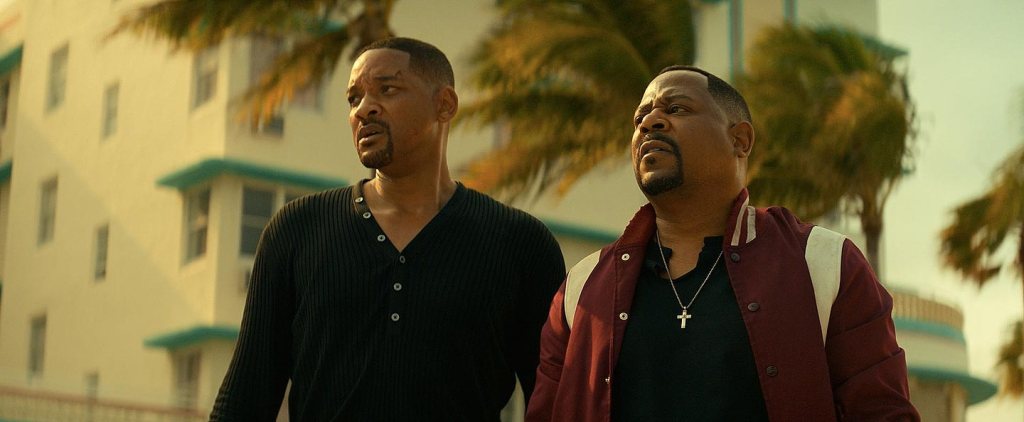
Will Smith is 51 years old; costar Martin Lawrence is 55. Their characters, Mike Lowry and Marcus Burnett, are feeling every bit of their age on the Miami police department where they haven’t been boys for quite some time, and are maybe looking to be a little less bad. But ‘Good Men’ just doesn’t quite have the same ring to it, does it?
Like always, Marcus is trying to talk himself into quitting – or in this case, 25 years after the first installment – retire. And as always, Mike pshaws his excuses and presses him into further recklessness. Age hasn’t mellowed Mike nearly enough. He’s still the guy scorching through the streets in his Porsche, shooting first and asking questions never, still giving his Captain (Joe Pantoliano) heart palpitations which are increasingly risky now that they’re all AARP eligible.
Currently Miami is being terrorized by the systematic assassination of every member of law enforcement who worked a case a quarter century ago. A mother-son pair of drug lords (Kate del Castillo, Jacob Scipio) are behind the bloody vengeance but they’ve proved virtually untouchable thus far. Mike has every reason to sit this one out, which inevitably means he’s going to barge right in, invited or not, so he gets assigned to the AMMO team headed by his ex Rita (Paola Nuñez) which will now have to solve the case while babysitting the legendary detective who acts more like a toddler with an assault rifle.
Bad Boys for Life is the third in the franchise and the first that isn’t directed by Michael Bay. Don’t worry though, directors Adil El Arbi and Bilall Fallah (Adil & Bilall) are adept at mimicking his style, recreating several iconic shots from the previous films, making fans feel right at home. As if that wasn’t enough, they even worked Bay in with a cameo, both as a very minor character in the film, and as the director of that particular scene, which features his signature 360 degree shot.
There may be a little more gray in their beards and a little less spring in their steps, but Smith and Lawrence recapture their dynamic and deliver an exciting and fun addition to the franchise. This movie has everything you’ve come to expect from the trilogy and manages to deliver it in a way that doesn’t feel derivative. While no one will ever call it a ‘good film,’ it is every bit the film that fans deserve, and I can’t imagine anyone being disappointed by it. Ludicrous car chases, improbable explosions, random impalement, a menacing helicopter and a blacked out motorcycle – Bad Boys for Life is a high octane delivery system for all the ‘Bayhem’ the original helped make industry standard. Yes, it’s junk food, but as far as greasy take-out goes, this burger is top notch.
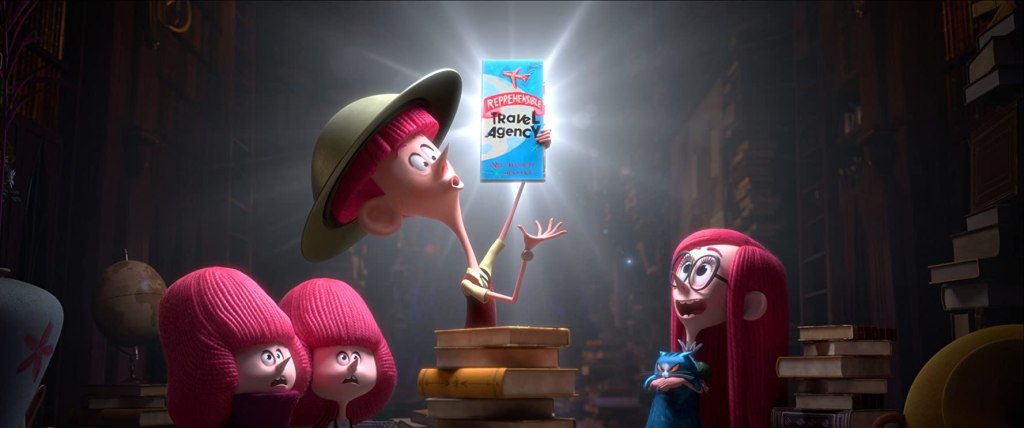
The Willoughbys come from a long line of impressively mustachioed ancestors as evidenced by the numerous oil paintings lining the hallowed halls of their “old fashioned” home. But the buck stops here, apparently.
Mother (Jane Krakowski) and Father (Martin Short) Willoughby love each other passionately. They are so consumed by their marriage neither can see anything outside it. No wonder Father has such a minimal mustache – and Mother none at all! They have four kids but not a thought to spare for any of them, never mind a care. Tim (Will Forte) is the oldest, but is still a young boy, unmustached and still attached to his head protector (you and I might call it a hat). He corals the other children – the golden-voiced Jane (Alessia Cara), and twin brothers both named Barnaby (Sean Cullen) with only a single sweater between them – and makes sure the kids don’t bother their parents with things like hunger or attention. They’re cold and they’re hungry but it’s all they’ve come to expect. Until they get a brilliant idea: to send their parents on a dangerous and frankly deadly trip cleverly disguised as a second honeymoon.
So off go Mother and Father and the children celebrate – finally, as orphans, they might fill their own bellies and occupy space in the house itself rather than the coal bin. But two strange things complicate matters: a baby gets left on their doorstep, and unable to care for her, they leave baby Ruth on the doorstep of the mysterious owner of a candy factory (best home ever!), Commander Melanoff (Terry Crews), and an unqualified but well-intentioned Nanny (Maya Rudolph) arrives. While the kids are initially wary of Nanny, she soon grows on them by providing the basic necessities of life and caring whether they live or die. It sounds a bit dire, I know, but worry not, this is a very family-friendly animated film by Netflix, and the kids are resilient and crafty, and their neglect never feels so serious that it cannot be overcome.
And of course, there are plenty of childish high-jinks, lots of pranks and booby traps and Nanny catapults, and a whole rainbow candy factory montage where a baby has the time of its life while narrowly avoiding death.
Oddly, and luckily, while the children have dismissed their parents, they learn valuable lessons about family. The Willoughbys may not land on the ending you’d expect, but they get their happy ending and they have an awful lot of fun doing it. This is a pleasant surprise from Netflix and I think your young kids are really going to like it.
When we first meet UN diplomat Sergio Vieira de Mello (Wagner Moura), he’s just been injured in a bombing of the UN headquarters in Baghdad. How did he get there and how will he get out? The film rewinds three years or so to trace his path as a high ranking special representative of the United Nations. Previously he’d worked to make East Timor an independent state, learning valuable lessons in open and honest communications with the very people he’s trying to help. It’s also where he meets Carolina (Ana de Armis), a woman so special that she’ll follow him to him to his next posting, in Iraq.
It’s 2003 and the U.S. has just declared war on Iraq. It’s a war neither Sergio nor Carolina believe in, but Sergio believes in his work and believes he has one last contribution to make before retiring to Brazil with his new love. Setting up headquarters in the Canal Hotel, he dismisses the U.S. troops guarding the building, taking pride in the fact that Iraqis would feel welcome to approach their offices. He was adamant that the UN remain neutral, unaffiliated with the US invasion. But this decision left the building vulnerable, and Al-Qaeda seized the opportunity, using a suicide driver to detonate a bomb under his office’s window. The blast injured over 100 people and killed at least 22. Sergio and Gil Loescher (Brían F. O’Byrne), a consultant to the UN High Commissioner for Refugees, are alive but trapped in the rubble. If nothing else, it gives Sergio plenty of time to reflect on his past.
Sergio de Mello is clearly important, if mostly unknown, and his peace-making ideals are admirable. It’s clear director Greg Barker wants to pay tribute to the man but in doing so, the story splinters. The love story is given equal if not more screen time than his storied political career, which inevitable gets simplified, complex situation distilled into soundbites, which actually seems to be the antithesis of what de Mello stood for.
Still, it’s an incredible performance from Moura and a competent one from de Armis. It is likely worth watching for that alone. It’s surprisingly slow at times for a movie that starts with an explosion, and I wish we knew more about the man and his motivations. But since this bombing resulted in a profound and lasting change to the way UN administers its practices globally, this event is worth commemorating.
Jack (Ben Affleck) is a middle-aged man sleepwalking through his life, completely numb. Once a high school basketball phenom, he’s now working a shit job, drinking constantly, isolated from his family and friends, separated from his wife. His life is sad and stuck.
So I suppose Father Devine considers it a kindness to reach out with an opportunity. Jack’s alma matter is short of a basketball coach, and his glory days have not been forgotten (nor have they been repeated in the 25+ years since he left, but that’s another story). Jack tries out many refusals before grudgingly accepting, a win that is celebrated only briefly as the catholic school soon realizes that Jack is perhaps not an ideal role model, screaming and cursing his way through games.
Still, Jack seems to come out of his shell bit by bit, as his drills start paying off and his severely losing team becomes a moderately winning one. But alcoholism is a disease with deep roots, and Jack has more skeletons in his closet than we’d previously imagined.
The Way Back is a story about suffering. It’s not about redemption, but maybe just that very small first step, the most important one, the one that feels awful and aching and may or may not lead to success. The way back for alcoholics is much more complicated than most movies can show. Healing is not linear. It’s not pretty. It’s not easy. And getting sober is not a cure – not a cure for the suffering, and not a cure for the alcoholism either. Ben Affleck knows this better than most. He’s struggled with addiction himself. He’s been in and out of rehab more than once or twice. He’s seen it wreck relationships, including his marriage to Jennifer Garner. I don’t know Ben Affleck. I don’t know if he drank to ease the pain or if addiction was just in his genes. Many people who have alcoholism in the family will never succumb themselves. Some will suffer a catalyst, an event in their lives that leads to drinking. Many of us go through these hard times, but someone with a predilection for addiction won’t be able to start. I think for many celebrities, the lifestyle itself is a trigger. it can mean a lot of events, a lot of parties, and a lot of free drinks. People in the throes of addiction will do anything to feed it, including stealing from their dear sweet grandmothers or selling their own bodies. Celebrities don’t have to do this of course. Money is no object so they have no real obstacle to their using. In fact, they probably have many enablers, covering for their absences, making excuses, managing the bumps and bruises. It’s probably difficult for a celebrity to see their addiction because that’s usually done when “hitting bottom” but when you have millions of dollars and personal assistants, they form a very large cushion that keeps you from really going splat. Of course, when you have unending access to your drug of choice, you’re also at risk for a very sad death. We’ve seen those happen to many times, proving money can’t insulate you from everything.
So when you put someone like Ben Affleck in this role, you’re sending a message. Affleck carries a heaviness, a darkness within him. His anguish in this movie is real, and I can only hope it was some sort of exorcism for him. His performance has depth and authenticity, and though the story sometimes dips too far into sports movie cliche to be satisfying or worthy, Affleck more than makes up for it.
We have continued our binge of Disney nature documentaries streaming on Disney+. It’s a welcome break from all the junk. Disney docs are like the strawberry of movies; they’re technically healthy but sweet enough to be eaten for dessert. We recently raved about both Elephant and Dolphin Reef, and now we’ve watched 2019’s Penguins. And guess what? It’s great.
Now, we’ve insinuated before that Disney nature documentaries are perhaps not the greatest source of information. They’re not just shooting facts at you rapid-fire, they’re crafting a story, which makes the doc far more palatable and definitely kid-friendly. that’s why I don’t call Disneynature documentaries the kale, but they’re definitely in the same tier of the pyramid.
In Penguins, “Steve” is a 2 foot Adelie penguin in the Antarctic. It’s spring time, and this is Steve’s coming of age. He’s finally considered old enough to make his way to the breeding grounds with the other male penguins. I’m not gonna lie: Steve is a bit of a bumbler. He trips over his own feet, he gets lost and turned around. He’s the last to the breeding ground, so he’s got fewer materials to make a nest to impress the ladies. He’s going to face a lot of rejection. Will he find himself a honey and make a family? You’ll have to watch to find out.
But even if Steve fails to triumph, there are still plenty of reasons to check out this movie. First, writer David Fowler puts together an awesome story and makes Steve into a compelling and relatable character. And then narrator Ed Helms steps in to fully animate Fowler’s story, giving life to penguin Steve, and drawing us in to his triumphs and challenges.
Of course, it’s nothing without the amazing pictures. Cinematographer Rolf Steinmann and principal photographer Sophie Darlington share the credit with a team of very dedicated people who bring a frozen land and its inhabitants straight into our living rooms. The crew can spend years capturing enough footage for a single 70-minute film, but the immersive experience captivates us and endears us to our little protagonists. Penguins is a fantastic offering from Disney+.
This gangster movie is both splashy and posh. No low-life thugs here, rather the cardigan-wearing upper crust of the criminal underworld. The gentlemen, indeed. With Guy Ritchie in the director’s chair, this translates to bloodshed over very expensive glasses of scotch and some ruined Louboutin heels.
The story is a bit of a tangle, especially since it’s told to us by blackmailer extraordinaire, Fletcher (Hugh Grant), who’s written a screenplay based on the dirty deeds he’s witnessed. He recounts it to Ray (Charlie Hunnam) with a certain amount of glee, Ray being Mickey’s right hand man, and Mickey (Matthew McConaughey) being the undisputed weed king of London. His drug empire is vast and highly profitable but he’s looking to sell and take early retirement, which means several of London’s rival gangs have been sniffing around his business. This includes Matthew (Jeremy Strong), a multi-millionaire looking to diversify, and Dry Eye (Henry Golding),a young mobster trying to make a name for himself.
If you can keep it all straight, the action’s actually quite a lot of fun, particularly with the addition of Coach (Colin Farrell). I was never 100% clear on who he is in the world, but he’s trained up a bunch of young men who choreograph elaborate fight-dances and them put them on Youtube. Except one time they go behind his back and hold up the wrong marijuana farm. Coach is furious, but he’s smart. He goes to Mickey directly to make amends, offering his services, and you bet they’ll be used.
And I haven’t even mentioned the bestiality, the insanely gorgeous wardrobe, the beautiful chrome-shifting car, the steak of questionable provenance, or the scene that makes “projectile vomiting” an extreme understatement.
While this may not be a Great Film, it is an extremely fun one. McConaughey is self-assured, Hunnam is commanding, and Grant all but steals the show. He does a flawless accent and doesn’t at all sound like himself. He’s a skeevy little rat trying to get a bigger piece of the cheese and it’s actually a lot of fun to watch him stroke his whiskers in greedy anticipation.
Despite some flaws, The Gentlemen is flashy and stylish, with director Ritchie flexing some real zeal.
Last week we were discussing Elephant, a brand new nature documentary released on Disney+. Disneynature films are perhaps not the most scientific among documentaries but they are beautifully photographed and extremely family-friendly. During these difficult days of self-quarantine, parents struggling to home-school their children or even just provide for some less junky screen time may want to turn to Disney+ for this not inconsiderable benefit. In fact, Disney+ is also home to National Geographic programs as well, perhaps better suited to older students. In any case, you can get a free one month trial from the streaming service and it’s hard to imagine a better time than now to use in.
Dolphin Reef is another incredible offering from Disneynature. This one dives under the waves near the Polynesian Islands in the Pacific Ocean to explore a colourful and diverse environment on the ocean’s floor. Dolphins have long been fascinating to we bipedal, air-breathing, earth-walkers. They are smart and engaging. They communicate and express emotion. They are playful and have close family bonds.
Echo is a young bottlenose dolphin who, at the age of 3, is struggling with the notion of growing up. His mom is devotedly and determinedly trying to teach him the ways of the reef but Echo keeps giving in to his silly side. But despite his playfulness, dolphin society is tricky, and survival depends on skill and preparedness.
As if Echo isn’t enough, we’ll also meet a mother-daughter humpback whale duo and learn some of the parallel trials and tribulations of growing up whale. In fact, there’s an entire ocean filled with orcas, sea turtles, and cuttlefish, and we’ll get the most amazing front row seats to it all.
What distinguishes a Disney nature documentary from others is that they write a narrative to go along with the pictures so kids get to know the animals personally. Each one becomes a character we can not only learn about, but root for. A few liberties are taken but on the whole the story fits accurately within the animal kingdom and the result is an exciting and engaging watch.
For me, even besides the dolphin and whale families we’ll get to know intimately, I just love trolling along the sandy bottom and discovering the bright and beautiful life that lives there. Lots of people look to the stars and imagine what alien life might exist, but I’ve always preferred plunging below the sea and exploring those unfathomable depths. There are creatures living on our own planet that defy our understanding. This documentary explores fairly shallow waters and still encounters fascinating species to capture the imagination.
Narrated by a very excited Natalie Portman, Dolphin Reef is an adventure worth taking.
When I get pulled over by the cops, I don’t ever worry about getting shot. And that’s not because I am polite or non-threatening or have no criminal record. It’s because of the colour of my skin. It is a privileged position to occupy and I didn’t earn it, I just have it.
Queen (Jodie Turner-Smith) and Slim (Daniel Kaluuya) don’t have that same privilege, because their skin is darker than mine. When they get pulled over driving home after their first date, the cop is immediately suspicious, belligerent and demanding. Slim is ordered out of the car, required to pop his trunk, and when he asks the cop to hurry it along, has a gun pulled on him as he is told to get on the ground. Worse, when Queen jumps out of the passenger side and slowly and loudly announces she is going to record this confrontation with her cell phone, the cop shoots her. Slim goes for the gun and in the ensuing struggle, the cop is accidentally killed, instantly turning Queen and Slim into two of America’s most wanted.
Could Queen and Slim have done things differently? Sure they could have. There probably was a scenario where their lives and the cop’s life went on as normal. But this isn’t that story. Queen & Slim is about the repercussions of the traffic stop gone wrong, and its greatest strength is making the chase relatable to someone who wouldn’t necessarily make better choices but by reason of his skin colour would likely face very different consequences for any mistakes he made (and probably no consequences at all).
Screenwriter Lena Waithe delivers a believable situation and sympathetic characters. She also does well to detach the public portrayal of Queen and Slim from their actual personas. They did not ask to be outlaws and they did not choose to become fugitives. Those were the only choices they were left with after a cop accidentally got shot. It helps immensely that we get to know Queen and Slim, ever so briefly, before their fateful confrontation with an overly aggressive cop. We get to see how the chase is framed from the outside while also seeing that there are not two sides to this story, that the lazy media narrative framing these two as cop-killers is more than just wrong, it is dangerous.
Left unsaid, but hanging in the air to digest afterward, is the question of how many more times does this sort of thing have to happen in real life before our society stops arguing over whether there is a problem and starts working together to fix it. The biggest strength of Queen & Slim is that Waithe doesn’t shy away at all from the underlying social issues but manages, above all else, to be a compelling love story about two people who just wanted a chance at a second date.







 dly announces she is going to record this confrontation with her cell phone, the cop shoots her. Slim goes for the gun and in the ensuing struggle, the cop is accidentally killed, instantly turning Queen and Slim into two of America’s most wanted.
 ASSHOLES WATCHING MOVIES