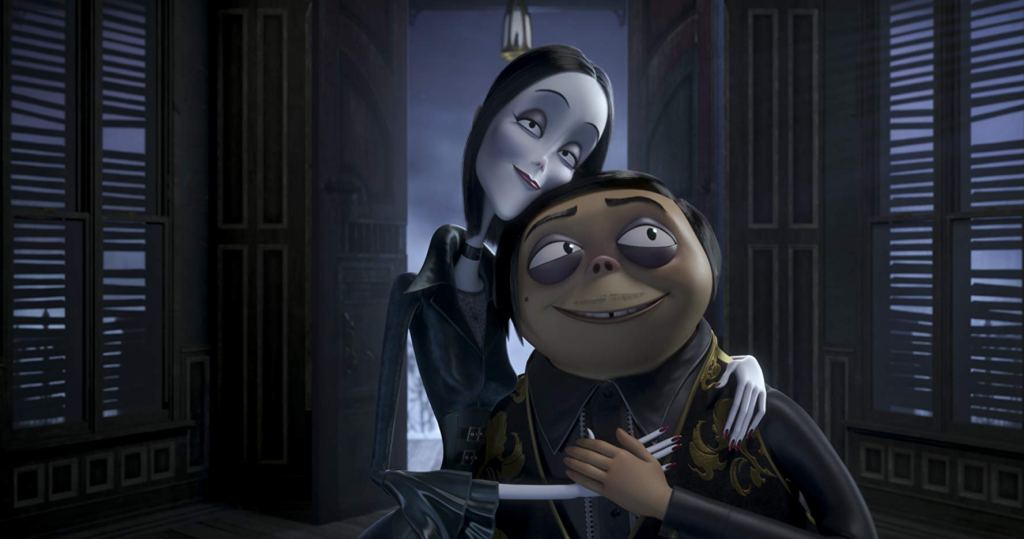
Tired of being chased with pitchforks and fire, Gomez (Oscar Isaac) and Morticia (Charlize Theron) find a perfectly horrible asylum to convert into their matrimonial home shortly after their wedding. Thirteen years later, their family resembles the one we all know and love: creepy daughter Wednesday (Chloe Grace Moretz), bumbling son Pugsley (Finn Wolfhard), faithful servants Lurch and Thing, indefatigable Grandma (Bette Middler), and a pet tiger. Out of fear and caution, Gomez and Morticia have kept the gates to their home closed, so their children have never seen the world outside it – have never breached the gates certainly, but an enveloping fog means they have also literally never seen beyond their own property.
Which means they don’t know that at the base of their hill, a new town is flourishing. A home renovation guru named Margaux (Allison Janney) has been building a town called Assimilation for her TV show, and besides her own daughter Parker (Elsie Fisher), several homogenized families live there as well – the rest of the homes will be auctioned off during her show’s season finale. But when Margaux drains the marsh, the fog lifts, revealing an unsightly castle on the hill filled with undesirables. And it’s not just the immediate Addams family but the whole clan: uncle Fester (Nick Kroll) leads the way, but soon everyone will be assembled for Pugsley’s rite of passage. Margaux protects her investment the only way she knows how: to cultivate fear among the existing residents, and to start sharpening her pitchfork (or catapult, if that’s what you have handy).
The new Addams Family movie combines elements from the original source as well as the beloved 90s films, so lots will be familiar, but there’s still enough new ground to keep you interested. It’s not quite as dark or as morbid as other iterations, which means it’s not quite as spooky as you’d like, but is probably safer for small children. The voice work is excellent; Theron and Isaac are nearly unrecognizable below the creepy accents they’ve refined. Wolfhard is perhaps the only one who doesn’t distinguish himself and sounds a little out of place – he’s just doing his regular little boy voice while Moretz, for example, is doing some very fine work as deadpan little Wednesday.
The movie does offer some fun little twists: the TV host’s daughter Parker makes friends with Wednesday when they unite against the school’s bullies. Parker decides to go goth to her mother’s complete horror, while Wednesday experiments with pink and unicorns and her own mother struggles with acceptance.
The animation is also quite well rendered and I appreciated the little details that make such a movie unique: Wednesday’s braids ending in nooses, Gomez’s tie pin a tiny dagger, the gate to their family home looking vaguely like metal teeth and opening like a set of jaws. The critics seem not to have loved this one but Sean and I found it quite enjoyable, definitely a fun Halloween outing for the whole family.
Marriage Story picks up long after most romances have wrapped up. Charlie (Adam Driver) and Nicole (Scarlett Johansson) were once in love, but as disagreements piled up, they grew apart. Now, as the film begins, they can barely tolerate each other, and they now have to figure out how to uncouple. Of course, since Charlie and Nicole have had trouble agreeing on day-to-day things, agreeing on terms of separation is next-to-impossible.
My synopsis might make the film seem dry, boring, or depressing. Marriage Story is none of those things. Certainly, it is often sad and difficult, but just as often, it is sweet and funny, and all the while, it is insightful and real.
There are many wonderful moments in Marriage Story, and the starting point for all of them is that neither Charlie nor Nicole is a bad person. Director Noah Baumbach never asks the audience to choose sides and never assigns blame for this breakdown. Charlie and Nicole are simply two people who have grown apart and who are being pulled in different directions.
Many films try to gloss over these stresses or claim that love will overcome them. But sometimes love is not enough. Marriage Story tackles that reality in a way that will ring true to anyone who has ever been in a serious relationship.
Marriage Story is one of those rare films that transcends genre. More than that, it is a film that is remarkably relatable and has something to offer for everyone. It is one of the best films of the year, and one you should watch as soon as it becomes available on Netflix on December 6. And if you have the chance to catch Marriage Story sooner (a limited theatrical release is scheduled for November), take it. It’s that good.
Ten years later, the gang’s still together, living in the White House like one big semi-content family, and even more improbably, still alive. Columbus (Jesse Eisenberg), Tallahassee (Woody Harrelson), Wichita (Emma Stone), and Little Rock (Abigail Breslin) have been together long enough that their zombie battles are like a well-choreographed ballet. They know each other intimately. Columbus and Wichita have somehow remained romantically involved, even if it’s stale (the lack of options might be keeping them together), and Tallahassee has appointed himself Little Rock’s substitute father, whether she wants or needs one or not.
You don’t even have to read between the lines to know that one day, the boys will wake up and find the girls gone. Sometimes you’d rather risk your brain being slurped out of your face holes than spend another night watching Netflix with your smarmy, curly-haired, concave-chested boyfriend.
The only hitch is that while these 4 bozos have gone stagnant this past decade, their zombie counterparts have not. The zombies are evolving, becoming harder to kill and better at killing. Which is depressing. Anyway, against their will, circumstances will see them all hitting the road with some new comrades in arms, hitting up Graceland and a hippie commune and literally an ice cream truck in between. Rosario Dawson joins the crew as Nevada, a badass innkeeper, and they pick up Zoey Deutch as Madison, a woman who has thus far managed to survive the zombie apocalypse because she’s absolutely brainless. It’s a role that you will make you hate her AND admire her for performing it just a little too well.
I’m naturally skeptical about sequels and I bet you are too. And yet this one reunites the whole gang and manages to recapture the magic. It leans on some of the things that made the first film unique, but doesn’t shy away from trying new things out. It finds the laugh more often than not.
I was particularly mesmerized by the clever set design; the White House is full of funny sight gags and Easter eggs that the movie doesn’t even pause to appreciate. The commune, while wholly different, is also very generously designed and outfitted. Everything in the movie is amped up – especially the violence. A head caving made even stoic Sean flinch. Or maybe he was suppressing a sneeze. The point is, my head was so firmly turned away from the screen in self-protection that I was watching him rather than the movie. Which only sounds like a complaint. In fact I quite enjoyed myself. There was really no need for a Zombieland sequel and it’s not overly concerned with justifying itself. But director Ruben Fleischer and company manage to make blood and guts endearing – go ahead and get splattered with good times.
Columbus (Jesse Eisenberg) tells us the first rule of surviving in the United States of Zombieland is: cardio. “The first to go are the fatties.” Well, shit. I mean, not that I’ll mind much. I’ve gone on record before – I am not a survivor. I would 130% rather die than live without clean fingernails, hot soup, pillow-top mattresses, a good light to read by, air conditioning, my hot tub…well, the list is nearly endless. I am what they call “high maintenance” and I am not embarrassed. My happiness is not accidental, it is the result of favourable conditions and many comfort items. It’s basic math. More is more. Plus, I think running for your life is undignified. I won’t even walk briskly for a bus.
Columbus, a loner and a weakling, is perhaps himself an unlikely survivor, but his odds increase when he teams up with fellow traveler Tallahassee (Woody Harrelson), who is infinitely cooler and braver and better at this zombie shit. And yet they still fall prey to a couple of young sisters, Wichita (Emma Stone) and Little Rock (Abigail Breslin), who are simply smarter. It’s when all 4 start traveling together that the fun really starts. Sure it contravenes some of Columbus’ dearly held rules, like traveling light and not being a hero, but just because you’re being chased by brain-hungry hoards doesn’t mean you’re not also horny.
It’s sort of incredible that it’s been 10 years since Zombieland came out; it was one of the first movies that Matt, Sean and I would have seen together. I would have met Sean about 2.5 months prior and he was already being the third wheel on Jay & Matt adventures. We saw Zombieland at a downtown Ottawa theatre that no longer exists – The World Exchange. I was about to say that we could walk there from our apartment but in October 2009, it was still technically only Sean’s apartment (and always would be – when I moved in with all my stuff, we moved up 2 floors to a spacious 2 bedroom). Now of course we’ve done the big suburban exodus. In 10 years we’ve bought 1 house, 3 more dogs, 4 cars, 6 weddings (5 of them ours). We’ve added 15 people to our immediate families – 9 by birth and 6 by marriage. If life can change this much in a decade for us and our cushy little existence, imagine how much things have changed for the people living the zombie apocalypse. They have no government, no infrastructure, no twinkies. When we left them at the end of Zombieland, all they had was each other. What have they been up to? How are they possibly surviving? Did they hole up in a farm? Contract the flu? Did Wichita beat Columbus to death with a studded baseball bat? We’ll find out this weekend, when the sequel finally hits theatres.
Is this a prequel or a postquel, I wondered, until the movie threw me into a Breaking Bad recap which I badly needed but basically indicated that the movie would pick up where the show left off – why else refresh events? In fact the movie picks up exactly where the show left off, with Walt dead and Jesse driving off madly, and I do mean madly, in an El Camino (says Sean – I can only identify it as far as subcategory “real ugly car”).
This story is told in two parts: the immediate minutes and days following the show’s big shoot-out finale, during which Jesse Pinkman has been liberated from his cage and is finally free from Walter White’s tyranny and all the fallout, and in flashbacks to the time of his captivity leading up to the show’s finale. I found it really difficult to tell the difference between the two despite Sean constantly reminding me “he has a beard!” (which means it’s a flashback”) or “no beard” when it wasn’t. I really should have been able to pick up on that myself, it’s a pretty handy little metric, but it was embarrassingly challenging for me. I’m much more confident in your own ability to keep things straight.
Now truth be told, I needed more than just a 30 second recap. I either have a “piss poor” memory or a “craptastic” one – I can never remember which – but either way, I meant to look up like a nice, meaty 20 minute supercut on Youtube and I guess I forgot to do that too. I annoyed the heck out of the Sean with two main questions that I ran on a loop: who is that guy, and isn’t he dead?
Anyway, poor Jesse survives Walter White, survives cooking in captivity, survives crooked cops and coked up ghosts only to come up $1800 short for taking the Saul Goodman ultimate escape plan route. That’s a tough break after 5 straight seasons worth of bad luck on AMC. Jesse Pinkman arguably deserves a break, but El Camino: A Breaking Bad Movie isn’t about to give him one.
It’s kind of nice, after 6 years, to get another little taste of the blue stuff. It’s also nice to revisit old friends. Breaking Bad ended on a bloody and dark note, so it’s kind of nice to have this caveat on a story many of us followed obsessively. Aaron Paul is better than ever and writer-director Vince Gilligan insists on giving us an authentic Breaking Bad experience. While not exactly essential, it’s a nice addition to the canon and proves that every once in a while, you can go home again.
I was babysitting my nephews this weekend, and after dinner we got a big bucket of popcorn, drinks in spill-proof containers, and crawled into bed to watch some “scary” Halloween movies together. Brady is newly 8 and Jack is 5 and two thirds so I didn’t want anything that was inappropriately scary, but I wanted to give them a taste of Halloween and who better than Tim Burton to do just that. We watched Frankenweenie, a favourite of mine, and Jack now has some very pervasive ideas about reanimating dead pets with electricity. I suggested to him that this was something that might only work in movies, but no, he assured me, this was not so. Apologies to my sister’s dog, whose corpse may suffer any range of indignities.
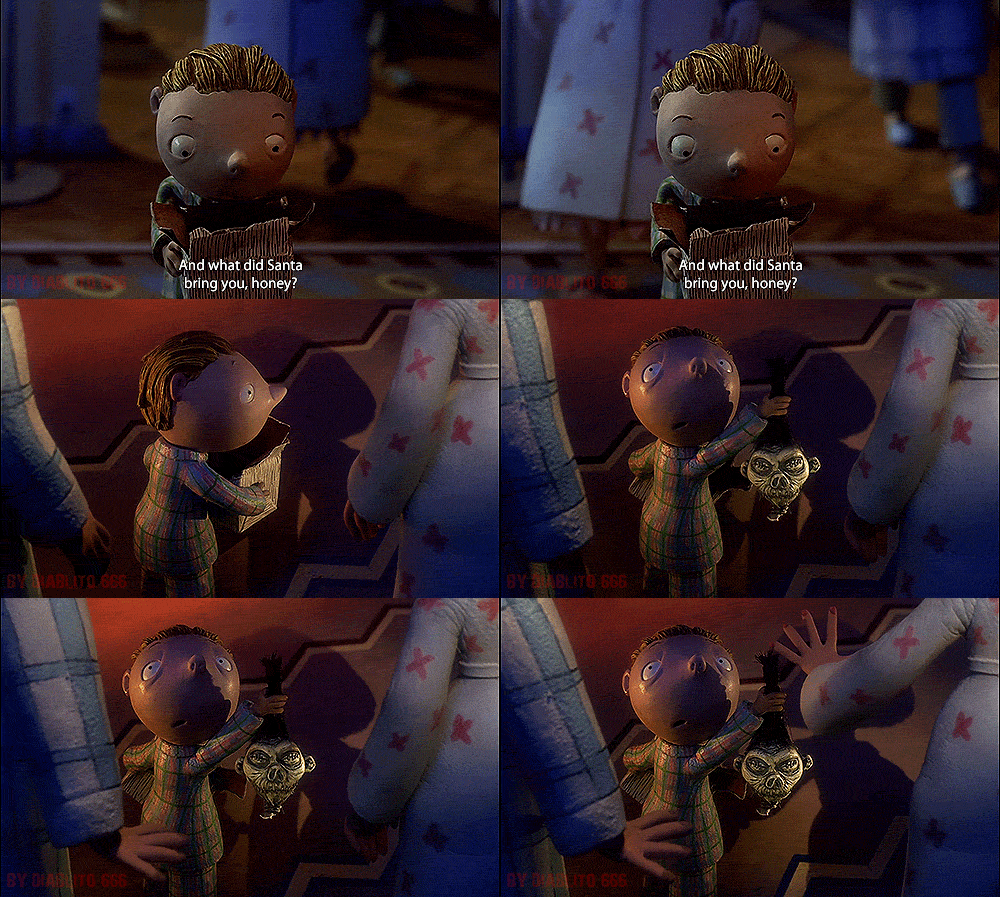
Interestingly, The Nightmare Before Christmas didn’t go over quite as well. It wasn’t too scary for them, but it was perhaps too boring. The fault is perhaps mine: they watched it fairly attentively until Herbie The Wonder Dog came up for a cuddle, and then they discovered some of the tricks he was willing to do in order to earn popcorn treats. So that did pull them away from the movie a bit. They were also taken by surprise by its ending – not the content of it, but the timing. And though I hadn’t remembered it being rather short, it is – only 76 minutes, and that’s counting credits. So we may have to try again next year to really give it a fair shake because this movie is quite beloved and dare I say almost cult-worthy…although, is that just among adults?
Jack Skellington (“Is he made of sticks?” Jack asked, and I didn’t exactly want to say bones, so I called him a skeleton and that seemed to appease him) is the pumpkin king, a resident of Halloween Town, where every year they put on a lavish but repetitive display of ghoulish horror. Jack Skellington is bored. So when he finds a clearing in the forest with portals to other holiday towns (and don’t you wish we’d gotten even a glimpse of some of the others?) you bet he opens up the most alluring and steps into the wonder of Christmas Town.
Now, very likely there are residents of Christmas Town who are every bit as bored of doing the same old thing every year as old Jack Skellington is, but we don’t hear from them. Instead we watch Jack’s eyes go round as he is mesmerized by all the merriment. When he eventually returns home, he conscripts Halloween Town’s citizens to put on their own Christmas…but a bunch of ghosts and monsters don’t quite pull off the winter wonderland of Jack’s vision. And the ways in which they get it wrong are quite endearing. Until they kidnap Santa Claus (Sandy Claws, as they mishear the title) and Jack steps into the role clad in trim red velvet suit. (“I’d punch him right in the nose,” says little Jack, quite perturbed by the Santa imposter).
Tim Burton has said that it was a shopping mall that sparked the idea for the film – watching as the Halloween merch gets taken down the day after the holiday and immediately replaced with Christmas stuff (of course, that was back in the 90s when we still had a modicum of decency…today both holidays exist commercially in tandem, as early as August).
Our kids may not have been big fans of the film, at least not yet, but there’s something about it that appeals to many others. Matt, Sean and I are headed to Disney World in a few weeks and we’ll witness Magic Kingdom go from Mickey’s Not So Spooky Halloween to Mickey’s Very Merry Christmas, literally overnight. And the great thing is: Jack and Sally, rarely seen in the parks otherwise, make special appearances over this holiday time. Disney Land’s Haunted Mansion gets a Nightmare before Christmas makeover, and you can purchase specially themed ears to match, and treats too of course, because Disney is a master at getting you to part with your money.
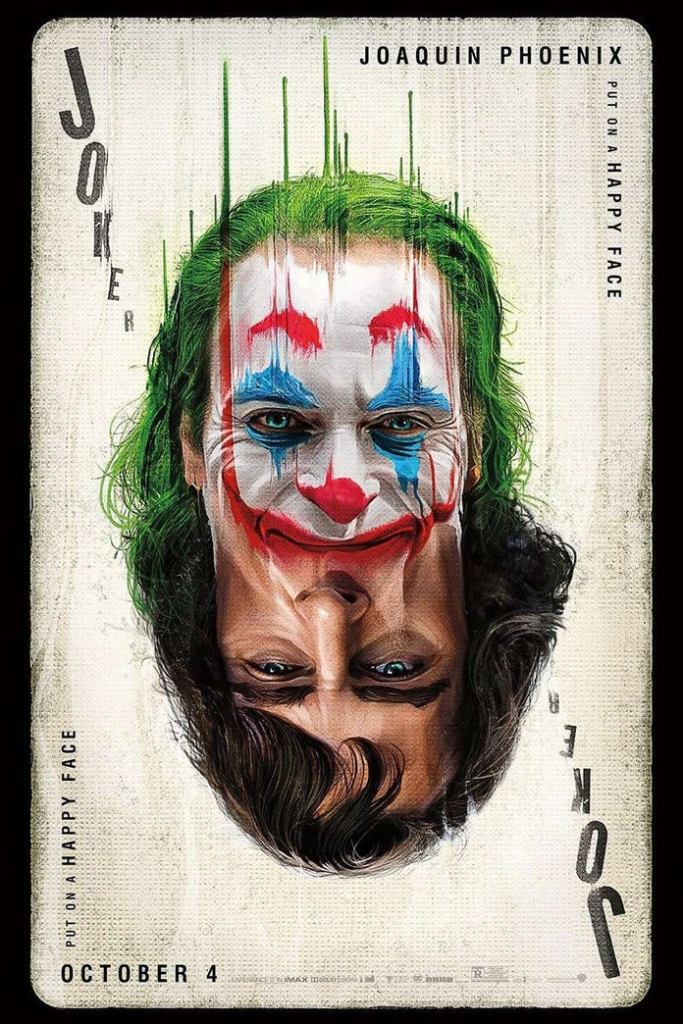
Sean and I both saw Joker at TIFF last month, at back to back screenings. We met up for lunch afterward (I believe we had a slight pause before seeing the Harriet Tubman movie) because boy did I have thoughts, comments, and questions, which I tried not to yell too loudly because: spoilers.
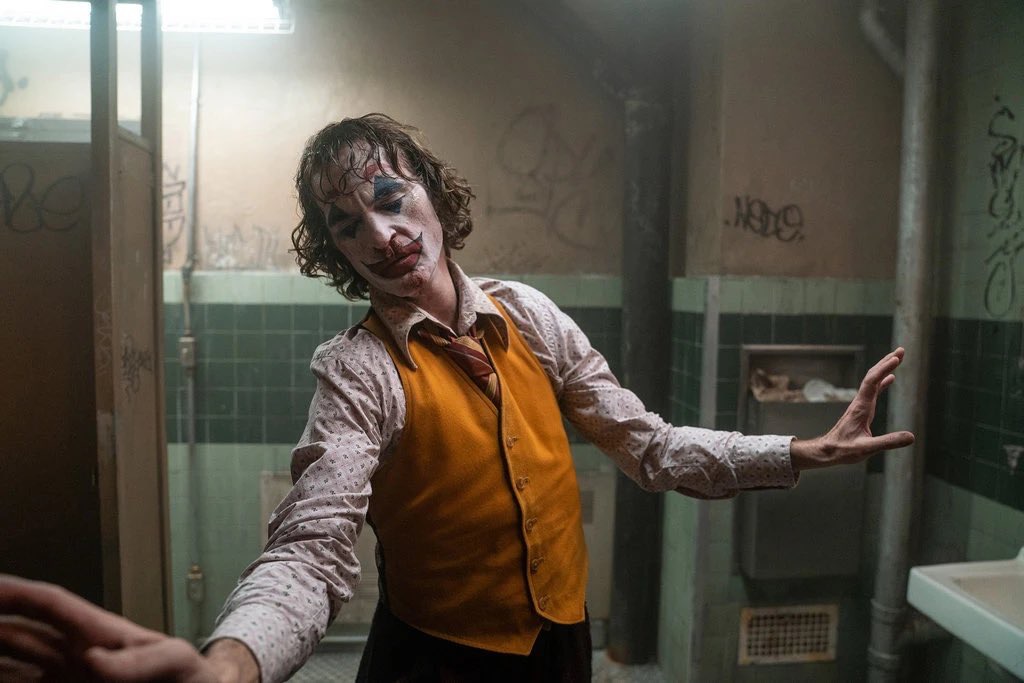
Joaquin Phoenix plays Arthur Fleck in a totally new but not entirely unfamiliar way. He works as a (semi) professional clown but dreams of becoming a stand-up comic. He’s not a great clown; he gets a lot of complaints. Maybe it’s because he breaks clown rules. Real clowns prefer to paint their faces in large circles because pointy-ended makeup gives kids a subliminal fright. As you can see, Arthur paints both eyes and mouth with sharp ends, normally prohibited in the clown community. But there was another rule-breaker, historically. His name was John Wayne Gacy, and Joker’s makeup is likely a subtle nod toward this man, a serial killer who entertained kids on the side as Pogo the clown. He also raped, tortured and murdered at least 33 teenage boys during the 1970s.
Arthur has a complicated relationship with his mother (Frances Conroy), with whom he lives. She’s not well, and depends on his support, meager as it is. She may be somewhat delusional because she writes long-winded letters about her poor living conditions to one-time employer Thomas Wayne, hoping his outrage will be enough to improve their circumstances. Until such a time, mother and son alleviate their suffering by cuddling up every night to watch their favourite late night talk show, Murray Franklin (Robert DeNiro).
Arthur is dangerously thin, but people aren’t just uncomfortable about his physicality. There’s also the laughing. He laughs often, and inappropriately. It’s a neurological condition, and he hands out cards to strangers to ease their discomfort when his laughing goes on just a little too long. Still, it gets him into trouble. Joker’s laugh is iconic, and Phoenix taps into something so deranged, so haunting, it’ll nail your feet to the floor. The laugh alone justifies casting him. It is distinctive, different, perfect. Unforgettable. Scary as hell. It sounds almost painful for Phoenix and it sent shivers down my spine.
Meanwhile, Gotham City is a total shit show. Garbage is piling up everywhere, home to super rats that terrorize the city. It’s never explicitly stated, but I’m guessing it’s 1981. The clothes are very late 70s/early 80s, you can still smoke indoors, and both Blow Out and Zorro The Gay Blade are playing at the movies. People are starting to agitate. The city’s becoming increasingly dangerous. There’s an undercurrent of discontent. It isn’t safe. Arthur gets robbed, jumped, beaten. There’s a certain electricity in the air. We all know Joker to be a villain, but the way things are going, these people may see him as more of a hero. Kill the rich – that’s their slogan. Not a great time to be the Wayne family. But is Joker the symbol this rebellion needs?
Arthur Fleck is nobody’s idea of a hero. He’s a mentally unstable man. He’s been in psych wards. He takes 7 different kinds of meds but still feels bad all the time. He keeps a joke diary filled with suicidal thoughts. “The worst part of having a mental illness,” he writes, “is people expect you to behave as if you don’t.” I’ve lost count of how many Jokers we’ve seen on screen now, but it truly feels like Phoenix doesn’t fuck with any of them. Truly, he and writers Todd Phillips and Scott Silver have created Arthur/Joker from the ground up. He is an amalgam of childhood trauma, torment, debasement. You really get the sense that if anything had gone even just a fraction differently, you’d end up with a different guy. Arthur’s natural reaction to the world isn’t insanity or violence or evil. He genuinely seems to want to bring joy to the world. He wants to make the people laugh. He is searching for a way in. He is searching, I suppose, for identity. For purpose. But for one reason or another, this guy just keeps slipping through the cracks. There’s nobody to help him. If one person had reached out when he needed it, this would be a very different story. And I suppose that’s why this movie is so good. It doesn’t feel like a comic book movie, it feels more like Taxi Driver. It’s a character study. This man feels unpredictable, and yet we know his ending. There is a surprising amount of tension for a movie that can really only end one way. But director Todd Phillips creates this constant sense of swirling stress and anxiety, this emotional tautness by repeatedly having Arthur reach out. He doesn’t want to be a weirdo, or a loner. He wants that same connection that we all do. But society is keeping its distance. He’s isolated. He’s forgotten and ignored. We have countless opportunities to save the world from the Joker but we never do – we fail Arthur Fleck. Does the film show empathy toward him? I suppose it does, in many ways. Or at least to people who fall through the cracks. Personally, I had a hard time feeling empathy toward his first victims. Arthur is a complex man living in some complex times. There is no single reason that tips him over into villainy. There are just an awful lot of cracks in the pavement. A chasm is bound to open up, which is maybe the scariest way to look at it. There is no vat of acid. Joker’s descent into madness, or crime, or evil, or whatever you want to call it – it’s grounded in reality.
Comic books and super hero movies tend to deal in quite general archetypes of good and evil. This makes the characters instantly recognizable as hero or villain, but it also serves to put a distance between audience and character because there is little to relate to. Todd Phillips’ Joker is much more layered, which means at times you’ll root for him, and other times you’ll be disgusted by him. It’s a push-pull that few actors could pull off, and it’s why Joaquin Phoenix, already one of this generation’s biggest and truest talents, deserves an Oscar nomination, and as of right now, I’d say even the win.
Joker, however, is not just a great performance. It’s a wonderful, thoughtful film, a send up to gritty character studies of another era. Todd Phillips has said “The goal was never to introduce Joaquin Phoenix into the comic book movie universe. The goal was to introduce comic book movies into the Joaquin Phoenix universe.” Goddamn I love that quote. I think it shows great appreciation for Phoenix’s body of work. This isn’t just another origin story, this is a deep dive into a man’s psyche. Phoenix tends to gravitate toward the broken and tormented, but they’re not one-dimensional. They are faceted individuals. Different actors have interpreted Joker in many ways: a fiend, a terrorist, a thug, a psychopath. But Joaquin Phoenix goes with something else: human.
Edit:
So I wrote all of that last month, after seeing Joker at TIFF. Since then, certain media outlets have tried to whip up a story about possible violence at Joker screenings and whether this movie sends a terrible message. I have wondered whether I should contribute to that noise at all but find that I do have something to say about it. Feel free to debate.
Does the movie treat the Joker too sympathetically? In a word: no. This is not the Joker from Batman comics. That Joker doesn’t exist yet. Arthur Fleck is a sad man with mental health problems. When he kills, he has a reason. None that justify the violence of course, but it’s not senseless or diabolical or insane.
Is Joker gratuitously violent? Actually, no. There is some violence, of course, but compared to other films, relatively little – in fact, probably relatively little even compared to other Batman movies. This is primarily a character study, so a lot of the interesting stuff is introspective, in his head, as his character transforms.
Is the film inviting violence from incels? Of course not. An incel, if you haven’t heard, is a man who believes himself to be INvoluntarily CELibate – ie, no one will sleep with him, and he blames it on some big female conspiracy. Incels have found each other in chat rooms and encourage each other to be nasty and wrong and gross, and angry toward women generally, and perhaps even violent toward them. They somehow think they are owed sex and even more confusingly, plot revenge for all the sex they aren’t getting. And somehow no one stops to think: this is why. This is why no one wants to date me. I am a creep. Women get a creep vibe from me, and they stay away because they sense I am an angry, dangerous dude. Maybe I should try…being nice? But the situation in the Joker movie doesn’t apply. There’s a woman he fixates on but even a criminally insane Arthur Fleck doesn’t blame her for his failures. He’s not an incel and I don’t think they even tread into that territory, so people trying to associate that with the movie are just being deliberately inflammatory.
Let’s remember that this movie is only the Joker’s birth. He’s a Joker fetus. He isn’t a criminal mastermind. There is no Batman yet; Bruce is still just a boy and Arthur is just a man finding his identity on the dark side. Where society has rejected him, the underbelly accepts him and raises him up. Of course it’s intoxicating. And of course it’s wrong. But if we’re talking body count, he’s responsible for only a fraction compared to Blade, or The Bride, or Rambo, or Walter White. And if we don’t protest every instance of violence, why are we targeting Joker? Especially when we could instead read it as a plea for early intervention, as a workbook for reaching out to the Arthur Flecks instead of merely condemning the Jokers.
Yi, a young woman with serious cankle problems, is grieving her father – not just his loss, but the music they shared and the adventures they’d planned but never went on. She spends less and less time at home, with her mother and grandma Nai Nai. Which is why her absence doesn’t raise any resounding alarm bells when she disappears suddenly.
Where has Yi (Chloe Bennet) gone?
Excellent question! The answer may surprise you! Unless of course you’ve seen the trailers, or the movie, in which case, the answer will be quite obvious.
A Yeti squats on the roof of her apartment building. He’s hiding out from the collector, Burnish (Eddie Izzard) who found him, and the scientist Dr. Zara (Sarah Paulson) who is determined to get him back. But poor Yeti (who Yi names Everest) just wants to go home – to, well, to Everest. So yeah, Yi sucks at naming pets, but the quest is clear: return Everest from whence he came, escaping bad guys in a series of escalating near-misses.
Along for the ride: next door neighbour and perennial cool guy Jin (Tenzing Norgay Trainor) and his rambunctious little cousin Peng (Albert Tsai).
[And just to satisfy your curiosity and save you a google search: yes, he is the grandson of THE Tenzing Norgay, first man to reach the summit of Mount Everest alongside Sir Edmund Hillary. Nice reference, Abominable.]
Anyway: cue some effusively pretty animation of Chinese landscapes and countrysides, beautiful rivers and fluttering flowers. In fact, even the city scenes are pretty astonishing what with the attention to detail regarding lights and architecture and even advertising (I see you, McDonalds). And great use of music. It all works together to create something magical, and this movie wasn’t exactly short on magic, what with a yeti who speaks to nature with specific requests, and nature responds in creative yet helpful ways. But the script doesn’t sit back and let the animation do all the talking. There’s a sweet story in here about valuing what’s most important. “Sweet” is often a synonym for simple and perhaps minor, and that may be a fair assessment here. It’s most a movie for kids, with a King Kong reference or two thrown in for the grown-ups. And while it’s not really showing us or telling us anything we haven’t already seen, it is inherently endearing.
Oh man. It’s already been more than a week and in many ways I’m still digesting this.
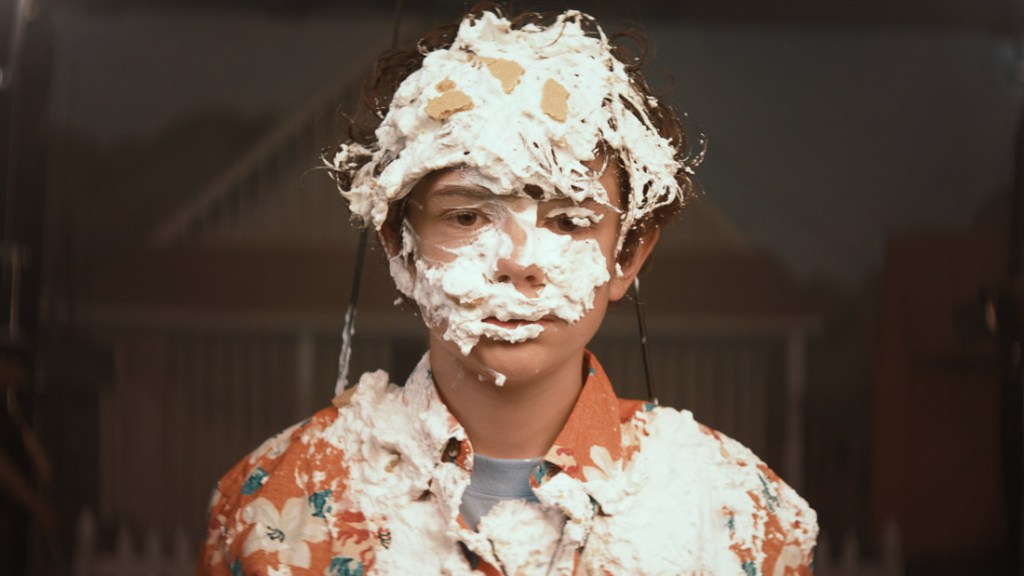
Honey Boy is an autobiographical movie that Shia LaBeouf wrote. Deep breaths.
Now we know a couple of things about Shia LaBeouf: he has suffered a pretty lengthy and public meltdown, and he has continued to put out some pretty worthy performances, albeit in smaller vehicles (American Honey and The Peanut Butter Falcon recently). In a review for Charlie Countryman, I attempted to parse the nature of his problems and his pain, but of course from the outside, you can only guess, and wish him well (or not). But Shia is at that point in his healing where he is letting us in. He is performing an exorcism here. The ghosts in his closet have been let loose – but will they haunt him less?
“Selfishly,” he told us, “I made this movie for 2 people: me, and my dad.” Let’s unpack that a bit.
First, you need to know that in this movie he wrote, Shia plays his father. His own father. Noah Jupe and Lucas Hedges play young Shia and older Shia, though the character goes by Otis in the film. What does it mean that he’s written this painfully intimate autobiographical film, but called his character by another name?
Shia’s father James was (is) an addict, an ex-con, abusive to both Shia and his mother. And yet when we meet young Otis, who is hard at work on the set of a show not unlike Even Stevens, he is living in a dingy motel with his dad. His dad is not just acting as a parental guardian, but as a paid one. James doesn’t work. He takes money from his kid. Which doesn’t stop him from neglecting the son he’s being paid handsomely to watch, or from hitting the child who is technically his boss.
This makes for a complicated relationship and a complicated childhood. And though Otis’s mother is seldom heard from , you do have to wonder – if it’s dad who has custody, just how bad is mom?
So you start to realize that this little kid has no parents. Or, actually, that he’d be better off without the ones he does have. But what he does have is a full-time job and more money than most adults. But he’s also got family obligations and staff who are also relatives but virtually no one telling him how to navigate these complex situations. So by the time Noah Jupe magically transforms into Lucas Hedges, Otis has PTSD and his own struggles with addiction and no idea how to take time out from his busy career and the pressures of Hollywood to deal with them. Until a court gives him very explicit directions to do so (and thank goodness).
But maybe his best therapy has been writing this screenplay. Clearly troubled after the TIFF premiere of Honey Boy, Shia is quick to reassure us that he’s happy to be here with us, but he’s quiet, introspective, quick to deflect to his costars and the director he so admires, Alma Har’el. As his struggles have become increasingly public and undeniable, he is coping with the tools he has available: creatively. But will his creation be his catharsis? And is any of this interesting or entertaining to those of us who have to personal stake in his recovery?
Resoundingly: yes. The absolute best bits are between young Otis (Jupe) and his father (LaBeouf). Mostly stuck in a crappy motel room, the anger between them is never at less than an aggressive simmer, and it’s ALWAYS on the verge of boiling over. Even the quiet is not to be trusted. The tension is awful and soon we too are responding like an abused kid, ready to flinch at the least provocation. If you come from a conflict-filled background yourself, you won’t fail to identify the triggers. Be gentle with yourself.
Honey Boy is a moving, emotional movie-going experience. I also hope it brought a certain amount of closure to a young man still wrestling with his demons.
James Glaisher (Eddie Redmayne) was a scientist and an aspiring meteorologist in a time when that field did not yet exist (1862, to be precise). So, he decided to invent it. To do that, he tapped balloon pilot Amelia Wren (Felicity Jones) (actually a balloon widow with a tragic backstory) to ascend toward the heavens, or at least beyond the clouds, in a historic balloon flight higher than any other.
Up they go, to dangerous heights. In the pursuit of science, Glaisher urges them higher still. With her husband’s death still fresh in her mind (and his blood perhaps still on her hands), Amelia prefers caution. Still, when they inevitably meet up with trouble, it is she who will save them both while he is basically just cargo, a useless man looking at his instruments.
It’s a dizzying and inspiring story, full of rah-rah, girls can do anything chutzpah that is of course completely fabricated. James Glaisher is in fact a real-life scientist, but the man who took him up in his balloon and ultimately saved his life was pioneer Henry Coxwell, who got written out of the story in order for these two The Theory of Everything costars to reunite. In truth, it is Amelia and not James who is the colour in the story. She is the one we naturally gravitate to. Would the story be as compelling without her?
Confusingly, IMDB lists the character as a Ms. Wren while the film itself seems to prefer Rennes. I suppose it doesn’t matter since she’s fictional, and perhaps it’s nearly fitting since Amelia is not just a fearless balloon pilot but a bit of a showgirl as well. Crowds have paid for the privilege of watching their launch, which funds their research, and she understands the value of putting on a bit of a show – which of course her stodgy scientist partner doesn’t get. He’s more into his pigeons, which he plans to throw from the balloon at different heights. The pigeons have no idea what’s in store for them.
The balloon ultimately reaches about 37 000 feet, which is roughly the cruising height of a jumbo jet. Up there, the air is cold, and there is less and less oxygen. Glaisher is the immediate victim, having brought along many thermometers but no warm clothes. For “authenticity,” director Tom Harper had Jones and Redmayne actually filming about 2000 feet in the air, which he captured via helicopter. In the olden days, an air balloon worked by 2 mechanisms. The basket was weighted with sandbags; to go higher, you let out some sand. To go lower, you let out some air. Today we have hot air balloons, which use fire to heat the air, and of course hot air rises. Allowing the air to cool means you drift down. I got to go up in a hot air balloon once. I am not overly fond of heights, or more specifically, of falling to my death from one, so I worried a lot about what the ascent would be like, and if I’d feel sick, or scared, and if the basket would bounce around, or if I’d have to hold on for dear life. In fact, the ascent was smooth, so utterly without event that I forgot to be scared at all and just completely enjoyed the ride. But then you have to get back down. That’s the part I’d failed to worry about, or even picture. And of course, that’s the bumpy part because the basket doesn’t just touch down gracefully, kissing the earth. It smacks it, hard, then jumps back up, then smacks down again, the basket getting drawn along jaggedly, thumping away while you assume the ‘crash’ position, huddled on its bottom, trying not to fall out.
There was something very satisfying about the movie, which is told within the framework of their historic 90 minute flight, with flashbacks telling the story of how they came to dance among the clouds together. Even from the sky, the film has a very strong sense of time and place. I was struck by the injustice of James presenting his findings to the Royal Society alone, because Amelia’s being female disqualified her from even being on the property. Of course since she never actually existed, the point is kind of moot, but their pairing does make for a very compelling story, and The Aeronauts are not exactly the first to embellish history in the service of better storytelling.

 My synopsis might make the film seem dry, boring, or depressing. Marriage Story is none of those things. Certainly, it is often sad and difficult, but just as often, it is sweet and funny, and all the while, it is insightful and real.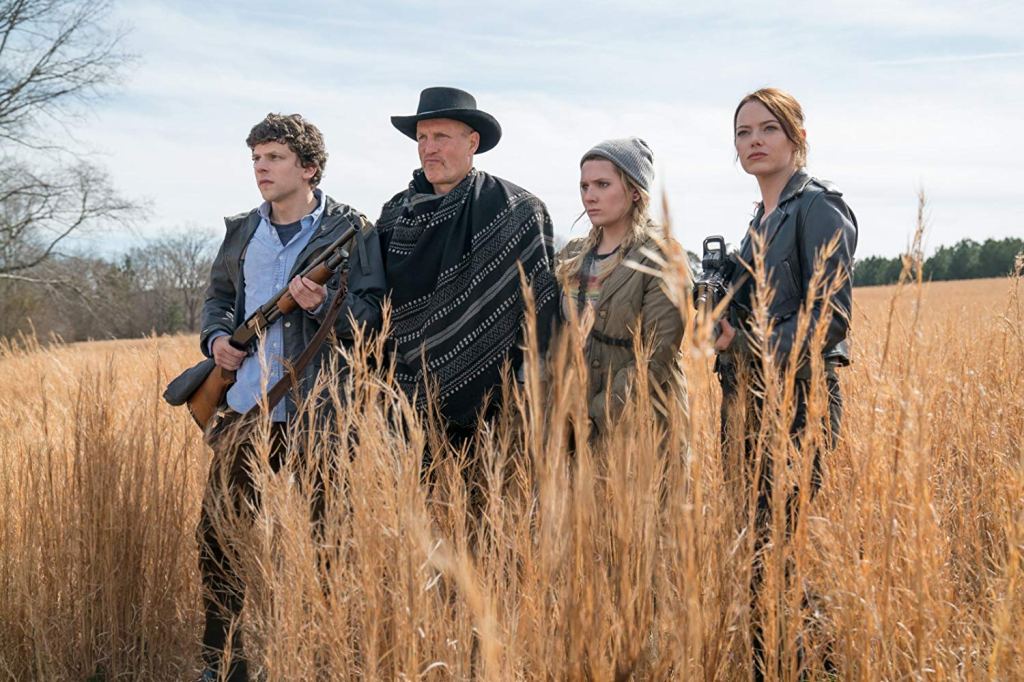










 ASSHOLES WATCHING MOVIES