Category Archives: Kick-ass!

The highest honour we can bestow on a film. Anyrhing in this category is a must-see.

Kingsman: The Golden Circle

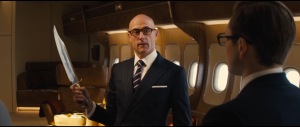
kingsman2You know when a movie has a really cool part that blows your mind and then you know the sequel will try to recreate that part a hundred times over? Then, when you see the sequel do exactly that, it’s still pretty good even if it’s not quite as good as the first time? Remember when I said almost exactly the same thing about the latest addition to the Fast and the Furious franchise, earlier this year? Well, call this the sequel to that review. For a moment I thought about reusing that same review but I didn’t, because clearly I have more respect for my audience than do those Hollywood big shots who keep green-lighting all these sequels.

Getting back to the subject that I’m supposed to be writing something original about, it is somewhat alarming that the level of ridiculousness that took the Furious series eight movies to reach only took the Kingsman franchise two films to equal.  Kingsman gained so much ground so quickly because it is over the top every chance it gets, right from the start, with one slow motion action sequence after another, all set to some purposely eclectic song choice.

But in all its efforts the Kingsman sequel never comes close to the fever dream that was the church sequence in Kingsman the first, which was the part that totally blew my mind. I realize it would have been cleverer if I had found a way to tie the head explosions at the end to the mind blowing language, but honestly nothing beats the church scene for me.

Even though it doesn’t achieve the same peak level as the first film, Kingsman: The Golden Circle is an enjoyable movie that comes out a little ahead of Furious 8 in the stupid yet enjoyable unnecessary sequel category (which I am quite sure will be an Oscar category starting this February).  Kingsman gains the edge over Furious in this important head-to-head showdown by being consistently funny between action scenes, a result of both its gleeful over-the-topness and the wacky tone it carries over from its predecessor.

Be warned that the film occasionally veers into sheer creepiness (um, a mucus membrane tracking device???). Also, be warned that you will be creeped out much more often than once if you are in any way adverse to people being ground into hamburger (literally) or chopped in half by electric lassos (which is also a thing that actually happens in this film for what I am guessing is the first time ever).

The occasional incident(s) of creepiness are easily forgiven, by me at least, because Kingsman: The Golden Circle is frenetic, confident, and surprisingly touching at times.  The highlights for me were Mark Strong covering John Denver and Elton John finally letting loose on stage after years of self-inflicted repression. Those scenes were more than well worth the price of admission by themselves.

I give Kingsman: The Golden Circle seven country roads (taking you home) out of ten.
 

Lu Over the Wall

Greetings from the Ottawa International Animation Festival, which we’re always proud to cover because not only is it our hometown festival, it’s also a really great one – terrific movies, great venues, well-organized by staff and volunteers. It makes an Asshole proud!

Our first stop at the festival was to the good old Bytowne, where all the best indie films get shown year-round. Lu Over the Wall is a Japanese film by director Masaaki Yuasa, and I have to say, I was pleasantly surprised by it.

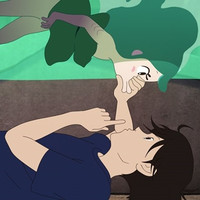
The film is about Kai, a surly middle schooler who seems isolated from his peers until it 48a6ae418cf7ea14caa9daee89cfc4381491527985_largeis discovered that he makes really interesting beats with his computer, and he gets recruited into a band by Yuuho and Kuniko. The band practices on a deserted island away from the mainland so that Kuniko’s family won’t discover his dirty little secret (he’s destined to be a temple keeper, not a rock star). But out there they stir up the myth that has shrouded their town for decades: that of merpeople.
Turns out, merpeople are attracted to music, and that’s exactly what prompts Lu, a very cute little mermaid, to leave the water to sing and dance with them. Everyone else is terrified of merpeople, who, legend has it, eat people, among other atrocities, but Kai can relate to Lu and so they become friends. It’s a tricky relationship to navigate when half the townspeople want the merfolk dead and gone, and the other half hope to exploit them for money.

No, this isn’t an animated take on The Shape of Water, though it’s beginning to sound like it. But it is a story about looking beyond our preconceptions, a story made all the more palatable by its incredibly sweet animation. When it’s meant to, the joy practically leaps right off the screen. You’ll feel your heart tug upward. Lu’s happiness is infectious. I mean, what kind of a person isn’t completely bowled over by mermaids? Like, how black is your soul? And Lu is so bright and bubbly she makes Ariel seem like a puddle of puke. Lu Over the Wall is giddy, upbeat, and as you might have guessed, has a soundtrack bursting with J-pop. I love how the movie evokes emotion by changing up its animation style and if for some reason your inner darkness has been able to resist up until now, I’ll leave you with just one word, the only word this review really needs: mer-doggies.

TIFF: Lady Bird

ladybird_01In making a coming of age film about a high school student, Greta Gerwig has come into her own – as a writer, as a director, as a woman with a voice.
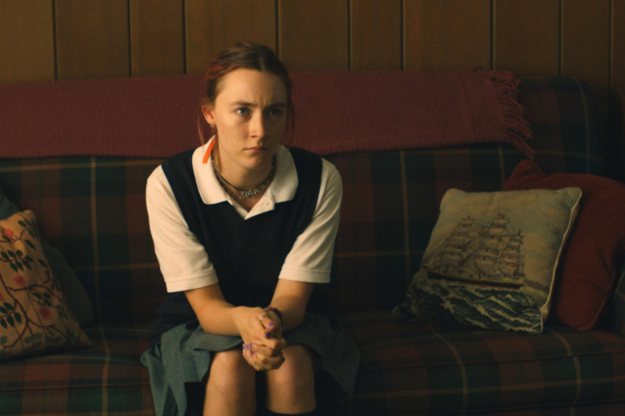
Lady Bird is the name that Christine (Saoirse Ronan) has given herself. It’s her senior year of high school and all she wants is out. Out of Sacramento, out of her parents’ house, out of her own skin which doesn’t quite seem to fit anymore. Like most teenagers, Lady Bird is kind of a d-bag. She thinks she knows more than any adult she’s ever met. She’s self-centered and blind to the needs of others, but in the sympathetic hands of Ronan, we don’t hate her and we certainly never tire of her. Her flaws should push us away but instead they endear us – maybe even remind us of ourselves at that age.

Her relationship with her mother (Laurie Metcalf) is relatable as heck and among the best I’ve ever seen written or performed on the big screen. Their relationship is a series of clashes between pragmatism and whimsy. Lady Bird doggedly indulges one artistic pursuit after another while her mother does the precarious high-wire act of balancing the needs of an entire family. Ronan and Metcalf are incredible together, the chemistry is electric and complicated and feels so real you’ll intermittently want to send your mother a fruit bouquet of thanks, and a nasty hate letter condemning her every decision. Or was that just me?

But the real kicker is that Lady Bird is not just a mother-daughter movie. Lady Bird’s life is full of characters and it’s amazing how fully realized they all are. We spend time with her father, her brother, her best friend, and several love interests, and Gerwig’s fabulous writing doesn’t lose sight of a single one of them. And her cast – her cast! Have I said yet that Saoirse Ronan is a vision and she brings so much to the role and this is truly the best I’ve ever seen her? Fun fact: she and Greta first met at TIFF two years ago, and Gerwig couldn’t imagine the role going to anyone else. And even though the writing is so, so good, and the character is absolute perfection on the page, Ronan just makes it even better. Even wonderfuller.

And Metcalf. This is such a great role and she really makes it her own: loving, frustrated, conflicted, supportive, scathing. Goddamn. She plays opposite Tracy Letts, who plays her husband and Lady Bird’s dad. He’s the good cop parent but not without his own challenges – believe me, the script does not neglect him. Lois Smith, Timothee Chalamet, and Lucas Hedges all help bring Lady Bird’s world into bold, bright, living colour while also contributing a little of their own. I’m telling you, this has got to be a contender for best script. The layers are many and I have never wanted to peel anything faster in my life! For my money, though, the lovely, luminous Beanie Feldstein has got to be the breakout star here. She plays Lady Bird’s BFF Julie. Don’t mistake her for a second banana. She may have shades of wallflower but she never gives you a second to discount her.

Lady Bird is absolutely one to watch, so do.

TIFF: Unicorn Store

Full disclosure: I own a unicorn named Mindy. She’s magical. She’s a goddamned magical creature. She’s also inflatable but don’t you DARE call her a pool toy. You can, however, call her the centre of attention, which is exactly what she was when I threw a goddamned magical unicorn party earlier this summer. I sent unicorn invitations. I had unicorn party hats, a unicorn pinata, and unicorn names for all the guests. I even made a unicorn cake. No, that’s not true. I actually made TWO unicorn cakes because Sean smashed the first one about 30 seconds after I finished it. And when you throw a unicorn party, people bring you unicorn presents, which is why I own unicorn slippers and a unicorn tape dispenser named Stuart and briefly had unicorn-coloured hair. This either makes me uniquely qualified to review this film, or I should recuse myself for the glaring conflict of interest.

I’m not actually obsessed with unicorns, but you know who is? Kit. Kit (Brie Larson) has literally been obsessed with unicorns her whole entire life. And after painting yet another unicorn-as-self-portrait, she’s unceremoniously flunked out of art school and returns home to mope in her parents’ basement (Joan Cusack, Bradley Whitford). In an effort to Not Be A Disappointment to them, she takes an uninspired job with a temp agency and just when it seems the world might be ready to beat the whimsy right out of her, the universe sends her a pop-up store that only sells unicorns, and only to her, run by a tinsel-afroed Samuel L. Jackson, of naturally. Turns out that owning a unicorn is something you have to earn, so Kit sets about getting her life unicorn-ready, and that’s going to take some major changes. But is unicorn ownership really the cure to what ails a directionless, fully grown woman who seems stuck in a perpetual unicorn phase? Isn’t there more to life than glitter and rainbows?

Samantha McIntyre’s script is winkingly funny. For some odd reason neither Sean nor I had gone into this expecting it to be funny, and yet the audience was in stitches. McIntyre has a very quirky style that endeared itself to me immediately. She creates sparks in the smallest little details. I also have to send a shout-out to costumer Mirren Gordon-Crozier who must have combed the known universe to find THE most fanciful pieces of clothing ever produced. Kit wears her personality on her body. Her shirt collection is all blue skies and rainbows. It reminded me of Kimmy Schmidt in that way, who is always seen in sunshine yellows and bright fuchsias. Their clothing is a reflection of who they are. That said, it might be Samuel L. Jackson’s suits that make the biggest and brightest wardrobe impression in this movie.

But the real rock star here is Brie Larson, who makes her directorial debut. She’s just finding her voice as a director so her style isn’t quite as quirky as the tone of the movie, but considering how much it shifts around, I think she handles it well, and I already can’t wait to see what other stories she’ll tell. She assembles a really great cast who are a lot of fun to watch. Cusack and Whitford are everyone’s embarrassing parents, and Mamoudou Athie as The Guy Who Will Build a Unicorn Stable Even Though He’s Not A Carpenter is a particular stand-out.

I really enjoyed Unicorn Store; it’s a sweet reminder that growing up doesn’t necessarily mean giving up on childhood dreams. Underneath the glitter there’s a message about conformity and how women are told to pull away from “girlish” things in order to fall into one of two male-approved categories: the drab, grim businesswoman, or the oversexualized dreamgirl. Anything seen as overtly feminine is assumed to be less serious, and even women themselves can internalize this notion. Not Kit. Brie Larson flexes her comedic chops by playing her as earnest but not naive. In a world where every man’s inner child is constantly catered to with movies about super heroes, robots, pirates, and zombies, this one, finally, is just for us.

TIFF 2017: Bingo! I Got Bingo!, Part 2

Catching 3 films by female directors is easy. The TIFF lineup this and every year has lots of interesting films to choose from, many of them directed by women. Getting full TIFF Bingo isn’t so easy.

I have stress dreams about the Midnight Madness ball and avoid it like it’s a not deep-fried vegetable so that’s out. And, while Battle of the Sexes had its moments, I can’t honestly say that I thought “Now this I’ve got to try”.

But I did…

Thank a Volunteer

Mom and Dad– The festival and the city that hosts it can be a little overwhelming at first. Even though I feel like an expert by the end of my stay, every year I’m feeling a little disoriented when I first get into town. So I’ve just checked into my hotel, it’s 11:40 at night, and I’ve got a Midnight Madness screening of Brian Taylor’s Mom and Dad in 20 minutes. I’m running around trying to find Ryerson theater and I’m getting stressed out imagining all the ways that I could humiliate myself trying to volley a beach ball in a crowded theater. Luckily, a friendly orange shirt is never far away and I was very thankful to the volunteers who helped me find where to line up. I never miss a chance to thank a volunteer and I applaud for them every time the TIFF commercial prompts us to.

So, anyway, Mom and Dad. Taylor (Crank, Ghost Rider: Spirit of Vengence) seems to be just begging us to make this a cult classic. An unexplained virus suddenly hits suburbia in the middle of the school day that infects parents with an uncontrollable urge to violently murder their offspring. Poor Carly (13 Reasons Why’s Anne Winters) and Josh Ryan (Transparent’s Zackary Arthur) are forced to fend for themselves against their now-deranged parents played by Nicolas Cage and Selma Blair.

Mom and Dad is bananas. Almost every aspect of the film- from the basic concept down to the music and over-caffeinated editing- seems driven by the same manic energy that fuels Cage’s typically unhinged performance. The actor, who in the eyes of the enthusiastic Midnight Madness crowd may as well have been John Lennon, already starts overacting long before the virus starts making everyone crazy. He outCages himself in this movie and- while it would be a stretch to call it a good performance- it feels like the right performance for this movie. But it’s Blair, surprisingly, who somehow finds a way to keep this runaway train from going off the rails. From the start, we can tell that her character is a good mom. She loves her kids but she’s exhausted and taken for granted. She’s the only believable character in the whole thing and her presence brings Mom and Dad back to earth. It’s through her that we start to sense that the virus is tapping into an existential crisis that was already in place before the infection.

To call Mom and Dad good would be ridiculous but it’s not really trying to be. It just wants to be fun and, for the most part, it is. It’s often funny, even coming dangerously close to smart, especially when it’s in terrible taste.

Phone Dies

I got some great photos this year, many of which you can see if you follow us on Twitter. I like sitting in the front row so I was able to get some shots of Nicolas Cage, Alicia Vikander, Alexander Payne, and Darren Aronofsky that I’m really happy with. But you won’t see a photo of Ellen Page (who, if I’m not mistaken, counts as a superhero out of spandex) because my phone died.

The Cured– So I did manage to get a couple of pictures of Ellen Page during the Q&A for The Cured. They’re just not tweetable because my phone didn’t have enough juice left for the flash to work. So it’s not a great picture. It’s a shame because I love her.

And, yes, fortunately for my TIFF Bingo card, my phone officially died on my way back to my hotel.

On to The Cured. This debut feature from Irish director David Freyne finds yet another way to breathe new life into a genre that seems to never run out of ways to reinvent itself: the zombie movie. Once this version of the zombie apocalypse has died down, two thirds of the “infected’ have been successfully cured and are slowly being reintegrated into society. Ex-zombies don’t have it easy though. They still have painful memories of the suffering that they inflicted and most people still don’t trust them.

Senan (Sam Keeley) has just been released from a treatment facility and is taken in by his brother’s wife Abbie (Page) who has been widowed by the outbreak. When he falls in with a militant group of zombie rights activists, Senan struggles to find a balance between his desire to fit in and atone for his crimes and his instinct to stand up for his fellow cured.

To Freyne, his film is really about how we treat each other in today’s mixed up world. It’s a serious movie with serious themes that somehow finds time to deliver the goods when it comes to zombie scares. Freyne’s direction is confident and precise, more so than almost any other movie I saw at the festival this year.

So there you have it. I wore out my phone battery, saw 3 films by female directors, thanked every volunteer that I spoke to, and even managed to see some good movies while I was at it. By now, experienced Bingo players have probably already spotted my path to victory but please feel free to stay tuned for more details.


TIFF: Black Kite

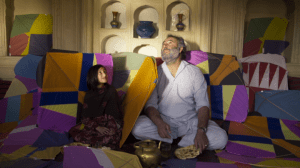
blackkite_tiff2017Afghanistan is the last place I’d expect to find a kid flying a kite. After watching Black Kite and seeing kites be such a prominent part of life, bringing a tiny bit of joy to those who are trapped in this war-torn land, it seems strange that I ever had a presumption on kites one way or the other.  The smallest of assumptions, something taken for granted without basis, led me to think I knew more about another’s circumstances than I do.  Being wrong about kites reminded me that actually, I know absolutely nothing about what it’s like to live in Afghanistan!  I have Black Kite’s writer/director Tarique Qayumi, a Canadian who came from Afghanistan as an eight-year old refugee, for brilliantly and effortlessly challenging my preconceptions.

Black Kite follows Arian, an Afghan man who has been captured by the Taliban and convicted of the highest crime.  Through a series of flashbacks, we learn how Arian came to be imprisoned and sentenced to death.  Kites feature prominently in his story, from childhood, through adolescence, to adulthood.  There’s a remarkable contrast between the bright coloured kites and Arian’s drab, washed out existence, not only in the prison but throughout most of his life as Afghanistan is oppressed by one ruling body after another.

There are some absolutely beautiful shots of the desert and sky, and some very poignant animation that conveys a lot about what these kites represent: freedom, a means of expression and communication, and a marker of milestones in a man’s life, both good and bad.

Another assumption that Black Kite dispels is that freedom is free.  Freedom is a foreign concept for Arian, not the inherent right that I treat it as.  Arian and his family constantly live in fear, under the boot of one regime or another, with seemingly arbitrary rules that have the sole purpose of keeping them down. The rulers may change but the rules remain more or less the same, so Arian and his compatriots are denied even the simplest pleasures.  It hurts to experience these denials second hand, making the first hand experience all the more difficult for my privileged mind to imagine.

Black Kite is a wonderful film and a timely one.  It showed me how much can be stripped away from individuals, and reminded me that the little freedoms are as important as the big ones.  If those little freedoms were preserved for all, this small world would be a much better place.  There is no easy solution but we should spend our energy searching for ways to help people less fortunate than us.  Instead, we spend our time arguing over how many refugees we should accept from war-torn countries like Afghanistan, places where every day could be your last and little freedoms, like flying a kite, cannot ever be taken for granted.

By the way, the answer to how many refugees we should accept is: as many as we can fit.  And we’ve got plenty of room.

The Leisure Seeker

This movie is about a couple of charming runaways on the lam. They haven’t committed any crimes but they’re keen to evade the responsibilities that weigh on them at home. We’ve seen lots of movies about people on the open road, but we’ve rarely seen a man beleaguered by Alzheimer’s helming a large winnebago while his cancer-stricken wife navigates and their adult children are panicking at home.

Ella (Helen Mirren) should be in the hospital receiving treatment, but instead she’s choosing this one last hurrah before Alzheimer’s has her husband John (Donald Sutherland) completely within its clutches. The Leisure Seeker is the name of their the-leisure-seekerbeloved RV, and this road trip is designed to trigger memories of happier times – their young family at play, their former selves in love. It’s obvious that the ‘in love’ part has never really faded for Ella and John, and maybe this is why it’s so hard for her to cope when he can’t remember who she is.

The pair hit the interstate armed with pecan logs, slides of old photos, and yes, a gun. This film is a moving eulogy to all the things that are slipping away – not just for John and Ella personally, but also perhaps on a more national scale (like a sense of community for one – though attempts to be any more political feel out of place). But as John’s moments of lucidity grow shorter and Ella’s anguish grows deeper. The Leisure Seeker is pointed toward Florida but we can’t deny what they’re truly headed for.

Mirren and Sutherland make the movie of course – the camera rarely strays from this couple so strongly bonded they can’t even bear to sleep in separate beds. Sutherland spins the dial on the many shades of dementia, his face quietly registering all of them. Mirren wears a cheerful mask but Ella’s pain and smouldering anger never disappear completely. This Brit and her Canadian costar make watching this American road trip movie worth while – even if their Italian director doesn’t quite get it right. The acting, however, is everything, and the casting is spot-on even if Mirren is inconsistent with her southern accent. Just as we’re meeting them, they’re getting ready to say their goodbyes. This is a bittersweet journey, and you’re welcome to tag along. You can leave your gun at home, but do pack some tissues.

Lean On Pete

1477639665404_0570x0400_1477639692033

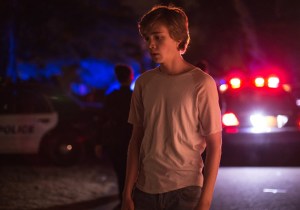
“It was just so unrelentingly bleak,” Jay sighed as we divvied up our review assignments after a busy day of films in Venice. That’s exactly right. Lean On Pete is misery from start to finish. Parents are thrown through glass doors and wind up in hospital. Teenagers have to take shitty jobs instead of fuflilling their athletic potential. As part of those jobs, teens see slow horses being sent to Mexico for slaughter. Nice aunts who may be able to help those teens have disappeared from phone books after fighting with teens’ parents. Will teens have to live on the street while they search for those nice aunts?

Having just mentioned horses being slaughtered in Mexico, is it in bad taste to say that Charlie Plummer is the glue that holds this film together? Well, either way, that’s the word I’m going to use, because Plummer is amazing as the teenager, Charley, who would have no luck if not for bad luck. Plummer more than holds his own against screen veterans like Steve Buscemi, Chloe Sevigny and Steve Zahn (none of whom stick around for too long). His strong performance and natural charisma will make you root for him.

I am not exaggerating when I say that every conceivable thing goes wrong for Charley in this movie. It’s horrible. Even as I warn you, I know you cannot be prepared for what is about to happen. Charley seems smart, and he’s clearly a hard worker, but he keeps getting dealt the worst possible hands, against all conceivable odds.

Plummer’s strong performance makes it so devastating to see what happens to this poor kid, especially because you know there are real kids out there with similar luck to Charley’s, stuck in a bad situation without any path out. Life isn’t fair, and Charley’s journey is evidence of that, because Charley doesn’t do anything to deserve the lifetime’s worth of misery he experiences during Lean On Pete’s two hour runtime.

There is something uplifting to be found in Charley’s resilience. In the face of all the misery he’s subjected to, he does not stop. He gets to where he wants to go, and maybe even gets a happy ending. Hopefully. After suffering with Charley, I need to tell myself he did, and the film is kind enough to let me believe it happened. I’m not sure the lift at the end was enough of a boost to put me back to level, but a cinematic reminder of how charmed a life I lead is never a bad thing when it’s this well put together, even if it’s this unrelentingly bleak.

Three Billboards Outside Ebbing, Missouri

Holy hell.

Writer-director Martin McDonagh has almost certainly reached the peak of his film making career with this film. It doesn’t get much better than this.

The three billboards in question have been rented by grieving mother Mildred Hayes (Frances McDormand) to accuse the town sheriff, Chief Willoughby (Woody Harrelson) of not having made any progress on the case since her daughter was brutally raped and murdered. Willoughby isn’t terribly pleased, but he’s got more important things to worry about – namely, terminal cancer. So it’s his racist, hotheaded, cruel officer Dixon (Sam Rockwell) who takes up his cause, torturing anyone he suspects of having helped.

MV5BZmMyMTg1NzEtNWZiZi00OTczLTg0NzUtNzFlNjI5YjJkMzkxXkEyXkFqcGdeQXVyNDg2MjUxNjM@._V1_SY1000_SX1500_AL_McDonagh uses lyrical language peppered with inspired cursewords; his heavy-weight cast punches it up with a surprising mixture of gravitas and black comedy.

Frances McDormand, national treasure, is of course fantastico. Wearing her ubiquitous coverall, she’s a no-nonsense woman who’s been through hell even before her daughter’s gruesome death. She is not without a softer side, though rarely seen. McDonagh gave her a couple of speeches that practically earned standing ovations at our screening. She walks a thin line between vengeance and justice but discovers she is not exempt herself. She’s got a terrific scene pitted against Willoughby that suggests these two have more history than we’re privy to. It’s a small town; there’s almost no vitriol without at least a measure of respect. As Willoughby, Harrelson once again reminds us he’s capable of almost anything. But, arguably, the man to watch is Sam Rockwell. He’s hateful, detestable, and yet we don’t quite hate him or detest him as we should. That’s sort of the miracle of McDonagh’s script – all of his characters are deeply flawed. Mildred is our protagonist but she’s no one’s hero. She makes too many mistakes. Dixon is all mistakes but for a small sliver of charm, and Rockwell exploits the hell out of it. He’s almost maniacal at times, and loads of fun to watch. Any time any of these power houses square off verbally, they’re shooting spitfire, and it’s even more entertaining to watch than a good old fashioned shoot out. And that’s not even mentioning a very capable stable of secondary characters that add dimensionality to the population of this small, insular town.

McDonagh’s world is not one of easy outs. It feels like he has asked himself – what would be most surprising here – and yet, despite a plot that constantly feels like it’s developing from the left field, it feels right.

I fully expect to see McDormand’s name on the Oscar ballot this year, in a race for Best Actress that’s already crowded (she’s the third name I’ve tossed out this festival alone). But Rockwell’s belongs there too – this is what Best Supporting aspires to be. Although conventionally shot, this is an extraordinary film, one I hope you’ll see and love when it comes out this November.

Suburbicon

Sean and I are in Venice for the Venice Film Festival. Last week we saw and loved Guillermo Del Toro’s The Shape of Water, which had us appreciating not only the lushness of the period (circa 1962, I believe), but also Del Toro’s refusal to completely excuse it. The 1950s are often given the nostalgia treatment in movies, coated in a thick gloss of fond memories with a healthy dose of forgetting the grim realities. This is a time period that inspires idiots to spout slogans like Make America Great Again, because that time period was actually quite bad for quite a lot of people. Del Toro’s film included some subtle nods to that fact, but Suburbicon is the movie that blows the lid right off it.

Suburbicon is the name of a town founded on the principles of an idyllic setting with all the conveniences of the city but none of the sordidness. The sprawling neighbourhoods MV5BMjExMjE5MDE4NV5BMl5BanBnXkFtZTgwMzU0NTEwMzI@._V1_SY1000_CR0,0,1449,1000_AL_are safe, the schools are good, it’s a great place to raise a family. Except if you’re the Meyerses, who just moved in. They’re not welcome (being black and all). They’re apparently the very people all these “nice” white folk have moved away from the cities to avoid. The Meyers don’t do a darn thing to incur the slightest ill will, except have a darker skin tone, but still the wrath of the townspeople is rained down upon them. Determined to force them out, their white neighbours harass them and abuse them and generally make such a ruckus that no one notices the neighbours directly behind them.

In that house, Gardner (Matt Damon), his wife (Julianne Moore), his wife’s sister (also Julianne Moore), and his young son Nicky are being held hostage in a bizarre home invasion that leaves one dead and the whole family shattered. It’s just the beginning of a bloody series of events that get more and more lurid. It’s so suspicious that an investigator (Oscar Isaac) shows up at their door. But everyone else is so busy with their unrequited race war that no attention is being paid to the white family wreaking havoc.

It’s exactly the kind of satire-caper at which the Coen brothers excel. Incompetent criminals seem to be their specialty. Frequent collaborator George Clooney joins not only as a co-writer but as the director. He’s added a layer of social consciousness with deep, resonating roots. Suburbicon is slick and it entertains you to within an inch of your life. The cast is wonderful, and Clooney, being an actor’s director, elicits a startling performance out of Matt Damon, and a sterling one out of young Noah Jupe. This black comedy earned a lot of laughs at our screening – seemingly the darker things got, the more we laughed out of anxiety and relief. But this is a brutal story that rewards people justly for their crimes. At first it may seem like we’re flipping between two different movies – the obvious and the absurd – but upon reflection, I like what Clooney’s done with the juxtaposition.

Suburbicon is a little wild, a little uneven, but a whole lot of fun. It’ll be hitting theatres late October.