Category Archives: Half-assed

Films in this category have something to offer but also have one or more flaws that detract from the experience. Still, these movies are probably better than most of the shit on Netflix.

The Kissing Booth 2

In the first fillm, Elle (Joey King) confronted her crush Noah (Jacob Elordi) at a kissing booth, which was awkward because Noah just happened to be the older brother of her best friend Lee (Joel Courtney), and according to the strict rules of their friendship pact, siblings were off limits. But the heart wants what it wants, sparks flew, and Elle and Noah spent a glorious, loved up summer together, before he headed off to college.

Now Elle’s starting her senior year of high school while juggling a long distance relationship which everyone else basically assumes means break up. Even Noah is feeling a bit neglected because of Elle’s misguided attempt to give him “space.” In fact, Noah wants just the opposite, encouraging Elle to apply to schools near him despite the fact that the Elle and Lee Friendship Pact also states that best friends should go to the same school, and that’s on a whole other coast.

Don’t worry, there are going to plenty of harmless, G-rated shenanigans: a series of games that until now I’d assumed only got played at church picnics, vying to be top score at an arcade even though it’s 2020, accidentally describing walking thirst trap Marco in excruciating detail over the school PA system – just your typical modern day high school antics.

I didn’t really care for the first movie and I didn’t expect much from this one either. Nor did I get it, to be honest. It is what it is: a sweet teeny bopper romance for the tween market. But it’s also a reminder of how much we ask of kids – kids who are still dressing up for Halloween! They have to predict what they’ll be happy doing for the rest of their lives, what the future job market will look like, whether their love can withstand the strain of distance and temptation, where to relocate geographically, and how much debt to cripple themselves with long-term, assuming they won’t be totally priced out of home ownership, and the institution of marriage still exists, and the gig economy hasn’t imploded any hope of insurance, and there’s still a planet healthy enough to withstand a generation after theirs. No pressure though, right? We definitely feel comfortable saddling 17 year-olds with these decisions? The exact same 17 year olds who thought they could solve the bulk of their problems with a Dance Dance Revolution tournament? Cool cool.

No hate for The Kissing Booth 2. It obviously has an audience, and its audience will find it without my intervention. Every generation needs its cheesy romances, and I’ve almost made my peace with that. Am I thrilled with this movie? Not even close. But it wasn’t made for me. Perhaps it was made for you. Or perhaps it’s not a perfect fit exactly but you’re looking for something undemanding and inoffensive. This’ll do. And maybe while we’re at it, this review will convince you I’ve matured, I’m mending my asshole ways, I’m more open and forgiving. It’s total horseshit of course. I suspect the truth is that COVID-19 has deadened me. It has decimated the movie industry and with so few options, it’s hard to completely discount any of them. We’re so desperate for content we’ll watch a sequel to a movie we couldn’t stand the first time – in fact my review said I’d rather eat my own toenails. Yikes. And now here I am two years later, eating COVID pie. It’s not good, but it’s literally all we have.



Terminator: Dark Fate

After so many disappointing sequels, I had given up hope that there would ever be another good Terminator film.  So I skipped Terminator: Dark Fate in theatres last year, figuring that there were far “better” movies that I would want to drag Jay to in the coming months, rather than another convoluted time travel story of undoing a life-changing apocalypse.  Judging from the paltry box office numbers for Dark Fate, I was not the only one who stayed away.

01TERMINATOR-3-jumbo-v2Since then, of course, a life-changing event of a different sort has occurred.  With theatres being shuttered for four months and counting due to the pandemic, Jay and I have seen most of what’s available, especially lately when new digital releases have slowed to a trickle.  Even as we were running out of movies and Dark Fate kept begging us to rent it for 99 cents, I passed repeatedly.  But when it popped up for free on Amazon Prime this week, I figured I’d give it a shot, and Jay was on board.

Jay remained on board for less than five minutes.  I hadn’t even gotten to the end of my Terminator 2 recap when gave up on the movie and the franchise.  I pressed on alone, hoping for the movie to not suck.  And if the bar is not sucking, Dark Fate can be considered a success.  But shouldn’t the bar be a lot higher?

Dark Fate is likely to be the last of the series (though I thought that before) because it has shown that Terminator has nothing new to offer.  It may be that the series feels stuck in the past because the original Judgment Day came and went almost 23 years ago without incident.  But the real problem is that the series hasn’t evolved at all in response.  The new apocalyptic futures provided by the franchise’s ever-changing timeline have just been copies of the original Terminator’s bone-filled landscape, and neither the villains nor the action have come close to any part of the consistently brilliant T2.

Dark Fate was wise to ignore all the other entries since T2 but despite its best efforts it ends up sharing their fate.  Dark Fate is not a bad movie but since it doesn’t offer anything new, this franchise still is stuck in the past.  In the end, Dark Fate made me wish I had asked Jay to watch T2 last night instead.  I bet she would have lasted longer than five minutes with that one.


MILF

Three middle-aged best friends are on vacation, more or less. They have left behind children, lovers, and burdens to spend some quality time together, although they may not all agree to which degree they are technically vacationing. Elise’s (Axelle Laffont) daughter is spending time with her father, Sonia (Marie-Josée Croze) is planning to meet her married lover in Spain, and Cécile (Virginie Ledoyen) is hosting them at her former family home. She hasn’t been there in 3 years but finally intends to clean it up and put it up for sale. She has mourned her husband and will now mourn the house. Elise and Sonia, however, are a little more open to fun.

In between packing and dusting, Elise and Sonia lure Cécile to the beach where they catch the eyes of some handsome young men who are leading a junior sailing expedition. Desperate to be noticed, Paul (Waël Sersoub) deliberately capsizes a child in his care so he can showily strip off his shirt and engage in some heroics. Most seasoned ladies would be wary if not downright insulted by such an obvious pick-up scenario, but Elise and Sonia are at least down for some harmless flirting. When they are spotted by the same guys at a club later that night, it seems like the vacation god Tequila is determined to make a match. Elise pairs off with Paul, while Sonia, still waiting to hear from her married boyfriend, spends time with shy and sensitive Julien (Matthias Dandois), who is easily smitten. The next day the boys bring a third friend for the ladies’ third friend, though Cécile, who is already scandalized by the age difference, is horrified to recognize Markus (Victor Meutelet) as her children’s not-so-long-ago babysitter.

The world has long since come to expect May-December romances and is usually fairly tolerant of them, so long as the December is male. In this case, the ladies are the more mature (and for their sake I feel compelled to point out that the boys are April-ish at best, and the ladies are perhaps late August to mid September). Is such an age difference the end of the world? Surely not. Has it the makings for an exciting summer fling? God yes: boys in their 20s are in their sexual prime – athletic, energetic, full of lust and dripping with stamina. Nearly a perfect match for a woman in her mid to late 40s who is just now hitting her own sexual peak; unburdened by the fertility aspect, she’s learned what she wants and how to get it. There may be fireworks in bed, but considering how women already mature faster than men, can this dynamic really work outside of the bedroom? MILF doesn’t really have an answer. It lacks purpose, and frankly, even passion. When Stella got her groove back, both Angela Bassett and Taye Diggs brought the heat. Their Jamaican romance may be partially responsible for global warming. MILF doesn’t come close, except as a cautionary tale for young men to get the fuck off of YouPorn before it ruins you for good.

The movie thinks MILF is a compliment (as opposed to cougar, which suggests that the older woman is purposely hunting), but for most of us, it leaves a bad taste in the mouth, and even isn’t accurate since one of the women isn’t even a mother.

Axelle Laffont’s direction isn’t particularly inspired, a fine pairing for a decidedly lacklustre script, though it must be said that she’s certainly not afraid to objectify her own body through a camera lens. There was no need to convince us: these 3 ladies are hot and could believably land any man they wanted. What of it? Well, no one’s really thought much beyond the sex, and if nothing else, these experienced ladies should have known better.

Fatal Affair

Ellie (Nia Long) and Marcus (Stephen Bishop) are recent empty-nesters who have sold up, left the city, and are starting a new chapter in a beautiful new home by the sea. Ellie is finishing up one last case before she’ll quit the firm and put up her own shingle nearer to home. But this one last case presents a wrinkle: her boss hires an IT “consultant” to help out (ie, obtain some emails in a less than legal way), and David (Omar Epps) isn’t exactly a stranger. Ellie and David went to college together, and it seems as though he may still be carrying a torch. A night out together turns a little steamier than Ellie meant so she puts an abrupt end to things, returning home to husband Marcus feeling more than a little guilty.

As if you couldn’t tell from the title, this is an extremely generic entry in the thriller-horror genre. It’s not called Happy Trust Exercise or Successful Long Term Relationship. It’s called Fatal Affair because David is obsessed with Ellie and he’s not going to let her marriage or indeed his own come between them. Obviously, the only reasonable way forward is a killing spree. Because the way to woman’s heart is stalking her family and murdering them in the face.

For any such plot to work, you’re going to have to accept that no one will answer their phones when they should, no one will call the cops when they should, no one will turn on a goddamned light when they should, and nobody remembers that David is a conveniently (for him) master hacker. Who is also oddly good at murder.

You know this movie. You’ve seen this movie. I mean, it’s brand new on Netflix, but you’ve seen a movie exactly like it at least half a dozen times. Its only saving grace is that Long, Epps and Bishop are very watchable, but when Long is forced by the script to break into David’s apartment even though she already suspects him of murdering his ex wife, there’s only so much she can do. These tropes are tired and the actors can try to inject them with fresh terror but this audience has seen it all and we’re not impressed. The only new ingredient director Peter Sullivan brings to the table is David’s murder hat, and even that’s nothing remarkable: it’s not a beekeeping veil or a Burker King crown or a half-ironic “60 and Sexy” trucker cap (which I only mention because my 6 year old nephew Ben recently inherited one from his great grandfather and wears it quite proudly). There’s nothing glaringly wrong with this movie, it’s just so overfamiliar that it saps all pretense of thrill right out of it, and a thriller without a thrill is just an er, a disappointing er.

The Wedding Year

Mara (Sarah Hyland) and Jake (Tyler Jesse Williams) are not normally the commitment types, but ever since they met they are astounding friends and relatives with their continued, healthy relationship. That’s not like them! Except together, maybe it is. Everything’s going smoothly until the wedding invitations start arriving…and don’t stop! Everyone’s had a year like this, the year when all your friends seemed to get married at once. When every other weekend was earmarked for a bridal shower or a stag and doe or a bachelor party or a say yes to the dress excursion or a wedding favour boot camp, or the weddings themselves of course, which may also include welcome cocktails, rehearsal dinners, and morning-after brunches. Weddings can suck up your time almost as quickly as your money once you factor in travel, time off, outfits, hair, shoes, hotel, plus shower and wedding gifts, and that’s if you’re NOT in the wedding party, which may require you to shell out for tux rentals, professional makeup application, even out of town trips for lavish bachelorettes. It’s a lot. Ad then there’s the toll it will take on your own relationship.

If you’ve ever gone to a wedding with a new partner as your +1, you know it’s a gamble. It means introducing them to your family – your whole family – before you may be ready. And it’s a lot of pressure to put on a new boyfriend or girlfriend, meeting everyone like that, sitting with them, trying to remember names, fielding questions about marriage and kids that are totally inappropriate, dealing with drunk uncles while trying to remain polite, navigating family photos when you’re not really part of the family. Total nightmare. But it can be equally hard, and perhaps worse, when you’ve been in a relationship for a while, have perhaps attended more than a few of these family events together. Now the pressure is on to declare when it will be “your turn.” Relatives of all kinds will think it’s their right to ask you deeply personal questions. Ever felt pinned to the spot by the question “When are you going to propose?” Instant anxiety, and of course your partner is looking on, with hungry eyes, or disinterested ones, and either way it’s uncomfortable. Or perhaps you’ve gotten “Isn’t your clock ticking?” because of course your womb is aunt Susan’s business and of course you should be made to declare your thoughts on fertility and family planning in public.

These are the kinds of things Mara and Jake will encounter during their Wedding Year. Brothers, sisters, cousins, friends. It’s a lot of forced joy and a big shiny spotlight on the state of your relationship. So even though they go into wedding season strong, all the love that’s in the air is going to feel sweltering, even suffocating by the end. Can their relationship possibly withstand the pressure?

This movie is not a great movie. It’s as bland as the food they normally serve at these banquet functions – inoffensive and totally forgettable. It’s a perfectly acceptable way to pass some time – just be careful who you watch it with 😉

Anna

Anna (Sasha Luss) is a young Russian woman selling tchotchkes to tourists in a market when a talent agent discovers her and makes her a model. She’s a working and indeed sought after model when she’s discovered by Alex (Luke Evans), an intelligence agent, who recruits her as a Russian spy and introduces her to their boss, Olga (Helen Mirren), a woman who attributes her successful career to being as meticulous as she is detached. Turns out, ‘beautiful model’ makes for a pretty good cover – she has access to an elite crowed and her fragile good looks make her seem innocent and naive. She is a deadly assassin but never suspected. Her goal is to work only long enough to retire to a simple life with financial security. But since when are spies ever allowed their own plans? American spy Lenny (Cillian Murphy) definitely has other plans for her – but how many times can one woman switch allegiances?

Anna is of course savvy enough to weaponize her beauty, but unlike Jennifer Lawrence in Red Sparrow, she uses sex to manipulate her own handlers. Unfortunately, this film invites too many comparisons to that movie and many others. The spy genre is prolific and writer-director Luc Besson has certainly drank from that well before, but it sort of feels like he’s run out of new things to say. He throws in so many crosses and double crosses you almost feel as though he’s making fun of them, and I might have preferred an out right parody (Paul Feig, I’m looking at you: we’re still waiting on Spy 2) to this twisty mess. Perhaps Besson is a little too comfortable and therefore a little complacent in assassin mode. Granted, the action is slick and well-choreographed, but you’ve seen it all before, and you’ve seen better.

Anna is as solid but bland. It won’t surprise you or delight you. It may mildly entertain you or distract you if you’re a fan of action/spy thrillers and don’t mind a little repetition. If you haven’t seen La Femme Nikita, see that instead and never mind this disappointing retread.

In The Line of Duty

Vice Captain Volk (Giancarlo Esposito) is running a pretty high-stakes operation which of course goes sour. With an officer down, the suspect takes off running, with Volk cautioning the other officers to hold back. Which doesn’t account for Officer Penny (Aaron Eckhart), a nearby cop on foot patrol, who hears the call and immediately gives chase. The suspect puts up a good chase too, nearly gets away in fact, but Penny corners him in an alley and when they both pull guns, Penny’s still standing, and the suspect is dead. Which is unfortunate for a couple of reasons: a) Penny’s got a trigger-happy reputation as it is, but worse b) the suspect was a kidnapper, and with him dead, there goes the only lead in the investigation. Oops.

Turns out, it’s Volk’s own daughter who’s been kidnapped, and they’ve got about 60 minutes to find her before she expires. Penny is immediately relieved of is gun and his badge, but by god, that’s not going to stop him from saving the day. Ava Brooks, however, might be a bigger impediment. Ava (Courtney Eaton) is a young woman armed with a live feed and a passion for truth. She sticks to Penny like glue and she’s live streaming this entire unsanctioned pursuit. Why Penny allows this to happen is about as puzzling as her cell phone’s amazing battery life, but let’s just be good sports about it and pretend these scenarios are likely.

Jeremy Drysdale’s script offers up a plot that’s drowning in clichés, and director Steven C. Miller doesn’t exactly have any tricks up his sleeve, but if you’re willing to overlook the increasingly unlikely (heck: ridiculous) events, Drysdale and Miller do deliver some wild and constant action. The Line of Duty (yes, there’s some confusion over its proper title) is a forgettable film but it’s oddly watchable in the moment. Eckhart and Eaton have little to no chemistry and in the long and storied history of buddy cop movies, this one isn’t going to make a dent in the genre. It may, however, help bridge the movie void left by an uncaring virus.

Guns Akimbo

I suspect Daniel Radcliffe may have perfected his American accent by watching Breaking Bad. He sounds so much like Jesse Pinkman (Aaron Paul), or indeed his Bojack Horseman character Todd, it’s eerie. In Guns Akimbo, Radcliffe’s character Miles doesn’t just sound like these guys, he’s also the lovable loser type, the sitting on his couch type, the unmotivated type. But sometimes despite your best efforts, life finds you, and it makes some demands.

Miles is sitting on his couch “trolling the trolls” as he calls it, stirring up shit with his keyboard with big bad words from an anonymous account. But when there’s a sudden pounding on his door, it seems that Miles has finally trolled the wrong troll, as the criminals behind world-wide sensation Skizm drag him into their deadly game. Skizm pits two people against each other as millions stream live to watch them fight to the death. It’s a viral murder game that Miles wants no part of, but when he wakes up with gun stigmata (guns literally bolted to his right and left hands), he doesn’t have much choice.

So we spend 90 minutes watching him get stalked by opponent Nyx (Samara Weaving), search ex-girlfriend Nova (Natasha Liu Bordizzo), try really hard not to die, and adapt to having guns for hands – which includes recruiting help from homeless crackhead Glenjamin (Rhys Darby) for every day needs such as unzipping to pee, and liking stuff on Instagram. You know, the basics.

As you might guess, Guns Akimbo is 100% about the glorification of violence and surprisingly, I’m not that mad about it, mostly because it’s pretty forthright and honest about it. You’re not going to stumble into this one thinking it might be about a close-knit family dealing with sudden onset Alzheimer’s, or a couple who find each other late in life only to have one of them die tragically and slightly heroically in their lover’s arms. No. Guns Akimbo sounds exactly like it is: bang, bang, bang2. It spends its first 5 minutes dropping hints of animation to prepare us for what’s to come. It briefly pretends to be a social commentary to justify the approaching onslaught, but honestly, who needs it? Finally, it gives up the pretense and indulges in the stylized and blood soaked violence it promised, with a fanfare of 80s pop. You’ll feel as if you’ve jumped into a video game that’s definitely rated M, though that can’t possibly stand for Mature. Maniac? Madman? Murderous rampage? You’re not here for satire or plot, you’re here to bear witness to the sheer volume of spurting GSWs, severed arteries, spent casings, and blatant disregard for human life. It is not a credit to anyone’s moral fiber and it does not improve the human spirit but it is a fun if gratuitous ride through our seediest impulses.

Other movies have gone here before – Nerve with Dave Franco and Emma Roberts was not bad if you don’t mind superficial thrills with a side dish of already outdated youth culture. These movies apparently find no irony in critiquing our voyeuristic tendencies while also capitalizing on them.

Radcliffe is fun, Weaving is a poster child for why you never bleach your eyebrows, and Darby is a welcome laugh in an otherwise very black comedy. The soundtrack, featuring “Citrus Hill” amidst covers of bright 80s tunes, provides a hyper backdrop for frenetic death and destruction. Nyx shoots from the hip, Miles tries not to shoot off his own dick, and the whole thing’s just a riot of violence and tribute to the games and shows and songs that promote it.

Where Hands Touch

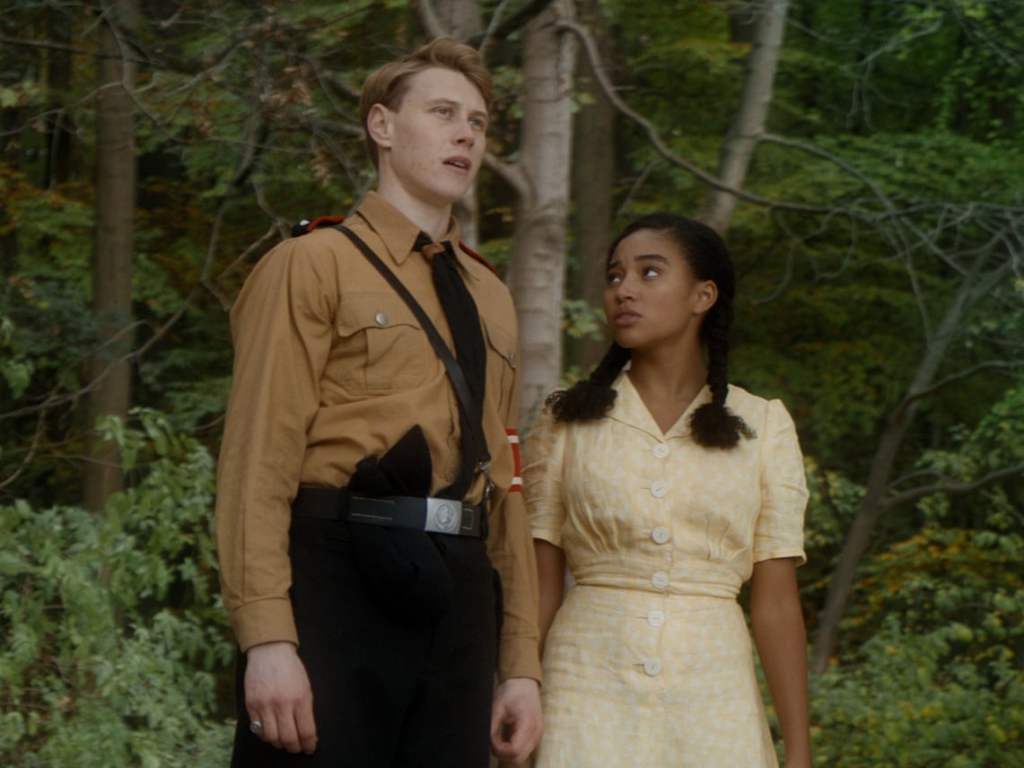
Leyna (Amandla Stenberg) is the only person of colour in her village. She’s aware of that fact, of course, all too aware, but it’s not until her 16th birthday when her difference starts to truly matter, so her mother packs her and little brother Koen up and takes them to Berlin where they can be ‘invisible.’ But Berlin isn’t any safer for a biracial girl in 1944. Leyna and her family live in fear, and Leyna’s mother Kerstin (Abbie Cornish) is so desperate she sacrifices her relationship with her own family to obtain some false papers for her daughter, papers that promise Leyna will never commit the crime of racial mixing with a German aryan, papers that claim she has been sterilized.

Koen joins the Hitler Youth, compulsory for every aryan boy, and his mother is trying her best to temper the hate he learns there with the values and morals of home. As for daughter Leyna, Kerstin is just trying to keep her alive, a feat made more difficult after Leyna falls in love with Lutz (George MacKay), himself a member of the Hitler Youth, and the son of a prominent SS officer. This could get them both killed – it has become obvious that the Nazis aren’t just hunting Jewish people, but anyone deemed “impure.”

There’s obviously an interesting story in there somewhere, but the script by writer-director Amma Asante doesn’t quite sniff it out. Possibly the best thread to follow would be that of Kerstin’s relationship with her children, both rebellious in their ways, and her struggle to balance her beliefs with what will keep the family safe, not unlike Scarlett Johansson’s Oscar-nominated turn in Jojo Rabbit.

Instead we experience the world from Leyna’s perspective. Amandla Stenbert does good work, but Leyna is a teenager, confused and confident at the same time. She insists she wants nothing more than to be treated like any other “good German,” which, considering the context, is kind of uncomfortable. Against the backdrop of millions of Jewish people being led to slaughter, it sort of feels like Leyna has shown up to a Black Lives Matter protest with a sign that reads “All Lives Matter.” Leyna’s youth sees only injustice against herself, and her lack of awareness or irony starts to feel worryingly tone deaf.

The increasingly improbable love story does little to recommend itself and its compassion feels miserly and misplaced. Sean and I recently watched Schindler’s List (he for the first time), a perfect reminder that there are plentiful and worthier movies on the subject, ones that manage to paint a fuller and more accurate picture.


Irresistible

Hilary campaigners woke up with a tremendous political hangover on November 9th, 2016. Liberals began to realize that they’d been living in bubbles. They were fundamentally surprised by their loss, surprised that so many people across America could vote against their own best interests. Where had they gone wrong? And how do we begin to address that disconnect?

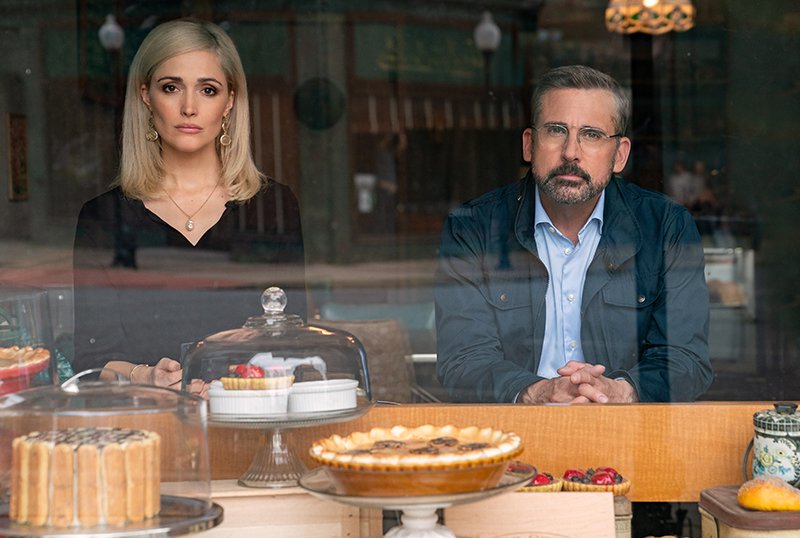
Democrat strategist Gary (Steve Carrell) is disillusioned, like a lot of us. He regroups and refocuses in conservative, smalltown (swing state) Wisconsin, USA where he finds an unlikely candidate in Col. Jack Hastings (Chris Cooper). Jack Hastings likely doesn’t know what it means to go viral, but he has, for an impassioned speech he gave to city council. Gary smells potential: Jack, a veteran, a farmer, a widower; you couldn’t build a better crossover candidate if you tried, and god knows they have. Jack’s a Democrat…he just doesn’t know it yet. It’s just one rural mayoral race, but maybe that’s a foothold the Democrats badly need to expand their base – a Democrat for the heartland, a “redder kind of blue.”

Writer-director Jon Stewart is a master satirist and for a long time he set the tone for how we voiced our discontent, how we parsed and digested the news, how we conquered our apathy and our hopelessness. He may have given up the anchor’s chair behind the desk of the Daily Show in 2015, but he’s clearly got more to say.

Irresistible is about the disingenuous handshake between money and politics. Mere seconds after Gary makes his move to Wisconsin, the other side sends rival strategist Faith (Rose Byrne) to even the odds. If anyone had any illusion that campaigns were about ideals, values, promises, or intentions, it was quickly, summarily, definitively dispersed. A campaign is about math: who has the most money, and how to turn those dollars into votes. It’s cynical as hell, but even with a glossy coat of Hollywood spin, it’s still not half as bad as real life. People don’t matter. They’re not individuals with specific needs and hopes, they’re reduced to “demographics,” a slick political term that divorces voters from their identity. Politicians don’t want to better your life, they want to trick you into believing in them for just long enough to cast a vote. And failing that, they want to trigger you into withholding your vote on the other side. Demographics are equations waiting to be solved, and campaigns hire lots of people to crack those numbers.

Jack represents a “redder kind of blue,” a shade of blue that people who are traditionally red would consider turning pink for. Except even children know that red and blue make purple, and that may be American democracy’s greatest failing. It forces 328 million people to contort themselves into one of two boxes: red, or blue. Both boxes suck and neither one fits anyone perfectly. Worse, though, it creates a dangerous “us” vs. “them” mentality. Its binary nature focuses on what divides us instead of what we share in common. It makes enemies of the other side, when in fact those people are our neighbours, our friends, our kin. We are capitalists. We thrive on choice. The pharmacy sells dozens of brands of toothpaste. The grocery store stocks even more brands of orange juice. You stand in front of the refrigerated case, and maybe you reach for the sweetest juice, or the one that’s locally sourced, or the one with the most vitamins, or the one with the most pulp, or the least pulp, or the cutest carton, or the most memorable commercials, or the healthiest ingredients, or maybe you just reach for whatever’s cheap. Or maybe you bypass the refrigerated section and buy a can of frozen orange juice, from concentrate. Or maybe you prefer the powdered stuff. Or the shelf-stable stuff. Or orange ‘drink.’ Or maybe, and yes this sounds crazy, but maybe you prefer cranberry juice. We need 87 orange juice options but only 2 political parties? Doesn’t that seem a little…crazy? But having that much choice means the brands have to be competitive. They have to care about what you, the consumer, wants. They have to bend to your will, not the other way around. If they want to make money, they have to be the most appealing and offer the very best. But the American political system forces you to choose between two disappointing options. Sure they could put some energy into finding out what you actually need, but instead they embrace the time-honoured American tradition of fear-mongering so you vote for them, or flinging mud so that you don’t vote for the other side.

Anyway, don’t worry, the movie doesn’t actually mention orange juice once. It’s just one of the tangents my mind follows when it’s been stimulated by something thoughtful, and interesting. While some critics didn’t care for it, I enjoyed Irresistible very much. I like Carrell’s charmingly pompous performance, and Stewart’s condescending liberal voice. I did wonder, for a while, what exactly was meant to be so irresistible, but of course the answer was right in front of me the whole time: money. To which Jon Stewart has just one simple message: resist.