Films in this category have something to offer but also have one or more flaws that detract from the experience. Still, these movies are probably better than most of the shit on Netflix.
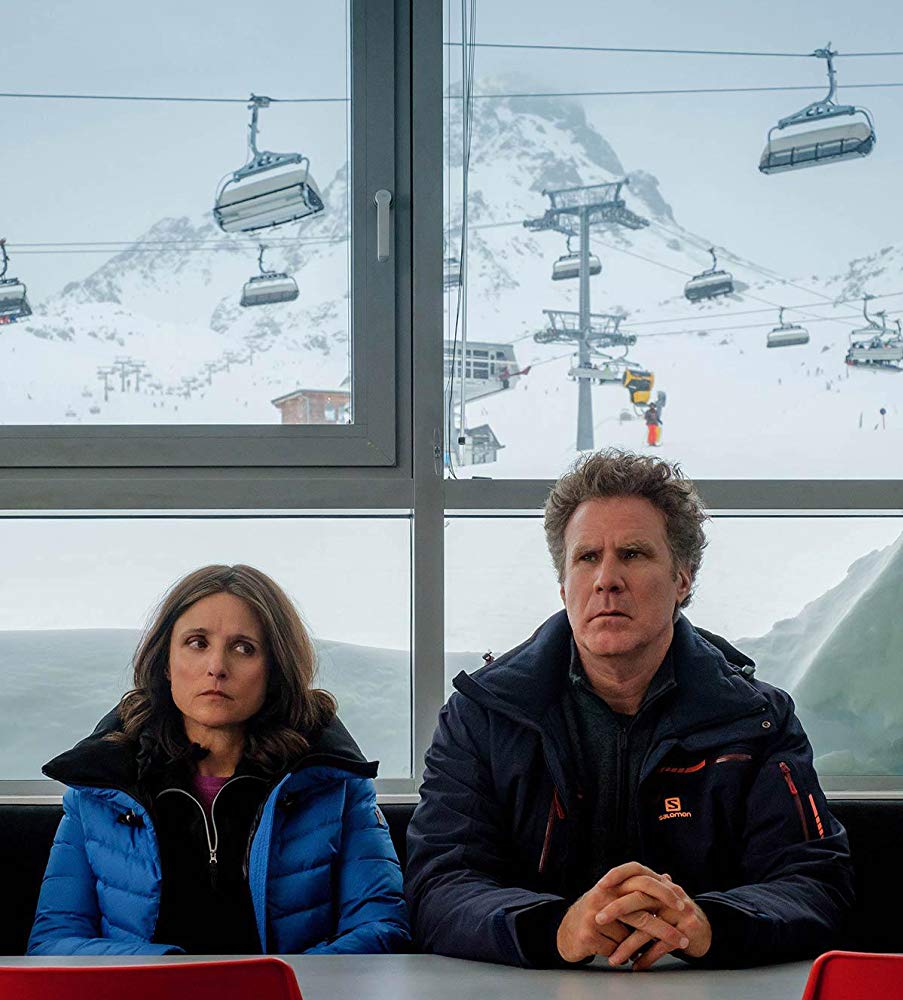
Billie (Julia Louis-Dreyfus) and Pete (Will Ferrell) are vacationing with their two teenage sons at a ski resort in the Alps. One day, during an outdoor lunch, a controlled avalanche sends a wall of snow down toward them, its powder cloud so substantial that all the restaurant patrons fear for their lives. In the panic, Pete flees, saving himself, leaving Billie trapped at the table, protecting their sons. When the snow cloud clears, no one is hurt, but tensions are high as his wife and sons believe he abandoned them in their time of need.
You won’t be surprised to learn that the rest of their vacation does not go well. Pete won’t admit what he did and Billie simmers in (mostly) silence, their interactions steeped in a strong brew of passive aggression. Things really reach a head when Pete’s coworker Zach (Zach Woods) shows up with his bubbly girlfriend Rosie (Zoe Chao) and their carefree hashtag lifestyle is no match for the simmering stress of their unhappily married friends. Billie tearfully, shakily recounts her brush with death and her husband’s cowardice, while the guests sit in horrified silence. She even gets the boys out of bed to confirm the story when Pete once again denies it. Oooof. The movie is supposed to be uncomfortable but it shouldn’t be so wildly miscast. Louis-Dreyfus is convincingly traumatized while Ferrell is just a buffoon. They’re feel like they’re making two different movies.
Downhill is the unnecessary American remake of the excellent Swedish movie Turist (known in English-speaking countries as Force Majeure). Force Majeure was one of the first films we reviewed here, and one that we talked about for weeks, admiring its cinematography and script, but most of all debating the ethics and themes. We went to a pub afterward, and talked about masculinity, filial duty, gender stereotypes, human instincts, and whether it’s fair to measure your relationship based on a split-second decision. Privately, we all wondered how we might have reacted ourselves.
Coming out of Downhill, all we debated was why Americans feel the need to remake movies and make them worse. Yes, laziness of course. Americans hate subtitles. And reading. But Parasite! Parasite just won Best Picture, and that’s subtitled. Progress? Or wishful thinking? At any rate, Downhill feels unfortunately titled considering how it compares to the heights achieved by its predecessor. If you’re going to bother, skip this one entirely and see Force Majeure. Provoking and invasive, it doesn’t just break the marriage open, it goes inside and pokes around.
Two people who refuse to ever marry again meet at a wedding, as you do. Rachel’s (Meryl Streep) a writer, Mark’s (Jack Nicholson) a writer, and they both know better when it comes to love. So of course they end up marrying, though not before Rachel keeps everyone at the wedding waiting for hours and hours as she tries to warm up her cold feet in the room next door. I mean honestly, what’s the max time you would spend at a wedding if the bride was refusing to walk down the aisle?
As if that was an inauspicious enough start to their marriage, the two embark immediately on a home renovation. Which, as we all know, is responsible for like 78% of all divorces and about 94% of matricides (when a wife kills her husband). But they get through it, even with the added pressure of a baby on the way who can’t possibly be born if the lace curtains aren’t hung. And Rachel, newly domesticated, is surprised to find how happy she is. And is totally devastated to find, during the waddliest waddle of her second pregnancy, that Mark is cheating on her.
What now? The Streep takes us up and down a whole xylophone of emotions, hitting every octave with masterful precision. Nicholson is the oboe to Streep’s xylophone, a little jauntier, but hitting complementary notes, pairing nicely. Plus his back hair catches pleasingly in the moonlight. But make no mistake: the xylophone is dominant.
Directed by Mike Nichols based on an autobiographical novel by Nora Ephron, the intimacy is authentic enough to make you feel like a voyeur but you need to decide in advance that you’re here for the performance, not the story. Because there isn’t much of one: love goes off the rails. It’s sad but it happens all the time. The minute Rachel shoves a key lime pie in Mark’s face, she’s every cliche we’ve seen before and none we haven’t.
Contrary to popular opinion, I do not see every single movie in the world, but usually I do at least know about them. Not much sneaks by me. So when this particular movie managed to snag an Oscar nomination (for original song), I was like: huh? Sean thought it might be “one of those religion ones” but it wasn’t until I saw the poster that I remembered it at all, indeed a religion one, starring Chrissy Metz from This Is Us (Randolph & Beth forever!). I’m glad to see her branching out but it wasn’t for that pesky Oscar nom, this one would 110% have passed me by,
Chrissy Metz stars as Joyce, a Christian mother who offers up the kind of teasing prayers during dinner that make husband Brian (Josh Lucas) smirk. But her son John (Marcel Ruiz) is a teenager, determined not to crack a smile. He’s in an eye-rolling phase. An avid basket ball player at school, John is also struggling with his origin story, having been adopted from Guatemala while Joyce and Brian were there on a church mission. Meanwhile, Joyce is at odds with the new “cool” young pastor at her church, Jason (Topher Grace). Jason has a spiky haircut and references The Bachelor during sermons and says things like “Dope!” He wears the same kind of headset microphone that Britney Spears wears and has rock bands with auto-tuned rappers sing “hymns.” Oh he’s shaking things up.
Meanwhile, the movie is determined to establish itself as not just a Christian movie, shelling out for pop songs by Bruno Mars and Macklemore; John is a kid like any other, saving a pristine pair of Jordans for an occasion so special that only he will know it when he sees it.
I happened to notice a Stephen Curry listed as a producer and wondered if it could be THAT Curry. I wondered even more when the all-star was mentioned by name – the Warriors would be in town to face Kevin Durant and the Thunder. This places the film for me immediately, in the season just before Durant joined Curry on Golden State, the very same season when Sean and I traveled to OKC to see Durant face Lebron, then playing for Cleveland, and then we drove down to Dallas to see them play the Warriors. We were traveling in December, for Sean’s birthday, and a snowstorm here in Ottawa meant we almost didn’t make it, touching down in Oklahoma with just minutes to spare. I remember the valet at our hotel apologizing for their unseasonably cool weather but of course it felt downright tropical to us. But in St Louis, MI, it was cold enough for a lake to have frozen, but warm enough that a trio of teenage boys were out playing on it when the ice gave way and John went down.
After an hour with no breath and no pulse, the doctors draw the logical conclusion; they’ve only worked this long to keep him decent for his mother to arrive and say goodbye. Her frantic prayer is heard, or else this movie wouldn’t be much of a movie, and a pulse reappears from nowhere. But his brain was starved of oxygen for far too long. In an induced-coma, his parents are prepped for his inevitable vegetative state. But you know that Joyce isn’t about to let that happen. She badgers his doctors just as much as she badgers the lord.
He recovers of course. That’s a foregone conclusion in a Christian film. Religion isn’t my thing and neither is an entirely predictable plot. But I will begrudgingly admit that Breakthrough has a whole mess of admirable performances. And interestingly for a movie that attributes John’s recover to god’s miracle, it dares to ask why god saves some and not others, which is one of religion’s great quandaries. Of course Breakthrough doesn’t have an answer, but I give it credit for even voicing the question.
And push come to shove, it’s now an Oscar-nominated film, for a song called I’m Standing With You, performed by the esteemed Chrissy Metz and written by Diane Warren. And Diane Warren is not to be messed with. She’s got 11 nominations under her belt, including for chart-busting songs like Because You Loved me, from Up Close and Personal, performed by Celine Dion, and How Do I Live from Con Air performed by Trisha Yearwood and I Don’t Want To Miss A Thing from Armageddon and performed of course by Aerosmith. The woman is a songwriting powerhouse. Will this be her year? Check it out:
Undeniably beautiful, but her competition is fierce:
Stand Up, written by Joshuah Brian Campbell & Cynthia Erivo, performed by Erivo for the movie Harriet
From Toy Story 4, I Can’t Let You Throw Yourself Away, written and performed Randy Newman, a man with 20 Oscar nominations and 2 wins under his belt (Toy Story 3‘s “We Belong Together” and “If I Didn’t Have You” from Monsters, Inc.)
Also from Disney, Into the Unknown, performed by Idina Menzel and AURORA, written by Kristen Anderson-Lopez and Robert Lopez who have two previous Oscar wins for “Let It Go” from Frozen and “Remember Me” from Coco.
And of course (I’m Gonna) Love Me Again from the Elton John biopic Rocketman. Written by John (who has a previous win for The Lion King’s Can You Feel the Love Tonight) and Bernie Taupin, performed by both Elton and Taron Egerton. It took the Globe – will it take the Oscar as well?
Cliff Secord (Billy Campbell) is a crack pilot training for the air racing nationals who has a bad case of the wrong place/wrong times. When testing out his plane, he flies over a shootout between mobsters and G-Men. In the end, his plane gets trashed, he is on the hook to pay for an exploded fuel truck, and he’ll have to put on a clown costume to earn enough money to settle his debts. But wait, what’s that underneath his plane’s seat? Why it’s Howard Hughes’s jetpack superweapon that the Nazis will do anything to get their hands on, and the FBI is racing to track it down first.
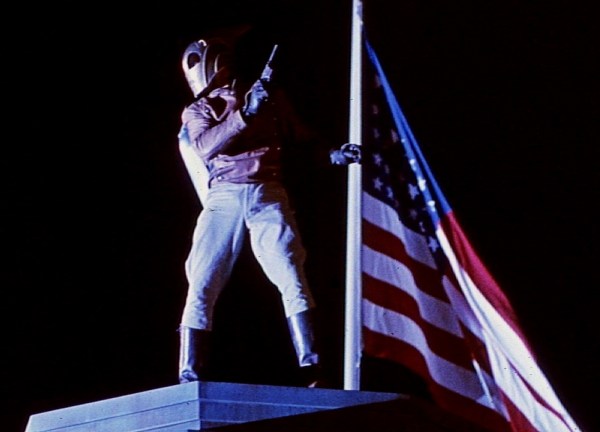
Naturally, Cliff takes to the skies and becomes a superhero, with the help of his engineer Peevy (Alan Arkin). But in doing so, Cliff attracts the attention of the Nazis and mobsters, and before you know it Cliff’s girlfriend Jenny (Jennifer Connelly) needs rescuing. It’s up to Cliff to hold onto his jetpack long enough to save Jenny and, I guess, also save America.
I hadn’t seen this movie since the 90s and what stuck with me after this recent viewing is how badly the Rocketeer’s effects have aged. They probably weren’t great even at the time but now they just look sad.
But in a way, the bad effects are kind of fitting, because this film’s whole raison d’être is nostalgia, and the clumsy effects feel like a remnant of that same bygone era. The Rocketeer is a throwback to that fabled time in America’s history where men were men, women were eye candy, the good guys always won, and even criminals were too patriotic to work for Nazis. It’s the cinematic version of Captain America punching Hitler in the face. Cue the flag waving and tears of pride.
Richard Jewell seems somewhat problematic. He’s power hungry, he’s got no regard for jurisdictional limits, and he thinks he’s a cop when he’s really just campus security. So when he finds a suspicious package under a park bench during the 1996 Olympics in Atlanta, you can see why the FBI might consider him a suspect. But that only goes so far, and doesn’t explain why the FBI viewed him as the ONLY suspect, or why they leaked his name to the press, or why they tried to coerce a confession from him through a fake training video. It’s malicious prosecution at its finest, aimed at a guy who was only guilty of being in the right place at the right time.
Richard Jewell also seems like he deserved to be a hero for a little bit longer. He saved lives by finding that suspicious package and getting the bomb squad involved. At first, he got the hero treatment, but within days, he was named as the prime suspect, and then his hero days were done. All he was after that point was the creepy guy who might have done it. The FBI wouldn’t be investigating him otherwise, would they? Turns out that yes, actually, they would, because they had no one else to pin this on.
Richard Jewell is profiling gone wrong. Clearly, the American justice system is really shitty to anyone who fits a profile. This case was one where a white man was being profiled, so it became a movie. Just imagine how many minorities have been, and are currently being, similarly pursued because they fit a profile, or were “close enough” to the profile for the FBI to squeeze them into that box.
Clint Eastwood is still looking for American heroes, and Richard Jewell clearly fits Eastwood’s profile. It’s a less dangerous profile than any in use by the FBI as long Eastwood doesn’t ask the heroes to play themselves. Eastwood’s retelling of Jewell’s story ignores any shades of grey, preferring to cast the FBI agents (played by Jon Hamm and Ian Gomez) and the media (led by Olivia Wilde) as corrupt and callous, and Jewell (Paul Walter Hauser), his mom (Kathy Bates) and his lawyer (Sam Rockwell) as decent and caring.
As a film, Richard Jewell works well enough (Bates and Rockwell are great as always, and the rest of the cast is solid) but it feels like a missed opportunity. The story isn’t that one poor guy got targeted one time. It’s that the system encourages and rewards this type of police work and this type of media coverage, where getting it right doesn’t matter half as much as finding someone, anyone, to blame.
Grace is a grandmother, a devout church lady, a steadfast volunteer. Also a murderer. Also a murderer? That one doesn’t fit. But she’s in jail and she confessed. So how come no one believes she did it?
Jasmine (Bresha Webb) is a young public defender. She’s already questioning whether the law the right career path for her, so to get throw this case as her first murder trial is a little daunting. She’s inching along cautiously but Grace (Crystal Fox) isn’t making things easy for her. She’s more concerned with protecting other people than herself.
In court, her story unravels: after a post-divorce depression, Grace meets an artist, a younger man who sweeps her off her feet. This is her alleged victim. But obviously things are not what they seem or else they wouldn’t have bothered to make a movie. Well, they hardly bothered to do even that. It’s pretty bland as courtroom dramas go, with a pedestrian script by writer-director Tyler Perry.
And yet this movie was fractionally entertaining to me, for a few reasons.
The boring reason: the performances were good. Ish. If you can look past the bad wigs.
It’s always fun to watch Sean, an actual real-life lawyer, squirm through what Tyler Perry (or whomever) thinks is the law. As a non-lawyer myself, there was plenty of objectionable content that even a lay person could easily point out, but yelling “I object!” from my bed hasn’t persuaded a single Netflix judge yet.
Perry boasted that this film was shot in just 5 days. What he didn’t say was that he edited in just 5 minutes. At least that’s how it feels. You could play a very saucy drinking game just pointing out the plot holes, continuity errors and other fun editing mistakes of which there is a continuous parade.
My grandmother, who turns 87 this week, recently received a jury summons. God bless her little heart but even IF she could drive there and then by some miracle find the right place, and let’s be clear that I do not believe she could do either of those things, she would then not hear any single thing that anyone said. Not a thing. But let’s for a minute pretend she somehow gets there, and somehow hears things. She’s still not going to understand them. Not a damn thing. My grandmother speaks a hybrid of French and English but understands neither. For the past three decades she’s been getting by on the popular “nod and smile” technique. Later she’ll ask my mom, if she remembers. Which she probably won’t. So I’m mentally inserting my grandmother into the jury box, picturing her confused scrunched up nose, picking invisible lint off her slacks, balling up kleenex and putting it in her sleeve, and if she thinks anyone’s looking, smiling vaguely and nodding uncertainly in the direction she thinks is appropriate. Wouldn’t you be pleased to have her on a jury of your peers?
But wait just a minute y’all: my daddy is sleepin and mama ain’t around. There’s a twist!
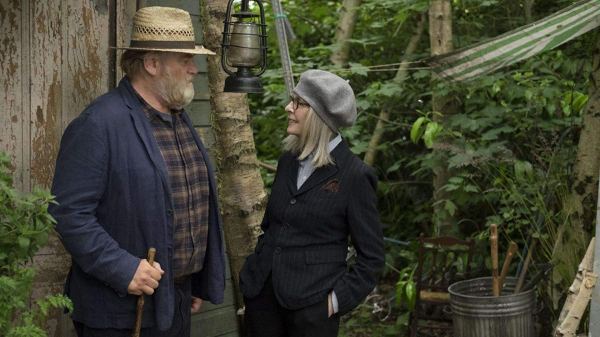
Emily (Diane Keaton) is a widow living a life she cannot afford. She’s angry with her dead husband, as after he died she discovered he had been cheating in her. She’s alone in an apartment she’s going to have to give up, having regular meetings/lunch dates with an accountant who’s helping sort out her tax problems. Then, one day while hiding from her problems in her apartment building’s attic, she lays eyes on Donald (Brendan Gleeson), the hermit of her dreams who lives just across the way on the grounds of a derilict hospital. Before you can say “squatter’s rights”, Emily and Donald are spending romantic nights together in the attic, but what will happen when the accountant and Emily’s neighbours find out?
Part romantic comedy, part self-discovery tale, and part real-life legal drama, Hampstead is kind of a mess. It claims to be based on the real life of Harry Hallowes, who became a landowner because of an arcane legal concept called adverse possession, but clearly many liberties have been taken with Hallowes’ story in this retelling. In fact, one might ask why this claims to be based on his life at all, other than as a cheap way to cash in on the press his lawsuit attracted. For his part, Hallowes made clear that he wanted nothing to do with the film, so it seems unlikely there is any truth to this romantic tale other than what was publicly reported about his case (with no mention whatsoever in the papers of Hallowes striking up a romantic relationship with a neighbouring widow who happened to be leading on her sleazy accountant, and you know the British tabloids would have been ALL OVER those sordid details if even rumoured).
Incidentally, I knew none of this “real-life” stuff until after having watched the film, and I still didn’t care for the movie. I found it tedious, chichéd, and nonsensical, and now I have even less goodwill toward it.
When you meet her mother, you’ll understand why Imogene Duncan would rather fake a suicide than go home when her boyfriend dumps her unceremoniously. Zelda isn’t the most nurturing of mothers given she spends more time in casinos than at home. A chronic gambler and hence constantly broke, Zelda (Annette Bening) isn’t much better now than she was then. Her boyfriend claims to be a time-traveling samurai (Matt Dillon), she’s renting Imogene’s (Kristen Wiig) bedroom to some stranger (Darren Criss), oh, and, her dead dad? Isn’t dead (Bob Balaban).
So displacing her disappointment in her failed relationship with her boyfriend to her father, she goes to New York in search for him but gets ejected from the city AGAIN. Poor Imogene. New Jersey is her worst nightmare but she just keeps winding up there no matter what she does. And spoiler alert: finding her absent father is not the key to her happiness. In fact, it’s very possible that Imogene doesn’t need to be saved by any man, not her dad, not her spoiled boyfriend, not even the samurai-CIA agent sleeping in her mother’s bed. If Imogene can just grow a tougher outer shell, she can take care of herself, face the truth, and fulfill her potential.
Girl Most Likely is a good reminder to fill your life with the right kind of people. And it’s a good reminder to me to fill my film appetite with a little more June Diane Raphael. Even playing the bitch best friend she was a scene-stealer and I almost hoped she’d reappear to fuck up Imogene’s life just a little more. Because she does it with such pizzazz! I love pizzazz. Although what an odd word to have just written twice. Amiright?
Lewis is abandoned by his mother on the steps of an orphanage. By the age of 12, he’s been through over a hundred adoption interviews with no luck, so he spends his time on inventions that never quite work out. One day his school science fair is interrupted by two interlopers: a weird dude in a bowler hat, and a kid named Wilbur who claims to be visiting from the future. It seems like a pretty dubious claim until his space ship whisks them away.
In the future, Lewis meets the Robinson family, a wacky bunch of people he bonds with instantly. Which is too bad, because for the good of the space-time continuum, he really will have to go back.
This movie feels like it was designed by committee if that committee was a classroom full of kindergarteners shouting out their most favouritest things: robots! dinosaurs! food fights! And Disney’s feeling generous enough to stuff the movie with every last ounce of feedback it received, no idea too outlandish or sporadic to include. A story can be weaved around them all, and it involves time travel and one genius kid with big ideas.
It’s not the best film that Disney has to offer, but it’s got rapid-fire visual gags and a riot of crazy ideas and eccentric characters brought to life by some vivid animation. And eventually it circles back on sweet themes, like family and imagination, things you might expect that Walt himself would have been proud his legacy continues to endorse.
If you were looking for a review of Passengers (2016) about a dick named Chris Pratt who pulls the grossest act of total bullshit and gets away with it, click here. Otherwise, Passengers (2008):
Captain Raymond Holt, who of course only plays Capt. Holt on Brooklyn 99 (Andre Braugher), calls in a highly educated but personally rutted psychologist, Dr. Claire Summers (Anne Hathaway) to support a small handful of passengers who have just survived a plane crash. She holds group sessions for grief counseling and quickly finds that the 5 passengers disagree on what happened. Some remember a flash or an explosion that the airline aggressively disavows.
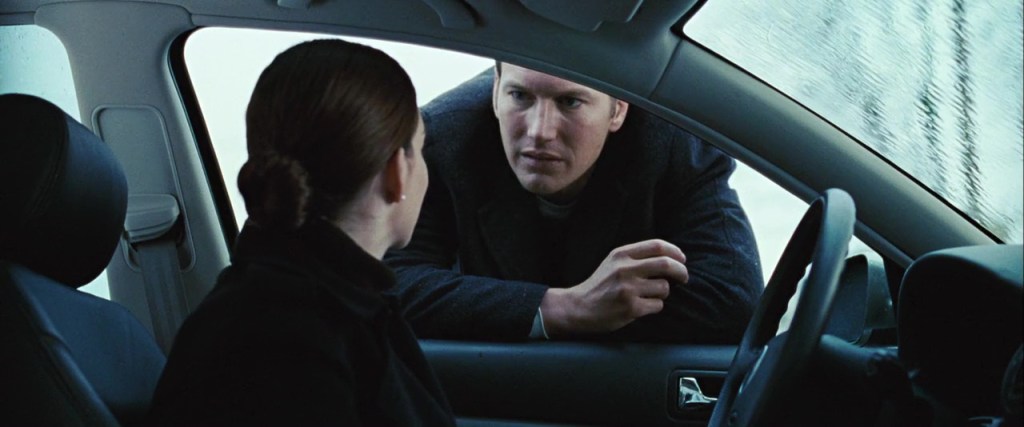
Despite several degrees that should tell her otherwise, Claire becomes personally involved, not only in untangling the mystery, but romantically with the most secretive of the passengers, Eric (Patrick Wilson). Eric’s reaction is strange in a different way. He’s almost elated, feels better than ever. But this little group of survivors has all kinds of inconsistencies to it, and Dr. Summers is practically tripping over herself to break all the ethical and professional boundaries that exist for a reason. Of course, when the members of her group begin disappearing one by one, it seems not even professional boundaries would keep them safe.
Passengers feels like someone conceived of a “twist ending” and then reverse-engineered the movie around it. It spends almost no time justifying or earning its end; instead it builds smoke screens around it, protecting an ending that then comes out of the blue because no one was clever enough to drop those juicy little hints that make your mind tingle and a surprise ending feel oh so tantalizing. An unearned ending feels more like a relief than a delight or a shock. It creates frustration instead of alleviating it. Because that’s the thing about thrillers: they’re supposed to build on themselves, creating suspense while leaving behind a subtle trail of clues. The mystery is an itch and it’s a flood of relief when finally everything comes together to scratch it.
Passengers is a bit of a mess in terms of logic and plot. The story is emotionally manipulative. Anne Hathaway is a bland leading lady. Are those things that might bother you? Or are you the kind of person for whom everything about the movie is incidental to the mere watching of it. In which case, Passengers is definitely a movie you can watch on Netflix. It begins, it plays for a while, and it ends. Thankfully.


 ero, with the help of his engineer Peevy (Alan Arkin). But in doing so, Cliff attracts the attention of the Nazis and mobsters, and before you know it Cliff’s girlfriend Jenny (Jennifer Connelly) needs rescuing. It’s up to Cliff to hold onto his jetpack long enough to save Jenny and, I guess, also save America.
 Rocketeer is a throwback to that fabled time in America’s history where men were men, women were eye candy, the good guys always won, and even criminals were too patriotic to work for Nazis. It’s the cinematic version of Captain America punching Hitler in the face. Cue the flag waving and tears of pride.

 oss the way on the grounds of a derilict hospital. Before you can say “squatter’s rights”, Emily and Donald are spending romantic nights together in the attic, but what will happen when the accountant and Emily’s neighbours find out?

 ASSHOLES WATCHING MOVIES