Category Archives: Movie Reviews

Our reviews and thoughts on the latest releases, classics, and nostalgic favourites. Things we loved, things we hated, and worst of all, things we were ambivalent about.

Unfractured

Greetings from Toronto’s Planet In Focus film festival, an environmental festival that highlights films that “question, explore, and tell stories about the world in which we live.”

Their opening night film is Chanda Chevannes’ Unfractured. It’s about fracking, but more than that, it’s about Dr. Sandra Steingraber, the tireless anti-fracking activist from upstate New York. The documentary follows her industrious and tenacious work to get her government to outlaw fracking. Chevannes follows her as she makes speeches, risks arrest at protests, and visits other countries to find out how others are dealing with this environmental disaster in the face of fierce opposition from its profiteers.

Dr. Steingraber is an eco-activist, a biologist, and a prolific writer on the topics of climate change and ecology. Her previous collaboration with Chevannes based on her highly acclaimed book, Living Downstream: An Ecologist’s Personal Investigation of Cancer and the Environment resulted in a documentary seen by millions. Unfractured is a further exploration of the topic, linking fracking not just to damage to the environment, but to terrible risks to the health of the people living anywhere near it.

Dr. Steingraber is also a wife and a mother. Even when her home life is shaky, she doggedly pursues her advocacy because she genuinely believes in health and safety not just for her own family but for her community. Her commitment to the cause is inspiring; I was particularly moved by “The antidote to despair and cynicism is to fight with your whole heart.” This documentary speaks to any of us who feel sometimes that the fight is just too big, that things are hopeless as they stand. As Steingraber puts it, “We are all members of a great human orchestra and it is now time to play the Save the World Symphony. You do not have to play a solo, but you do have to know what instrument you hold and find your place in the score.”


OPENING NIGHT GALA & RECEPTION

Thursday, October 19, 2017
The Royal Cinema
6:30 PM (Doors Open at 6:00 PM)
Reception to follow at Revival Bar at 9:00 PM


The Square

Sometimes, I walk out of a movie and wonder why a director decided to insert a scene that didn’t seem to add anything to the film.  With The Square, I walked out wondering why the majority of the scenes had been included.  Even the film’s poster gets in on the act, blatantly photoshopping Elisabeth Moss into a scene in which she doesn’t appear.  That is a fitting allegory for her role in the film as well as for a lot of the movie’s scenes.  Moss didn’t need to be there in the poster picture but someone went to the effort of adding her anyway, for no obvious reason.  The same thing seems to have happened with many scenThe-Square-movie-posteres in this film, the latest from Ruben Ostlund, who previously directed Force Majeure.

The Square centres around an obnoxious, entitled museum curator (Christian, played by Claes Bang) who makes more than a few mistakes in promoting his museum’s new exhibition and, on the side, searching for his stolen phone, wallet, and cufflinks.  The fact he sees himself as a pretty good guy only makes things worse for him and everyone he comes into contact with.  In between his missteps, we are treated to some truly bizarre scenes involving a human pretending to be an ape at a dinner party, a real ape acting as a third wheel at Moss’ character’s apartment, and a cheerleading performance by one of Christian’s kids, none of which advance the plot in any way, despite a lot of effort being put into staging and filming these scenes.  But to what end?  The Square repeatedly left me feeling like I had missed the point, but it happened so many times I had to conclude there was no point.

That is The Square: an overlong mess of ideas patched together into a two and a half hour long feature.  The movie starts well enough but doesn’t know where to go once it gets started, and certainly doesn’t know how to wrap up what it’s laid out.

The frustrating part is that many of the ideas in the film have the potential to make for good satire, but the movie can’t figure out how to unlock their potential or say anything meaningful, aside from pointing out how much idiocy and chaos can be created by a self-entitled boor, which we are all way too familiar with in our real lives right now.

All in all, The Square never amounts to much.  Just like its protagonist, it is aimless, clueless, and we’d be better off if it went away quietly.

The Meyerowitz Stories (New and Selected)

The Meyerowitz family is fractured. Danny (Adam Sandler) is a self-described ‘extremely good parker’ with little else on the horizon. A loving dad and devoted house husband, his life is in transition now that he and his wife are separating and his only daughter is off to college. Moving in with his estranged father Harold (Dustin Hoffman) seems like an opportunity to get to know him, except it turns out that feeling’s not mutual.

Harold abandoned Danny and daughter Jean (Elizabeth Marvel) in favour of a new family when they were quite young. He’s never acted as a real father to them and even now he’s mostly only interested in what they can do for him. Not to mention the complicating factor of his alcoholic wife Maureen (Emma Thompson) who MV5BN2M5YzA2ODAtOTNmMi00MGYyLWIxYWYtY2M2NmE4ZGE1ODQ1XkEyXkFqcGdeQXVyNjAwODA4Mw@@._V1_inserts herself into cramped dynamics like she’s determined to put the Wicked back into Step Mother. Both throw out the red carpet when favoured son Matthew (Ben Stiller) makes a reluctant appearance. Harold has fostered a competitive streak between his children by different mothers but they otherwise aren’t close. So when their father’s life and career necessitate them pulling together, it’s a little awkward. Actually, it’s extremely awkward and kind of heart breaking. Because they aren’t bad people, they’ve just been starved of their father’s love and have no idea how to act like a family now that there’s no real chance that things will ever be different.

This being a Noah Baumbach work, the comedy isn’t broad, but it is damn funny. When I finished it (a Netflix original) I immediately wanted to restart it, just to catch all the amazing little asides and offhand jokes that are so casually but expertly tossed out.

Although Harold is a self-absorbed contrarian, he’s not quite despicable in the hands of Dustin Hoffman and his grizzled white beard. Adam Sandler gives a nuanced performance that’ll make you believe in him as an actor once again – and it’s been a good long while since that’s been true. Actually, there are loads of big names, some in pretty small roles, but everyone is kind of spectacular in this. Having recently had no patience for Golden Exits at the New Hampshire Film Festival, I wondered if the our film lexicon was finally full to bursting with movies about privileged white people whining about their lives. But the family dysfunction in The Meyerowitz Stories feels relatable and authentic and the characters are trying too hard to be decent people in the face of it all: I kind of loved it. It’s amazing how many years later childhood resentments and jealousies can bubble to the surface, but this is the kind of movie that makes us all feel “Same” in one way or another, and it just feels good and cathartic that we aren’t alone.


The Florida Project

Thank you New Hampshire Film Festival for bringing this beautiful film to us. We missed seeing it at TIFF and it got huge buzz. HUGE. Director Sean Baker is following up his crazy-good Tangerine and we’ve been collectively, societally waiting with baited breath for his next effort. It feels like Sean Baker is doing important work without all the trumpets and majorettes and fanfare. But I sort of hope that maybe I can blow the horn a bit here, wave a flag or two: The Florida Project is fucking awesome.

6 year old Moonee has the run of the crummy Orlando motel where she and her mother live in “extended stays.” Halley, her mom, can’t get work at Disney and has no other MV5BYjZhMDZmZjItNjcyZC00ZWY2LTkzMzUtZWM0ZDgyYzM2Nzg2XkEyXkFqcGdeQXVyNDg2MjUxNjM@._V1_SY1000_CR0,0,1333,1000_AL_options, so you can imagine some of the crazy things they do for money. It’s a destitute, desperate kind of life but you’d never know it to see Mooney adventuring around free-range with her comrades.
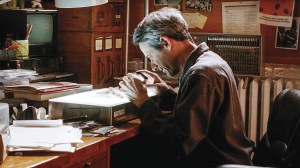
Sean Baker is a master of society’s fringes, and the near-homelessness of the people constantly scrounging for rent between scrapes with the law or family services is about as marginal as you get. Situate that beside the self-proclaimed “happiest place on earth” where the wealthy tourists stay in much nicer digs and it’s an uncomfortable reminder that the rich get richer and the poor get poorer.

Moonee, meanwhile, is seemingly untouched by her circumstances. Intellectually, you know it’s not true: that of course she’s affected by what she sees and hears and eats and meets and experiences, and that she’ll find it hard to climb above her mother’s station. But for now she’s a happy-go-lucky kid who rarely faces consequences, although that’s largely thanks to the motel’s manager and de-facto babysitter, Bobby, who is the eyes, ears, caregiver and mediator when parents just aren’t up to snuff. And believe me, this is a building where neglect rules the day. I felt real tension watching these kids be unwatched.

Halley, barely more than a kid herself, and scarcely more responsible, is tattooed with bad decisions but not without sympathy. Bria Vinaite, who plays her, really understands Halley’s sharp corners and soft underbelly. Willem Dafoe gives Bobby a complexity and edge that make his character fascinating. He’s like the beating heart of the building he supervises. But it’s little Brooklynn Prince as Moonee who just about steals the whole gosh darn movie. She is so real and raw it often feels like you’re watching a documentary, and that the stakes are indeed life-altering. Child actors can make or break a movie but Sean Baker has found not one but a trio of incredibly spirited, natural, and talented kids that make this movie what it is.

The Florida Project is audacious, authentic, absorbing. And it’s begging to be watched.

Golden Exits

A beautiful young Australian woman named Naomi (OF COURSE she’s named Naomi) movies to New York City to fuck with the marriages of two different couples. Okay, officially Naomi (Emily Browning) is there to work and learn from a boring archivist named Nick (Adam Horovitz – yes, THAT Adam Horovitz, a real live Beastie Boy!) but she’s 25 and yielding her sexuality like a weapon.

They say this is a man’s world, but if that man has an assistant in a tight sweater, who really has the upper hand? Naomi knows she has power and she’s not afraid to cause a little havoc. A good marriage doesn’t have cracks for 25-year-olds to wiggle into but golden_exits_adam_horovitz_stillNick’s marriage isn’t quite so solid. He and Alyssa (Chloe Sevigny) have been together a decade and there have been cracks before, so we learn from Alyssa’s sister Gwendolyn (Mary-Louise Parker). Plus, Nick’s life is so, so boring (SO boring he can’t help but repeatedly describe it as ‘thrilling’, without a trace of irony, and it never fails to break your heart).
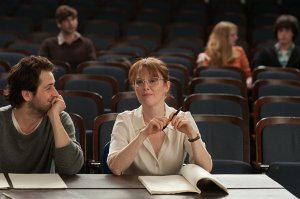
Meanwhile, Naomi is also “reconnecting” with Buddy (Jason Schwartzman), who married the ripe young assistant he hired not so long ago (Analeigh Tipton) and is now finding it a little constricting to work and live with the same woman – which I suppose is why he sneaks out with Naomi behind her back.

You can probably tell this movie is about the precarious balance of relationships, and how a tiny (Aussie) nudge can upset the whole thing. But not just the balance of relationships I suppose, but of life. These Brooklynites are so privileged they’ve lost sight of it, and so stagnant that the arrival of a single student can send shockwaves through their families that will reverberate long after Naomi has gone back home.

Director Alex Ross Perry has a knack for unlovable characters but though I think we’re supposed to find a way to love them anyway, I truly did not. Their ennui is contagious.

Browning as the temptress transcends the cliche and Horovitz is pretty great as a guy who isn’t quite sure whether he’s okay with his life or not. The camera fixates on each character as we eavesdrop on their overly articulate verbal ejaculations but ultimately this is a movie about boring, every day people that doesn’t do much despite saying tonnes. What happens to a marriage after passion fades? And what happens to a movie if I never felt passion for it in the first place? Irreconcilable differences, let’s say.

The English Teacher

Julianne Moore is The English Teacher. That she is 40-something and unmarried seems to be a major plot point, one that made me immediately vomit into my mouth. Apparently because her standards are too high, a prim, stick-up-her-ass voice-over lady informs us. And indeed we witness several of Ms. Linda Sinclair’s dates, during which she mentally marks them up with red pen and assigns them grades – mostly failing. She is much more comfortable in front of a classroom of teenagers, discussing the authors, stories and characters who never disappoint her.

But then an older student returns, having failed to make a living writing plays in New York City. Linda adores his play of course, loves it so much she steps out of her comfort MV5BMTA3MDcyOTY0OTdeQTJeQWpwZ15BbWU3MDQwNjczMjk@._V1_SY1000_CR0,0,1505,1000_AL_zone to help mount it at her school, with the help of drama teacher extraordinaire, Mr. Kapinas (Nathan Lane). Things do not exactly go smoothly. The play is costly; Mr. Kapinas is demanding; the leading lady (Lily Collins) is a temperamental trouble-maker; the school board objects to the violence. All the while Linda keeps clashing with Jason’s dad (Greg Kinnear), believing that the play’s dark themes have been inspired by their real life.

The thing is, Julianne Moore is great, but the movie that surrounds her is not. It’s kind of a mess. The movie begins and ends with the prissy narration, but forgets it entirely otherwise. These little gimmicks only detract from a movie that’s already a bit hard to follow. It’s a modest movie about a playwright being forced to insert a happy ending into his work – which then forces a happy ending on itself, which feels completely improbable and doesn’t fit with the underlying sadness of the film’s tone. I didn’t hate this film but I cannot figure out the point of it. Only because I was hot for teacher will I generously give this a grade of C-.

Transformers: The Last Knight

I wrote a whole other review of this horrible, awful, infuriating movie and then accidentally deleted it.  Honestly, my review was unremarkable for the most part so it’s not a huge loss.  This movie makes no sense, it’s the fifth movie in a tired franchise that was only ever enjoyable if you, like me, liked seeing robots decapitate other robots in slow motion (and which stopped being awesome four movies ago), and it’s got Mark Wahlberg doing his usual “acting” by which I mean that he talks really fast in a whiny voice when he is under pressure and otherwise just stands around flexing his biceps and looking confused.  In short, it is the why-critics-say-transformers-the-last-knight-is-2017s-most-toxic-movie (1)worst Transformers movie yet, and the next one will probably be even worse.

But there was one part of my review worth saving, and it’s this: Mark Wahlberg was clearly born to be in Michael Bay movies.  It is the perfect match of all perfect matches.  These two eventually found each other, but there are so many Wahlberg-less Michael Bay movies, and isn’t that a shame?

So…what if Michael Bay made special editions of his back catalogue, George Lucas style, and digitally inserted Wahlberg into all his “classics” as a way to link all his movies together?

Think about it!  It would be the greatest shared universe of all time.  We could have Bad Boys fighting bad robots under the supervision of Wahlberg and his good friend Joe Pantoliano, the space shuttle in Armageddon could be a robot who owes a favour to Wahlberg and who figures out a way to save Bruce Willis as payback, and Wahlberg could help bring Sean Connery and his estranged daughter Claire Forlani together while at the same time helping Nicholas Cage foil Ed Harris’ plot to steal that face-meltingly-deadly VX gas, this time without losing Michael Biehn’s whole SEAL team.  And then Wahlberg could assemble a team of one million Ewan MacGregor clones along with the time travelling pilot duo of Ben Affleck and Josh Hartnett to destroy the Transformers once and for all, saving us all from ever having to see Transformers 6: Shia’s Revenge.

This needs to happen.


My Cousin Rachel

Philip (Sam Claflin), receives distressing news from his cousin and guardian, who adopted him as an orphaned baby. While recovering from an illness in Italy, he met and married a woman and now has regrets. If his strange and hasty missives are to believed, this woman, Rachel (Rachel Weisz), is trying to kill him. Philip rushes off to intervene but his guardian is dead before he arrives. He swears vengeance on the widow but she has conveniently disappeared.

Philip returns home, to the estate he will now inherit once he comes of age – and luckily, MV5BMDYxOTU1ZDItYjJkMC00ZTVmLWFhZDktNDFiODRlODI1MzQ4L2ltYWdlXkEyXkFqcGdeQXVyNDcxNzU3MTE@._V1_his required 25th birthday is right around the corner. But before it can be celebrated, the ballsy widow shows up for a social call. Draped in black, she looks like a grieving widow, but passionate kiss shared between the two perhaps belie other motives. Of course, this particular widow does not look like the wicked witch of Philip’s dreams, but seeing how she’s played by the enchanting Rachel Weisz, probably looks more like the woman in a different kind of dream altogether.

So the film’s central mystery unfolds: is Rachel trying to seduce young Philip into sharing his inheritance (the will was never changed to reflect her at all), or are there genuine feelings here? Whichever way you lean, this is a dark romance at best. A bad romance (roma, ro-a-a?). Which of course is intoxicating to stupid virginal Philip who will follow his cock just about anywhere it seems.

Gothic and moody, Rachel Weisz is a commanding and alluring black widow. Unfortunately, director Roger Michell has less of a firm grip on this Du Maurier mystery. Did she or didn’t she?  Either he doesn’t know, or doesn’t care. So it’s less satisfying than it should be. But ambiguity would have been just fine by me; it’s what allows us to contemplate Rachel’s precarious position and explore the feminist slant – is a woman left penniless and powerless acting in her own self-interest really all that shocking or evil? In any case, Weisz is the reason to watch. Her every moment on screen is magnetic.

Blade Runner 2049

blade4Has there ever been a more beautiful vision of a dystopian society than what Denis Villeneuve and Roger Deakins serve up in Blade Runner 2049?  Even a photo of a dead tree will be captivating to those around you.  Nuclear wastelands, city-sized garbage dumps, and coastal dams will all amaze.  Visually, this is exactly the sequel that Blade Runner deserved.

Story-wise, Blade Runner 2049 is probably the sequel that Blade Runner deserved as well, though that’s not necessarily a compliment.  The story is muddled right from the hard-to-read title cards that try to bring us up to date on what’s happened in that world’s last 30 years.

The facts in the title cards turn out to be quite important to keep up in Blade Runner 2049’s world as we follow an LAPD officer (Ryan Gosling) trying to solve a 30-year-old mystery involving our old friend Deckard (Harrison Ford).  Though it is unfortunate that the title cards are as dense as they are, I would not have wanted the movie to try to retell its background story, as the 163 minute run time is plenty long enough already!

Refreshingly, Blade Runner’s world is not our world.  It is an alternative future, so there is no attempt to revise the original’s timeline (as you may recall, Blade Runner is set in 2019 in a world where robot slaves are fighting space battles and colonizing other planets for humans, so things did not exactly turn out in our world as the first film predicted).  Interestingly, those differences make it easier for the view to focus on the similarities between their world and ours.  Villeneuve has delivered another very thoughtful, deliberate and satisfying sci-fi film, and it’s easy to analogize to our world every time a replicant is treated as disposable property (which happens a lot).  The film also offers a lot to chew on regarding memory and the nature of reality.  Honestly, I’m still digesting it all as a I write, while also trying to sort out a few of the story’s finer points, and this film is one that I’m going to have to watch again to get everything sorted.

It’s remarkable how closely this sequel resembles the first movie,  in style and substance, despite being released 35 years later.  More remarkably, at the same time it is paying tribute to the original, Blade Runner 2049 is telling a fresh story set in this familiar world, and manages to leave the original movie’s largest question unanswered in a surprisingly satisfying way.  So while Blade Runner 2049 is not the best movie of 2017, it is a good movie made great by its technical excellence, which naturally makes it the perfect sequel to Blade Runner.

The Drop In

I enjoy short films because they are their own genre with their own rules.  Unlike feature-length film, there’s no standard runtime, only an upper limit of 40 minutes (including credits) in order to qualify for Oscar consideration.   The fact that shorts usually jump right into the action makes the genre feel freer and less predictable than feature films.  I also like that shorts tend not to use a standard three-act narrative structure (exposition-rising action-climax), forsaking it for the sake of moving right to the heart of the story.

The Drop In is only 12 minutes long, but in that time the film manages to delivers two big twists that took me by surprise (which I won’t reveal here).  The film starts with a seemingly innocuous encounter that soon turns into a tense, high-stakes confrontation.  Even before anything significant is revealed, that tension is apparent between the film’s only two characters. We may not understand why these two are in conflict but we know, whatever the reason, that this face-off means big trouble for Joelle, a Toronto hairstylist who agreed to stay late to help out a new client.

This short feels like the start of a TV series and the abrupt and inconclusive ending left me curious to see more. That’s often the best place to be, with interest piqued, trying to guess both what came before and what comes next.  But sometimes both past and future are better left unknown, and I think The Drop In makes the right choice by telling this story in short film form, rather than to try to make it feature length.  After all, the first rule of show business is to always leave them wanting more, and The Drop In does exactly that.