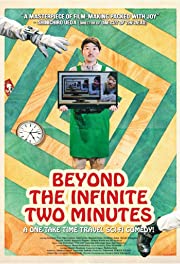
You’ve seen time loop movies before, but you haven’t seen one like this. An official selection of the Fantasia Film Festival 2021.
The Premise: Cafe owner Kato (Kazunori Tosa) returns home after a long day at work via a very short commute as he lives just above it. His apartment is just as he left it but contains a surprise: a message from himself, delivered “live” from the cafe downstairs. Weird, right? Turns out the monitors in his home and his cafe are linked, and the one in the cafe is suddenly broadcasting from two minutes in the future. By racing up and down the stairs, Kato can leave a message and then hear it, or deliver a message he knows he’s already heard. Things get interesting when his friends get involved, tinkering with the system in order to see deeper into the future, and using it to procure money, money that actually belongs to some gangsters because of course it does. Too bad they didn’t see that coming.
The Verdict: The film has an immediacy that distinguishes it from other movies in the genre. Kato’s ability to tamper with it and interact with it directly is also a refreshing addition to genre rules that are perhaps growing stale. But best of all, not to mention rather daringly, director Junta Yamaguchi pulls this off in a single 70 minute long take. One single take! It’s seamless, never gimmicky, infusing energy and urgency in a movie that’s surprisingly full of fun and a bubbling levity despite growing threats and intensity. It’s high-concept without being alienating, an inventive twist inspiring real creativity within the cast and crew. They keep things simple, the film bare bones in order to emphasize its moving parts. The characters are uncomplicated but surprisingly fully-formed, which adds to the intimacy of a time loop with such limited scope. Haunted by potential paradoxes, this madcap mini adventure shows us how anxiety drives us to recreate the past rather than pursuing the future. This movie is a testament to hard work both behind and in front of the screen; the crew pulls it off with an ease that only comes from serious rehearsal. I’m not sure when it happened exactly, but Beyond The Infinite Two Minutes quietly became my favourite film at the festival.
I am a fan of a post-apocalyptic/dystopian nightmare done well, and I wasn’t sure that’s what Glasshouse promised, but boy did it deliver. Glasshouse is an official selection of the Fantasia Film Festival 2021.
The Premise: Living in a glasshouse in total isolation, a matriarch helps her family survive The Shred, a dementia-like virus that steals memory. They take turns standing guard, growing food, maintaining the home, educating each other, and comforting themselves with ritual. It’s survival and subsistence, but with a certain peace that very few others would have encountered in this new world. The tenuous peace is inevitably shattered by the arrival of a Stranger, the first in a long time that they haven’t immediately dispatched. His presence stirs up an uncomfortable past, and it seems perhaps there are worse fates than forgetting.
The Verdict: Director Kelsey Egan takes her time introducing us to the unique social ecosystem of the glasshouse in which our family lives. A dangerous toxin in the air means there are no live animals and edible plants need to be treated with the same care and attention as human lungs. It’s a precarious way to live yet we are given to understand that they are the lucky ones, and have stayed that way thanks to vigilance, ritual, and an armed guard. Yet they allow a stranger to enter, and to stay. True, two of the sisters are young women, and quickly seduced by the only man who isn’t their brother. But it turns out their relative peace was a carefully balanced construct and the Stranger has shifted the dynamic simply by infiltrating it. It’s always juicy and fascinating to imagine how someone would survive the end of the world, and this particular family makes great a host for the apocalypse. Writers Egan and Emma Lungiswa De Wet make a convincing and absorbing case for their take, creating a world that’s innately creepy and inspires suspicion. Families are of course always a bounty for a story-teller; they are unique partnerships built upon jealousies, secrets, and competition, yet they are bound to each other with ties only they, and sometimes not even they, can understand. A fantastic young cast including Jessica Alexander, Anja Taljaard, and Hilton Pelser make us believe in the frailty of their survival, and warn us that the last one to succumb isn’t exactly the winner. While oblivion is bliss, remembering is a burden.
Honestly, I hardly know what to make of this movie let alone tell you about it, but one thing’s for sure: it may be on Disney+, but it’s not for kids. R-rated for sex, drugs, and bad words, Vacation Friends is a raunchy comedy that I expected to hate and then kind of didn’t.
The Premise: Marcus (Lil Rel Howery) and Emily’s (Yvonne Orji) romantic, tropical vacation is on the brink of ruin, but in randomly befriending Ron (John Cena) and Kyla (Meredith Hagner), they agree to dispense with Marcus’ usual precision planning and go with the flow to save their getaway. Ron and Kyla are nothing like them – they’re rule-breaking, thrill-seeking party animals who manage to bring out an unknown wild side in both Marcus and Emily during their week in sunny Mexico. Emily and Marcus assume this friendship will dissolve upon return to their normal lives and are surprised – and not in the good way – to find months later that Ron and Kyla have arrived uninvited to their wedding. Ron and Kyla haven’t changed a bit, but Marcus and Emily are straight-laced as ever, in fact desperate to appear even more conservative in front of Emily’s judgmental family. What could possibly go wrong?
The Verdict: Everything goes wrong, naturally. I have a pretty serious dislike of John Cena, but my love for Lil Rel Howery overpowered it, and I managed to check this one out with a somewhat open mind but low expectations. In part, this is a very dumb, inherently dumb movie, with adults acting like kids, with hijinks so janky you can hardly forgive them. And yet I have to give it up to the writers (Tom Mullen, Tim Mullen, and Clay Tarver, who also directs), who somehow managed to incorporate several jokes that were startlingly funny. The story itself may have felt recycled, but the chemistry between the couples really helped the jokes land – sometimes even take you by surprise – and though the film is unapologetically raunchy, it never gets mean or negative, so the laughs are clean and easy. Vacation Friends isn’t winning any awards but if you’re willing to let loose the way Marcus and Emily do in Mexico, I think you’ll be pleased with the result.
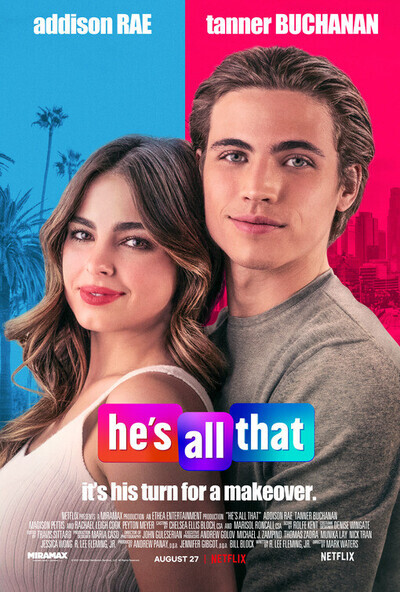
Small rant, hardly even a thing: When we older millennials look back on the teen movies of our youth, yeah, they’re problematic. She’s All That had a cruel but common theme for its time (1999): a popular jock (Freddie Prinze Jr.) made a disgusting bet with his friends that he could transform a loser (Rachel Leigh Cook) into a hottie. It’s a disgusting premise and I totally understand wanting to redeem ourselves, but a simple gender flip was never going to do it. With a teenager girl in the driver’s seat, it’s less sexist but just as gross. We can do better.
The Premise: Padgett (Addison Rae) (but what kind of name is Padgett?) is an influencer with enough followers and pull to earn significant sponsorship, enough to pose as at least as wealthy as her friends at an incredibly affluent high school. When a live feed goes totally wrong, earning both a bad breakup and an even worse meme, her loss of sponsor puts everything in jeopardy. Her plan to win them back involves picking her high school’s biggest loser (Tanner Buchanan) and surreptitiously makeover him into someone not just datable, not just fuckable, but prom kingable.
The Verdict: Part teen romance, part shameless product placement, it’s very easy to not take He’s All That very seriously. Turns out, people still don’t like finding out that they’re bets, and frankly I’m surprised that Padgett’s mommy never warned her against them. Single mother Anna, played by Rachel Leigh Cook, should know better. Matthew Lillard, who also appeared in the original, now more than 20 years ago, plays the high school principal. Lessons will be learned, teenagers will be crowned, if you’re over 30 you’ll feel ancient, social media will be lionized, Kourtney Kardashian will prove behind a shadow of a doubt that she is not an actor, Kiss Me will be covered, and by God, there will be dance offs. For some reason.
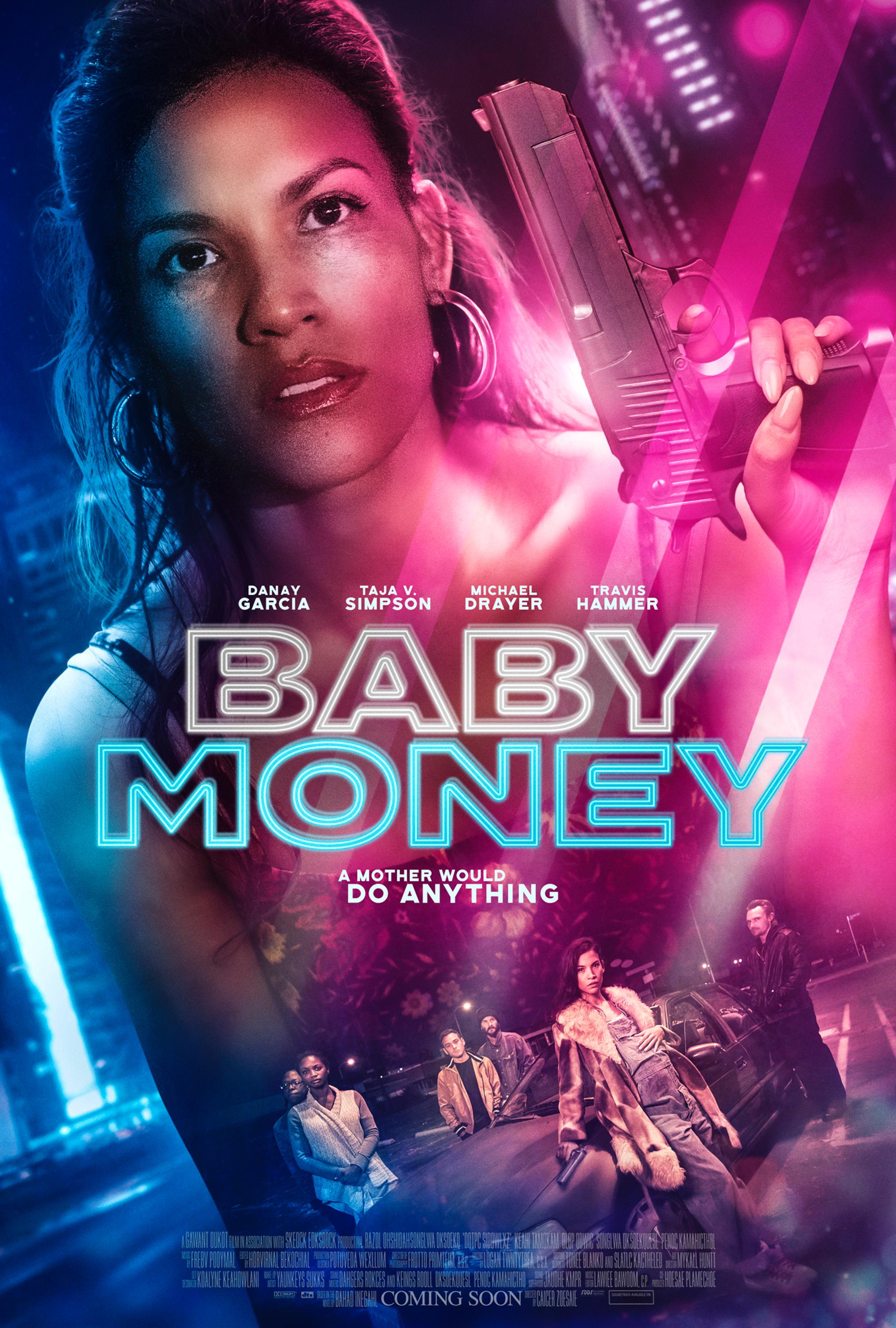
Minny knows it’s a bad idea, but a surprise pregnancy has left her in want of money, so she warily allows boyfriend Gil to go along on a home robbery that promises him a ten thousand dollar payday, and even agrees to be the group’s getaway driver.
Things went well and the couple went home to set up a nursery with a name brand diaper genie. The end.
Haha. Just kidding. The home invasion goes badly, because of course it does, and after a bloody shoot-out, Gil and the living remains of his posse hole up in the nearby home of a single mother and her special-needs son. Things are hair-trigger heated while they wait for their emotional and very pregnant getaway driver to return. Things are tense between the lady of the house and the criminals, of course, but they’re also increasingly volatile amongst the criminals themselves. It’s a bad situation quickly and steadily growing worse.
We’ve all seen plenty of home robberies (in movies, I hope); Baby Money distinguishes itself by being more of a character study of regular, relatable people in a desperate situation. Will they make good choices? They will not. How bad will things get? Watch to find out, and thanks to a company of strong performances, you won’t be disappointed.
Baby Money is an official Fantasia Film Festival 2021 selection.
Directors: Mikhael Bassilli, Luc Walpoth
Starring: Danay Garcia, Michael Drayer, Joey Kern, Taja V. Simpson, Eric Davis, and Vernon Taylor III
#Blue_Whale uses a played-out construct to frame its frenetic story, but the tale it tells is still relevant, and horrifying in more ways than one.
The Premise: Teenager Dana is reeling and confused by her younger sister’s recent suicide. Unwilling to accept that her sister was truly suicidal, she searches through her computer for evidence to the contrary and instead stumbles across something much more sinister. Sister Yulya was involved in an online game that hooked teenagers with a series of challenging tasks meant to ultimately result in their suicides. Convinced that Yulya must have been compelled, Dana seeks the truth the only way she knows how: by joining the game and risking her own life – and that of everyone she knows.
The Verdict: #Blue_Whale fits undoubtedly within the horror genre, but it’s also alarming to note that the movie is inspired by real-life online suicide ‘games.’ Director Anna Zaytseva tells the story through screens (screenlife storytelling ) – cell phone live streams, social media posts, desk top messaging, desperate texts. While this format may have seemed novel and exciting at first, now it feels like an annoying contrivance, not to mention a not very honest one. If you’ve watched any live streams, then you know they’re 80% blurry, 40% shoes/sidewalk, 98% heavy breathing, yet thanks to the magic of movies, this girl is able to keep herself in frame despite literally running for her life. Anyway, Dana struggles through fifty tasks in fifty days, each more dangerous than the last, each designed to alienate her from friends, family, reality, and hope. While she tries to tease out the game’s admins, she’s also worrying about and falling for another player, a teen who is legitimately suicidal. The film is fast-paced, an immediacy which reflects the almost non-existent attention span of this online generation, and a sensory overload that breeds an overwhelming paranoia. Anchored by a brave and ballsy performance by Anna Potebnya, #Blue_Whale’s success is found in her vulnerability, indeed in the vulnerability of all these susceptible teenagers, so close to adulthood, yet still at risk of manipulation. The film is a horror first and foremost, but it’s also a life lesson worth heeding.
Ann (Marion Cotillard) and Henry (Adam Driver) are an odd but glamourous couple – she, a world-famous, beautiful, apple-eating opera singer, he a successful, provocative, banana-loving stand-up comedian. And yet they’re in love. The public eats up their love story, consuming the pretty pictures they see in the media.
Annette will not be for everyone, and for once that’s not me being a snob condescending to you normies who surely won’t appreciate creative cinema when you see it (though god knows I’m alarmingly comfortable being that bitch); it’s me, a snob and seasoned consumer of movies, telling you that even I found it weird and difficult to digest. First of all, it’s a musical. It’s a musical that’s not stylized as a musical. It’s a tediously descriptive musical. The song that opens the film is called So May We Start, and those are more or less all of the lyrics as well, asking in a prolonged and pedestrian way if they should start the film. I didn’t turn it off, so I guess that passed for consent, so we see them become their characters, Driver donning a long, curly wig, and ten minutes into the film, it begins. If not immediately won over, I was at least intrigued enough to keep this party going. But all subsequent songs – and there are many, they are constant – are equally plainly descriptive. Their love song: “We Love Each Other So Much.” Simon Helberg’s song about being Ann’s accompanist: “I’m an Accompanist.” Henry’s song about fatherhood skills: “I’m A Good Father.” Not a metaphor for miles. And yet, when Henry performs his comedy, there isn’t a single joke. There are only songs about the usual contents of a stand-up routine. And when Ann’s on stage at the opera, her song is about the most common components of the opera: death, and bows. The songs stand in for actual entertaining content. Are the songs themselves supposed to be entertaining? It’s hard to say for sure but it’s even harder to believe that yes, they are. Because truly, they aren’t. And I normally love a musical, even a half-baked one, and I’ve always enjoyed using 5000 words when 5 would do. But these songs, conceived by the band Sparks, are just not for me. Too avant-garde? Not avant-garde enough?
But this isn’t even the weird, or weirdest, part of the movie. Henry’s embroiled in a scandal and the couple grow apart as her star continues to rise as his career stalls and then fails. Even their newborn baby isn’t uniting them, cute as little Annette is. And by cute I mean she’s not cute at all. She’s very, very creepy. That’s a mean thing to say about a baby; good thing she’s actually a puppet. I’ve misused the word ‘actually’ in that sentence, though I do not mean to deceive you. Mostly I’m confused myself. Visually, verifiably, clearly, Annette is ‘played’ by a creepy rubber puppet who moves like a stiff rubber puppet, with unblinking glass eyes and obvious ligatures to keep her joints relatively articulated. My god is she creepy. Not quite as creepy as the wispy mustache that Henry grows, but still quite remarkably creepy. But wait – there’s more! The film never comments on the fact that Annette appears to you and I to be a puppet – they simply treat her like a real baby, as if this movie is a middle school Christmas pageant with no budget and no recently birthed siblings to play the baby Jesus. Annette’s mom and dad simply see their beautiful baby girl. However, baby Annette does have something strange about her, a gift the film lauds as unusual and extraordinary, but which doesn’t seem all that weird compared to the weirdness of the film itself. It’s like an elephant holding a press conference to tell us that a 7 year old boy is reading at a 6th grade level. That’s quite remarkable, sure, and good for the kid, but are we really just glossing over the fact that an elephant learned both English, AND the power of the media? The medium IS the message, people.
Do not let me dissuade you from watching Annette. After a debut at Cannes and a tiny theatrical run, it is now streaming on Amazon Prime, a fairly innocuous way to sample a truly original film, and while you may or may not respond to it, at least it’s not another Hollywood retread. It’s daring and risky (it pairs a pedo mustache with a douchebag fedora!) and a fun game is to keep your face neutral and simply record the spot in the film where your spouse finally buckles and says “That’s weird.” For Sean it didn’t come until 1h24m into the film, at a point so random and arbitrary that I was astounded and amused in equal portions. I wish my reaction to the film was just as balanced, but still, I was pleasantly surprised by the film’s moving end. It perhaps wasn’t totally earned, but it was a few very stirring minutes of film at the end of a 2h21m movie.
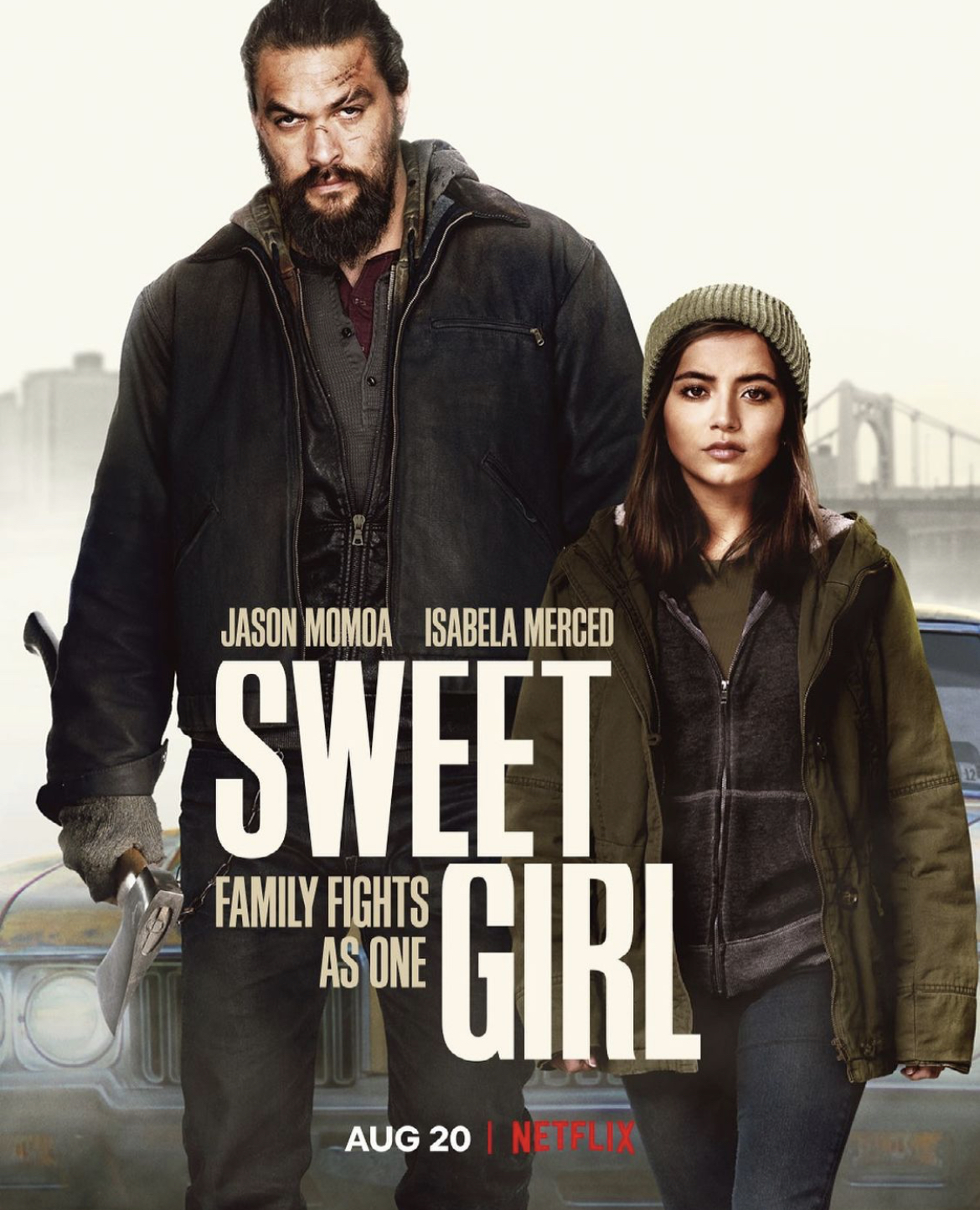
Ray Cooper (Jason Momoa) is understandably upset when he and his daughter Rachel (Isabela Merced) watch their beloved wife and mother die of a cancer that is treatable, if only they could afford it. An affordable generic brand is tragically pulled from the market, having been bought out by its larger and more expensive competitor, BioPrime. Ray harbours an inevitable and totally justified grudge, and vows to take it out on BioPrime CEO Simon Keeley (Justin Bartha). It just so happens that Ray is a trained fighter with a passion for justice, so even though there’s a hitman literally hot on his trail, Ray’s going to see this thing through, to avenge his wife and protect his daughter.
So: grief and action. Blood and then more blood. The action’s decent, but it’s definitely a watered down version of better scenes in better movies. Not great movies, mind you; Sweet Girl is a pretty low bar, and no one involved in the movie seems motivated to reach any higher. I probably should have been more motivated to reach for the remote to give this movie the boot, but had I, this review would end here and you’d never know how Sweet Girl turns around.
It gets worse. It goes from generic, forgettable action movie with a superficial social justice heart to a bullshit “twist ending” that thinks it’s quite clever but will only earn eye rolls at best. Nothing feels authentic enough to care about or good enough to enjoy. The acting ensemble is not to blame; Momoa is the weakest link but the others, including Amy Brenneman, Manuel Garcia-Rulfo, and Lex Scott Davis, do a plausible job with implausible words and circumstances. It’s not enough to save a worthless cause. However, if you’d feel content just to watch Momoa throw some punches (and his hair over his shoulder), this movie delivers exactly that, with little else to distract you.
Nightmares appear to become real in this female-directed British horror screaming at the Fantasia Film Festival.
The Premise: Little Leah lives in a vicarage; her father is a Father, and he welcomes lost and needy souls into their home, God’s home. If the house seems crowded by day, it gives ample space for Leah’s imagination to unfold into its dark corners at night. But while nightmares swirl around the old house at bedtime, a small visitor appears at Leah’s window. This ghost/apparition/whatever is also a little girl, and at first her presence is soothing to Leah, but soon we learn that this paranormal personality may not be as benign as first thought.
The Verdict: Horror movies have long since exploited the fact that a child’s perception can really amplify our experience of anxiety and fright. Leah is a fairly stoic little girl, surviving a less than stellar home life. Tinged by grief, trauma, and silence, Leah relates a lot to her ghostly guest, both harbouring a simmering anger and a desire to be heard by the adults determined to ignore and suppress them. Of course, the more you repress something, the more you’re guaranteed for it to pop out in surprising and unsettling ways. A reckoning is looming, but who is its target and how will the casualties come? As Leah is kept in the dark, literally and figuratively, to some of her family’s past and pain, we, the audience, are also left out, only putting together the story as Leah searches out clues and processes what they mean. While a supernatural spirit walks the halls of Leah’s home, it’s clear the house is also haunted by sadness and secrecy, grief becoming its own ghost. Writer-director Ruth Platt gives an old story new life, and elicits two very fine performances from young actors Kiera Thompson and Sienna Sayer.
PAW Patrol is a popular (9 seasons popular so far) children’s cartoon, at least here in Canada, where one small boy named Ryder is the Bosley to an intrepid group of puppies who form a rescue operation in their small town of Adventure Bay. Here, every kid under 5 can tell you who their favourite pup is: most will pick Chase, the police officer German Shepherd, or Marshall, the Dalmatian fire fighter. Sky, the Cockapoo helicopter pilot, Rocky the recycling, handyman Schnauzer/Scottie mix, Zuma the water rescue Lab, and Rubble the construction Bulldog round out the PAW Patrol, contributing when Ryder deems it necessary, each episode a lesson in thoughtful problem-solving and selecting appropriate skills. The pups each live in a special doghouse that easily transforms into their custom vehicles or “pupmobiles” and besides the collars that alert them to emergencies, they also wear pup packs that contain tools related to their jobs, like grappling hooks, zip lines, and jet packs. They assemble in a tall tower called The Lookout which serves not just as their lair but as their phone booth (Superman style, where they get into costume). They each have a catchphrase and over the years they’ve made a number of friends – Everest, who helps with snow rescues, Rex, who operates in the jungle, etc. As the show is incredible toyetic and in fact seems to serve primarily as a merchandising machine, each of these special helpers inspires its own toy line, so even if you already had all the original pups, plus their vehicles, and the Lookout, you’ll aslo need all of their specialized snow equipment, jungle ensembles, archeology outfits, etc, etc. With all of my nieces and nephews at some point whole-heartedly devoted to the show (even Prime Minister Justin Trudeau and his kids are fans), I cannot tell you how many dollars I have spent on these items. As good aunts and uncles, we watched enough episodes to be able to identify the pups, name our favourite (Rubble), utter the correct catch phrases during play, and scorn the show’s main antagonist, a mischievous mayor from a nearby town named Humdinger, who has a harem of cats, of course.
In the movie, which is only available in theatres here in Canada but may be streamed elsewhere on Paramount+, Humdinger has gone to the nearby metropolis of Adventure City to see what trouble can be caused there. The pups are summoned to provide help when he is immediately responsible for a number of catastrophes, including a fireworks display gone horribly wrong, a “hyperloop” subway that does a series of upside-down loops, and a cloud catcher that ensured good weather but of course was overused and goes rogue.
I happened to be hosting my 5 year old niece Ella this weekend, along with 3 rambunctious boys, her older brother and cousins, and thought it might be nice for her and I to watch the movie together. I was surprised to find that all the boys, who have since grown out of the franchise, were keen to watch at all. Having seen the trailer, they’d determined that the movie looked funny, and was probably made for older kids. Indeed, the movie abandons the 2-D animation of children’s cartoon shows and has transformed the pups for a modern movie experience. The kids debated who looked the most different, but seemed to enjoyed the new look overall.
In the big city, the PAW Patrol encounters bigger challenges than they’re used to in their dozy little bay, really raising the stakes of their rescue operation. They also make a new friend a Dachshund named Liberty who’s got street smarts and city savvy. This is a fortuitous choice for a couple of reasons: first, we have a wiener dog in our own house, a pup named Walt who was enjoying movie time with the kids, having 8 hands to pet his extra-long body, and 4 bowls of popcorn to steal from. Walt is still relatively new here, and the current obsession and constant receiver of round the clock attention from the kids. To find that their cartoon counterparts have also adopted a Dachshund was a thrill for the kids, and the fact that Liberty also happened to be a homeless dog provided an important learning opportunity for all of us. These kids live in a small town like the pups on the show normally do, but as we drove them into the much larger city where Sean and I live, we drove by a couple of homeless people, who the kids never fail to spot and need to talk about. The sight is unfamiliar to them, but the concept is of course absurd to them, to all kids I’m sure, that our society just allows certain people to not have a home. We explain as best we can, but we know our excuses are lousy, and they sound particularly hollow when said out loud to innocent children.
When TV shows make the leap to the big screen, it’s an opportunity to expand on the universe, and setting up the pups to perform in the big city is certainly an excellent use of the medium. For me, though, it definitely brought about an uncomfortable line of questioning. Back home in Adventure Bay, the pups get frequent calls from Cap’N Turbot and Farmer Yumi, recurring characters with familiar foibles, who get into predictable and formulaic scrapes and mishaps. In the city, however, you realize the absurdity when small dogs are careening armoured rescue vehicles down crowded city streets, and normal adult human beings trapped in a burning skyscraper don’t object when the only responders are the same dogs who probably spend their days off sniffing each other’s butts and being distracted by squirrels. Suddenly, you’re asking a lot more from your audience.
PAW Patrol: The Movie may look more like Pixar than it normally does on TV, but it is not a movie intended for all audiences. It’s made for children, and the children who watched it with me rated it very highly. They could not have identified the more famous voice cast (including Randall Park, Tyler Perry, Jimmy Kimmel, and Kim Kardashian), but they did appreciate the new design, and actually got up to dance around to the songs – there are over 75 of them, with original contributions from Simple Plan, Alien Ant Farm, and a real catchy bop from Adam Levine. If you have little PAW Patrollers in your home, the movie is sure to be a hit.
Today’s review brought to you by Ella (5), Brady (9), Jack (7), and Ben (also 7): my loves.







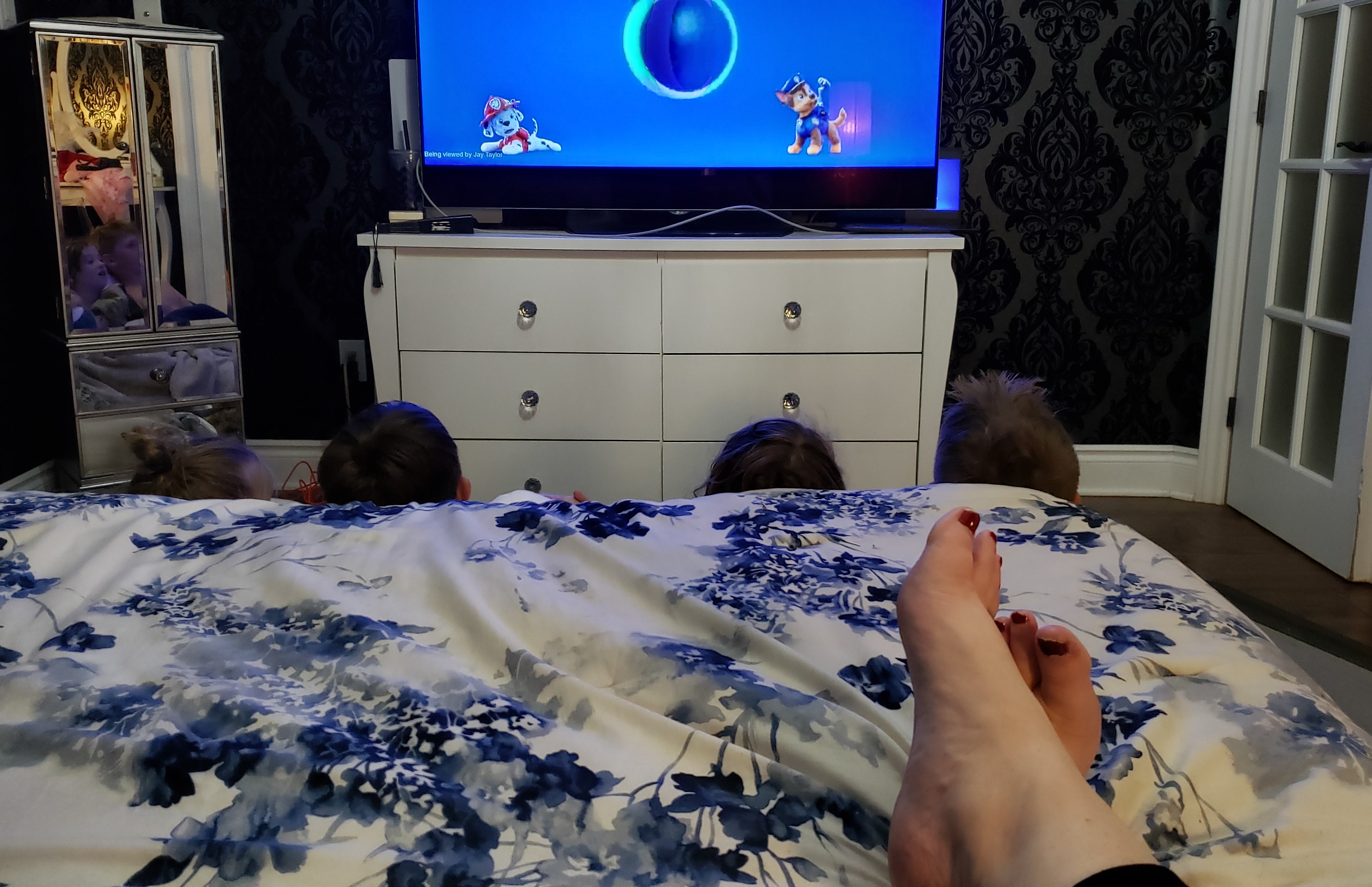
 ASSHOLES WATCHING MOVIES