
Myalgic encephalomyelitis (ME), commonly referred to as chronic fatigue syndrome (CFS). It’s a debilitating chronic disease as often misunderstood as it is misdiagnosed. People like to call it “the lazy disease” or “the I don’t want to go to work” disease. Doctors often diagnose a mental disorder rather than the autoimmune disease it actually is, telling patients “it’s all in their heads.” But to the 1-2.4 million people who suffer with it in the United States alone, it’s a disease that leaves you drained, sensitive to light and noise and possibly much else, perhaps unable to stand and walk. Permanently housebound and bedridden, they feel they’ve gone missing from their lives – it passes them by while they lie in bed, sometimes with cognitive impairments that make them feel like they’re not truly living.
Director Jennifer Brea is one such person. She was a happy newlywed when suddenly she just got hit with a disease she didn’t even know about. Robbed of the things she once loved doing, this film documents her daily struggles, the constant tug of war that must be waged against her body. She also reaches out to people around the world suffering the same thing, and together they try every supposed miracle cure on the market. When none work exactly as they hope, they stage a protest most are unable to attend. It’s really sad to see such vibrant people struck down by such sweeping disability. It is no wonder that despite serious medical symptoms, one of the most common causes of death for ME sufferers is suicide.
I am moved personally by this film because as you may know, I too have an autoimmune disorder. There are tonnes of autoimmune disorders and all but a handful are practically unknown, even to doctors. I admit to a small bit of jealousy when Brea complains about ME being the least-funded of the major diseases because my disease doesn’t even rate – we call it an “orphan disease” – nobody’s even trying to cure it. There is no funding. There is no ribbon. There is no textbook. I’ve visited approximately 100 doctors and I’ve had to educate all but 2. The lives this disease ruins are too few for anyone to care. So in that way I understand perfectly what she’s going through; you have a terrible disease and you have no hope of cure. You have no hope, period. And on top of having no hope for yourself, you also have this huge burden of guilt because like her, I’ve dragged someone else into the equation. And while Sean is not sick, his life is also disabled by my disease. If I’m too riddled with pain to leave the house, he stays home with me. He cares with me. He deals with my terrible moods when I’m in pain, and my pushing him away when I’m in despair. He has brought me around the world to different doctors, and he feels the same low when I leave another appointment hopeless. In order to live our lives, I push myself out of bed and out of the house too often, and we both know I’ll pay the price. I’ve cried in anguish in Paris, outside the Centre Pompidou. I’ve bled across the Miami boardwalk. Even right now, in Austin, Texas for the South By SouthWest Conference and Festival, my suitcase is bursting with pills, gauze, and needles (that Sean has had to learn to inject me with) just to get me through, and I’ve limped along in secret pain, unable to even bring one of my most depended-upon medications with me because it’s illegal in this country.
So you’ll understand why I think a film like Unrest is so important. It sheds light in a dark corner of the medical community. It’s important to remember the real people who live their lives in this dark corner. They have voices. They have families who love them. They have friends who miss them. And if we cannot contribute to the cure, we can become allies. We can be witnesses and sympathizers and believers, so that nobody needs to hear from a doctor that “it’s all in your head.”
It’s screening at SXSW March 14 at the Vimeo Theatre and March 16 at Alamo Lamar, which serves great pretzels.
 out to be largely unstructured: 50 minutes into the film we still haven’t seen any exploding arms, but we’ve seen plenty of Smith’s unironic mini van, his cat, and his Hipster facial hair. The film is dotted with seemingly random Youtube videos that slowly reveal the personal tragedy behind some of Smith’s listlessness.
 us with deliberately soothing music and excellently edited nature sounds. The film makes participants of us, the pace a thing of beauty, very measured, very calm, each image carefully and mindfully chosen. And it doesn’t hurt one ounce that Benedict Cumberbatch narrates.
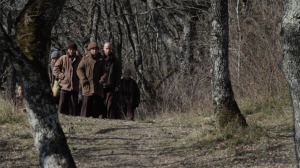 captured, the snippets of life, the tranquility: these all guide us down a path of – and forgive the use of this word – enlightenment.
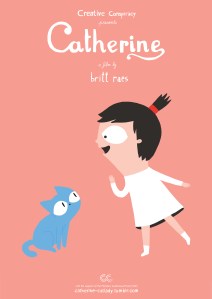 them to suicide) and that seems about right to me. Even though Catherine’s a bit of a hazard, you can’t help but root for her, root for her happiness. I am completely drawn in by the animation by Creative Conspiracy studios – it looks very picture-book friendly, yet the humour within is surprisingly dark. The colours are like candy and used thoughtfully throughout. I always admire short films because to tell a story well they must be economical and equally strong visually and narratively. Catherine (the film) is all of these things wrapped up in a cutesy little package. Catherine (the character) is not so perfect, nor, it turns out, so cute: Catherine grows up. Into a woman who means well but can’t connect with humans. Wonder why? See the film!
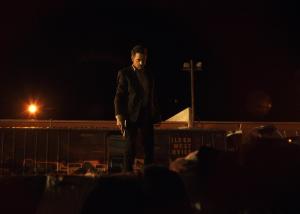 No matter how hard you try, you can’t see everything at a festival like SXSW. To prepare for these big festivals, we study the schedule like our lives depend on it, read the synopses repeatedly, and try to see as many of our favourite artists as possible. All that prep work helps a lot, but sometimes a tight schedule makes a choice for us. That happened today with Small Town Crime and we were better off for it. Put simply, Small Town Crime is an indie gem that is one of the best films I’ve seen in 2017.
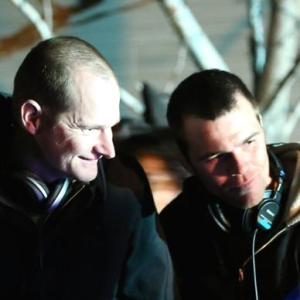 Functioning both as a whodunnit and an offbeat action-comedy, Small Town Crime is consistently good, especially when Hawkes’ character shares the screen with Forster’s concerned grandfather and Clifton Collins Jr.’s refreshingly self-aware pimp. Writer-directors Eshom and Ian Nelms clearly recognized what they had and give those three characters a hefty share of screen time. That must have been particularly difficult here since the cast is extremely deep. Even with the focus on that trio, I was left wanting to see more of them. I’d be first in line for a sequel (or a television series) showcasing more of their adventures.
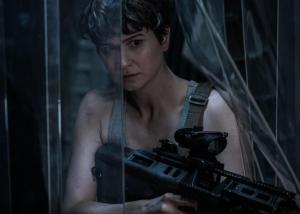 Anytime you get a chance to watch Alien with Sir Ridley Scott, you take it. How great is it that we got that chance? Even better, Scott was not alone. He brought Alien: Covenant footage with him, as well as Covenant stars Katherine Waterston, Danny McBride, and Michael Fassbender. An entertaining Q&A took place after the bulk of the new footage. We didn’t learn any big secrets but it’s obvious that all three actors were thrilled to have had the chance to work with Scott, particularly McBride who joked that his parents were thrilled he was finally making a real movie.
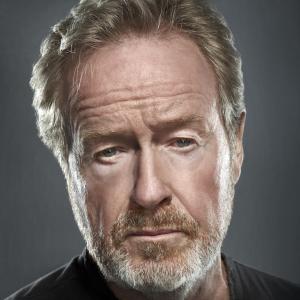 The new footage proves that Scott is not afraid to rip himself off, and that’s great news as far as I’m concerned. You would expect Alien: Covenant to bear at least a passing resemblance to Alien (as the former’s purpose, aside from making tons of money, is to bridge the gap between Prometheus and the original quadrilogy. But the similarities are greater than that, they’re intentional callbacks to the original. That made the footage from Covenant FEEL like Alien, as it took us to the same places that Alien did, only now we know what’s going to happen (and what has to happen). Scott delivers on his setups with glee, letting us know he’s right there with us. A facehugger scene featuring Billy Crudup was especially awesome. It’s a good bet there will be more moments like that in the footage still to come.
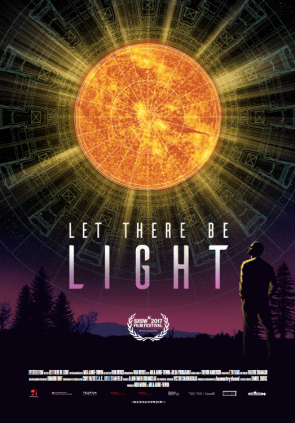 energy from its proponents. Directors Mila Aung-Thwin and Van Royko interview some very charismatic and enthusiastic supporter and collaborators of the project, called ITER (International Thermonuclear Experimental Reactor). It’s pretty much the most complex machine ever designed and the commitment of these people cannot be overstated.
 They want something temporary, first of all, so as not to permanently alter the land. Think of sutures: something that dissolves after the healing is done. To that end, they come to a beautiful and striking solution of tethering helium-filled balloons. However, the fence is not just symbolic of connectedness, but represents an awful lot of actual collaboration between peoples and communities to make this art happen.

 ASSHOLES WATCHING MOVIES