Replicas

Neither critics nor audiences seem to like this one much, but everyone’s game to give it a try because Keanu Reeves is in it. Should you?

Replicas is a sci-fi film, not unlike Altered Carbon in terms of the science, but very much different in terms of the fiction. In the future, a dying person’s “self” (the content of their minds) can be uploaded to a server, and then downloaded into another body. Keanu plays William Foster, a brilliant scientist trying to make that concept workable at a secret facility in Puerto Rico. The upload and the download both go well, but the robotic bodies always seem to reject the process, sometimes even destroying themselves in the process. He’s been working on this for a while, but if his breakthrough doesn’t come soon, they may lose their funding. Even so, William opts to take his family on vacation – after all, he has asked wife Mona (Alice Eve) and their three kids to uproot for him, but he hasn’t been around much. So of course he accidentally kills them all in a terrible traffic accident that very night. In a grief-crazed panic, he calls fellow researcher Ed (Thomas Middleditch), and forces him to quickly upload all 4 of the recently deceased. William knows that the download into robot bodies isn’t viable, so he guilts Ed into using his own area of research to help: human cloning. And as if having a whole family of secret clones isn’t difficult enough, they have to steal very expensive lab equipment to do the job, and then lie about their success to their boss.

This premise is loaded with potential, and the film contains lots of threads that justify anyone choosing this material. So why don’t we like it?

In part, something researchers call  “uncanny valley” which basically posits that as robots become more human-like, we go from admiration to revulsion. Anything that we know is unreal, but seems real, makes us feel a bit uneasy. And now William’s living in a whole house of them – very good copies of his family, but copies nonetheless, and not entirely perfect either. As humans, we have a natural revulsion to this. 2001’s Final Fantasy: The Spirits Within had ultra-realistic human animation, and suffered defeat at the box office. Steven Spielberg’s A.I. made some serious money, but the movie creeped out both audiences and critics, some of whom have since revised their originally ambivalent reviews. But still: this stuff makes us uncomfortable, and usually for good reason.

The uncanny valley isn’t Replicas’ only problem though. Ultimately, its own ambition topples it. The first half sometimes feels a bit silly, and William’s choices are consistently problematic. Of course we’d all like just a little more time with our lost loved ones, but William takes it to extremes, and drags his buddy into the mess with him, which is a lot to ask of a coworker who only ever consented to looking after a fish.

The uneasiness generated by a family that now consists mainly of the undead (not zombies, but kinda definitely zombies) would do better in a horror film, but instead director Jeffrey Nachmanoff commits to a family drama but can’t quite make it work. And there was plenty to work with: grief, survivor’s guilt, basic human existential questions of identity of self – but instead Nachmanoff gets bogged down explaining imaginary science as if this was a term paper and not a piece of entertainment. Keanu manages to stay serious even whilst wearing the silliest hat of the future AND waving his hands in the air like he just don’t care, but the script goes from suspicious to limp and I’m pretty sure the director was in the can for the entire back 9. Replicas does not work well as a movie, but it does star the internet’s boyfriend, and for his presence alone, I bet people will continue to watch.

The Show Must Go On: The Queen + Adam Lambert Story

By the early 1980s, Queen was one of the biggest stadium rock bands in the world. Their set at the 1985 Live Aid concert is basically the most significant live performance of all time. Queen meaning Roger Taylor on drums, Brian May on guitar, John Deacon on bass, and Freddie Mercury on piano and vocals. Mercury was a flamboyant showman on the stage, an inimitable presence with an incredible voice. When he died in 1991, the band more or less died with him; his bandmates were his friends, and they needed to mourn him away from the music.

I can’t remember when I was first aware of Queen because I was born into a world already obsessed with them. I remember being in my mom’s van and hearing the telltale bassline of Under Pressure and being mad, SO mad, when it turned out to be “that old song” by Queen, and not Ice Ice Baby by Vanilla Ice, a flash in the pan hip-hop monstrosity that sampled from Queen/David Bowie without crediting them. Imagine being disappointed by Under Pressure. Imagine. I have been atoning for that musical folly ever since.

I have probably never been to a hockey game that didn’t play We Will Rock You at least 5 times. As a kid I probably thought it was specifically written for hockey. But in 1992 the band got an even bigger boost from a different Canadian export, Mike Myers. Wayne’s World was released just a few months after Mercury’s (AIDS-related) death, and the studio begged Myers to go with a Guns N Roses instead, but Myers was insistent. The film propelled Bohemian Rhapsody to #2 on the charts 17 years after its first release. Mercury saw the head banging scene before his death, found it hilarious, and approved the song for the film’s use. It was a nice way for new fans and old fans to appreciate Queen once again. Just two months later, in April 1992, the remaining Queen members put on a benefit, The Freddie Mercury Tribute Concert, to which 1.2 billion viewers tuned in (they made the Guinness Book of Records!). Performers including Robert Plant, Elton John, Annie Lennox, George Michael, and David Bowie performed alongside the original members, and they raised over £20M for AIDS charities.

This would prove a wise and prophetic move: Queen never tried to replace the irreplaceable Freddie Mercury. When they were ready to perform again, they performed as Queen + ________. John Deacon retired in 1997, but a new Greatest Hits (III) album was released in 1999, Queen + Wyclef Jean on Another One Bites the Dust, George Michael on Somebody to Love, and Elton John on The Show Must Go On (among others). And beginning in 2005, they toured + Paul Rodgers. Fans could enjoy the music they loved without feeling their Mercury had been replaced. May and Taylor could play again, in tribute to their friend of course, but also because this was their music too, their passion.

In 2011, Queen began playing with American Idol loser, Adam Lambert (that year’s winner, Kris Allen, has long since been forgotten – the show has a pretty crummy record: out of 17 seasons, only 2 early winners ever had any lasting success, Kelly Clarkson and Carrie Underwood). But Queen knew a winner when it saw one.

This documentary covers a lot of ground. A LOT. But it’s Queen, so let’s gobble it up. And it’s kind of cool that this iconic band, now consisting of two aging rock stars, can see in Lambert a little bit of their old friend. Adam Lambert is himself a flamboyant showman, but he doesn’t invite comparison to Mercury, which is what makes this union work. He is a confident performer in his own right, and May and Taylor seem re-energized in rediscovering their old hits with him, old hits that, like me, Lambert has grown up just knowing. And though he’s also passionate about his solo work, Lambert knows what a huge opportunity this is, how lucky he is to perform to arenas filled with people. But most of all, it’s just cool to see how things have changed, from Freddie Mercury’s deathbed confession of AIDS, to Lambert being able to perform as an openly gay man. Many great bands continue to tour long past their prime, eventually becoming a sort of cover band of themselves. Queen, however, has lasted because it’s been open to change, it has evolved. They never wallpapered over their past. They knew they had a once in a lifetime thing with Freddie, but they also admit they’ve somehow found it again with Lambert.

Can’t get enough? Join the conversation on Youtube!


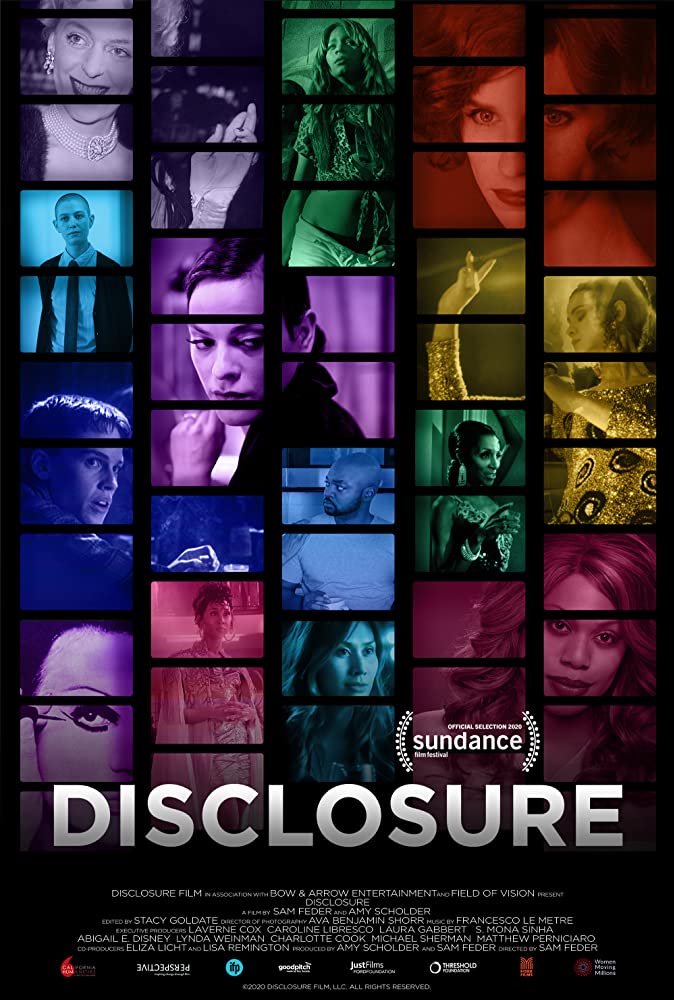
Disclosure: Trans Lives On Screen

Disclosure gives us an in-depth look at Hollywood’s depiction of transgender people and the impact those stories have had not just on a transgender lives but on American culture as a whole.

Director Sam Feder puts together a documentary of enormous value, not just because of the breadth and depth of its interview subjects (actors certainly, but also historians, researchers, activists and more) but because this film acts as a valuable resource for cis-gendered people to learn and reflect more on the topic without burdening the trans community. Often we lean on minority communities to teach us how to value and respect them when we should be doing the work ourselves. Feder has generously accounted for our laziness and apathy and has made this easily-digested anthology on trans representation widely available through Netflix. No excuses: just watch it.

Let trans people tell you how it’s felt to grow up watching what few transgendered roles there are be of trans people being trafficked, raped, beaten, and murdered. And yet still they were grateful just to know that somewhere out there, someone else felt like them. Or what it’s like to see cis-gendered people playing trans-gendered characters, perpetuating the notion that some sort of trick is being played, or that gender is a kind of performance. And how important it is just to have any kind of representation at all, since the vast majority of us either don’t know someone who is transgendered, or don’t know that we do – and this includes most young people growing up who are trans themselves. Movie and television characters, however, come into our homes and our consciousness, so we need to get them right.

This documentary could easily shame me for not asking the right questions, not saying the right things, not knowing the right people. Instead, it just allows us to be a part of the conversation, to start thinking in the right direction, to start noticing the gaps, and to meet some people outside of our normal circles. They have every right to be angry and yet Feder and company flood us with hope and optimism. They show us the path forward with respect and dignity, and the very least we can do is take that first step.

Join us on Youtube for further discussion.

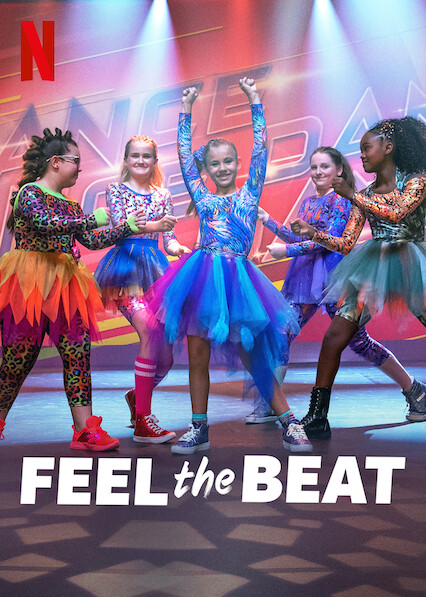
Feel The Beat

Not only did I fail to feel the beat, I couldn’t even find a pulse.

But that’s me, discerning movie viewer, critic without a cause. I won’t deny that it may hold some cachet as a family-friendly offering for the tween set. For the rest of us, it’s exceedingly missable.

April (Sofia Carson) is a hometown success story, having left for stardom on the Broad Way. She didn’t find it, of course, and slinks back home, tail between her legs. Luckily the small town where she’s from is sufficiently square that their twitter feeds have sme sort of hillbilly 3 day delay (a mild scandal brews on social media). To them, she’s still Impressive April, and the (very) humble dance studio where she got her start fawns over her terse, uninterested, one-word replies to their burning questions. This they call a “master class.” But when April gets a whiff of redemption (ie, a national dance competition with a handy dandy “teacher feature” which could put her in front of a judge’s panel including a top Broadway producer), suddenly she’s interested. Sure her interest is self-serving and mostly takes the form of verbally abusing an eager if unskilled dance troupe. They’re a bunch of misfits, as dictated by the trope, with a lineup including a deaf girl, a chubby girl, a poor girl, and a boy.

As you might venture to guess, the road to nationals is predictably paved with teachable moments and personal growth for our girl April, who never quite got to likable with me, which is just fine since I also found her unwatchable. Absolutely nothing personal with any of the cast, who were dancing their little tushies off. This is merely a trite script and a small budget and a green, though not necessarily untalented, crew. Which adds up to a harmless but ultimately subpar, forgettable movie that I did not need to see.

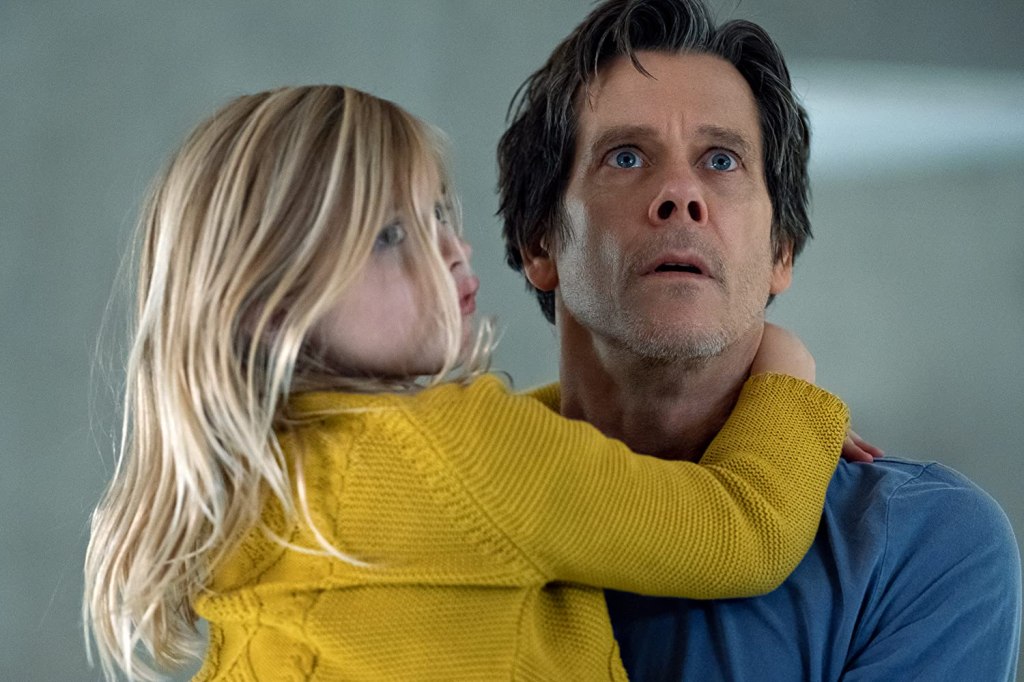
You Should Have Left

Susanna (Amanda Seyfriend), a young, beautiful actress between jobs, and her old, rich ex-banker husband Theo (Kevin Bacon) take their daughter Ella on a picturesque little hideaway vacation in Wales. The home they rent is nestled in some truly gorgeous if isolated Welsh countryside, but the house itself is strikingly modern.

It’s on this vacation that a little girl will learn that her father was once accused of murdering his first wife. They probably thought that this is what Ella would remember of their time in Wales, but then Theo learns that Susanna is having an affair, and that little explosive piece of news grabs all the headlines. But both of these facts will be overshadowed by what comes next.

The whole family’s been having nightmares since they arrived. Nightmares that don’t always feel like nightmares. But strange things are happening during the day, too. It’s the house (is it the house?); Sean correctly identified it as a “murder house” about ten seconds after clocking it and it’s definitely giving off hostile vibes. Perhaps not your traditional haunted house (think American Psycho rather than Psycho Psycho) but it does have a peculiar knack for rearranging itself on the fly. You may have opened the door to the laundry room but you have found yourself in the basement. What’s in the basement? Nothing good, but you’ll have to walk down an ever-lengthening hallway to meet your fate.

Writer-director David Koepp delivers some effective jump scare and both Seyfriend and Bacon are convincingly paranoid and/or terrified, but something just feels off, and I don’t mean the morphing blueprint. There’s just no definitive villain, nothing concrete to fear. There’s a fair amount of tension but it doesn’t ever build to a satisfying conclusion. Koepp fucks around with time, space, the supernatural, and the existential: if you threw a punch with your eyes closed you should be able to hit something, but Koepp just never hits his mark, or defines it. He’s got a pretty bag of tricks, by which I mean he took some pretty meticulous notes while watching The Shining one night. This movie didn’t scare me and I get scared every time our furnace kicks in. Every. Time. But worse, it didn’t interest me or entertain me. A dozen loose ends don’t add up to a mystery, it means a script hit production before it had any right to, and now there’s another aimless horror movie in the world bringing the bell curve down for everyone.

7500

7500 is the emergency code for a plane hijacking. Fasten your seatbelts, passengers. This is going to be one hell of a bumpy ride.

Tobias (Joseph Gordon-Levitt) is the American copilot on a flight from Berlin to Paris. He and Michael, the captain (Carlo Kitzlinger) are going through the usual piloty pre-flight rituals: ordering their sandwiches, deciding whether they’ll wait for tardy passengers, saying the word “check” a lot, or, to changed things up, occasionally “checked.” Extremely banal shit is what I’m getting at. The fun in being a pilot is apparently in the strut through the airport. Inside the cockpit it’s mostly just paperwork and hitting the right button for autopilot.

But unluckily for Tobias and Michael, no one titles their movie 7500 and then fails to follow through with hijackers. We know it’s coming, but the waiting is agony. Right up until the improvised glass shiv comes out, Tobias and Michael are having an uneventful day at the office which just happens to be 35000 feet above ground, zipping through the clouds at approximately 900 km/hr. I’m having a worse flight than they are, but that’s because I know the title and they think it’s something like “gawd I can’t wait for the weekend.” I feel a tightness in my chest, anxiety in my breathing. And soon enough, so do they.

Emergencies are why we even bother to have pilots at all. Sort of. The autopilot can fly and land and even handle things like engine blow-outs. And arguably it would do better in situations like this. The cockpit must never be breached. The pilot knows that. He or she knows that her #1 priority in a hijacking/hostage situation is to keep the bad guys out. But there’s a difference between knowing that, training for that, and actually doing it when the hijacker has a knife to a passenger’s throat. Or, let’s say, to the flight attendant’s throat who is secretly your girlfriend/baby mama. The autopilot would have no problem obeying this rule, but human pilots are vulnerable – to fear, to compassion, basically to emotion. Which is both a feature and a bug.

So Tobias is in a pickle. A big fat pickle.

This is not Die Hard. We’re not here to have fun. This entire movie takes place in a cockpit, and very nearly in real time. You can’t actually smell the fear pooling in Tobias’s armpits, but you might think you can, and I wouldn’t blame you one bit. This film is intense. So intense I hit pause about 45 minutes in just so I could catch my breath. We are marinating in Tobias’ stress sweat and it is brutally unpleasant. But this is how Patrick Vollrath’s 7500 distinguishes itself from virtually all others in the genre. This is not about action, or heroics. We spend 90 minutes living in a terrified copilot’s shoes. It is neither glamourous nor dignified.

Such is Joseph Gordon-Levitt’s talent that he’s able to convey concern for his unseen passengers and crew – the way he blinks, the way he breathes, the way he hesitates or doesn’t. We can’t see past the cockpit door, but we think of them, and even of the people in the city down below, asleep in their beds, unaware that a terrorist plans for them to die before they wake. Beyond the opposing forces of the highjacker and the pilot, there is little else. We are meant to feel this event viscerally, painfully. It is unlikely to gain traction as a mindfulness exercise but boy oh boy does it force you to live in the moment.

I like 7500 about as much as I like flying, which is to say, not at all. This is not a movie to be “enjoyed.” But airplanes take you to a new and perhaps exotic location. They take you to places that are exciting and interesting to explore. A vacation allows you to try on a different sort of life for a while. Maybe you enjoy it, maybe you don’t, but either way, travel makes you learn things, about the world and about yourself. And sometimes you don’t have to travel any further than your couch to get there.

21 Bridges

When Andre’s a kid, his father, a cop, is gunned down. The funeral feels a lot like a super hero origin story; the pastor even quotes a bible verse that sounds a lot like a Tony Stark sign up sheet: “If you do wrong, be afraid, for he does not bear the sword in vain. For he is the servant of God, an avenger who carries out God’s wrath on the wrongdoer.” So being a cop is not a choice for Andre, it’s in his DNA, or so he tells the review board who are wondering why he shoots so many suspects. “None without just cause,” he tells them. But he’s about to learn a thing or two about just cause.

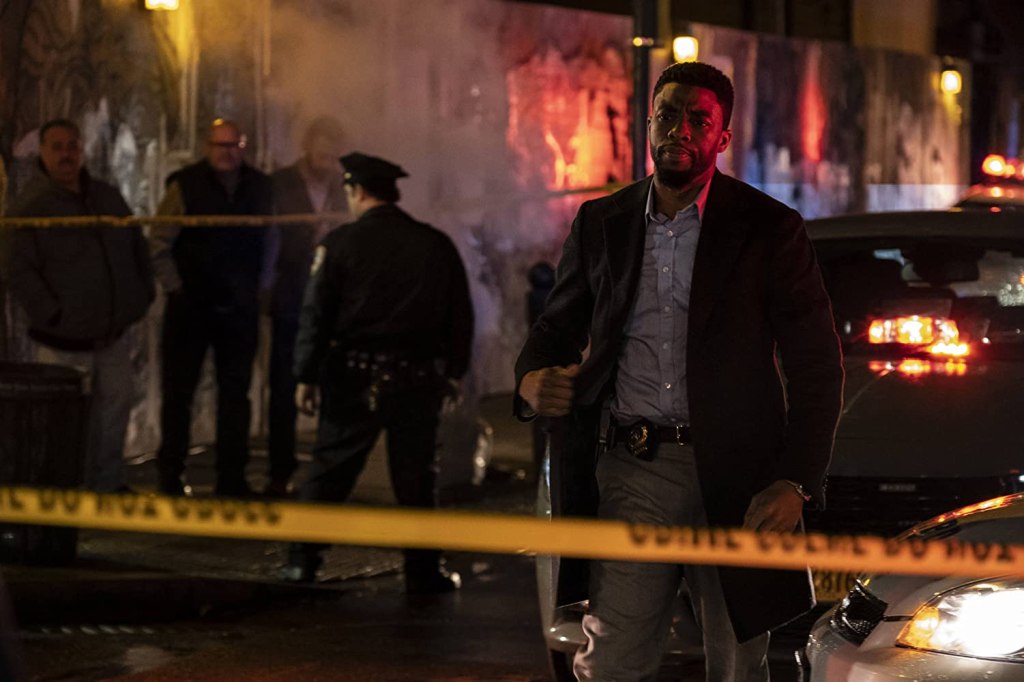
That night, two men hit up a business looking to steal a little coke. Turns out, it’s a lot of coke. Mike thinks they should walk away, but Ray insists they carry on. Mike was probably right, even before they’re interrupted by cops. The deal’s gone sour very quickly, and when they flee with 50kg of pure cocaine, they leave behind the bodies of 7 police officers. Detective Andre (Chadwick Boseman) is on the case, and local precinct captain (JK Simmons) doesn’t so much imply as order him to find “just cause,” and quick. Andre orders the island of Manhattan to be shut down, all 21 bridges, while he and partner Frankie (Sienna Miller) hunt their suspects.

At this point, Ray (Taylor Kitsch) and Mike (Stephan James) know they’re pretty much fucked, but with cops one step ahead of them, they begin to realize that this is way bigger than a mere $6M in stolen coke.

Trigger warning: this is a rough film if you’re feeling traumatized by law enforcement right now. No-knock warrants, corrupt cops, and someone in police custody literally saying “I can’t breathe.” It’s a cliche for a reason: these things really do happen this often.

But as much as I like seeing J. Jonah Jameson and Black Panther hanging out in New York City, this film could probably use a little Spider-man. It could use a little something, anyway; a little something to believe in might have been nice. 21 Bridges is a competent action crime drama, and Chadwick Boseman is a solid leading man, but the film just never quite takes a stance, and in the face of this much filth, you kind of need it to.

The Courier

Ezekiel Mannings (Gary Oldman) is a very bad man. His job title is literally “crime lord” on his business cards (okay, the business cards are unseen in his wallet but I’m SURE they’re there) and he’s awaiting trial for what I’m also certain is just a small fraction of his many crimes. Or perhaps I should say he is not awaiting trial so much as the trial is waiting to hear from one key witness – Nick Murch (Amit Shah) – whom a federal task force has been protecting so he can deliver his crucial testimony, ie, he saw Ezekiel Mannings murder someone right in the head.

You don’t need to see Mannings’ business card to know he’s a bad guy: he wears an eye patch. Which is a statement. Of Evil. I’ve known a few people without a full set of eyes and they’ve never elected to go with the patch. Glass eyes look surprisingly good if you’ve got a socket that wants filling. The only eye patch I’ve ever seen in real life is the little band-aid coloured ones that kids sometimes wear to help correct a lazy eye, and those are quite adorable and definitely don’t count. I’m talking all-black, special ordered from the pirate store, cover of Evil Monthly magazine, doubling down with a goatee, eye patch.

Nor do you need to see Nick Murch’s business card to know that he’s a nerd. Probably an IT guy. He’s nervous and jittery, and his outfit has definitely not been approved by a woman. I mean, he’s got reason to be nervous and jittery. He IS about to testify against a really bad dude, and the whole case basically hinges on him as a witness. But before he can video conference in (from an unspecified European location), a courier (Olga Kurylenko) arrives at the safe house to deliver a package. Spoiler alert: it’s a bomb. A lot of people die, and someone’s even trying to kill her, but instead of fleeing for her life, she volunteers as Nick’s defacto bodyguard and personal protector. Basically, she and Nick end up fighting for their lives in an underground parking structure, and they’ll have to do it for an hour before the cops arrive (why an hour? who knows. but it’s a great little conceit to put some real-time pressure on the situation). Agent Bryant (William Moseley) and his sniper (Greg Orvis) are particularly persistent.

Is this a good movie? No. We never get a satisfying explanation for why this nameless bike courier would stick around to fight a fight that isn’t hers. Or why she’s so darn good at it; “military” hardly covers it.

The violence is…extensive. As in face caved in. As in literal terminal velocity when a body hits a brick wall so hard the skull cracks open like an egg. As in any foreign object with a somewhat pointed end will soon be lodged in someone’s body cavity. And the victim will always agonizingly pull it out, with a flourish of spurting blood. This became such an odd pattern I started chanting “pull it out!” pull it out!” and they always did, even when it was a 3 foot metal rod through the throat.

And to even out the odds, the bad guys were of course prone to soliloquizing, always pausing for one last smug speech just long enough for the heroes to once again narrowly escape certain death. The brutality was so unending that I didn’t really care which side won as long as everyone just stopped getting up. And also: what’s up with this parking garage where a gun battle to the death can be staged for over an hour and not a single person even ran to their car for a stick of gum? I’m suspicious.

Now there is some merit to a movie with mindless violence, I suppose. A time and a place for it, at any rate. But this wasn’t so much mindless as mind boggling. Turns out the eye patch was the least of my worries.

Dying to know more?

Mope

Just on the off-chance that your internet browser history is squeaky clean and filled with wholesome pinterest pies and youtube videos of puppy piles, I offer you this:

Mope (in addition to other definitions, of course) (noun)

a bottom-tier porn performer willing to do the dirtiest, most depraved work in the business

We first meet Steve Driver (Nathan Stewart-Jarrett) and Tom Dong (Kelly Sry) as they sit among a bunch of men in their underwear. As soon as a light turns green the men cheer, and then start chanting “Bukaki, bukaki!” like a rallying cry, which I suppose it is, to their junk. Another definition:

Bukaki (both a verb and a noun, I think) (it’s filthy, so feel free to look away)

to gather around a woman and cum on her face as a group

The men keep up the chant as they circle around a naked woman named Treasure who is kneeling on a tarp, which should, in theory, be unnecessary, as all the men have only one target in mind. They all, more or less, hit their mark, with only Steve left in the end, still trying to get the job done. Tom offers his (moral) support, which helps push Steve over the edge, and poor Treasure’s face is indeed glazed like a donut. Tom and Steve become instant friends.

For some reason, Steve and Tom are desperate to break into the porn industry, which is why:

a) They agree to a ball-busting audition. I’ll spare you the textbook definition because it pretty much is what it seems – only remember, porn stars don’t wear Toms or ballet flats, they wear 9 inch platform heels.

b) They also agree to share a dorm and split a single salary between them.

But these boys are ambitious. They don’t want to be mopes forever, they want to be porn stars. They pitch themselves to director Rocket (David Arquette), the “auteur of porn,” as the Jackie Chan and Chris Tucker of adult entertainment. It…doesn’t work out for them. Nothing works out for them. The universe is telling them that porn fame is not in the cards for them. Tom accepts his fate, happy to fix up the studio’s subpar website, and contribute to a gang bang once in a while, but Steve is fixated, and maybe a little unstable.

The movie feels almost as amateurish as the porn scene it describes. It also fails to really justify itself as a film even though it’s an (apparently) true story. The script doesn’t generate much sympathy for these characters, who remain unlikable at best, nor does it ever quite find their humanity. This is a piece of shock cinema unlike any other, but that’s not a redeeming quality. The movie goes off the rails in the finale minutes of the film (you wouldn’t believe it if it wasn’t true), making for some memorable cinema, but memorable in the way that trauma is memorable. If only you could forget it. It’s not good for the soul, and I wholly regret having undertaken it.

Handsome Devil

Like many of you, when I heard the title, I naturally assumed the movie was about this guy:

His name is Herbie but he literally answers to Handsome Devil, a name he lives and breathes every single day.

It’s quite effortless, and quite evident in his swagger. But anyway,contractually I have to eventually boomerang this runaway movie review and get back to the topic at hand: handsome devils who are not my verygoodboy Herbie.

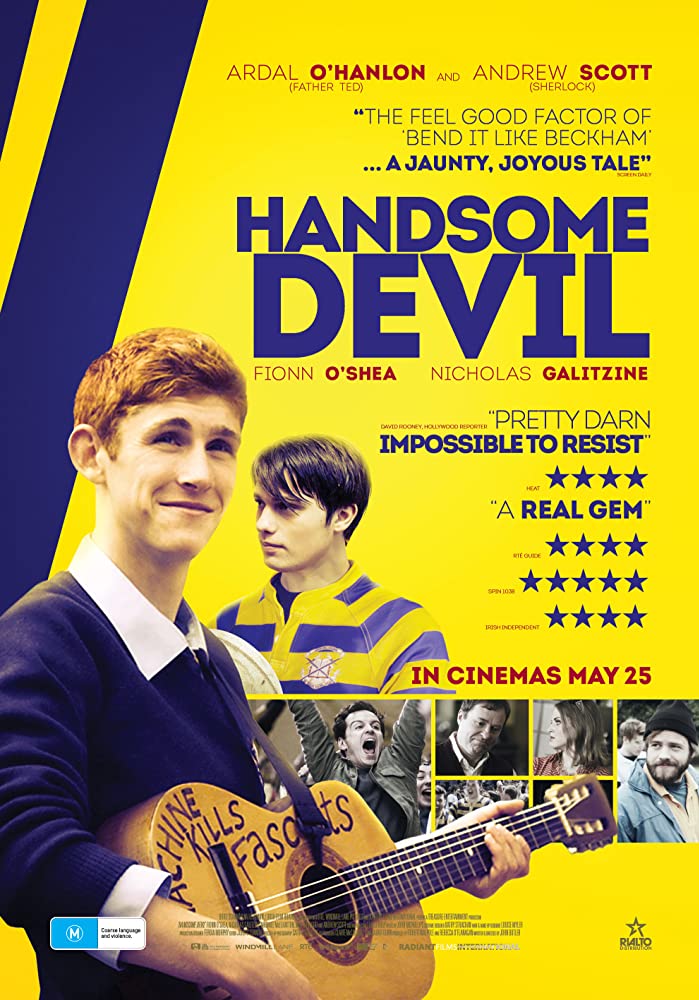
Enter: Ned (Fionn O’Shea). He’s a teenager at boarding school, a constant target of bullies because he’s gay. And then the worst thing happens: the new kid Conor (Nicholas Galitzine), star rugby player, rooms with him. Which means all the jocks (aka bullies) now have an open invitation to hang out in his bedroom, and Ned no longer has a single safe sanctuary on the entire campus. Nor does he own enough boxy furniture to build an adequate barricade around his bed, but that doesn’t stop him from trying.

As you might guess, the proximity does eventually break down their defenses (literal and figurative), and Ned and Conor start to bond. They’re not so different after all! With the encouragement of the new English teacher (Andrew Scott), who challenges students to find their own voices, the two boys find common ground in music.

A simple message, but one we apparently still need to hear. People fear what they don’t know, but all it takes is one friendship outside your normal social circle to expand your horizons and overcome some of the invisible barriers between us. The differences between skin colour. sexual orientation, gender, etc, are superficial at best. Friendships, relationships, even just basic respect – these are based on our shared values and interests.

School is not always a safe space for queer kids (or different kids, or kids), and we’ve been telling them ‘it gets better’ for a long, long time. Which is true: it does get better. But it’s nice every once in a while to hear a story where better starts happening NOW. Queer cinema can often be a bit of a tragedy fest, and while it’s important to remember those experiences as well, it’s really nice to celebrate the victories. O’Shea and Galitzine have a wonderful, subtle chemistry, and give their characters an authenticity I know a lot of us will relate to.