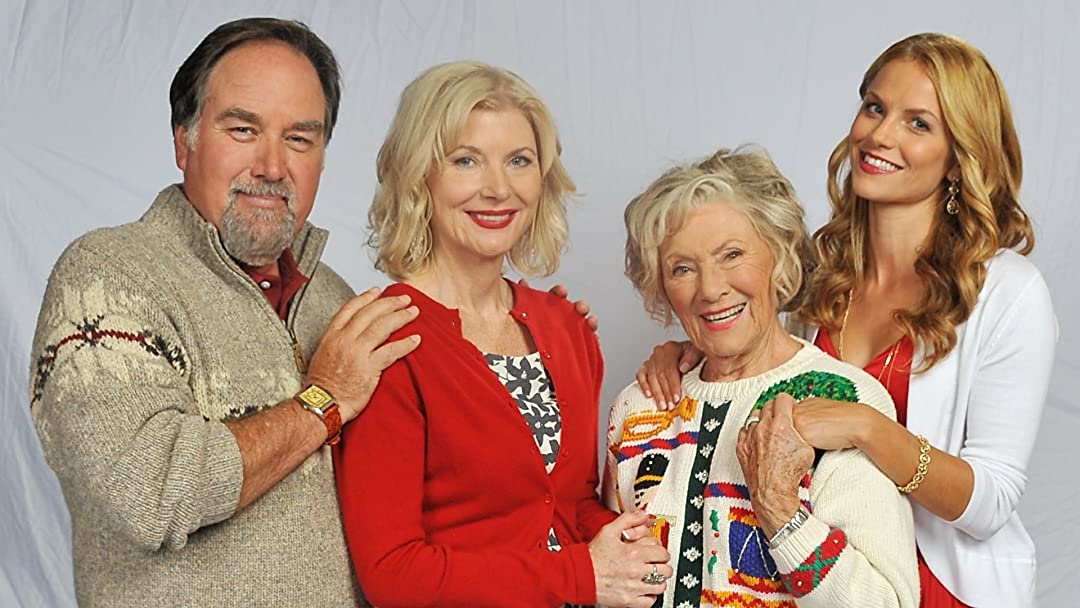
Never say a dying grandma can’t milk her last breaths for all they’re worth – Evie (Marion Ross) certainly does. Recently discharged from the hospital, she’s laid up in her daughter’s home, and with granddaughter Sara (Ellen Hollman) home for Christmas too, she schemes to reconnect the estranged mother-daughter duo with the perfect Christmas list. Will it work? And will grandma still be around to see it?
Evie’s list has some fairly banal items for Sara and mom Michelle (Beth Broderick) to cross off together: bake cookies from scratch, cut down a real tree, do some work for charity. Typical stuff. Normally they’d be triggering each other left and right and tearing each other’s hair out, but with grandma’s imminent death hanging over them, their usual bickering seems trivial and they’re managing to mend the rift.
Don’t worry, don’t worry, there’s a little wiggle room in there for romance. Grandma’s hot doctor makes house calls. Dr. “call me Brandon” Reed (Aaron Hill) is, like so many men in holiday romances, almost too good to be true. He’s an attentive doctor but he’s also Mr. Fix It, working a side gig as a handyman to make spare cash for an orphanage where he spends all his free time. His only flaw is that he buys bacon flavoured butter, and let me be clear, that’s not necessarily a flaw in my book but in Sara’s, and clearly it’s not a deal breaker for her either.
A Perfect Christmas List deviates slightly from the normal formula in that its main focus is on the three generations of women, and repairing a broken relationship before it’s too late. These types of movies often espouse family values, and they always make sure the heroine has interests and friends outside of her romantic relationship, which is kind of refreshing if you think about it, and very nearly (dare I say it?) feminist. She’ll always have a best friend, or a close coworker, or a solicitous sister, or a mother she doesn’t go a day without calling, and she doesn’t drop them just because she met a man. And the holiday romance man is not only okay with that, he actually likes your mouthy best friend. He checks on your mom. He fits in seamlessly with your family. Dr. Brandon has a crush on Sara but understands that she’s making time for family right now. And when she does have a free moment, he doesn’t jump to her beck and call, he honours his commitment to the orphaned children and trusts that Sara will wait. Call it corny, call it idealistic or even unrealistic, but let’s also think about calling it GOALS.
Artemis Fowl is a series of quite beloved fantasy novels written by Eoin Colfer. If you are a fan of the books, may I suggest you put that aside right now and meet Artemis Fowl the movie as a similarly titled but only loosely based third cousin twice removed type situation.
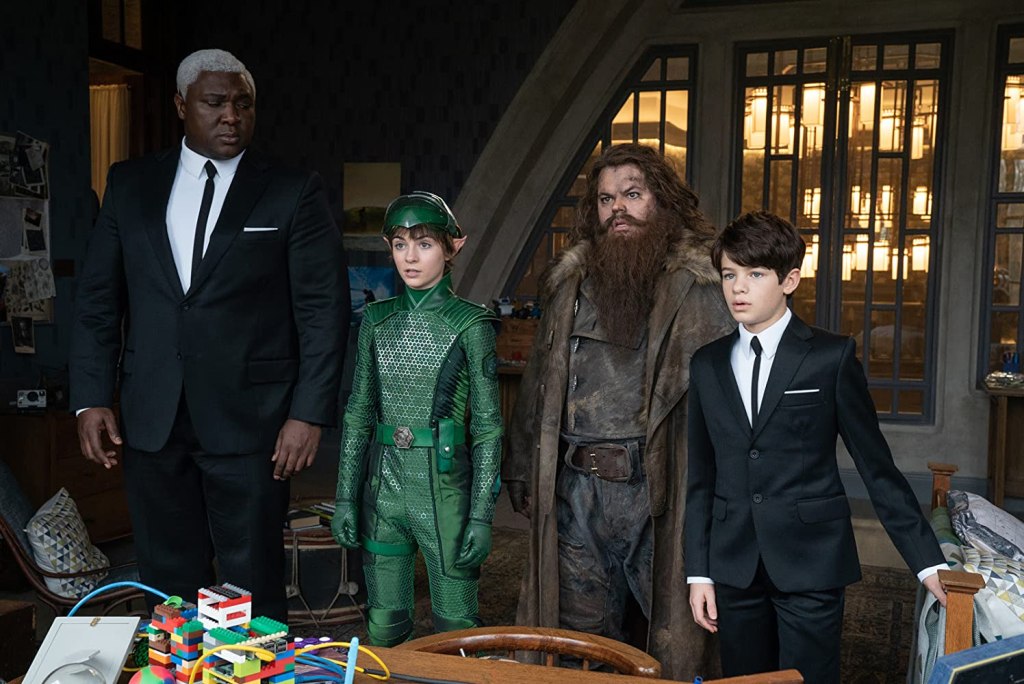
Artemis Fowl (Ferdia Shaw) is a 12 year old genius rambling about his big old house in Ireland with only his definitely-not-a-butler manservant/bodyguard Domovoi Butler (Nonso Anozie) for company. He learns from TV that his father (Colin Farrell) has gone mysteriously missing (is that redundant? i think yes) and also, I think, that he’s behind some major art-thievery. Which is when Alfred Mr. Butler gently guides young Bruce Artemis down to the batcave secret lair and lays some truth on him: he comes from a family of criminal masterminds. He’s meant to be some sort of prodigy villain, and so donning the batsuit and sunglasses, he receives the obligatory ransom call and gets down to saving the world or maybe just his dad, I’m really not sure, this part wasn’t entirely clear to me.
Meanwhile, keeping in mind that Ireland is apparently quite magical, we’re introduced to some non-human characters such as Mulch Diggums (Josh Gad), a felonious oversized dwarf who seems like he would have bad breath, Holly Short (Lara McDonnell), who I think is a fairy, and her boss Commander Root (Judi Dench), who’s in charge of making sure magical creatures don’t mix with humans, and Juliet (Tamara Smart) who is some much younger relation of Mr. Butler’s and whose presence I never quite understood. Also various goblins, elves, trolls, Italians, and even a centaur with a sexy little canter. Most of these…beings…are technically enemies. Well, enemy is a strong word for people who don’t even know each other. Maybe “non-belligerent” is a better term for it, a term I picked up mere moments before watching this film thanks to a Spike Lee movie about the race discrimination and the Vietnam war (who knew these two movies would have so much this one thing in common!). Anyway, it’s hard to keep track of who’s on who’s side and what that side wants and why. And then there’s you know, alliances made and broken, objectives intended and abandoned, just stuff. Presumably. I don’t really know. There’s magical force fields/space-time continuums (?), dislocating jaws, and a coup against an 800 year old stickler for rules.
The movie is kind of a mess. This is a kid’s movie and I’m struggling to relay any of the plot points, and I’m frankly not even 100% convinced there were any, it may have just 90 minutes of pure pixie chaos for all I know. It hurt my brain to try to keep up, but on the other hand it wasn’t really interesting enough to pause let alone rewind.
Those who have read the book(s) will of course bring important supplemental information to the film, which will either a) make it a more pleasant, sensical viewing experience or b) make it that much more frustrating, just a big old soak in a bath of disappointment. I’m guessing it’s b but let’s not marinate in negativity. Let’s optimistically assume that you subscribed to Disney+ hoping for a child’s version of Men In Black where the aliens are now fairies and the good parts are now the suck and the idea of a sequel both frightens and confuses you.
If you wanna hear more, and you know you do: Youtube!
The Vietnam War. Yeah, we all flinch at the words. As a Canadian, I actually didn’t learn about this in school as we were “non-belligerent” (what a term!) (also, we were busy learning about our contributions in WW2, a war America remembers fondly by screaming at random Europeans “we saved your asses!” but Canadians remember as the war we joined immediately because we “thought Nazis were bad” and America ignored for two whole years because “Nazis were maybe okay” and finally joined when “something bad happened to us, on our soil.” Ahem) and I was born long enough after it that there was already a hit Broadway musical about it. But we can’t help having absorbed quite a bit about it, through pop culture of course, and by sheer proximity to our war-mongering neighbours to the south. I knew that it was a tough war because many Americans came to oppose it, which was probably the right attitude, but it meant that a lot of returning vets didn’t get the respect they deserved or the help they needed – which is an American hallmark, actually, by no means exclusive to the Vietnam war. And I knew that bad shit had happened there: we called it the My Lai Massacre; the Vietnamese call it the Son My Massacre, but either way you slice, it meant that 500 unarmedcivilians – men, women, children, babies – were slaughtered by U.S. soldiers. Women were gang-raped and their bodies mutilated, as were children as young as 12. When their cover-up was eventually busted, 26 soldiers were charged with criminal offenses but only Lieutenant William Calley Jr. was convicted. Found guilty of killing 22 villagers, he was given a life sentence but served only three and a half years under house arrest. And for me, the Vietnam war was oddly muddled up with hippies and their peaceful sit-in protests and with civil rights and their peaceful marches. And historically, that’s correct. Some were putting daisies into guns for peace and others were being sent to war, and those things were happening concurrently but not equally. Young black men were being sent to Vietnam in disproportionate numbers while young white men could easily avoid it simply by attending college: Bill Clinton deferred once for college, Joe Biden and Dick Cheney each deferred 5 times. And if staying in school indefinitely wasn’t your bag, your wealth and privilege could work for you in other ways; Donald Trump avoided the draft 4 times with educational deferments but the 5th time Uncle Sam came calling he out and out dodged it – his father called in a favour from a Queens podiatrist who wrote up a false diagnosis of “bone spurs” even though he’d been found physically fit to fight just two years prior and has since said it just “healed up on its own” with no treatment necessary!
Anyway, black civil rights leaders, including Martin Luther King Jr., were opposed to the war for exactly this reason. Once again, black men were being asked (well, told) to serve their country, and there weren’t any colleges or doctors writing bogus deferrals for them. They were asked to protect the freedoms of people in other countries when they still didn’t have that at home for themselves. They were called up in greater numbers of course, and were a higher proportion of combat casualties in Vietnam, and African American soldiers encountered bigots in their ranks, discrimination in the field, disadvantage when it came to promotions and decorations, and fewer services if and when they returned home. That’s a whole lot to untangle, but have no fear: Spike Lee is reaching back into the baggage of his righteous anger, and he’s not afraid to tackle these iniquities.
In Spike Lee’s Da 5 Bloods, Norman (Chadwick Boseman), a soldier in 1970s Vietnam, tells us “War is about money. Money is about war. Every time I walk out my front door, I see cops patrolling my neighborhood like it’s some kind of police state. I can feel just how much I ain’t worth.” Spike Lee always ends up sounding prescient in his films, but his trick is simply having the temerity to acknowledge that the patterns in our shameful history march on today.
Many years later, four Vietnam vets, Paul (Delroy Lindo), Otis (Clarke Peters), Eddie (Norm Lewis), and Melvin (Isiah Whitlock Jr.) return to Vietnam to repatriate the body of their fallen comrade and 5th Blood, Norman…and also the pile of gold they stashed along with him. Now surely worth millions of dollars, you might guess that this buried treasure is not going to bring out the best in even the most devoted of brothers in arms. Greed, guilt, nostalgia, regret – these we understand, but Paul’s motivation is particularly murky. Unabashedly sporting a MAGA hat, prone to racist outbursts, he’s convinced himself that he’s doing this for Norman’s honour. But propelled by fury, by a barely-restrained rage for the many ways he and his African American servicemen were vilified for their role in Vietnam, that pile of gold bricks starts to feel like reparations. And this recovery mission starts to feel more like one of revenge – against an enemy that Paul can no longer distinguish.
Delroy Lindo’s performance is the sun around which all the other planets orbit, and like all bright balls of fury, Paul is flirting with supernova. And for his part, Spike Lee has of course never been known for his reticence. As a director, he’s prone to flourishes, allowing Paul’s stream-of-consciousness mutterings to morph into a rousing monologue, staring down the barrel of the camera, staring us down, charging us with his passion and urgency. Lee splices the story of his 5 Bloods with real life footage – Muhammad Ali’s conscientious objections, the Kent State massacre, the Black Lives Matter movement (yes, his film is once AGAIN that prescient, he’s taking the pulse of America right from the jugular, right from its crushed windpipe, his alarm and his agitation a perfect reflection of today simply by being unafraid to hold an honest mirror up to the ugliness of yesterday). His script stresses the cyclical nature of the violence without letting anyone off the hook. Spike Lee’s strength as a filmmaker has always been his point of view, his authorial voice resonating backwards and forwards through time, the immediacy of his plea undiminished.
Da 5 Bloods is as potent as anything Spike Lee has ever done, and possibly the boldest feather in Netflix’s cap. The film is visually arresting, the aspect ratio in constant flux as we travel through time (and our four main actors embody their characters in both timelines, a choice I can only assume is deliberate since Netflix has proven willing to splash out for de-aging, perhaps a nod to these men wanting and needing to believe they are still heroic, still capable, still virile, or a symptom of having glorified the time in their heads, and wanting to recapture that now, before it’s too late). But most of all I admire Da 5 Bloods as an allegory for reparations. Not even an allegory, really, but a template what financial amends might look like and how we can begin to take the next steps forward.
Spoiler alert: it’s Pete Davidson. He’s the king of Staten Island. Supposably. You know, Pete Davidson. The young SNL cast member who told us, from experience, that you shouldn’t choose your rehab while you’re high (I believe “equine therapy” was involved), and who was briefly engaged to Ariana Grande.
Pete Davidson has obviously had his share of addictions issues. He’s suffered from depression, anxiety, PTSD, and borderline personality disorder. His mom got him through high school by bribing him with stand-up in exchange for his attendance. He smokes weed so he can perform. He smokes weed to treat his Crohn’s, a painful medical condition. He smokes weed because he likes it. And maybe he smokes weed to forget his traumatic personal connection to the most horrific day in American history: his father, a fire-fighter, died in 9/11.
The King of Staten Island, a collaboration between Pete Davidson and Judd Apatow, is a semi-autobiographical film about Davidson’s particular relationship/struggle with growing up.
“Scott” (Davidson) is a 20-something pothead who dreams of being a tattoo artist, as evidenced by some very inconsistent ink on his friends’ bodies. One of his canvasses/victims is a 9 year old boy, and you can bet that boy’s father is soon pounding on Scott’s mom’s door. Did I mention he still lives with his mom? He does. His younger sister has recently gone off to college and now his mom Margie (Marisa Tomei) is mourning her empty nest while also not actually benefiting from it because of course Scott won’t/can’t actually leave, drawing permanent stickmen on his friends’ torsos not paying particularly well/at all. But it turns out that tattooing a 9 year old boy has an upside: the boy’s angry father Ray (Bill Burr) takes Margie out on her first date in 17 years. Which, admittedly, is nicer for her than it is for Scott, who isn’t exactly keen to see his dead father replaced, isn’t a big fan Ray, and isn’t thrilled to be displaced by him.
Judd Apatow is of course the king of comedy. He’s paired up with Steve Carell (The 40-Year-Old Virgin), Seth Rogen (Knocked Up), Adam Sandler (Funny People) and Amy Schumer (Trainwreck) – comedians at the top of their game, or just cresting their fame, and Apatow’s gotten career-best performances out of all of them. It’s weird then that this collab with Davidson has set new watermarks for both juvenile humour and serious themes. Together they navigate sacrifice and childhood trauma but manage to season generously with firehouse frat-boy antics. Like most of Apatow’s films, it’s long for a comedy; the script is loose, breezy even, and Apatow gives his actors plenty of space. It’s low-key for the most part, but it hits on both fragility and hilarity with surprising ease. Pete Davidson may not be the most versatile of actors, but he’s good enough to play some version of himself, seemingly relaxed and comfortable, and hopefully somewhat cleansed by the process. Healing comes in all shapes and sizes and grief is a malleable, personal thing. Sometimes it even looks like an R-rated comedy.
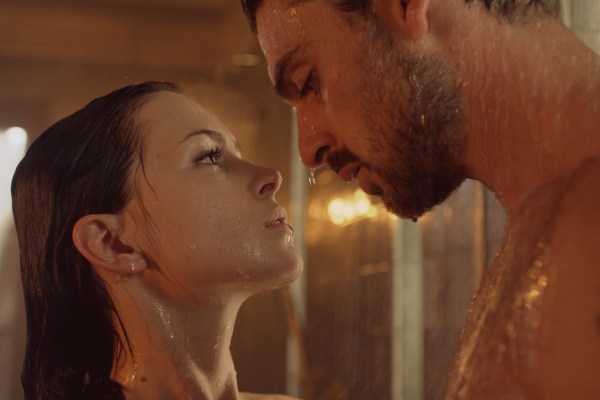
Laura is kidnapped on her 29th birthday by a criminal who saw her in a vision after being shot. The criminal’s plan is to hold Laura captive for one year and wait for her to fall in love with him. And in the meantime, force himself on her at every turn. Essentially, this is a Beauty and the Beast situation, if Beast was a sex offender.
The worst part is this guy clearly believes Laura will love him despite his abuse, or possibly because of it. Has he been watching too much Disney, too much porn, or both?
The second worst part is the English, the low quality of which seems like it’s dubbed, but it’s not. This is a Polish film that uses three languages, Polish for Laura, Italian for the criminal, and “English” for when they talk to each other. I’m almost positive you will recognize many of the phrases in this film, such as:
“Who the fuck you are?”
Or, “I’m not a bag of potatoes.”
Or, “If you feel like running you should wear a different pair of shoes.”
Or, “Why are you looking at it? Do you want to touch it?”
And that’s just a small sample of the prose that’s on offer. Naturally, the “it” in that last one is the rapist’s penis. And naturally, we shut off this movie at that point, much later than we should have. Here’s hoping I can save you from making a similar mistake.
In 1979, James Baldwin wrote a letter to his agent describing his next book, “Remember This House.” It was to be a revolutionary, personal account of the lives and assassinations of three of his close friends: Medgar Evers, Malcolm X and Martin Luther King, Jr. But when Baldwin died, he’d only managed about 30 completed pages of this manuscript. Filmmaker Raoul Peck delivers a stirring documentary as an ode to the book James Baldwin never finished, a work that enmeshes the civil rights work not only of these 3 great men, but that of Baldwin himself.
Samuel L. Jackson narrates some of the strongest and most poetic words – which will not surprise you if you’ve read Baldwin before. He had his finger on the pulse of America, his America, the oft-forgotten America, and he reported on his people with undeniable lyricism, beauty, and confidence.
The documentary expands on his thoughts with archival footage, which is used most effectively when bridging words he wrote 40 or 50 years ago to images of modern conditions and protest, which still apply. I Am Not Your Negro is about civil rights, but it’s also an expression of identity, of unrest, of passion, of hope. He wrote about his people because he saw beauty there, even in the struggle. He was buoyed by it, as much as they were by him. They shored each other up, and as these same issues continue to be fought for even today, it is no wonder we still turn to his words of wisdom and of utter poetry.
Cineplex is offering Canadians a whole bunch of movies that speak to the black experience for free this month – check here for a complete list – and this is one of them, as it should be. I hadn’t seen it since it was released in theatres and Sean hadn’t seen it at all.
It’s been 7 years since this movie came out, but I still remember how deeply it had moved me, saddened me, enraged me, which is why a part of me wasn’t super keen to revisit it. And another part of me was disgusted by that part’s response: the suffering and inherent iniquity of my fellow human beings makes me uncomfortable because IT SHOULD. My ancestors helped create this mess, my privilege benefits from it, and my inaction maintains it.
Oscar Grant III was just 22 years old when he was shot by a white cop while lying face down on the ground. It’s been nearly 12 years since his death signaled a significant problem in policing, and nearly 12 years since we’ve continued to allow our darker skinned friends to die for their melanin. The problem has of course existed as long as policing has; American law enforcement was built in the wake of slavery as a new way to round up black bodies and extort free labour from them, but only in this century has the presence of cellphones allowed these shootings to be captured on film. Grant’s name joins a long list of black men and women murdered by police.
Fruitvale Station is the first feature length film by director Ryan Coogler and his first collaboration with Michael B. Jordan – but not his last. His next film, Creed, gives Rocky fans (and Rocky himself) a strong black protagonist to root for, an extension of Apollo Creed’s (Carl Weathers) legacy, but also a modern American hero for a new audience to look up to. Coogler’s next film takes that premise to an even greater height with Marvel’s first black super hero movie, Black Panther. Through Wakanda, Coogler explores themes of responsibility and identity. He casts Jordan as Killmonger, the fearsome but ultimately sympathetic villain. He helps T’Challa realize that Wakanda’s relative strength and power means they owe something to their neighbours in need, a message that seems not to permeate stubborn white audiences.
Cineplex and other streaming services are also offering another Michael B. Jordan super hero movie for fee this month: Just Mercy. Bryan Stevenson is a real-life African American lawyer who helps wrongfully convicted death row prisoners. Just Mercy is further proof that Michael B. Jordan is himself a black idol, and a major, bankable Hollywood star, living up to his name’s GOAT status.
Black Lives Matter: because of course they do. It’s a statement that feels crazy to have to make, which only makes me realize to a further degree how crazy it must be to have to live it. We support the movement 1000%, without reservation. We are only a little movie channel and we are trying to be better allies by listening and learning. To that end, we humbly offer up a few movies, many of which can be streamed for free, that focus on the black experience.
Bart Bromley is an Aspie; he’ll tell you as much in one of his many long-winded, one-sided “conversations.” Bart (Tye Sheridan) lives with his mother. Well, not so much “with” as very much separately, but in her basement. She (Helen Hunt) leaves his meals on the top stair, and he eats them alone, while watching his filmed-in-secret videos, studying and imitating the people he tapes. Wanting to be like them, or at least pretend more convincingly.
Bart is a hotel night clerk, which, not coincidentally, is a great place to hide a bunch of cameras and really get into voyeurism for real. He doesn’t mean to do anything bad, it’s just that observing people is how he learns to live among them. Inevitably (it seems), one night he checks in a woman who is then murdered in her hotel room. Bart is at home, watching it happen. He sprints back to work and arrives just in time for the detective (John Leguizamo) to find him covered in blood, standing over her body. Not a good look, and Bart’s demeanor doesn’t exactly exude innocence. Transferred to another hotel, he checks in Andrea (Ana de Armas), an even more beguiling guest, one who he can actually talk to. So it kinda sucks when it seems she might end up the next victim.
Sheridan and de Armas are actually quite good in this, which is frustrating because the movie itself is…not. Sheridan’s put in the work, and his performance is convincing, even if I’m not thrilled by how his Asperger’s is portrayed. The real problem is that for a thriller – for a murder mystery! – there are no thrills whatsoever. Not even a frisson. And even though there’s a murderer unaccounted for, we don’t really care. There’s no tension, no real worry. The detective is the most chill, low-key cop you’ve ever met, the mother is strangely hands-off, Bart’s boss is surprisingly accommodating, and Andrea is an understanding and receptive romantic interest. Never has being a murder suspect been so easy breezy!
Writer-director Michael Cristofer doesn’t find anything interesting beyond his basic premise, and he fails to make a significant connection with his audience.
Welcome to near future Detroit, just a few days before a new mind-control signal will be broadcast across the U.S.A. to end crime. In the lead-up to turning on the mind-control switch, anyone trying to cross the border to Canada is shot on sight by the fine, upstanding members of the U.S. Border Patrol. Also, all police officers are being laid off, which puts an awful lot of faith in this new system to be in good working order as it comes online. Oh, and for some reason you have to trade in your old money for new money as part of this switchover.
Anyway, a few idiots decide to stage the last great heist in American history (hence the title) by hacking the mind-control system, stealing a billion dollars’ worth of the old money, driving to Canada, and living free for the rest of their lives. That is literally their plan, word for word.
Why do they want to steal money that the U.S. government has marked for destruction? Well, that’s why I called them idiots in the previous paragraph. Their plan doesn’t make sense. And that’s just the heist. Don’t even try to reconcile the implementation of the mind-control system with little things like the U.S. Constitution or self-defence, or make sense of why people are lining up to kill themselves before this system comes into effect, or figure out why there are numerous large protests IN FAVOUR OF the mind-control system.
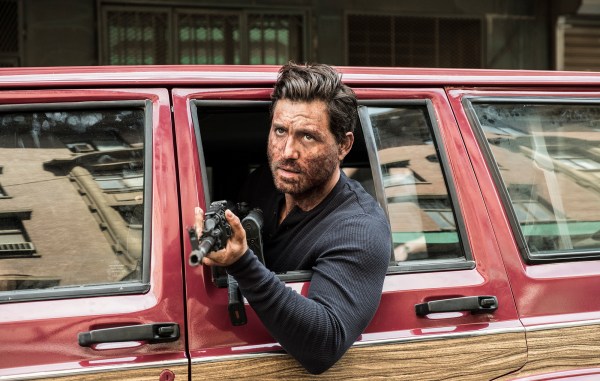
This movie is absolutely intolerable for many reasons but is absolutely unforgivable right now since police officers and FBI agents abuse incapacitated subjects ON MULTIPLE OCCASIONS. All the stupidity in the script pales in comparison to Netflix’s decision to release this in the same week as George Floyd was laid to rest.



 The worst part is this guy clearly believes Laura will love him despite his abuse, or possibly because of it. Has he been watching too much Disney, too much porn, or both?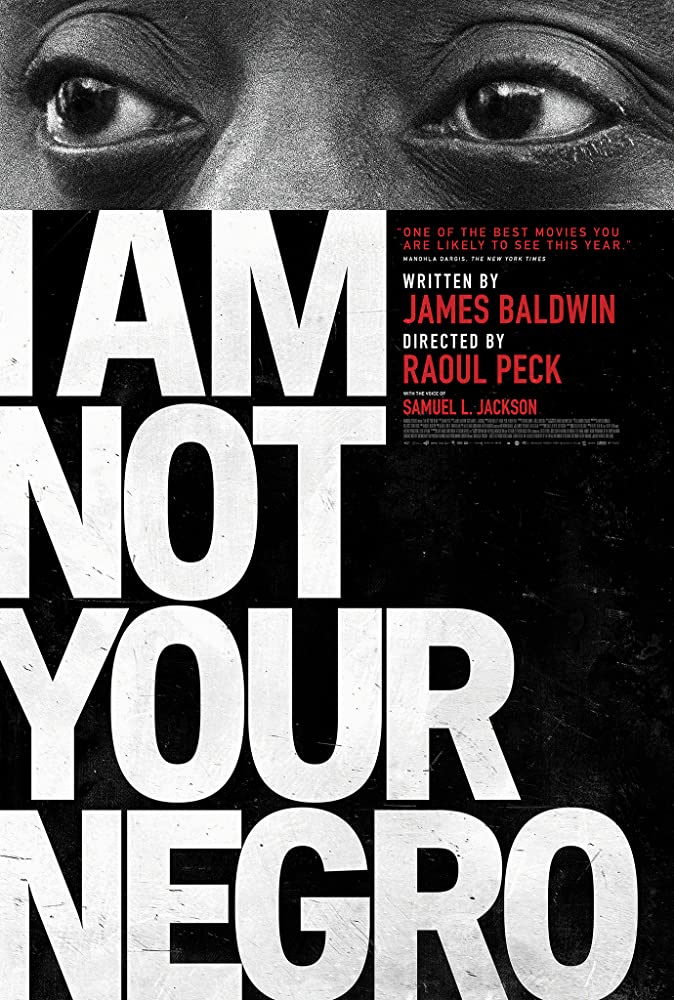
 ASSHOLES WATCHING MOVIES