Nacho Libre

This is such an oddball comedy that its appeal is inevitably very slim. It’s by the same people who brought you Napolean Dynamite, which itself a polarizing film, though it had a wider appeal. Jared and Jerusha Hess have a very bizarre and very specific sense of humour. Nacho Libre isn’t for everyone and that’s okay.

Nacho is a Mexican monk (Jack Black) who cooks bleak meals in an orphanage who has spent his whole life dreaming of something more. The arrival of a beautiful nun, Sister Encarnacion (Ana de la Reguera) inspires him to finally follow his passion of being a luchador. A luchador is a Mexican wrestler; they wear sparkly full-face masks which they never ever remove. Nacho meets a skinny but scrappy homeless man, Esqueleto (Hector Jimenez) and they soon form a wrestling duo that transforms their lives, and that of the orphans. But the monastery wants to shut down Nacho’s wrestling career and the wrestling federation wants to squelch an outsider like Nacho. And Nacho just wants to impress a woman who is technically already married to god.

Anyway, I decided to revisit this movie after our own trip to Mexico a few weeks ago. On New Year’s Eve the resort set up a street fair that included a luchador ring. My nephews, ages 8 and 6 were of course ecstatic but watching it go down live and in person, I found it even harder to take seriously that this movie.

I know that people who like to read posts aren’t necessary the same people who like to watch videos, but if you would take 5 seconds out of your busy day to hit Subscribe over on Youtube, it would mean a great deal to us. Plus it’s free! That’s right: FREE! And then it’s up to you whether you want to stick around and watch the luchador match that we saw while in Mexico, or watch me try my hand at Japanese DIY candy, or Sean choke down a cocktail known as Piss in the Snow. We have a page conveniently labelled Youtube at the tippy top of this site where we try to keep current with our video content. And we’d like to thank you all for continuing to astonish us with your support – your likes, your comments, your frequent visits, be it here or on Youtube or on Twitter or anywhere else – your time is precious and you honour us every time you spare some of it for your little passion project.

Brewster’s Millions

Monty Brewster (Richard Pryor) is a minor league relief pitcher who still dreams of the majors even though he’s a little long in the tooth. His best friend and catcher, Spike Nolan (John Candy), seems a little more content with their lot in life, just happy to still be playing ball alongside his best bud. But life is about to change.

A long, long, long, long-lost uncle of Monty’s has just died, leaving him, his sole living heir, millions of dollars. But there’s a catch:

  1. He has 30 million dollars to spend in 30 days.
  2. He MUST spend the entire 30 million, and if he does so, he’ll inherit a further $300M.
  3. But he can’t acquire assets. At the end of 30 days, all the money has to be gone, to the penny, but he can’t have a single thing to show for it.
  4. He can’t willfully destroy the stuff either.
  5. He can donate 5% and gamble 5% but that’s it – the rest must be spent.
  6. He can’t tell anyone what he’s doing. Not his best friend Spike, not even the paralegal Miss Drake (Lonette McKee) hired to keep tabs on all his receipts.

Ready, set, go! Imagine. Imagine leaving that meeting with a frothy sense of urgency. Imagine leaving the bank vault (this is 1985: it’s all cash) with a pile of money. What’s the first thing you’d do?

Monty makes a valiant attempt: he buys priceless stamps and slaps them on postcards, he prepares his minor league team to play the New York Yankees, he runs a phony mayoral campaign, he treats a lot of people to a lot of champagne lunches. But some of his attempts backfire; his high-risk investments somehow pay off, even his long-shot gambles hit big. Now he’s got to spend those dividends as well!

But the real comedy is that the people close to him look on in horror. To them, he seems to be burning through his windfall at an alarming rate. He seems crazy. And he is, more or less: this mandate to burn through money recklessly is crazy-making. Richard Pryor is a lot of fun to watch in these moments. He can hardly believe his “luck.” And the chemistry with John Candy is pure pleasure. But it leaves you wanting more: more Pryor, certainly, and more unfiltered Pryor in particular. Brewster’s Millions is a PG comedy, and Pryor is not at his best at that rating. So there are times when you’re almost seeing him reigning himself in. I’m certain that a very exciting director’s cut of this movie exists somewhere – or at least out-takes worth their weight in gold. Still, this is a fun, silly movie, not quite as good as others in its genre, but worth it for Pryor alone.

The Great San Francisco Earthquake

First of all, it seems cavalier and irresponsible to bloat an earthquake’s ego with an adjective like ‘great.’ The Terrible San Francisco Earthquake, maybe, or Horrific, or Woeful. You know, out of respect for the dead.

The story of San Francisco’s deadly 1906 earthquake has rarely been reported accurately. Today we think of San Francisco as rather liberal, or more specifically: techy, leftist, flaky, homosexual wine snobs who love bikes and brunch. But it wasn’t always so: San Francisco came into its own during the gold rush, populated by gamblers, adventurers, and prospectors.

By 1906, San Francisco was a wealthy city, the economic capital of the west, but its wealth was a magnet for greed and corruption and nobody embodied that sentiment more than its mayor. San Francisco unfortunately is located not just on the San Andreas fault, but over 7 other earthquake faults as well. It’s not a matter of if, but when. Lots of people told the mayor how vulnerable San Francisco was, and that measures need to be in place in case of emergency, but the mayor was buys lining his own pockets. So when the earthquake hit, it was immediately devastating. And then fires broke out, and spread, nearly unchecked. Aftershocks hit fast and often, hampering rescue efforts. The mayor should have authorized a firebreak but didn’t want to sacrifice the homes of his wealthiest constituents/contributors. Instead he issued martial law, illegal for anyone but the president to do, and had “looters” shot on sight, even though many of the looters turned out to be victims trying to rescue their own meager possessions from the ruins of their own homes and businesses.

With the city a pile of ashes and ruins, efforts to rebuild began, and so did the mayor’s big cover-up. To maintain its status as an economic player, the mayor downplayed the death toll, staking it around 500 thought it is now believed to have been near 6000, or about a fifth of the city’s population. It was also rebranded as a devastating fire rather than an earthquake; fires were a familiar enemy, one that could be understood, and planned for. It was also covered by insurance, whereas earthquakes were not. Photos published in the papers were retouched to look more like fire damage, monetary damage estimates were manipulated. San Francisco was rebuilt by the same shady people who let it be destroyed in the first place. The film is imbued with a sense that its citizens today may soon pay a terrible price for the arrogance and greed of their ancestors.

The Great San Francisco Earthquake is a documentary, but it reenacts its events based on the many first-hand accounts left by survivors in heart breaking detail.

The 15:17 to Paris

I’ve been off Clint Eastwood, and it didn’t exactly take a lot of sleuthing to know enough to stay away from this one regardless. But now that it’s available on Netflix Sean wondered: well, how bad could it be, really?

If you ever find yourself asking that question, give yourself a quick and stinging slap in the face. Better yet, have a trusted friend administer the dose for you if you can. How bad can it be? How bad? You don’t want to know how bad. But if you do, you glutton for punishment, a quick guide to its faults:

  1. Perhaps you know that this movie is based on the true events of a terrorist attack on a train bound for Paris. This is the story of the people who fought the terrorist and the 300 rounds of ammunition on him, and took him down, saving untold lives. That’s an enormously good thing that took place in a matter of seconds. Movies aren’t allowed to be mere seconds long, so Clintwood makes a series of choices to pad the piece. Things like: someone tried to medicate one of the heroes for ADD as a kid! How dare they? And one of them was denied his dream job because he lacked depth perception: scandalous!
  2. Overstuffing the movie with these pathetic attempts to cast its heroes in gold only serves to dilute the actual events of the movie, the very thing that almost everyone would agree were heroic acts just reading a newspaper account of them.
  3. Eastwood seems determined to shoe-horn religious references into the film wherever he can. Toward the end, when the heroes are tending to a gunshot victim, one True American Hero asks him if he’d like to pray and the victim shouts “No!” and his wife, clearly offended, adds “He’s not ready to go!” and their reaction to the proposed religion exactly mirrors my own internal reaction each and every time there’s an awkward attempt.
  4. Worst of all, and it’s bad enough to be the only point on this list, is that Eastwood casts the real-life heroes to play themselves. It’s a terrible, misguided direction. I can’t imagine what Eastwood was thinking. These men deserve credit for their bravery but no one has ever accused them of being capable actors. And since Eastwood brings in Jenna Fisher and Judy Greer in the relatively minor roles of their mothers, he’s clearly not opposed to paying professionals, professionals who only make the amateurs look worse in comparison.

Guys, straight up: it’s painful to watch. I don’t want to dump on the actual guys because honestly, it’s not their fault. No one would blame them for trying to make a few bucks on their claim to fame. This is all Eastwood. He should damn well know better. And the fact that he has continued to receive funded projects post-15:17 to Paris is all the proof that white male privilege is alive and well that we need.

Young Adult

Mavis is immediately identifiable as a character who’s a little stuck. She wakes up in her Hello Kitty tshirt, drinks a Diet Coke breakfast, watches a lot of bad reality TV when she should be working. Maybe her stunted growth is what makes her so successful; Mavis writes a young adult series and maybe she’s a little TOO good at putting herself into that head space.

Anyway, Mavis (Charlize Theron) has a tight deadline, so she does the rational thing and focuses all of her energy on obsessing over an email sent from the current wife of her ex-boyfriend, Buddy. It’s a baby announcement. They’ve just had a baby. Mavis assumes that Buddy’s miserable, trapped in their scuzzy hometown by a wife and now a kid. So she drives to said hometown to test her theory.

Mavis is kind of pathetic and kind of unlikable, and yet we’ve all been her, at least a little. She’s 37 but hasn’t let go of her past – perhaps the last time she felt like a whole, complete person. She peaked in high school: ugh. Gross. But the good news is, when she arrives in crap hometown, she hits a wall named Matt (Patton Oswalt). She doesn’t remember him from high school – she wouldn’t, she was popular, they didn’t exactly run in the same crowds – but he provides the little voice of reason that she clearly lacks. Not that she’s going to let a little thing like reason dissuade her; she reaches out to Buddy (Patrick Wilson) and to our communal chagrin but not surprise, he responds. To his ex girlfriend. Who I’m pretty sure he knows is trouble. While he’s dealing with his wife’s breast milk.

Anyway, Charlize Theron is disturbingly good in this. Disturbingly. Even when Mavis is being so hateful we can hardly keep looking at the screen, Theron manages the all-important drop of humanity that keeps us from throwing in the towel. She finds and celebrates Mavis’ flaws. Without her, this movie could have come off as seriously bitter. Young Adult is dark and dour, but director Jason Reitman plays to Theron’s strengths and pulls off a serious mood.

The Throw Aways

A notorious hacker is captured by the CIA and forced to work for them. They were dumb enough to let the key to a very important cyber program get away and now they’re vulnerable to attack. It was pretty fucking stupid. So now they’ve threatened this hacker with prison unless he agrees to fix the problem for them and he agrees, at least outwardly. Secretly, he assembles his team using the lousiest CIA agents his algorithm can find. They’re a pretty lousy bunch. Boy is this going to be fun!

Last week we were happily lying on a beach in Mexico, reading between trips to the bar. My beach reads tend to be non-traditional at best – the first couple graphic novels in a series, the follow-up to The Paris Wife which is not called but could be called The Kenyan On-Again-Off-Again Wife, and a piece of nonfiction about cyber attacks perpetrated by and anticipated by the American government. It was good enough that I passed it to Sean as soon as I was done, even though I’d already recounted most of the exciting bits to him while bobbing up and down in various bodies of water.

Anyway, that’ s the problem with books. They get you all riled up about a subject suddenly you’re watching crappy movies just to keep the high going (inspired by the same book we also watched The Interview – you may remember that the movie’s very existence got North Korea so mad that they hacked Sony and released a bunch of embarrassing emails, including one in which Angelina Jolie is called “a minimally talented spoiled brat,” one where Kevin Hart is called a “whore,”  and one in which Leonardo DiCaprio (or LDC, as Brad Pitt called him at the Golden Globes on Sunday) is called “despicable.” It is still a very bad movie.)

Don’t watch this movie. Do read The Perfect Weapon: War, Sabotage, and Fear in the Cyber Age by David E. Sanger if you have a modicum of interest. Bathing suit optional.

Togo

I never meant to raise a pack of dogs, it just happened – one dog at a time. First there was Herbie, who was kind enough to allow Sean into the tribe. Herbie was such a swell dog that it seemed irresponsible not to want a second. Thus came Gertie, a tiny little ball of fluff who moved so preciously you might mistake her for an animatronic. Herbie was a good big brother, taking care of his little sister, tolerating her effusive affection. When we moved homes, we got a third, reasoning that Herbie and Gertie would just assume Fudgie came with the property. It would all be one big adjustment that came with more square footage, more land, and one more tiny wagging tail. Three dogs in three years. Fudgie was a quaking, anxiety-riddled mess with lots of kisses and an inexhaustible love of fetch. And then after a hiatus, Sean thought maybe we needed a fourth. And the thing is, nobody actually needs a fourth dog. It tips the scales toward madness. But I’d had a large surgery where basically by body was set on fire in an attempt to burn out the disease. It was painful, and I returned home a mass of fresh oozing wounds who’d wait at home for them to slowly turn into scar tissue. For some reason Sean thought I might need a little cheering up, and a puppy had never failed him yet. Bronx was the runt of his litter, a tiny guy who was immediately intiated into the pack by alpha Herbie, who licked him tip to tail, claiming him.

Togo immediately reminds us of Bronx. He too was the runt of his litter, but like Bronx, he grew up to be a big guy with an even bigger heart. Bronx is an utter sweetheart. He often gets into mischief but doesn’t have a single mischievous bone in his body; he’s simply a bit of a bonehead. He’s still playful like a puppy and he has a big sloppy kiss for every single person he meets. The baby of our 4, he likes having his brothers around him and frets when they are not. Gertie was at the hospital again today, and he cried until she came home.

Togo is a husky, but as the runt, his owner Leonhard Seppala (Willem Dafoe) dismisses him. There’s no room on a serious Alaska team for a useless dog, so Leonhard tries to give the dog away, but Togo is also full of mischief, and finds a way to escape. Lucky for him Leonhard’s wife Constance (Julianne Nicholson) is a lighter touch. She has the tendency to treat Togo more like a pet than a working dog, a real hazard out in the Alaskan wilds, but soon Togo tugs at even Leonhard’s heart.

In 1925, Alaska was hit hard with diptheria. The children in Leonhard’s town were doomed to perish as the life-saving serum was hundreds of miles away, unreachable. But Leonhard decides to make the perilous trip with trusty Togo leading the way. This real-life journey lives in history books but for nearly a century, another dog, Balto, has taken all the credit. To be fair, Balto is just a dog; he isn’t the one who wrote the stories and stole the glory. But it was Togo who deserved the recognition. It was his run.

I have a friend who was born so far north it makes Alaska look like Vermont. She grew up with a team of dog sled Huskies. As working dogs integral to their way of life, the dogs were very well-treated. But they weren’t pets. When the dogs had stopped being useful, they were “recycled” into furs the family could wear. Nothing is ever wasted up north. Though she’s lived “in the south” for a number of years now, it’s still a surprise to her how dogs have a much different role in a family’s life down here.

Togo is a working dog who crossed the line into Leonhard’s heart. He didn’t care if statues were erected in his memory, he just wanted to be Leonhard’s best pal. That’s the wonderful thing about dogs. They live and breathe for you. They fill your life with love and light. Disney knows this, and they’ve made voluminous trade in the dog movie business – but they’re not the ones who animated the lie that was Balto. If you’re interested in correcting this particular piece of history, or if you’re simply looking for a movie about a verygoodboy, you can find it now on Disney+.

The Great Gatsby

Nick Carraway meant to be a writer but is lured by the temptation of easy money to New York City for work, and a shack to stay in outside the city, on Long Island. He’s sandwiched between mansions, and across the bay dwells the old money, including his cousin Daisy Buchanan and her husband Tom. But everyone’s gossiping about Nick’s mysterious neighbour, Jay Gatsby.

There’s almost no one more suited to the decadence of The Great Gatsby than director Baz Luhrmann. Certainly Gatsby’s epic parties, brimming with booze, booming music, and beaded dresses, are brought to life with enthusiasm and an orgasmic level of detail under his direction.

But F. Scott Fitzgerald’s seminal novel isn’t just about the excess, but its flip side as well, the roaring/rotten 20s, the social upheaval and the resistance to change. But maybe a novel as ambitious as this, a book that has spoken to us for generations, belongs strictly to the page. Because as much as Baz Luhrmann gets right, the movie never quite grabs you the way it’s meant to. The way it should. Sean is a philistine who’s never actually read the novel (gasp!) and I wonder how his experience of the film differs from mine. For that matter, his experience of life.

Gatsby, you see, is the mysterious figure who haunts the pages of Fitzgerald’s genius work, but in the film, he’s all too knowable, especially when navigated by Leonardo DiCaprio, a muse of Luhrmann’s and an extremely familiar face to American moviegoers. And Tobey Maguire was already over when Luhrmann cast him as Carraway, the news just hadn’t quite made it to Australia yet. But Carey Mulligan as the luminous, quintessential, ethereal Daisy Buchanan? That was right. Inspired, even.

The best thing about this movie is and always has been Jay-Z’s genre-defying soundtrack. Luhrmann is no stranger to pairing period films with modern music to dazzling effect, but hip hop fits 1924 like it was always there, nestled between the cigarette holders and the champagne fountains and the bobbed haircuts. The costumes are a close second of course, every woman dripping with pearls and jet beads and scandalously raised hemlines. The accoutrements are perfection, so right that they almost distract from the fact that the movie itself is just wrong. And it’s not that anyone could have done it better. It’s probably just that no one should have even tried.

Meet The Robinsons

Lewis is abandoned by his mother on the steps of an orphanage. By the age of 12, he’s been through over a hundred adoption interviews with no luck, so he spends his time on inventions that never quite work out. One day his school science fair is interrupted by two interlopers: a weird dude in a bowler hat, and a kid named Wilbur who claims to be visiting from the future. It seems like a pretty dubious claim until his space ship whisks them away.

In the future, Lewis meets the Robinson family, a wacky bunch of people he bonds with instantly. Which is too bad, because for the good of the space-time continuum, he really will have to go back.

This movie feels like it was designed by committee if that committee was a classroom full of kindergarteners shouting out their most favouritest things: robots! dinosaurs! food fights! And Disney’s feeling generous enough to stuff the movie with every last ounce of feedback it received, no idea too outlandish or sporadic to include. A story can be weaved around them all, and it involves time travel and one genius kid with big ideas.

It’s not the best film that Disney has to offer, but it’s got rapid-fire visual gags and a riot of crazy ideas and eccentric characters brought to life by some vivid animation. And eventually it circles back on sweet themes, like family and imagination, things you might expect that Walt himself would have been proud his legacy continues to endorse.

Matilda

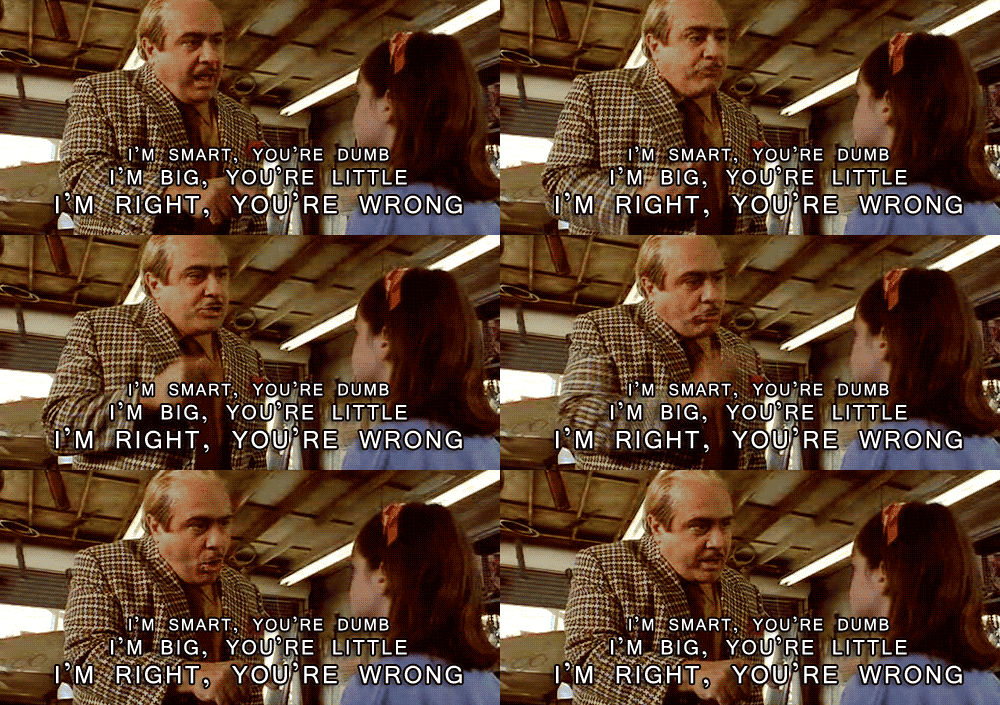
Matilda is a precocious little girl who just doesn’t fit in with her family. Her father’s a crook, her mother’s a bingo hound, and her brother is a bully and a dullard. Six year old Matilda is mostly left to her own devices, which is probably for the best. She devours books from the local library but isn’t sent to school until the elementary school’s principal buys a lemon from her sleazy salesman father and her fate is sealed. Now poor Matilda’s got three adults on her case: her buffoon of a father (Danny DeVito), her flighty mother (Rhea Perlman), and the horrid Mz. Trunchbull (Pam Ferris).

It turns out Principal Trunchbull doesn’t just terrorize the students at her school, but the teachers too, and Matilda’s sainted teacher Miss Honey (Embeth Davidtz) in particular because it turns out Trunchbully is also the mean old aunt who raised her. So Miss Honey and Matilda have loads in common, aside from the fact that they both read at the same level. They’re both looking to replace the misfit families they were born into.

As a story for children, Matilda is a bit of a weird one. It turns out that Matilda has special powers that come in handy when an adult in her life treats her unfairly. And objectively, the adults in her life are deserving of her scorn, but they’re wildly drawn caricatures, sadists and criminals. I suppose Roald Dhal wanted to acknowledge that sometimes children feel powerless and small and Matilda gets to confront this imbalance in a way that most little kids never will. They’ll simply wait to grow up and hopefully do it to their own kids one day. Such is life. Matilda gets to exact her revenge now, and it’s exactly the kind of revenge a 6 year old would think up.

Danny DeVito directs this little ensemble and though the effects have aged incredibly poorly, it must be said that the casting of Mara Wilson as the eponymous star was a stroke of genius. She is believable as a little know it all but somehow always sweet, never obnoxious. She never seems like a brat. She’s the kind of kid you might just want to scoop up and take home – so it’s almost understandable when the lovely Miss Honey does just that. Okay, not really. In real life I think it’s much harder to adopt a kid who has two living parents. But in the movie, both Matilda and Miss Honey get their happy ending, and it’s hard to argue that.

However, it’s easier to argue other things. Like when Miss Honey confides in Matilda that her father’s suicide was actually probably murder, and Principal Trunchbull the murderer. Which is a weird thing to unload on a kid. And to not share with the authorities for decades. But Miss Honey isn’t exactly the angelic teacher we’re led to believe she is. She rather passively stands by and watches her wee tiny students get abused on a regular basis. She actually seems a bit like an idiot. But who’s counting?