We are sitting smack dab in the golden days of the Summer of Keanu – John Wick 3, Always Be My Maybe, Toy Story 4 – a real career renaissance for Hollywood’s nicest leading man, a Keanussance if you will, though it doesn’t roll of the tongue quite as convincingly as McConaissance did.
Henry Torne (Keanu Reeves) is a toll booth operator and chronically nice guy in that passive way that drives his wife (Judy Greer) kind of crazy. He’s so nice, in fact, that he goes to prison for a crime he didn’t commit. Accused of bank robbery, he protects a friend (Fisher Stevens) and takes the sentence, losing his wife in the process. His cellie is a crazy man named Max (James Caan), away for life. Henry does his time and eventually leaves prison with one important lesson imparted by criminals more hardened than he: you did the time, you may as well have done the crime.
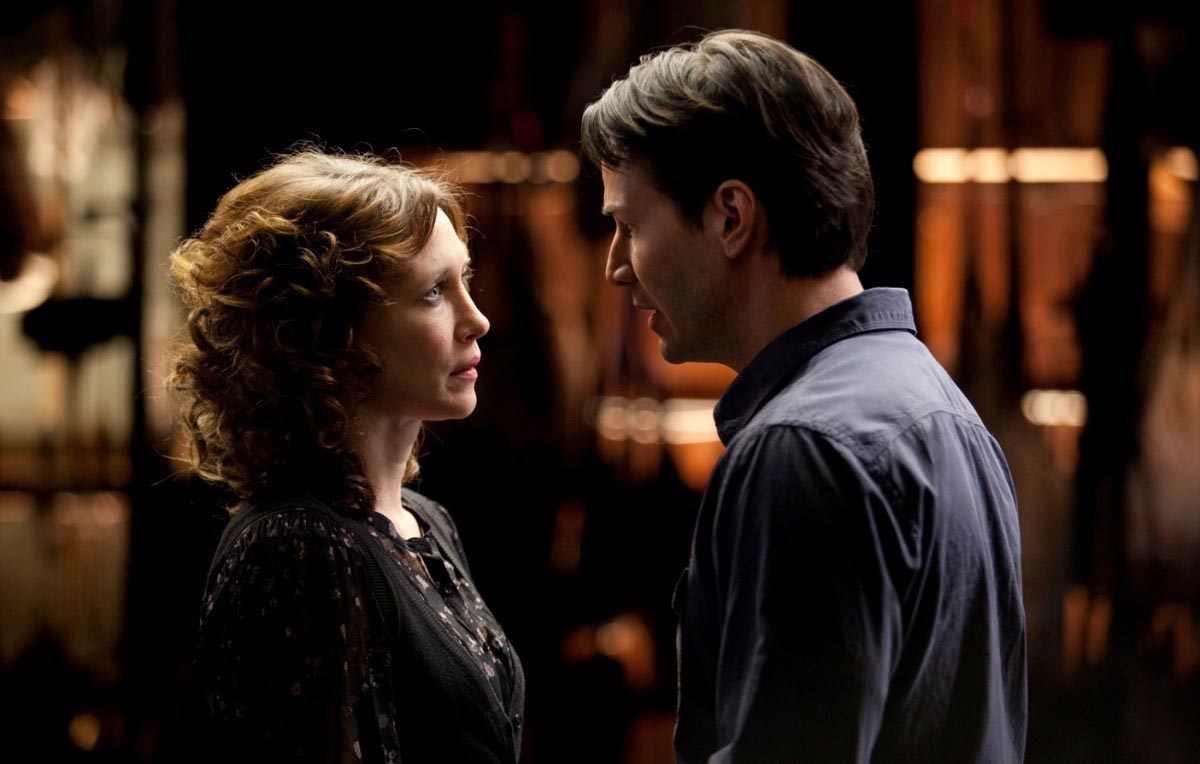
And that thought just niggles at him. So much so that he springs Max out of prison and they befriend a Buffalo actress (Vera Farmiga) who just happens to be doing a play in an old theatre that has a prohibition-era tunnel running from its basement straight to the bank’s vault. Convenient! Love and money, all in one fell swoop.
Of course, Henry is not exactly a professional thief. He got caught – and remember, he got caught for a crime he DIDN’T commit. How much of a disaster is he going to be with the real thing?
Safe to say this film (released in 2011) is NOT part of the Keanussance. Reeves suffers from the coolest of detachments while the rest ham things up. Farmiga in particular is several degrees north of TOO DAMN MUCH. Henry’s Crime is entertaining at times, merely watchable at others, and sometimes it’s just slow and not building to much. Sometimes I’m startled to come across titles featuring several prominent actors that I’ve simply never heard of before, but the reason why usually becomes quite clear, quite quickly. While there are worse crimes than Henry’s, a misdemeanor rather than a felony, it’s still not worth doing time for.
I have always had copies of E. B. White’s Stuart Little and Charlotte’s Web on my book shelf. It’s surprisingly sexy to read them aloud to a partner in bed.
Decidedly less sexy is the 1999 movie adaptation of the world’s 14th most popular mouse (it’s a very informal survey, but how many do you think you could name?).
George Little (Jonathan Lipnicki) wakes up on the best day of his life: he’s getting a sibling! He wakes his parents by jumping on their bed; the movie is too polite to mention Mr. Little’s balls, but as far as I know, kids in the bed results in dad getting kicked in the balls 100% of the time. Anyway. Mr. and Mrs. Little (Hugh Laurie and Geena Davis) are keen to give George a little brother, so while George is at school, they head down to the orphanage to browse the kids and see what’s on sale. Or, you know, “fall in love.” And they do fall in love with a clever little guy named Stuart, who just happens to be a mouse (Michael J. Fox). The social worker tries to discourage the match – adoptions outside the species rarely work, she tells them – but the Littles are not to be dissuaded. They bring Stuart home, clothe him with teeny tiny sweater vests, install the world’s tiniest plumbing fixtures, but tuck him into a normal yet comically oversized bed. There’s only one problem, really: George is terribly disappointed. He wanted a brother but got a mouse! Actually, there IS one member of the family disheartened than George, and that’s Snowbell the cat (Nathan Lane). Imagine being a cat with a mouse for an owner. Oh, the indignity.
So while George is quietly disapproving, Snowbell is actively plotting against him. It’s the nicest situation Stuart’s ever had, but it’s precarious.
Stuart Little is adventurous and colourful; the little mouse gets in exactly the sorts of mischief that kids will never fail to find entertaining. The story offers much less for adults, unless you’re prepared to read the “cross-species” adoption as a thinly-veiled critique of inter-racial adoptions, in which case the rich white family’s triumph is a little less palatable.
Jerry Seinfeld, Jim Carrey, Steve Martin, Ray Romano, Albert Brooks, Ben Stiller, and Matthew Broderick were all considered for the voice of Stuart Little, but it ultimately went to Michael J. Fox, who gives him exactly the right amount of spunk and spirit. He’s a sweet little guy, and well-rendered; for a film that came out 20 years ago, the CGI holds up sufficiently well. I didn’t see this film at the time because it came out in direct competition with Toy Story 2. It didn’t do as well as that one, but it did make more money than Notting Hill, American Pie, American Beauty, or The Green Mile. It was, however, outperformed by The Sixth Sense (and about 10 others) but I mention that one in particular because believe it or not, M. Night Shyamalan wrote BOTH The Sixth Sense and Stuart Little, and was later revealed to have ghost-written another film that year, She’s All That. Surprise! Well it surprised me, anyway. And kind of made me want to rewind and reassess Stuart Little for a twist ending I didn’t see coming. But no. It’s just the cat.
I’ve been on a bit of a kick lately to see what Chris Evans does when he’s not Captain America – particularly since he’s super not Captain America anymore. I think I only really know him from Snowpiercer, which is one of the best movies ever made, so it’s a solid credit, I’ll give him that. But it seems our most civic-minded super hero is super selective when it comes to the roles he takes, which doesn’t necessarily shake out to him choosing only the best. Since Snowpiercer (2013), he’s only been in three non-Marvel films. So yeah, it makes sense that you might want to retreat from that universe, for your own sanity and such (although caveat: his buddy Falcon is along for the ride). 2014 saw the release of both this film, and Before We Go and then there was 2017’s Gifted, which I never saw because Matt called Evans’ performance ‘bland’ and the film “sentimental.’ So when he’s not chasing down bad guys, he’s either drawn to the syrupy stuff, or he’s stuck with it. I know in recent months, as he did the Endgame press tour, he mentioned wanting/needing time off. As the only bachelor Avenger, he was feeling lonely, and wanting to devote time to finding love and starting a family. Which doesn’t mean he’ll be absent from the big screen. At least not for a while. He’s slated to appear in Rian Johnson’s Knives Out later this year, The Red Sea Diving Resort, also intended for release later this year, a limited TV series opposite Michelle Dockery called Defending Jacob, a starring role in Antoine Fuqua’s Infinite next year, and eventually appearing in a film as the only living descendant of Dr. Jekyll and Mr. Hyde. And then: love and babies!
For now: Playing It Cool.
We only know him as “Me,” a screenwriter recently commissioned to write a rom-com. Only problem: he’s never been in love, doesn’t really believe in it. So he and his best friend, also a writer, Scott (Topher Grace) hit the town for “research” which is when it hits him: love. Or, you know, infatuation. With a woman who seems entirely to good to be true, and she is, because she’s already engaged. To someone else, obviously.
But the memory of having met The Perfect Woman haunts him, and blocks him creatively, so instead of writing, he investigates, telling himself he only wants to know her name. ‘Her’ as we know her (Michelle Monaghan), remains elusive, but along the way his inner writer lets loose and he tells a lot of stories, testing himself out as the leading man to see if any of them feel plausible. When he finally finds Her, they try being “just friends,” which means he spends an uncomfortable amount of time begging for sex, despite her still being attached. But he cares about Her, y’all! Does that make it better or worse?
This rom-com swears off all the rom-com tropes. But can it really resist? Actually, some of the language is already quite dated, and those things tend to niggle at me. Like, overt and dirty sexism for no reason. Not that there IS a reason. You know what I mean. But aside from that, what we need from rom-coms is a small dose of sweetness, a big dose of laughs, and just enough wink-wink, we’re-in-on-the-joke to make it all go down smoothly, like a milkshake. You know it’s bad for you, it’s entirely too sweet, but sometimes, you just can’t resist. Playing It Cool wants to be a milkshake but it’s not even a rootbeer float. It’s more like that flat gingerale your mother used to make you for a sore tummy. Evans and Monaghan are effortless together, but the script is totally devoid of character. It’s cool to reject the usual cliches, it’s even welcome, but you have to replace them with something. That’s where the writing part of writing a script comes in. Playing It Cool plays it a little too cool.
The real Apollo 13 mission was largely ignored in 1970. People had already seen men walk on the moon twice before, so this just seemed like more of the same. Interest was so low that lots of news programs weren’t even broadcasting it. Until, that is, things went wrong.
An oxygen tank exploded, which crippled essential systems. The 3 astronauts aboard just had to hang out in an increasingly inhospitable ship as the NASA crew on the ground scrambled to get them home safely. The planned moon walk was of course aborted; they never landed on the moon, just orbited around it. Over the next few days, the spacecraft had limited power, a worrying loss of cabin heat, a shortage or drinkable water, and an urgent need to fix the carbon dioxide removal system or die trying.
America might have been bored with moon walks, but for astronaut Jim Lovell, it would be the culmination of his life’s ambition. It was not to be.
Ron Howard brought this story of NASA’s most successful failure to the big screen in 1995, and still thinks of it as his best film. In fact, he thinks the launch sequence is the highest point of his career, and he’s not wrong. Watching First Man more than 20 years later, it’s clear that Apollo 13 had a huge impact on movies that would follow it.
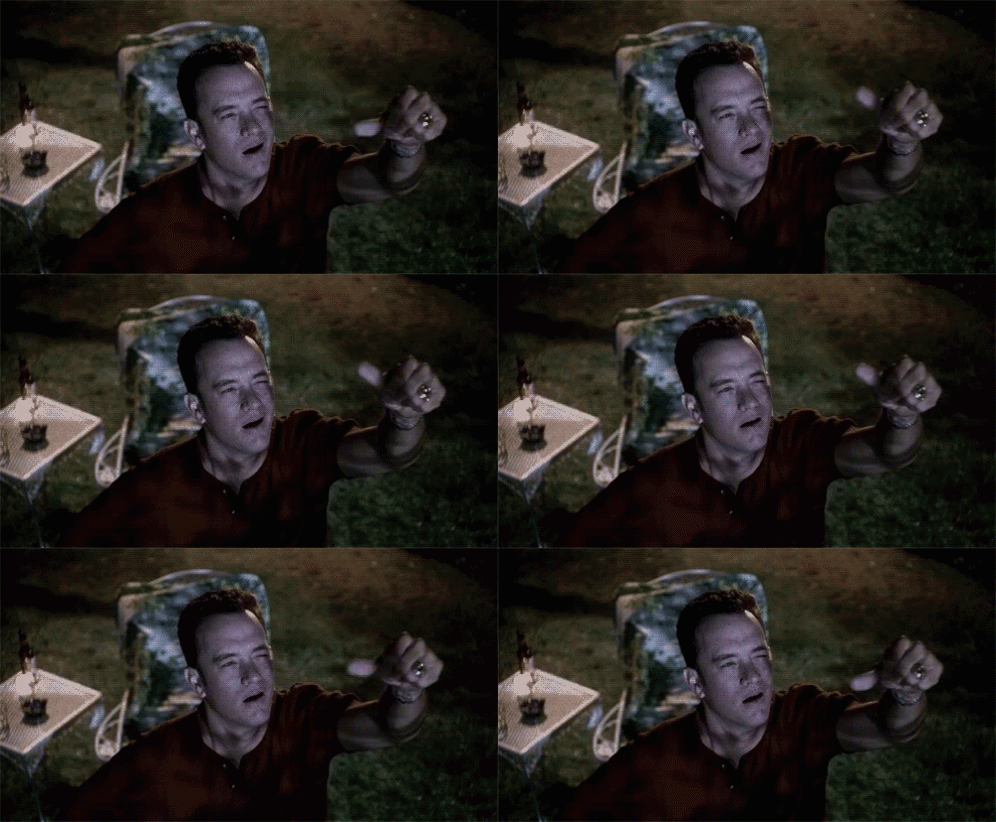
Jim Lovell thought that perhaps Kevin Costner had a passing likeness, but once Ron Howard signed on as director, he immediately sent the script to Tom Hanks, who is a known space buff. Bill Paxton portrayed Fred Haise, while Kevin Bacon got the role of Jack Swigert, who was never supposed to be there. He was only on the mission as a backup, but blood screening suggested that Ken Mattingly (Gary Sinise) might have the measles, and he was replaced last minute. Though this was an undoubtedly heartbreaking switch, it was Mattingly’s expertise on the ground that ultimately helped save his crewmates. He sat in the simulator for days, doing simulation after simulation until he could work out a way to rescue his friends.
The actors, or actornauts as Howard called them on set, floated around in $30K space suits. And yes, they really did float. Steven Spielberg suggested that Howard approached NASA for special permission to use its KC-135 airplane, and permission was granted. Dubbed the vomit comet, the plane climbs to 38 000 feet and then does a big 15 000 foot drop, creating a zero-gravity effect, but it only creates about 23 seconds of weightlessness. For the film’s production, they had the plane perform 612 dives, for a total of 54 minutes of footage. Even still, sometimes when you see the actors just bobbing around in their capsule, they’re actually just sitting on seesaws. Pretending to be in space is hard! [Note: the 3 actors were very proud to report that none of them vomited on the comet…but several cameramen could not say the same.]
It took them 6 days to get them safely home, and while America did not care about a third module landing on the moon, it became obsessed with the imperiled mission that may or may not return. Millions of people tuned in every night, and so did the friends and families of the astronauts on board. NASA didn’t have time to give them proper updates, so they, like everyone else, relied on Walter Cronkite to feed them information. Ron Howard brought Cronkite in to record a few extra reports.
Tom Hanks and Gary Sinise had of course appeared together the year before in Forrest Gump, where Sinise’s Lieutenant Dan says to Forrest: ” If you’re ever a shrimp boat captain, that’s the day I’m an astronaut.” Lo and behold. The movie is full of little Ron Howard nods: Kathleen Quinlan who plays Jim’s wife Marilyn, actually had her first ever screen credit in American Graffiti, in which she played Peggy, a girl complaining in a bathroom about her boyfriend Steve – who was of course played by Howard himself. He also found a role for Roger Corman, the producer who gave Ron his first big break in Grand Theft Auto. Ron’s mother, his father, his wife, and of course his brother all appear in the film. The real Marilyn Lovell is briefly seen in the grandstands at the launch, and the real Jim shakes hands with the fake Jim aboard the Iwo Jima.
Apollo 13 was well-received, and it holds up well almost 25 years later. There are lots of movies about astronaut heroes, but Apollo 13 sets itself apart by portraying the time when someone’s dream doesn’t come true. It takes a story whose outcome is known (and in fact infamous: “Houston, we have a problem”) and still makes it feel tense and compelling.
I missed the Jonas Brothers Happening. I mean, I wasn’t exactly living under a rock, but I was disconnected from pop music. I was going through a rough divorce from a partner whose mental health was on the rocks. I was rebuilding my life from scratch, working hard to finance my fresh start. I was exhausted and exhilarated and my playlist was full of power anthems, a kick-ass score for my happy new life. I remember being in a movie theatre and the trivia before the movie had me guessing between a Jonas and a Bieber, and I was clueless. Although I knew of them, I hadn’t knowingly consumed either – though I knew I’d likely heard their songs in malls or cabs if not clubs – and couldn’t name a song, or a brother. And then just as I was sticking my head up above the sand, the brothers were no more. Well, bands dissolve more readily than blood, but Jonas Brothers was over, and soon enough each Jonas was hitting the radio individually, which made it marginally easier to keep track of them.
Chasing Happiness is streaming now on Amazon Prime; it’s about Jonas Brothers reforming as a band now that they’re adults. A lot of shit went down, which they are surprisingly candid about. I’m obviously not a fan, but their transparency and realness are readily apparent and it’s hard not to get sucked into their particular brand of rags to riches.
They were close growing up, and they were competitive too. Like any brothers anywhere. Or indeed sisters. My sisters and I get super competitive if we’re playing a board game or competing for Mom’s attention, but I guess we’re not talented enough to have Jonas-level game. We’re not even good at the same things. But those brothers are disgustingly talented; any one of them can sing 9 out of 10 top 40 artists right off the billboard any day of the week. And they’re for real: they play real instruments, they write their own songs. Even as kids they were writing their own songs. Fifteen year olds are pretty shitty song writers, but they were so earnest and industrious it’s hard not to admire them anyway.
Few people have experienced such meteoric fame, let alone so quickly, and at such a young age. It’s three literal dreams come true, but enormous pressure too. Their father was a pastor, and he lost his job when his sons chose rock and roll (trying hard not to snigger when I write that), and the family home too. So now these teenage boys are the bread winners for their family. Meanwhile the machine just keeps getting bigger and bigger until it feels unmanageable.
Anyway, even having no idea who these guys really are, I still really enjoy sitting in on their family therapy sessions. Their Christianity and sexuality were on constant display despite them being minors. The media scrutiny sometimes made them into a joke, and their seminal years were tainted sometimes by fear and paranoia. There are cracks in Jonas Brothers, and one of the brothers plugs the crack with a stick of dynamite and lights it up.
Kaboom. Other bands can implode and go their own ways. But these boys are actual family. It’s sad and fascinating and honest. Man. I felt their pain. There’s resentment and betrayal and heartbreak there. Still is. It’s intense. But I really admire their willingness to lay themselves bare. I’m fairly confident that no one reading this has walked in shoes like theirs. But anyone with siblings will relate to this. We’ve all felt that knife. I’ve felt that knife. And anyone whose life changed after kids will relate to this. Anyone who’s grown apart from a best friend will relate to this. Maybe just anyone with a pulse will relate to this. I’ve gone and surprised myself by giving a damn about the Jonas Bros. I think I’m actually recommending this guys. Colour me surprised.
I keep writing this and deleting this because it keeps sounding like I’m describing a nightmare rather than a movie. Which actually should tell you a lot about how much I enjoyed this film.
Suspiria is MEANT to be confrontational. It’s so emotionally and visually confronting I was simply overwhelmed, and got out my ironing board in order to deal. With a buffer of a white denim jacket and a bunch of iron-on patches (including a little gremlin named Gizmo, Wonder Woman, and IT’s Pennywise), I did my best to brave the onslaught.
Susie (Dakota Johnson) is an untrained dancer who arrives in Berlin hoping to be admitted to a venerated dance company run by the fearsome Madame Blanc (Tilda Swinton). Many scoff at her ambition (conceit?), but her audition dazzles the evaluators and just her luck – there’s a spot that’s opened up. Actually, that spot belonged to Patricia (Chloe Grace Moretz), who we saw crack up during the film’s opening scenes. She was paranoid, disturbed, certain that the academy was targeting her for some nefarious thing. And now she’s MIA.
And the thing is, something IS seriously afoot at the dance company. It seems to be a front for witchcraft; the instructors belong to a coven and the dancers are new recruits – either possible witches, or possible victims. Suspicion is met with violence, and the movie LOVES violence, embraces every and any excuse. Even the dance itself feels aggressive, but the gore is second to none. The narrative takes a back seat to the dedicated and repeated brutality, so you can either get in step with the stylized lunacy, or avoid it altogether. Attempting to fight your way through it is probably only going to result in a frustrating and disappointing (not to mention disgusting) cinematic experience.
Do I admire director Luca Guadagnino for swinging so big? Sure. But I don’t have to like it. I was oddly excited for this film because I tend to like a cinematic risk, but Suspiria (2018 edition) proved to be a test of my endurance, and beyond the limits of my patience. To be honest, I was half-lost just by the casting of Dakota Johnson alone. I realize her acting “pedigree” may impress some, but her parents (Melanie Griffith and Don Johnson) aren’t known for being good in things so much as just for being in them. They’re famous, but not exactly lauded. And despite her celebrity parents, Dakota Johnson has still had to break her way in by getting naked (Fifty Shades of Indignity: the series) and has yet to make an impression on me as someone worth watching. Her blandness and blankness may have somewhat been the point in this, but I just don’t find her remotely compelling and I could equally be watching a rock or a potato or the space above her left shoulder and it would all shake out to about the same. Tilda Swinton is of course made for movies such as these, but she gets not one but 3 roles, and at least one of them is trash. Yes, makeup can do marvelous things. But even when Tilda Swinton is made up to look like an elderly man, it was still very obviously Tilda Swinton made up to look like an elderly man.
Did I enjoy Suspria? I did not. I think there’s some trick to melting into a movie like this, but to be honest, we struggled so much just to find the German to English captions, finding the trick and using the trick was clearly beyond us.
This movie meant to be Hank Williams’ Walk The Line, but it fails in every way imaginable.
Tom Hiddleston, as the country-western crooner, is no Joaquin Phoenix, and I do mean that in the nastiest way possible. I’m never a fan of Hiddleston, but in this he’s charmless and unforgivably bland, though it’s at least as much the fault as writer-director Marc Abraham who apparently thinks Hank Williams is the most boring man on earth but decided to make a movie about him anyway.
It doesn’t help that Hank Williams just isn’t that interesting a subject. Oh, he drinks, you say? Cheats on his wife? Squabbles with his bandmates? As if we have seen exactly those issues in better movies than this a hundred times before. And Williams just doesn’t have the allure of Johnny Cash or the talent of Ray Charles or the magnetism of James Brown. He’s just an entitled white dude who made life rough for himself. He made some music and then he died. Hank Williams may be a legend, but you’d never know it from this movie. It makes him seem banal and tiresome. And that’s gotta be hard to do to a man known as the King of Country Music, influencer of Elvis Presley and Bob Dylan, prolific song writer, winner of a posthumous Pulitzer for craftsmanship.
Of course, the film itself is unstructured and just sort of plods along, dragging its feet through the obligatory musician-biopic tropes like womanizing and shenanigans on tour. Abraham seems to be a pretty dull fellow and he’s fully committed to bathing everyone else in that same flat light. The only thing consistent about I Saw The Light is how relentlessly lifeless it is. Neither Hiddleston nor Elizabeth Olsen can do a single thing about it, and you’d kind of expect more from a Loki-Scarlett Witch combo. There should be sparks at the very least. Instead, Olsen’s Audrey Williams (Hank’s first wife) has a heart full of self-interest and their turbulent marriage seems always to be two paths rapidly diverging. Only Hank’s semi-weird relationship with his mother (Cherry Jones) provides the slightest kindling, but that’s neglected and the smoke dissipates before there’s fire. Pity.
Donald Glover dropped a 55 minute short film this weekend – it streamed on Amazon Prime, and at Coachella. Music, TV, movies: there seems to be nothing he can’t do, and do extremely well, at that. His multi-facetedness might be annoying if he wasn’t so actually talented.
The film, Guava Island, is hard to describe. It’s really more a parable than a traditional narrative, so don’t get hung up on that. And all praise to Childish Gambino: do not be surprised when a LOT of his music inevitably pops up.
He plays Deni, just a dude on this fictional island who is about to bring his music to an all-night music festival that’s super frowned upon by the island’s big boss, Red Cargo. Red can’t tolerate a music festival that might mean the island’s factory workers call in sick for the work the next day, a Sunday, including Deni’s girlfriend Kofi (Rihanna) and friend Yara (Letitia Wright).
It’s the perfect setting to talk about corruption, and the influence of art, its ability to unite a people. But it’s not the perfect medium. It’s not that the film is too short, it’s that the idea is both half-baked and heavy-handed. It made me wish it was less of a movie and more of a visual album, like Beyonce’s Lemonade, because that’s when the movie truly came live for me, when Glover lets his music take over and the reasons we love him and frequent collaborator/director Hiro Murai are allowed to shine down upon the island.
Rihanna and Wright are criminally underused; their main purpose is to smile admiringly at Glover. Rightly so, perhaps, but to have both of these women on hand and not give them something to do seems wasteful, and a tease. Maybe this concept works better for a Coachella audience. Few are likely to have stood in place to watch the film straight through, but maybe just standing under its shadow is enough.
I didn’t think I needed The Jane Austen Book Club in my life. Hollywood has taught me that movies based on book clubs just don’t really feel cinematic. But I saw that it was early (2007) Emily Blunt and I was tired of searching for something better, so I settled.
Lesson #1: trust your instincts.
Jocelyn (Maria Bello) has just lost her best friend and life partner, who happened to be a dog. Some may think the funeral is a little over the top, but Jocelyn’s grief is real, and her friends have gathered round to help her through a difficult time – only Sylvia’s husband Daniel (Jimmy Smits) can’t seem to keep the snide comments to himself. Turns out, that’s not the only thing he can’t keep to himself as he soon confessed to Sylvia (Amy Brenneman), devoted wife of a quarter century, mother of his children, that he’s seeing another woman and that leaving the other woman is non-negotiable. So. Jocelyn sets aside her own grief to take care of her flailing friend. Sylvia’s daughter Allegra (Maggie Grace) moves back in so she’s not alone and pal Bernadette (Kathy Baker) has the genius idea to establish a Jane Austen book club to provide a distraction. Since there are 6 novels to discuss, they’re in need of 2 more members. Bernadette brings aboard Prudie (Emily Blunt), an unfulfilled French teacher yearning for more than this provincial life, and Jocelyn recruits a young man and virtual stranger, Grigg (Hugh Dancy), as perhaps bait to liven up Sylvia’s gloomy divorce.
You can already tell that the book club is mostly an excuse to bitch about men (and women), and then we occasionally follow the women home to watch them make their various mistakes in real time, which is charming. Hint: that was sarcasm. The ensemble work between the women is actually pretty good but it’s an otherwise formulaic, sentimental, maudlin piece of crap pushed by Big Kleenex to turn women into weepies. Plus, it can’t help but be compared unfavourably to the Austen works discussed in the film. And that they should have seen coming.
Richard Dunn (Jeff Daniels) is a failed writer, and perhaps just a failure, period. His successful surgeon wife Claire (Lisa Kudrow) has rented him a little writerly cottage in Long Island and gifted him a laptop as well as the time and space needed to get to work on his second novel. Despite that sounding like absolute pure heaven to most of us, Richard doesn’t manage a shred of gratitude. Instead he wonders if this is in fact a trial separation in sheep’s clothing.
So I guess that’s why he doesn’t feel particularly guilty when he spends this time not at his desk but getting to know a teenage girl named Abby (Emma Stone). Abby is a lonely, solitary sort of person, despite the fact that she has a devoted friend and a bad boyfriend. She and Richard are practically kindred spirits, which they discover when he repeatedly hires her as a babysitter despite the fact that he has no kids. Yes, it plays as creepy as it sounds. And yet a friendship blooms in this unlikely, inhospitable place.
Despite Richard’s middle age, he is a child. He is petulant. Self-indulgent, he sees only his own need and sorrow. This is further indulged by his imaginary friend, Captain Excellent (Ryan Reynolds, before he played Deadpool or even Green Lantern), a super hero type in cape and tights who tells him what he wants to hear.
You can imagine what it might be like to be married to a Richard. This is a coming of age tale for a man who is way too old to need one. A late bloomer or just too pathetic for words? Richard straddles that line, uncomfortably. But he’s reaching out, so not all hope is lost. He’s perhaps reaching out to the wrong person, to an inappropriate person. How is this relationship likely to be interpreted – by his wife, or her parents, for example? And yet this is what it is to be human. It’s all about the connection. Richard and Abby can truly be themselves around each other in ways that they haven’t achieved anywhere else.
Jeff Daniels continues to be good in dark roles. Emma Stone is vulnerable and feverish. They’re a couple of wounded characters and they ooze their indie drama. There’s a danger of drowning in all the mutual wallowing. For all its quirk, Paper Man might be lumped into those “man-child-struggling-to-grow-up” films (coming of middle age?), but it is saved by some very compelling performances.






 exactly those issues in better movies than this a hundred times before. And Williams just doesn’t have the allure of Johnny Cash or the talent of Ray Charles or the magnetism of James Brown. He’s just an entitled white dude who made life rough for himself. He made some music and then he died. Hank Williams may be a legend, but you’d never know it from this movie. It makes him seem banal and tiresome. And that’s gotta be hard to do to a man known as the King of Country Music, influencer of Elvis Presley and Bob Dylan, prolific song writer, winner of a posthumous Pulitzer for craftsmanship.
 The film, Guava Island, is hard to describe. It’s really more a parable than a traditional narrative, so don’t get hung up on that. And all praise to Childish Gambino: do not be surprised when a LOT of his music inevitably pops up.
 Daniel (Jimmy Smits) can’t seem to keep the snide comments to himself. Turns out, that’s not the only thing he can’t keep to himself as he soon confessed to Sylvia (Amy Brenneman), devoted wife of a quarter century, mother of his children, that he’s seeing another woman and that leaving the other woman is non-negotiable. So. Jocelyn sets aside her own grief to take care of her flailing friend. Sylvia’s daughter Allegra (Maggie Grace) moves back in so she’s not alone and pal Bernadette (Kathy Baker) has the genius idea to establish a Jane Austen book club to provide a distraction. Since there are 6 novels to discuss, they’re in need of 2 more members. Bernadette brings aboard Prudie (Emily Blunt), an unfulfilled French teacher yearning for more than this provincial life, and Jocelyn recruits a young man and virtual stranger, Grigg (Hugh Dancy), as perhaps bait to liven up Sylvia’s gloomy divorce.
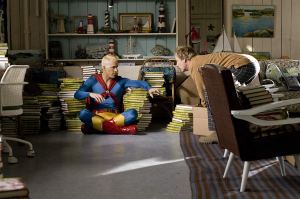 his own need and sorrow. This is further indulged by his imaginary friend, Captain Excellent (Ryan Reynolds, before he played Deadpool or even Green Lantern), a super hero type in cape and tights who tells him what he wants to hear.
 ASSHOLES WATCHING MOVIES