
In the late 1940s, Prince Seretse Khama of Bechuanaland is studying law in Britain to help prepare for his eventual ascension to the throne back home. As the fates would have it, while he’s there he meets and falls in love with a clerk, Ruth Williams, and they plan to marry. One slight hitch: she is a white woman. He is a black African prince. Hard  to say who their love most angers: her family, his constituents, or the status quo. Interracial marriage wasn’t exactly popular in 1940s England, and her whiteness isn’t even the whole problem: her social status is far beneath that of a prince. But they marry anyway, anticipating disapproval, unprepared for the reality of the diplomatic firestorm and political tumult their marriage would actually entail. His right to the throne is threatened, as is her life. He is threatened with exile, she with ostracism. Still, they persist in their love, not just of each other, but for the people of the new Republic of Botswana.
Director Amma Asante did the film Belle, which I truly loved. In this movie you can feel how earnestly she strove for realism: the real home of Ruth & Seretse was used. Their grandson makes a brief appearance. Botswanans were invited to be cast as extras, with 3000 showing up for the first day of filming! The real hospital where Ruth gave birth is used. And the singing during a pivotal scene in which Ruth finally gains a measure of acceptable from the tribe’s women, that was spontaneous and beautiful.
 David Oyelow and Rosamund Pike play the lead roles and you couldn’t ask for a better acted movie. Oyelow is dignified as this humble prince, Pike strong and heart-breaking. They help strike a balance between the passion of their love and the stark reality of apartheid. It would be easy for one of these plot lines to swallow the other, but Asante manages float above it, entangling both, as would have been the case in real life.
It’s an inspiring forgotten story, tastefully and thoughtfully made, but for me, it just failed to really engage. Such a soaring story should really stir you up in the watching, but I found it a bit boring, the story telling too conventional. It’s still a worthy watch for knowledge’s sake alone, but it lacked a true spark.
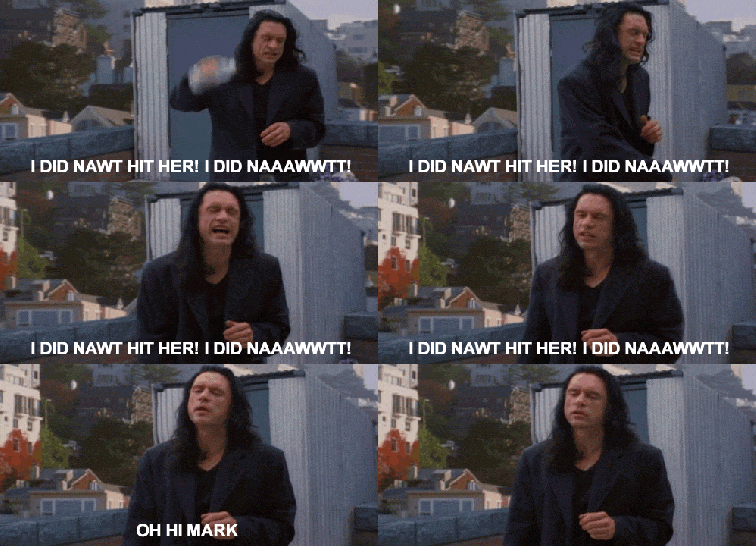 movie ever made, the Citizen Kane of bad movies, a movie so bad it’s achieved cult status. Tommy Wiseau was obsessed with movies and had enough cash to get one made, so he did. And he did it with such earnestness and such a complete lack of talent that people love to watch it. Ottawa’s own
 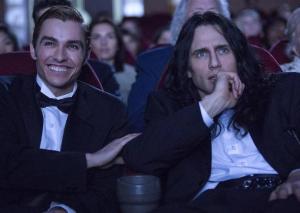 with him. James and Seth debuted
 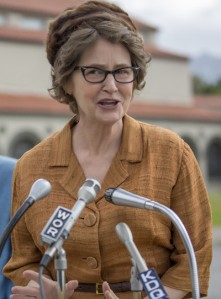 Anyway. This movie is NOT the story of Madalyn’s gleeful adoption of a derisive nickname given to her by Life magazine on its front page (“The Most Hated Woman in America”). No, this film instead focuses on that time in 1995 when Madalyn (Melissa Leo) was kidnapped from her own home, along with her son (Michael Chernus) and granddaughter (Juno Temple) by the likes of Josh Lucas and Rory Cochrane. A friend of the family has trouble convincing anyone that a crime has occurred, and only a reluctant journalist (Adam Scott) pursues their disappearance.
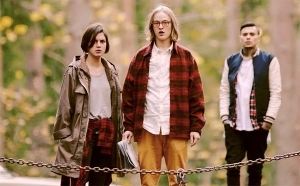 the murders. He talks his friend Elias (Mikael Gabriel) into helping him recreate them, hoping to solve them once and for all, but Elias is in it for the sex, not so much the solving. They coax along two best friends who think they’re going on a very different trip – Ida (Nelly Hirst-Gee) is happy to escape her oppressively-religious home life, and Nora (Mimosa Willamo) is just happy to spend time with Ida.

 I suppose it was to be expected that Ray Kroc, the “founder” of McDonald’s, was an asshole. But, wow, was he ever an asshole. He died well before this movie was made but it seems he would have agreed with that assessment and been fine with it since it got him where he wanted to be – it made him rich, eventually.
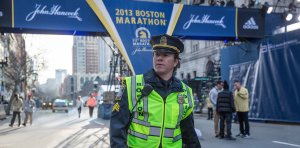 Terrorists are despicable. They take lives or limbs and create chaos and fear, sometimes in support of twisted ideology, sometimes just for kicks, and always demonstrate a complete lack of humanity. Sensational as their actions are, what deserves recognition are not the acts themselves, but the responses by the terrorists’ targets.
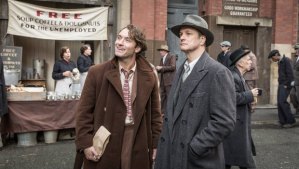 time, counting F. Scott Fitzgerald (Guy Pearce) and Ernest Hemingway (Dominic West) among his authors. They’re all jealous of each other, of course, all big egos with weighty demands on Max’s time, and skill. This movie will make you feel as though editors do not get paid nearly enough. It might also question just who is the Genius referred to in the title – is it the brilliant writer, or is the man editing his writing so that it may appear brilliant to others? Certainly Max is good at spotting talent, but also at shaping it.
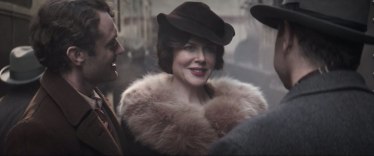 pull necessary to hone a manuscript into a masterpiece. Max Perkins has an excellent track record but still prefers to hide behind an editor’s anonymity, still grapples with the fear of having “deformed” someone’s work.
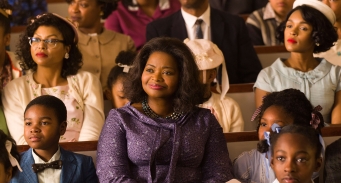 NASA pay them equally? Not by a long shot. Treat them fairly? Not so much. Promote them? Never. But hire them they must because there’s a space race on with the Russians, and they can’t afford not to hire the best and the brightest no matter the skin colour encasing the brains.
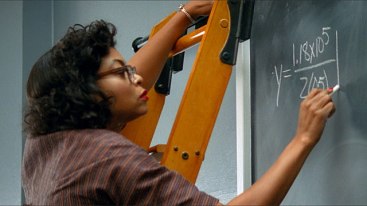 had the audience applauding. These women are so inspirational that it would be hard to mess up the story, and Hidden Figures manages not to stand in its own way. At the Toronto International Film Festival this fall, Pharrell Williams, who collaborated on the score with Hans Zimmer, gave a concert of all the original music he’d worked on for the film. I worried that he might overshadow the film, but in fact his music fits right in very comfortably, establishing the time period in a pop-heavy way.
 ASSHOLES WATCHING MOVIES