Tag Archives: biopic

Mr. Turner

Earlier this week, Matt and I went to the Bytowne, a historic old cinema with a vintage red velvet curtain, conveniently located in downtown Ottawa, to see Mr. Turner. At 3:30 in the afternoon, we sat among a sea of gray hair, the audience makeup largely retirement-aged, discount-wielding seniors here to see “the show”. What show? The early bird show, that’s what! No matter which specific film is showing, it’s all the same if a) you’re going to talk loudly throughout the whole thing, as old people so often do, and the ones directly behind us certainly did with vigour if not with understanding, or b) you’re going to sleep throughout the whole thing, as the old man sitting beside Matt did, his light snores drowned out by the shouting behind us, and his MR TURNERsleeping body obscuring our access to the aisle when we’d finally won our freedom.

Mr. Turner is a biopic about the famous painter J.M.W. Turner, a man far more complex than I ever would have guessed. I’m finding it hard to review a film that I simultaneously felt was very, very good, but also a yawn, so instead I’m passing the buck and forcing Matt into an interview of sorts.

Jay: Mike Leigh is known to be scrupulous in his research and has recreated the last quarter-century of Turner’s life quite faithfully. What this means is this movie is relatively free of conventional “plot.” How did you deal with this as a viewer, and do you believe it was an asset or a detractor to the film?

Matt: I think Leigh’s attention to detail was both Mr. Turner’s strength and its weakness. It made for a production design that was almost above reproach and that was almost always interesting to look at. mr-turner-timothy-spall-3His commitment to historical accuracy was admirable and to his credit, I never felt talked down to as I often do when I got to the movies. Quite the opposite. I think he might have given me too much credit. The danger is a movie can sometimes get so bogged down in these details that it can alienate the viewer and Mr. Turner alienated me. Mr. Turner didn’t just take its time, it was slow and all the facts seemed to get in the way of telling a story.

Jay: Yeah, I thought some of the asides, like the little rant about slavery, kind of took you out of the movie, and definitely added length but not illumination. Other scenes, like when a young Queen Victoria visits the Academy and he overhears her spurn his work, are so much more vital. We see Turner stung by the Queen’s rejection of his work and then lampooned by music hall comedians for his move toward abstraction. He wants to please the public and yet isn’t prepared to compromise his vision to do so. Do you think director Mike Leigh sees himself in this character?

Matt: I don’t know much about Leigh except that I’ve sat through several of his films. Sometimes it’s a pleasure, sometimes it’s a chore. Even my favourite of his films unfold way too slowly for mainstream North American audiences. He seems to tell the stories he wants to tell without compromising his vision and isn’t afraid to alienate viewers with shorter attention spans. So, in tha way, I can see how he would identify with Mr. Turner and that would explain why everything about this movie feels like it Mr Turner scene from filmwas the one that he has been waiting his entire career to make.
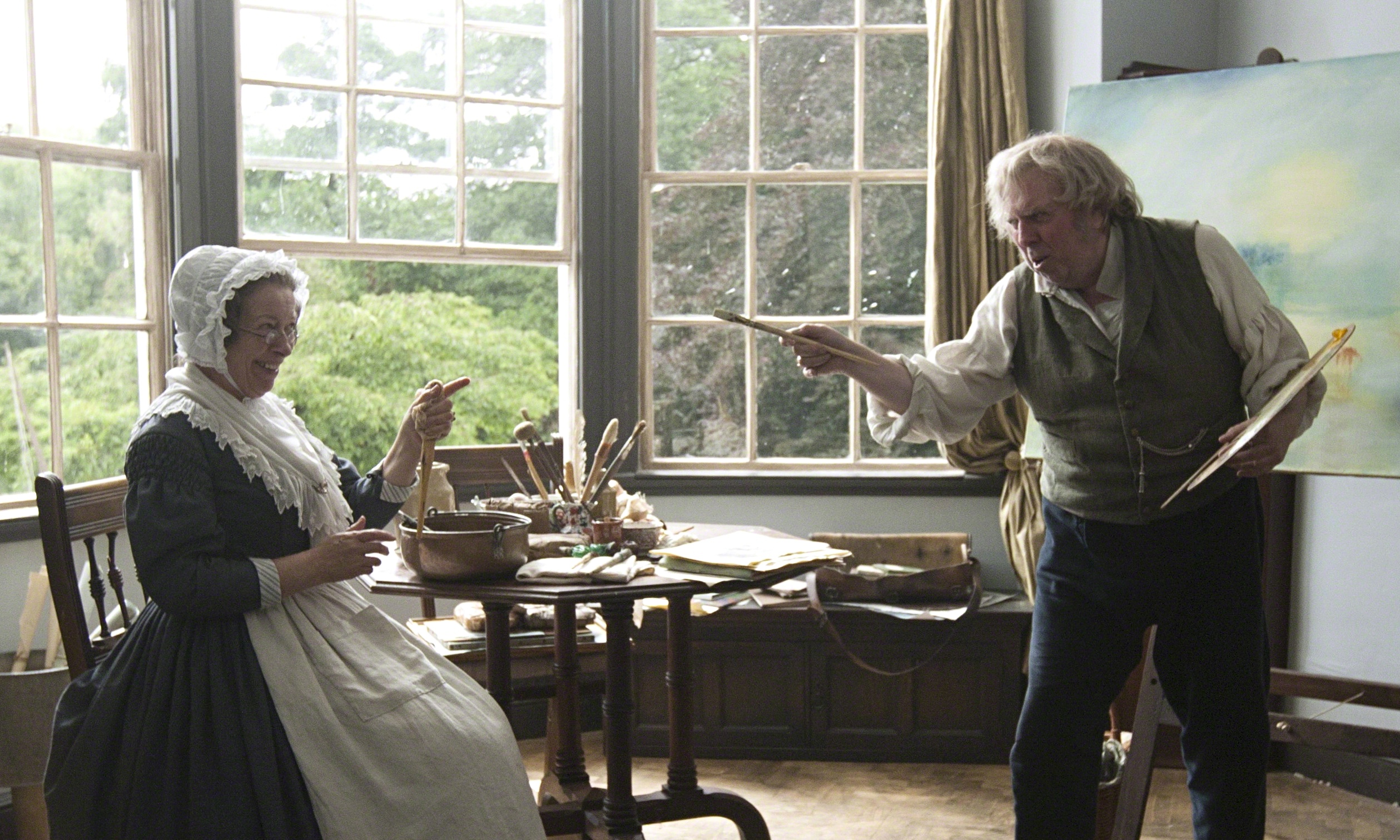
Jay: I think it was in the works for years and years, actually. That being said, I imagine that to pour so much of yourself into a movie, you’d want as many butts in the seats as possible. Movie directors aren’t normally known for making art for art’s sake. He works with a lot of his long-time collaborators, like Dick Pope (or Poop, according to the Oscars), his amazing cinematographer, and this time he also cast his own romantic partner as Turner’s romantic partner, Mrs. Booth. Turner not only neglects his family, but outright denies them to most others who ask. Why do you think that was and why did his attitude toward family seemingly change once he met Mrs Booth?

Matt: Well, this movie threw a lot of information at me so I’m not sure but I interpreted that as shame and embarrassment over having neglected his family. I thought it was easier for him to start over with a new family than repair the damage that he did to his first one.imagesCAC12HG6
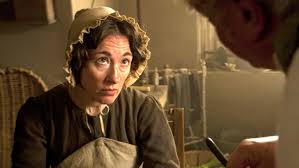
Jay: I felt like he genuinely just didn’t care. Like the art was the only thing that mattered to him. He didn’t have time or interest in relationships, except for his father, whom he cherished yet seemed to treat as a servant. There were so many seemingly contradictory aspects of the character that I can’t believe Spall pulled it off, and with grunts half the time rather than words! Timothy Spall has received many accolades for his portrayal of Mr. Turner, including best actor from the London Film Critics, the New York Film Critics, and the Cannes Film Festival. Usually known as more of a character actor, how do you feel about his failure to earn an Oscar nomination?

Matt: Well, I wouldn’t call it a failure because it was one of the best performances I’ve seen all year. He’s an actor I’ve always admired and Leigh is the only director I can think of who would have the balls to cast Spall as a lead. I think the Academy snub is mostly due to 2014 just being a particularly competitive year when it comes to male lead performances with David Oyelowo already being one of the most controversial Oscar snubs in recent memory. I think the main difference between the Oscars and the awards that Spall has already won is that the Oscars are a huge television event and they have to walk that fine line between being “prestigious” but also putting on a good show. So they want Bradley Cooper and Benedict Cumberbatch to show up. I think the Oscars try to find a balance between the tastes of critics and the tastes of audiences and I think Spall’s snub mostly boils down to Mr. Turner’s failure – or lack of effort – to connect with the general public.

MrTurner1_495_305_c1Jay: Agreed. It WAS a great year to be a man in the movies, but then again, isn’t it always? I mean, it’s great to be a male artist period, as evidenced by Turner himself. He lived the life he wanted while abusing the various women in his life. I like how Leigh presented this to us without judgement. Here is a man, who is both great, and deeply flawed. And I loved how the whole movie took on a glow, like it was a painting come to life. Actually, many of the many scenes n Mr. Turner open in long shot, with this huge, gorgeous landscape and Turner barely visible down in the corner, just a solitary outline of a figure. It kind of reminded me of the “hidden” elephant in one of his canvasses. Tip of the hat to all the film makers who made that feeling possible.

Selma

I know who Martin Luther King was. But this movie made me realize how little I know about what he went through as a leader in the civil rights movement, and it was just a tiny sample of what must have gone on throughout the 1960s (and beyond). It made me want to learn more and I think that is an important accomplishment. It has now been 50 years since the events in the movie actually took place, and I think the horrors that went on need to be remembered so we can try to learn from them (because we do still have a lot to learn). All of this is in the background. This movie would be notable for that alone, and it is hard to separate out the fact that what we are seeing actually happened, which I have been trying to do so I can then judge Selma as a movie and not just as something that needs to be seen as a record of important events.

The events in this movie are horrific. It is difficult to imagine that any of them could ever have happened, but then you remember that things like this still DO happen, that for some reason the USA still can’t or won’t indict cops who kill black people (and it is not just a US problem, the recent incidents just happened to take place there). And still that is only a small part of the big picture, because it is not just “white, black and other”. There are lots of concurrent struggles for equality going on, still, with no resolution in sight. We have made some progress but not nearly enough (and as a straight white male what I would consider enough may not even actually be enough, which makes it even clearer that 50 years later we still aren’t close to achieving real equality).

I would not likely have thought about any of this today if I hadn’t watched Selma, and it goes to show again that regardless of how well this movie was made, I am glad I saw it.  But here’s the thing: this movie is incredibly good. David Oyelowo IS Martin Luther King. He is phenomenal. He would have carried this by himself but he does not need to. Everyone involved is intent on making this movie the best picture of the year. Their love and respect for the subject matter drew me in from the very start. I do not think this movie could be any better. Because of the subject matter I cannot promise that you will be entertained but I can promise that you will be moved.

Ten out of ten. See it.

The Imitation Game

Mathematician Alan Turing (Benedict Cumberbatch) meets a girl at a bar while taking a break from trying to build a machine that can break a Nazi code. She may not be the genius that Turing is but she makes an off-hand remark that helps him see a problem that he’s been struggling with in a new way. He gets this crazy look in his eye and runs off without warning, leaving her wondering what she just said. She has just given Turing his Eureka moment.

I hate Eureka moments in movies and The Imitation Game has a few of them. Actually, there were a handful of scenes here and there that felt lazy and occasionally a little pandering. Worst of all though, they distract from what is overall a fantastic script.

Winner of the People’s Choice Award at last year’s Toronto International Film Festival, some have suggested The Imitation Game as the front-runner for the Best Picture Oscar. They may be on to something. Like The King’s Speech and Argo, there isn’t much special about it except that it’s a good story told very well with healthy doses of dramatic license taken to keep the truth from getting in the way of a good story.

The best reason to see The Imitation Game is Benedict Cumberbatch. Turing is a tough guy to get to know. At first, the film establishes only that he is brilliant at all things math and ignorant of most things social. He’s portrayed almost as a British Sheldon Cooper, hilariously misunderstanding statements that he takes too literally. He uses logic, not emotion, to guide him and at first it seems like he doesn’t feel much of anything. With time, and the more time he spends with new friend Joan Clarke (well played by Keira Knightley), Cumberbatch slowly lets us see a little compassion and lots of pain. By the end, we’re left with one of the year’s best performances and a genuinely heart-breaking ending.


Read another Asshole’s opinion of The Imitation Game.

The Madness of King George

I’m actually kind of partial to the films of 1994 because it was the 1995 Oscar ceremony, honouring the best of ’94, that got me hooked on all things Oscar. In honour of my upcoming 20th annual Oscar party, I decided to check this movie out- one of the few that I still hadn’t seen from that year.

In The Madness of King George, Nigel Hawthorne plays King George II during his struggle with mental illness (never so-called in the film for obvious reasons) in the late 1780’s. The pretty much always awesome Helen Mirren plays his wife Queen Charlotte who has no idea what to do with him. “It was something he ate!” she yells at no one in particular while the King derails a concert by storming the stage swatting away anyone trying to assist him.

The Madness of King George is quite well-done until the photo finish ending where the king races to Parliament to prove that he’s sane again before his son the Prince of Wales, played as a complete dickwad by Rupert Everett, can be declared Regent. I still have mixed feelings about this movie though, mostly about Dr. Willis, played by Ian Holm (old Bilbo Baggins). On the one hand, his theorizing about power’s connection to madness is interesting. All mad men think of themselves as kings, he muses. What fantasy then does a mad king take refuge in? It’s the feedback we get from others, including the insults and constructive criticism that shapes us so how can you keep a grip on reality when everyone around you looks to you as royalty? It’s a good question worth thinking about. Although, with medical hindsight being 20/20, they seem pretty sure now that the king’s madness was due to a rare blood disorder, not believing his own hype.

Dr. Willis’ answer to this is behavioural modification, basically meaning that the patient will be put in restraints every time he misbehaves (e.g. talking crazy, not eating, swearing etc.). Ok, I know that this is 1788 but, working in mental health myself, I was a little disturbed to see this practice potrayed as almost heroic rather than (again, hindsight 20/20) primitive. Compared to the king’s other doctors, of course, Willis was quite forward-thinking. One doctor is hilariously outraged at the impropriety of conducting a physical examination of the king while another just can’t get enough royal crap to examine.

It was hell to be declared mad in 1788. You can see it on the king’s face every now and then, when he becomes temporarily lucid enough to wonder what is happening to him. I would have rather the film focus on this more, instead of finding a doctor to declare as hero just because he is a little less incompetent or inhumane than the rest.

The Theory of Everything

Finally a movie that answers the age-old question: Does Stephen Hawking watch Dancing with the Stars?

Okay, no, it doesn’t answer that. But go ahead and assume yes.

More like, is Stephen Hawking kind of a dick?

You go into this movie knowing that, whatever else, there will be a sure thing on your ballet for this year’s Oscar pool: Eddie Redmayne has already won. You may be less prepared for the fact that at times this movie feels like a companion piece to Interstellar (and I mean that in a good way) and that when the lights come on during the end credits, you’ll be caught in a packed theatre with tears still wet on your face.

This movie is strikingly well-lit. I loved the lighting, the glow, it felt romantic, and helped you remember that in fact this is not so much a biopic as a love story between Dr Hawking and his first wife, Jane. Eddie Redmayne was fairly forgettable in Les Miserables but absolutely claims the screen in this role, capturing expressiveness even in stillness, and showcasing joy and wit not easily conveyed. Felicity Jones, as Jane, may take a back seat on paper, but her performance stands up every bit to his. It’s a subtle portrayal, but strong and sure. Stephen Hawking, the concept, the icon, belongs to us all, but Felicity Jones reminds us that he is a man, and once, he belonged just to her. And there’s so much vulnerability and heartbreak, as a couple once deeply in love are forced into the caretaker and reluctant patient role that chafes for both of them.

I haven’t read Jane Hawking’s book upon which this movie is based. She wrote an earlier one that was much less forgiving, painting Hawking as controlling and almost dictatorish, and you can kind of pick up hints of that even in this second, gentler version, his manipulation of events, his reluctance to express gratitude.

When Stephen and Jane are still a very young couple, Hawking’s father tries to warn her away, saying that this will not be a battle but rather a defeat. He’s wrong and he’s right. Because there is a battle. Stephen outlives the projection by 50 years (and counting). But love is simply not enough. We see love grow, and then wither. And so this movie works much better as a study of love’s ability to withstand challenges than as a traditional biopic. Because I have read A Brief History of Time, and though there are touches, this movie is really “science lite”. It glosses over some pretty major milestones if the measure is the man, and not his marriage. But this is not a story about the failure of marriage because even as it crumbles, it seems a triumph that it lasted at all, and certainly as long as it did.

I wondered what Marsh would make of this movie – he won an Oscar some time ago for his documentary, Man On Wire – but would his work translate? If this was anything other than a story of real, living people, of a living legend in fact, it would be less dazzling. Certainly we’ve got a couple of knock-out performances and some very pretty things to look at, period wise, and even a few well-timed chuckles and some gorgeous gothic backdrops, but pulled together, does it make a Best Picture? It’s hard to say, because of course this isn’t just another period romance, this is the Stephen Hawking story, or at least a piece of it, and it feels incomplete for having just skirted around the outside of his genius. The thing that makes him most remarkable is remarked upon the least, and that feels a bit hollow. I still liked this movie tremendously, and was moved by it, but I suppose I also mourn for the many missing pieces.

Nowhere Boy

Nowhere Boy is about John Lennon’s early years – adolescence toward young manhood, which as we know is not a normal coming of age tale since the nowhere boy was well on his way to becoming the most famous man in the world.

The film shows the influence of two women on John’s life: his mean Aunt Mimi (Kristin Scott Thomas) who raised him, and his absent mother Julia (Anne-Marie Duff), who re-enters his life at a crucial bit, extracting pain but also possibly inspiring artistry.

MV5BOTI2MDM0Mzg5M15BMl5BanBnXkFtZTcwNDI0OTQ0Mw@@._V1_SY1000_CR0,0,1505,1000_AL_Lennon (Aaron Taylor-Johnson) knew Mimi wasn’t his mother, but did not learn his mother’s identity until his uncle died and she showed up to the funeral. He was shocked to learn that all this time, she’s lived in the neighbourhood, must have been watching as he grew up. Julia is the younger, prettier, more outgoing, easier to love sister of Mimi’s. John and Julia’s relationship feels a little like a romance as they get to know each other in a little bubble.

But remember, during this time he’s also meeting George, and Paul. The world Beatles is never uttered, though, because this isn’t about the birth of the band. It’s about one ordinary teenager’s life, and the family secrets and tragedies that ushered him into adulthood.

It constricts the heart a little to know that the man who sang All You Need Is Love didn’t always get it. And if he had, we might not have him, or his beautiful lyrics, or his search for truth and meaning.

Sam Taylor-Johnson directed this film, with input from Paul McCartney and Lennon’s half sister, Julia Baird. It is her feature length debut. Her style is unpretentious, and she knows where her focus should be: on John. On the many Johns. The lesser-known Johns. It’s satisfying, as a biopic, because of its narrow scope. We all know who John became; this film tells us how he became. It’s fresh, and that’s very hard to do when we’re talking about one of the most recognizable human beings on the planet. It leaves behind the expected trappings and delivers only gleeful hints of what might be on the horizon. It’s thrilling to watch because of where it does not go.

Casting was obviously going to be a huge part of the film’s success or failure. Taylor-Johnson admits she was most nervous about finding the right Paul, as he’s still alive to see it. Instead of look-alikes, she went with a sweet-faced actor known to us as the drummer kid from Love Actually, Thomas Brodie-Sangster. But John, of course, makes the movie thrum, and Aaron Taylor-Johnson was its beating heart. With no overt mimicry, he embodies John’s spirit. It’s beautiful to watch.

Monster

This movie came out in 2003. I bought the DVD and watched it once and never again – until now. Fifteen years later, it’s as rough as I remembered.

Aileen “Lee” Wuornos is a hooker past her prime. She meets Selby at a bar one night and it’s the oddest case of love at first sight. Lee (Charlize Theron) is smitten, and self-centered Selby (Christina Ricci) loves the attention she lavishes upon her.

Anyway, girlfriends are expensive. Pretty soon Aileen has to start working the highways again. One night, a trick goes wrong. Not that they’re ever right, but more wrong than usual. A john drives her int the woods and beats her unconscious before waking her back up with sodomy. Oh god. I can’t believe I just described that scene so flippantly! It’s HORRIFYING and I’m traumatized and I’m coping by being weirdly light hearted about it. Anyway, Aileen is in a bad way, but what he doesn’t know and she does is that she’s armed. She manages to to break away just long enough to shoot (and kill) him.

Is it weird to describe murder as empowering? Aileen is unsuitable for any other kind of work and though she’d like to quit prostitution, she and Selby can’t quite partying, so it’s back to working truck stops, only this time she only uses sex as the bait, and then murders them for cash and cars. This becomes another one of her addictions.

Aileen Wuornos is a real-life serial murderer. A lot has already been said about Charlize Theron’s physical transformation to play her, so I’m going to concentrate instead on what an interesting character she is. I mean, there’s no denying that Aileen herself is a victim. She even convinces herself it’s a justification for her increasing blood lust. What she does is undeniably wrong but society had already left her in the dust. Where, exactly, was Aileen’s place? That’s what earned Charlize her Oscar. She didn’t try to excuse away her crimes, but she did find empathy for her. Theron is intense as hell in this movie. Her eyes shoot laser beams with such focus you’d think her life depended on it – and in fact, for Aileen, it did. A moment’s inattention could have cost her her life. But otherwise she’s not at home in her body. Theron prowls as Aileen, her shoulders curling, discomfort in her very posture. Her performance is one for the ages.

Director Patty Jenkins treats Aileen with compassion, and she might be the first to do so. Monster doesn’t feel exploitative. Aileen might have had the morals beaten out of her, but we haven’t, and Jenkins’ framing of her always keeps this in mind. The first time Aileen kills, it’s in self defense. Subsequently though, she kills for every time a man has done her dirty, and that’s a very long list. When a tiny sliver of redemption offers itself, Aileen is unequipped to take it. But Jenkins refuses to objectify her; she treats her humanely, which is possibly more than Wuernos ever got in life.