
Writer-director Greta Gerwig has a clear feminist point of view when retelling the classic tale Little Women. She doesn’t deviate much from the novel penned by Louisa May Alcott (two novels in fact – more on that later) and doesn’t need to. Alcott was surprisingly modern unconventional for her time (1832-1888), writing about domesticity and women’s work but making it clear that they all had minds and passions and ambitions of their own, even if society was set up to constrain their use.
The novels are largely classified as autobiographical or semi-autobiographical fiction, with Jo March standing in for Alcott herself as she pulls stories from her own life to illustrate herself and her sisters transitioning from childhood to womanhood. The first novel was such a success that Alcott quickly wrote a follow up which she titled Good Wives, telling more about her characters are their lives as grown women. An avalanche of fan mail had poured in, much of it demanding a happy ending for Jo, happy meaning married of course, so Alcott wove that into her own story, but bucked against the traditional and created a second option for Jo, one she hoped would appease readers (she was, after all, needing to support her family on the earnings from her work) but would still honour the true spirit of the character she and so many others had come to love. But 150 years later, Gerwig restores Alcott’s true intentions, bending the ending just a bit, leaving it not a little ambiguous so that we may choose which of the paths was truly more important to Jo.
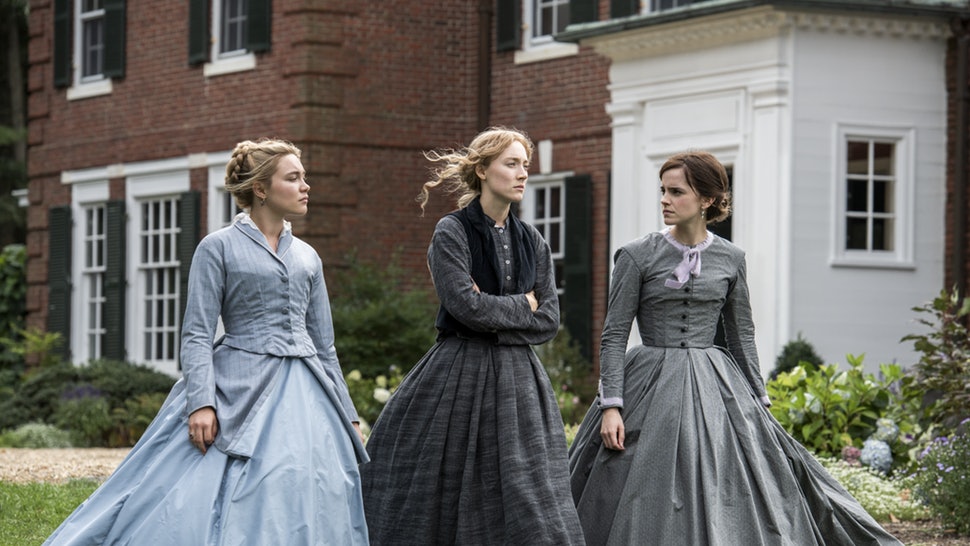
As a writer with 3 sisters myself, who often put on plays together in the basement (we had no attic) of our home, you can probably guess why I loved this novel from a young age. It wasn’t its radical (for the time) point of view, it was the wonderful bond of sisterhood so deeply felt within its pages. Even as the sisters fight (sometimes physically, as illustrated in the film), their attachments are secure, their love never wavering. Modern sisterhood is often portrayed as catty and competitive but we too were a home of Little Women with big personalities and are close to this day, as our Snapchat can attest.
Jo (Saoirse Ronan) is the writer, not just of their childhood productions but also evidently of this retelling. Big sister Meg (Emma Watson) is the actress, Amy (Florence Pugh) the dreamer and youngest Beth (Eliza Scanlen) the sweet, shy musician. Marmee (Laura Dern) presides over her family with unending patience and affection even as she spreads the family’s resources thin taking care of others in the community. The next door neighbours are almost as rich as they are irresistible; Mr. Laurence (Chris Cooper) cuts a sad figure from the window of his large but empty house, and young Laurie (Timothee Chalamet) clearly feels stifled as its only other occupant. Both men will get folded into the March family home in their own ways. Mr. Laurence is fond of young Beth, who reminds him of his own departed daughter, while Laurie and Jo get on like a house on fire, often to the exclusion of Amy who feels on so spurned.
The brilliance of Alcott is that even as some of these sisters settled into marriage and domesticity, the work never seems to judge them. Their paths are held in equal esteem to that of Jo’s. Alcott, who remained unmarried herself, was revolutionary in her thinking, in painting love and career in equal measure and equal worth. 151 years later, we still haven’t truly caught up, still trying to balance those wants and needs in a way that feels satisfying and right. Although I loved the spirit of this adaptation, I suppose I thought Gerwig might have a little more to say on the matter. I imagined that she might have stamped just a bit more of herself into the proceedings.
Saoirse Ronan and Florence Pugh are the stand-outs among the cast; as this is the seventh movie adaptation I suppose by now we know these are the plum roles (Jo having been played by the likes of Katharine Hepburn and Winona Ryder, and Amy by Elizabeth Taylor and Kirsten Dunst). All great directors have their muses and it seems Ronan may be that for Gerwig, playing her leading lady twice now, and likely to secure an Oscar nomination. Pugh has already had a dizzyingly successful 2019, and she certainly makes the most of her scenes in this. As Gerwig must, she trims many of the novel’s excesses, choosing scenes for plot and character development and losing many of the fun and funny anecdotal ones that make the novel feel so lively and warm. But Gerwig’s adaptation is both faithful and wise. It’s only that I admire her unique voice so much that I wish she had respected her source material a little less and allowed her own perspective to shine through a little more. If it is possible to love something while being just the tiniest bit disappointed, then that’s my verdict. Gerwig gives Little Women 100% but I unfairly hoped for 110%. Still, it’s a pleasure to see a female story be so lovingly preserved through the years, in timeless and timely ways.
 who goes the extra mile to get a juicy story, BUT he just got fired. Well, okay, he quit on principle, but the net effect is, he’s unemployed. Which kinda works out perfectly because the Secretary of State is about to announce her run for President, and she just needs someone with a comedic touch to punch up her scripts a bit. Enter Fred, who in fact has crossed paths with her before. She was the babysitter he had prepubescent chub for, and maybe he’s been carrying just the tiniest lit torch ever since.
 Mr. Incredible is feeling more like Mr. Second Banana being relegated to the side lines, but Pixar is famous for doing a protagonist switcheroo for its sequels: Finding Nemo became Finding Dory, Monsters University was about Mike instead of Sully, and Cars 2 followed Mater rather than Lightning McQueen. I think it’s a great idea, in 2018, to give Elastigirl top billing (even if it’s still the 60s in the Incredibles’ universe), but I wish they had kept that messaging consistent enough not to have her waist be about the same size as her neck, or to have her fighting crime in thigh-high pleather high-heeled boots that would have Julia Roberts in Pretty Woman blushing.
 being in charge. She’d never had another job. She was naturally meek, and kind of nervous. She was surrounded by assertive men, some of whom weren’t crazy to have her among their midst and certainly didn’t see her as an equal never mind a boss, and none of whom were shy about voicing their opinions. She was, however, an accomplished socialite, which in the city of Washington, means she counted many prominent politicians among her friends – and the particular politician at the epicenter of this scandal was among her closest. These facts are not to diminish her but to illustrate just how courageous she truly was to take the stance she did.
 Shakespeare” of greeting cards, he lost his mojo when his wife left him. It’s kind of too bad because the mayor has just proposed a new holiday that could revitalize the greeting card industry and and get ole Bob the redemption he’s after.
 ASSHOLES WATCHING MOVIES