Tag Archives: Canadian content

The Christmas Calendar

When Emily’s grandmother passes away, she quits her job as a lawyer and returns home to run her fledgling bakery. Emily (Laura Bell Bundy) quickly learns that keeping the bakery going is likely to be an uphill battle, especially when esteemed French pastry chef Gerard (Brendon Zub) opens a competing bakery across the street (this town isn’t big enough for the both of us!).

Not to worry though: Emily’s got a pretty decent distraction going on. Some anonymous suitor dropped off a Christmas calendar to her bakery, and each day she’s drumming up business by opening up a little door to find a hand-written love note inside. The town’s women are swooning over them, the town’s men are laying bets, the town newspaper is following the story, but nobody knows who sent it. And don’t go assuming you know either, just because the secret admirer and the sexy French baker arrived in town on the same day. Purely coincidence. And the townspeople agree because every time they discuss potential admirers, a whole bunch of walk-on characters are mentioned but Gerard is constantly, conveniently left off the list. And Emily’s not going to jump the gun and find out too soon – this little mystery is good for business.

The leads are not charmless but you’ll notice that ‘Brendon Zub’ is not exactly French sounding and, well, neither is his accent – but it does manage to come off as unintentionally sinister. For a movie about competing bakers, there is a curious absence of food porn. None of the bakers ever bake. They do, however, handle the food barehanded and sell stuff that’s fallen on the floor. But perhaps it’s the editing that is most baffling. One moment the two bakers are feuding, the next they’re feeding each other truffles. Even considering the typical phony will they-won’t they of a Hallmark Christmas movies, this film feels like it’s missing a very important 15 minutes from the middle. Or maybe it’s the script, which sounds like it was written by someone raised in a locked closet. But no, let’s be real: the worst part is definitely that accent.


To cleanse your Christmas palate, here is my niece Ella, a 4 year old in pre-kindergarten, and her cousin Jack, 5 (nearly 6, he would want me to tell you), a kindergartener, both in the same class at school, singing you a little song – in French 😉
Phil

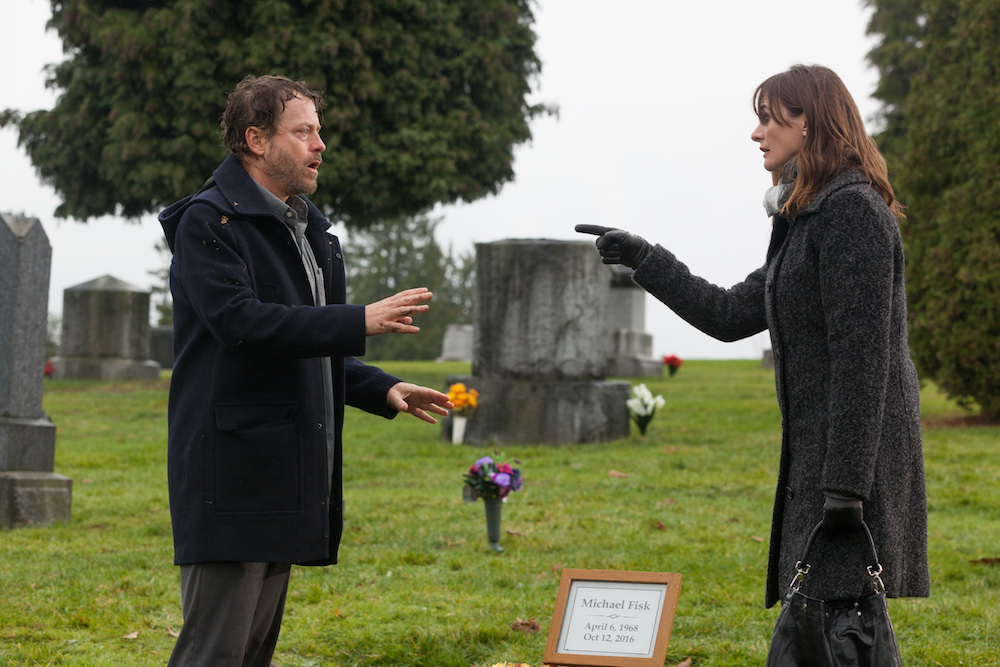
Phil (Greg Kinnear) is a depressed dentist who becomes obsessed with his patient Michael (Bradley Whitford) who seems to have it all. Chasing the secret to happiness, Phil more or less stalks the guy and his perfect family. Phil’s as surprised as anyone when Michael suddenly, and seemingly inexplicably, commits suicide. If the guy who has everything takes his life, where does that leave guys like Phil who most decidedly do not?

If you answered black-out drunk on Michael’s grave, you answered right! That’s where Michael’s widow Alicia (Emily Mortimer) finds him the next morning, hung over with a face full of dirt. But it does not account for why Phil decides on the spot to impersonate Michael’s long-lost Greek friend Spiros as a way of ingratiating himself into the grieving family. Before you know it, he’s renovating their bathroom while digging through Michael’s belongings trying to answer the age old question WHY?

I get it. Suicide is one of those tricky things, like cancer, that leave us feeling vulnerable. We want to know why so that we can feel safe. If someone got cancer because they smoke, we feel relieved because we ourselves are not smokers. Bullet dodged. If someone commits suicide because they have huge gambling debts, lucky us again, because we aren’t gamblers. Phew. We need these tangible markers to help us feel insulated from these scary possibilities. When a vegetarian marathon runner gets cancer, well, that reminds us how random it can all be. And when someone who lives a good life ends it – well, don’t we all sleep a little worse at night wondering why?

Both Phil and Michael’s widow Alicia would like to understand Michael’s motivations, but the truth is, those aren’t always knowable. Mental health is complicated and the things that make one person feel hopeless and helpless don’t always translate. Is better, then, to have each other – even if one of them is not who they claim?

Greg Kinnear stars and directs himself in Phil, a very dark comedy that doesn’t work more often than it does. And it’s not just the tricky subject matter, though it’s difficult to feel good about watching one man find the meaning in his life because of another man’s suicide. Doesn’t quite feel right. Or maybe it’s just not pushed far enough to be convincing. It’s obviously got dark undertones but Greg Kinnear often pushes the goofy side, and those two things don’t always pair well. The script is clunky and the direction doesn’t help – even the performances struggle to rise above. Phil is fine, a mild disappointment I suppose. There’s worse to watch but better too, so I suggest you scroll a little further before clicking on this one.

How To Bee

Naomi Mark has set out to make a documentary about beekeeping. Her father Don kept bees for a time when she was a child but gave it up for lack of time. Her fascination, and his, has continued.

Don left America and came to Canada’s Yukon in search of wide open spaces and adventure. He trapped, ran dog sleds, and worked in fire towers: the whole northern Canadian experience. And then, a little late in life, he settled down with Ruth and had a family, one he hoped would be self-sustaining. Now that the kids are grown and he’s retired, Don has taken to keeping bees once again and now has one of the most prolific apiaries the Yukon has ever seen.

Naomi’s documentary, shot over three beekeeping seasons, is a way to pass Don’s knowledge on to his daughter. Naomi believes this to be a documentary about beekeeping until it becomes clear that it’s actually a way to keep her dad alive and spend time with him in his dying days.

Don has been living with COPD (Chronic Obstructive Pulmonary Disease) for longer than anyone knew. Naomi begins to realize that there’s more than one reason for her father pullig away from his beloved bees.

The documentary isn’t always my favourite kind of doc; too much melancholic staring silently into the camera, too many flowery narrations. But it’s hard to deny the real, raw emotion behind the film’s original premise and how deeply affecting it can be to watch someone lose a parent, even when many of the people involved are in pretty deep denial. It’s also interesting to watch Naomi, a novice beekeeper at best, struggle to keep her hive alive when we know important bees are to our environmental well-being. Meanwhile, her father, crucial and vital for so many years to her family’s well being, is also in decline. It’s a downward trend that perhaps gives the hive an elevated status in Naomi’s mind since she has some control over the life of her bees if not that of her father. At any rate, with such a loving film, it’s nice to know that honey won’t be Don’s only legacy.

TIFF19: This Is Not A Movie

Director Yung Chang sets his sights on Robert Fisk, a ground-breaking and game-changing longtime foreign correspondent. Reporting primarily from the Middle East, the documentary visits his old stomping grounds – Syria, Palestine, Lebanon, and revisits many of his old stories, some of which (many of which) are ongoing. Problems in the Middle East are a revolving door, and a journalist has to have fortitude and determination to keep reporting with the same urgency and integrity when the story seems unending.

Robert Fisk clearly has a lot of deeply held beliefs about a journalist’s integrity, and it is clear that his has been questioned many times over the years. He writes what he sees, whether or not it’s what readers back home want to hear. His angle isn’t always the popular one. He’s been called racist, he’s been called an anti-Semite. But to him, truth is truth, even if it’s uncomfortable.

He also talks about what it’s been like to be amidst armed conflict so many times – and certainly, he seems inured, wanting to stop and poke around even as local guides nervously caution him of the danger. Wars are notoriously “dodgy things to predict” he tells us, as he barrels straight in. But there are consequences to this bombardment. One’s sensitivity becomes anesthetized; emotions are suppressed in the name of objectivity.

He’s a bit of a dinosaur, no longer truly of this world, which has moved on a bit in his absence. He still clings to newsprint even if his own words are purely digital. He’s realistic about the story’s ceaselessness, but keeps a fresh eye because “I still want to see what’s next.” Even in the face of great human tragedy “I can’t draw myself away.”

In the age of social media and fake news, Fisk is perhaps the kind of dinosaur we need. A reminder of how important it is to seek and expose truth. His rule of thumb: be on the side of those who suffer. Challenge authority. Don’t look away.

TIFF19: No Crying At The Dinner Table

Director Carol Nguyen interviews her own Vietnamese-Canadian family, mining them for secrets.

Mostly they share their losses, their grief. The short film explores the cultural and generational differences in how her father, mother, and sister have experienced loss, from physical expressions of sympathy to regret and shame and forgiveness. It’s incredibly personal and soberly realized. What Nguyen accomplished in just 16 minutes is a veritable portrait of grief, and a moving, and living, family history. Her precisely-composed shots reflect the range of emotions, from raw to repressed, and her unobtrusive camera allows us a spot at the dinner table, preferably close to the tissues.

I love how we get to experience the difference between old country new country for this immigrant family, but the truth is, all families are different. Nguyen’s mother shares that she only kissed her own mother once, when she was very ill. Just once. She’s fairly matter of fact in the recounting, but her eyes betray some anguish.

I come from a very physically affectionate family, though I wouldn’t have described us as such until I met Sean’s family. We don’t necessary feel the urge to hug and kiss all the time, but I think our casual touches are actually a testament to our closeness. We might stroke each other in jest, or pinch each other with affection. Rarely does a family gathering go by without someone’s hair getting brushed, or braided. Or perhaps feet rubbed or nails painted. And we might sit very close together, even touching, even lying on top of each other if someone needs the cuddle, or sitting atop each other, if someone’s being a pain. Sean is not naturally a physically affectionate person. I call him a robot all the time, and he assures me that he has feelings, and I pretend to believe him. We just didn’t grow up the same way. It’s fine. We’ve just had to get used to each other. But now he’s the one always reaching for my hand, and he gives me a backrub almost every night before bed (of course, he mislabels this as foreplay, but that’s another story for another short film whose review I’ve highjacked). With coaching, I’ve even gotten him to admit to his mother that he loves her right before hanging up the phone. That’s huge for him. And occasionally he and his father have exchanged a hug rather than a handshake.

And that’s kind of another great revelation hidden inside this film’s 16 minutes. People do change, even just one generation to the next. We learn. We do better. Trauma changes us, but life goes on, and maybe next time, we do it differently. That’s a beautiful thing.

TIFF19: Sweetness in the Belly

Though not ironically titled, the fact remains: Sweetness in the Belly is actually quite bland. I suppose there are worse things than blandness, but if you are going to spent several million dollars and the better part of a year to make something, it better be worthwhile.

Perhaps you’re a fan MV5BMWQ4NDEwZDktZTcyMC00M2VmLThlNjEtMzdmZmZiMDc4MTMxXkEyXkFqcGdeQXVyNTQxOTM1NTc@._V1_of the novel by Camilla Gibb, and of course I read it myself about 500 books ago. I have little memory of it, but had the vague impression of not having appreciated it much.
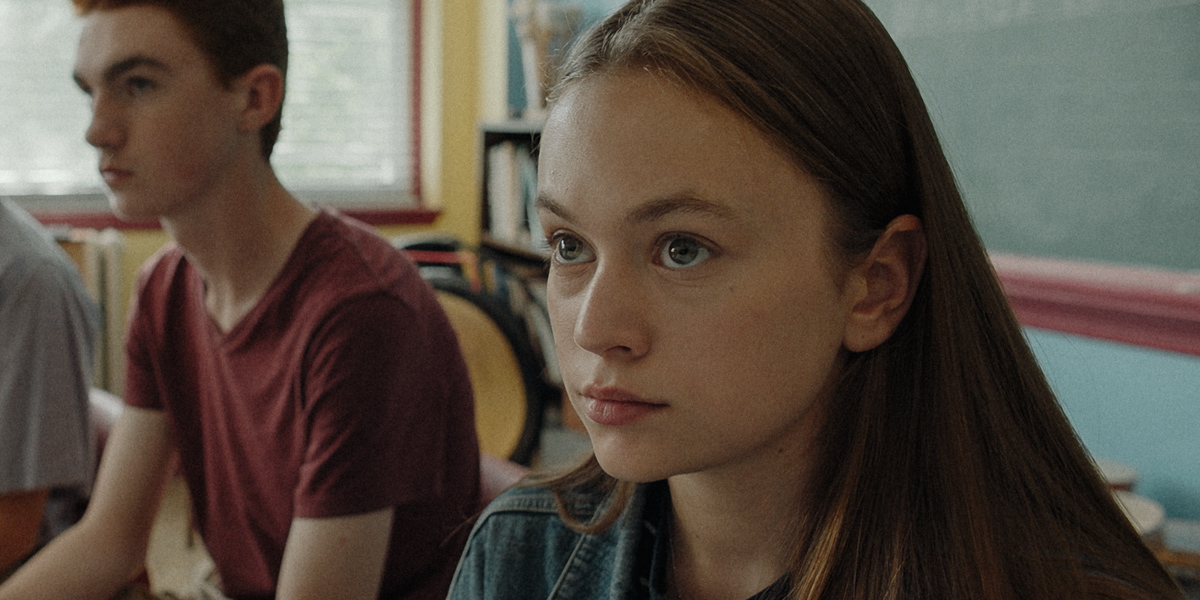
In 1975, in the wake of Haile Selassie being deposed, many Ethiopians flee, fearing for their lives. Many others do not have the opportunity, and pay with theirs. In the chaos of so many people emigrating at once, Lily Abdal (Dakota Fanning) finds herself in London without knowing what happened to her lover, Aziz (Yahya Abdul-Mateen II).

Lily is a special case. Though she is Muslim like the other immigrants fleeing Ethiopia, her skin is white. This means she is plucked from a long line of black women and given special treatment. While hundreds of others share cots in a community centre, Lily gets an apartment to herself, though it’s not long before she invites another woman, Amina (Wunmi Mosaku), to join her. Together they start trying to reunite families amid all the chaos.

It’s hard to dump on a movie with such noble subject matter – but hi, I’m Jay, and I’m an asshole. I watch a lot of movies and I guess I’m fairly critical of them. Sweetness in the Belly is more like a Mild Irritant in Your Eye. I just kept waiting for it to start, and when it didn’t, I started waiting for it to end. Zeresenay Mehari, the director, seems content with banality and the film never gathers any momentum. It’s occasionally moving and competently performed, but you will spend the whole movie waiting for it to get interesting.

TIFF19: Murmur

Donna has just been convicted of impaired driving and is sentenced to hours of community service. She lives alone in a serviceable apartment, her only company empty bottles of wine, and regret. Her grown daughter wants nothing to do with her.

Serving her time at an animal shelter, Donna gets the grubby, grotty tasks, which she performs uncomplainingly. She moves through her day, from mopping up shit, to alcohol counseling, back home to her wine, with little fuss, and little connection. It’s not until a mangy scruffball named Charlie is scheduled to be put down that we see Donna’s softer side. She begs her boss to allow Charlie to come home with her instead; Charlie is old, and sick, but she vows to take good care of him for his remaining days.

Her relief is obvious. Estranged from her daughter, isolated in her little apartment, Charlie is the first sign of affection we’ve seen from Donna. They bond. Are they maybe kinda sorta two of a kind? Both rejects? At any rate, the arrangement is so satisfying that Donna doesn’t stop at just one. Pretty soon she’s popping puppies like Pringles (no, she doesn’t eat them), her small apartment brimming with pets and still she can’t stop bringing them home.

Shan MacDonald is wonderful as Donna. She doesn’t try to pretty her up, or make her more likable. Donna is tough, and MacDonald rises to the occasion. I don’t imagine it’s an easy role to play, but there’s a universality in the loneliness that really resonates.

Murmur was a little slow to engage me as Donna’s life is bleak, and has so little personal interaction. But the dogs open her up in a lovely, tragic, humane way. It becomes easy to guess at the many ways in which Donna may relate to the dogs, may see herself in them. She certainly seems to find companionship easier with animals that with humans, and you know she’s not the first or the last to do that. Her social isolation is heart-breaking, and the film really manages to say something meaningful about addictions – empathetic without letting anyone off the hook.

TIFF19: Black Conflux

Set in 1980s Newfoundland, Black Conflux has an air of inevitability, and a foreboding sense of dread. There can be no doubt that this story will end badly. It seems certain that Jackie (Ella Ballentine) is going to cross paths with Dennis (Ryan McDonald). It also seems certain that if she does, it will not go well. You see, Dennis is an incel, or he would have been if that term had existed in 1987. He has a beer truck full of imaginary women who worship him, but he has nothing but contempt for the real women he meets. Jackie is a high schooler who has somehow caught Dennis’ attention, even though the two don’t seem to ever have met before. The more time we spend with Dennis, the more we come to think that the women in the beer truck might not be imaginary. They might be ghosts of other women that caught Dennis’ attention, and it seems like Jackie could be next.blackconflux_0HERO

Writer-director Nicole Dorsey’s talent and confidence are on full display in her first feature-length film. She has written two great characters in Jackie and Dennis. We quickly feel like we know them and can predict them, and Dorsey uses that to generate a great deal of tension in anticipation of the convergence (/conflux) of their stories. Adding to the tension are the slow pacing and the atmospheric shots of Newfoundland’s wild beauty, which reminded me there are plenty of places on the rock to hide a body or two or ten.

Dorsey is aided by two great performances from Ballentine and McDonald, who make their characters feel real. We care what happens to Jackie because we like her and we can relate to the teenage world she is trying to navigate, having been there ourselves. And while we don’t really like Dennis, we feel a bit sorry for his struggles to navigate the world he inhabits, even though he’s clearly making things more difficult than they need to be. Jackie is the more sympathetic one (mainly because she is not acting like a serial killer) but despite Dennis’ issues (or maybe because of them) I found myself fascinated by both characters.

It’s not that Black Conflux keeps the audience guessing, because a confrontation between Jackie and Dennis seems inevitable (after all, it’s in the title!). What makes Black Conflux so enjoyable is that it keeps the audience engaged, invested and interested in the journey to the climax. It’s a great debut feature for Dorsey and a great start to my 2019 Toronto International Film Festival viewing.

Good Boys

Eleven is such a precious age. You’re straddling the cusp of childhood and adolescence. You’re feeling big in your britches but the world’s still treating you like you’re a little kid.

I remember going to Denny’s once, and the waitress brought me one of those paper kid’s menu-placemat hybrids with 3 crayons so I could choose between the grilled cheese or the chicken nuggets. I was insulted. Beyond insulted. The kid’s menu was for 12 and under and I was 9. Nine! Practically a grown-ass woman, I thought. How dare she. I have never been back to a Denny’s. That’s a true story. I hold a grudge. The point being, those tween years are tough. They didn’t even call us tweens back when I was a tween. In fact, my little sister gave me a homemade card calling me a “teeny bopper” which makes it sound like I grew up in the 1950s – actually, that’s just a word she got from my grandfather, but it stuck. I didn’t care much for that either, but surprisingly, I still speak to both my sister and my grandfather, though I do sometimes still harbour dark doubts that they deserve it.

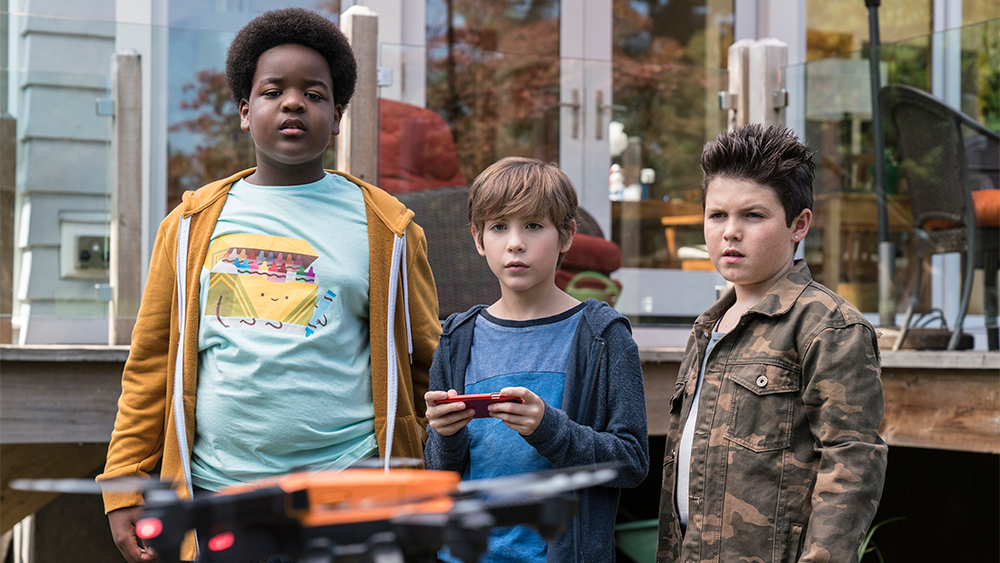
Max (Jacob Tremblay) is the undisputed leader of the bean bag boys, a trio including golden-voiced Thor (Brady Noon) and nervous nelly Lucas (Keith L. Williams). They have just unlocked the most coveted of achievements: they’ve secured an invitation to cool kid Soren’s (Izaac Wang) party, a kissing party with girls and everything. None of them know how to kiss, which is a problem, but not insurmountable. Between the 3 of them, they come up with quite a plan for learning how, but their brilliant plan falls apart when they lose Max’s dad’s work drone to a couple of teenage girls, then steal their drugs in retaliation, then spend the rest of the movie in an epic quest to make things right.

I loved the characters from the start. The script really captures the line they’re straddling between youth and adulthood. The kids are just beginning to think about sex but haven’t got a clue. They talk big and swear hard, but their innocence is always quite apparent. As a grown-up, you just want to clasp your hands to your heart and declare them precious, but doing so would probably have them die of embarrassment. Oh lord it’s hard to be eleven.

All 3 kids are well-cast and have a great rapport. You believe them as a unit, even as they’re starting to realize that they may not be destined to be best friends forever as previously believed. The script is a magnet for vulgarity, and perhaps embraces it a little too heartily, but for all its gross-out humour, it has a lot of heart. I especially love how much the kids have internalized the concept of consent. It gives me hope. Good Boys reminded me of my own awkward transitional years, but mostly it made me think of my oldest nephew, who will turn 8 in a couple of weeks. I cradled him in my arms the day he was born, he peed on me while I gave him a bath, he’s clung to my neck when he had a booboo. But every day he’s getting bigger, and thinking more for himself, and growing apart from the very adults that he used to want nothing more than to play with on the living room floor. It’s nearly impossible for me to stop seeing him as a little guy, but since I’ve known him, all he wants to do is grow. I remember when his biggest goal in life was to weigh 40 lbs so he could go from car seat to booster seat. And then he wanted to be just tall enough to ride the Vortex water slide at the Great Wolf Lodge. Now he wants to be old enough to watch End Game. Meanwhile, who among us doesn’t occasionally wish we could hit pause? Have him stay cute and cuddly forever, sweet smelling and polite?

Good Boys made me laugh, but more than that, it made me smile.

Astronaut

Becoming an astronaut was always a dream of mine.  As early as I can remember, I was fascinated by the idea that there were other planets and stars surrounding us, and the idea that I could float around in outer space and jump so much higher and further on the moon than on Earth.  At the time I lived in Kentucky and learned at school that I could write to NASA and they would send back random photos of space shuttles, planets, satellites, and so much more.  So write I did.  I wrote almost as many letters then as Jay does now (she is singlehandedly keeping Canada Post’s lettercarriers employed), and ended up with stacks of photos that I treasured throughout my childhood.

AstronautObviously, I am not the only one who dreamed of becoming an astronaut.  Space travel is clearly on a lot of people’s bucket lists, as shown by the proposed reality show cataloguing a one-way mission to Mars (which went belly-up earlier this year), the numerous space flights available for purchase (Virgin Galactic has collected $80 million in deposits for 90 minute voyages costing $250,000 each), and NSYNC’s Lance Bass attempting to buy his way onto a Russian rocket (he couldn’t afford it after Justin Timberlake left the band), among other examples.

In Astronaut, Angus (Richard Dreyfuss) definitely has space travel on his bucket list.  He’s always looking to the stars and, as a retired civil engineer, possesses the type of scientific knowledge that might grant a seat on a NASA mission.  Unfortunately, he never secured a NASA spot during his career and his dreams of space travel seem more and more distant as his health begins to fail.   But the stars align when a billionaire (Colm Feore) announces a contest that will give the winner a seat on the first commercial flight to space, which otherwise would be too expensive for Angus (and the rest of the 99%) to afford.  You can probably guess who becomes one of the twelve finalists in that lottery, but even with that stroke of luck things don’t come easy to Angus, not only because of the health issues I mentioned, but also because he’s trying to settle his wife’s estate and he’s struggling with an impending move to a retirement home.

Astronaut asks us to suspend our disbelief on more than one occasion, and in exchange rewards us with a sweet and engaging fairy tale.  The pieces fit together so neatly and conveniently that there is never any real tension or possibility of failure, but the movie works even with relatively low stakes because of Dreyfuss’ stellar performance.  Angus is a great combination of gruff and personable, and Astronaut is elevated by Dreyfuss’ wonderful chemistry with Angus’ family and friends, particularly his daughter (Krista Bridges), his son-in-law (Lyriq Bent), and his grandson (Richie Lawrence).

Writer-director Shelagh McLeod wisely focuses on Angus’ personal relationships rather than the space flight itself and Astronaut is better for it, because the fantastical (and potentially unbelievable) elements of the film are just minor details.  What matters is watching Angus reach for the stars, and I happily cheered him on from start to finish.