
I suppose it’s inevitable that I’ve failed to relate to this coming of age comedy about a young girl in high school who’s utterly obsessed with snogging. More alienating than the age difference is my absolute distaste for the word snogging, which is repeated so often in the film that my stomach acid has stripped away the mucus lining of my throat after throwing up in my mouth so frequently.
In fact, I do not care at all for kissing in films because I really cannot abide the sound effects attributed to it. You can hear the spit. It’s all spit. It’s slurpy and damp and you can just hear the strings of saliva between open, bacteria-ridden mouths. It grosses me the fuck out. Which is weird because I don’t really mind it in person. But as in many things, real-life kissing is almost nothing like movie kissing, and if done reasonably well, and  with the avoidance of too much tooth contact, it’s never nearly as noisy. So I already know that I hate kissing scenes in movies. And poor Georgia wants nothing more than kissing all the time. Scratch that. She wants snogging, because she’s British and therefore had to come up with a gross word for it that ruins it for the rest of us. I mean, first of all, snogging has always sounded to me like rather more than just kissing. In fact, it pretty much sounds like the whole enchilada. The whole kit and caboodle. But no, snogging is what twerpy little teenage girls do to the backs of their hands at sleepovers and such. Georgia is sadly snog-free at this stage in her life, but she’s devoted herself (at the expense of school, friends, and family, naturally) to correcting this void. And wouldn’t you know it: the eminently dreamy Robbie moves to town, and is the perfect target for all her lusty fantasies (which mostly involve running uphill???).
Angus is just about the only thing that I don’t despise in the film. Angus is Georgia’s long-suffering cat. Normally I don’t go in for cats, but Angus tolerates dog-levels of indignity – tea parties, costumes, even getting pretend-lost so that Georgia and cat-loving Robbie can share a moment or two searching for him.
The other thing that director Gurinder Chadha gets right is casting a very young, very floppy-haired Aaron Taylor-Johnson (who of course isn’t going by that yet) as dreamboat Robbie. It is quite arresting to see him so young and smooth-faced in this film after so recently having seen him waggle his penis about in A Million Little Pieces, and bare the madness of his soul in Outlaw King. I know I complained about all the brutal horse murder in the latter, but it turns out that the slaughter of innocent animals is easier for me to cope with than the sound of perfect snogging.
 the rest. But her friends are getting tired of Zoe’s (Noel Wells) bullshit and she’s not much fun to be around now that her life is fully falling apart. The only person who seems to understand is Paul (Josh Radnor), the unhappily married man across the street. His wife has given him permission to have an affair, and Zoe is undeniably cute in a damaged way, but he’s still a bit shy to ask for what he wants.
 emotionally, her physical transformation is NOT normal teenage stuff. She’s suddenly compelled to eat the family’s pet goldfish. She grows webbing between her toes. In her mind, these are linked to the onset of her period but her doctor disagrees. Moodier than ever, Mia is also learning to be more secretive.
 wells of courage in an actor to be as vulnerable as she is up on that screen, so raw and real that we are instantly transported to our own childhoods. And Fisher is indeed a very young woman herself, (otherwise best known as the voice of Agnes from Despicable Me, for which she improvised that delightful little tune about unicorns) which makes it even more impressive that straight out of the box, she’s amazing and transcendent.
 neighbourhood games of hell? Obviously someone must derive pleasure from being on the brink of abject horror, and at the beginning of Summer of 84, we meet 4 such young fellows. Davey and his friends are 15 in the summer of 84, mere shadows of mustaches playing on their upper lips, and haven’t yet outgrown their midnight game of “manhunt.” I think it’s creepy even before the big news is revealed: the Cape May slayer is on the loose in their community. With 13 confirmed kills and a preference for teenage boys, Davey and his buddies should rationally be concerned about this serial killer but they’re kids, hornily hovering about the precipice between childhood and growing up, and instead they think it’s kind of cool.
 should be in mine as well. Laggies? An expression I was unfamiliar with, but could kind of understand with context. Urban Dictionary, bless its lack of soul, provides several helpful definitions, including 1. dragging along (which I believe Megan is doing) 2. someone who is stalkerish (which Megan borderline is) 3. a combination of both large + saggy, referring to boobs, as in “she’s got a nice rack, but she’s laggy” (which Megan most assuredly is NOT) 4. “the laggies” is a disease (well, a pretend one) caused by chronic masturbation (I’ll let you watch the movie to find out which characters may suffer from it).
 Turturro) may be stepping out on their mom, but he’s also the geeky guy who still takes them to Benihana for special occasions even though they’re far too old. Their mother (Edie Falco) has never struck them as a sexual being before, but it turns out that she too has wants and needs, and that maybe not all her tears and concerns are for them. This is a really great script that unfolds over just a couple of days, but pivotal days that will completely reconstruct the family.
 psychological projections, so even though the movie is without dialogue, we still feel what Clyde is feeling. When in the car with his mother, we don’t hear them argue, but when a speech bubble features a bear biting off the head of a rabbit, we get the gist. Clyde’s mother is schizophrenic, and what she sees as a fun-filled family road trip from San Diego up to New York, the rest of the world views more as kidnapping. It’s a trip that will change Clyde and his family forever.
 Smith is so named because it was the most American name his father could bestow. But as much as he and his teenage sister embrace their new lifestyle, their parents are more tepid. They’re chasing the American Dream but wish to protect their Indian culture as well. Furthermore, even as hard as they may try, they’re never getting things quite right. This is a real moment in time from an immigrant’s perspective, written by someone who knows the process, Anjul Nigam, Indian-born, who also plays Smith’s father.
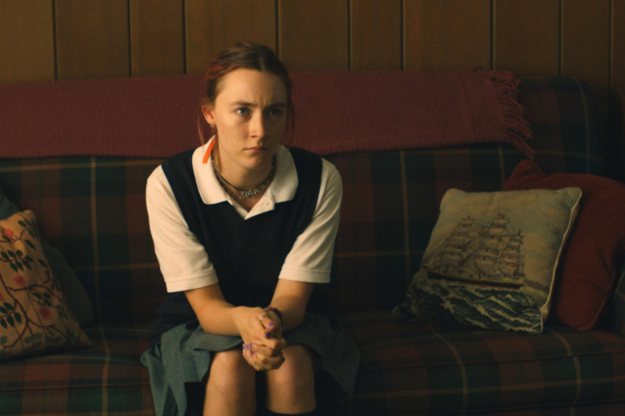 In making a coming of age film about a high school student, Greta Gerwig has come into her own – as a writer, as a director, as a woman with a voice.
 ASSHOLES WATCHING MOVIES