Tag Archives: documentaries

TIFF: Amanda Knox

It’s so great to be back at the Toronto International Film Festival! I felt nostalgic the moment I stepped off the train. The rushed breakfasts, the possibility of a close encounter with your favourite celebrity, the feeling that I’m finally starting to know my way around this once intimidating city, and the hope of catching one of the year’s best films keep me coming back every year. And, for the first time, I get to share the experience with my parents. So why am I tempted to just skip my next movie and go to bed early?

Partly, it’s because I woke up at 4 a.m. yesterday to catch my train and got back to my hotel at 2:30 a.m. this morning after a Midnight Madness screening. Partly, it’s because I’ve been catching four screenings a day since I got here. Both good reasons I think for me to be getting close to early TIFF fatigue but Amanda Knox, which just had its world premiere at the Festival, is another big reason why I couldn’t sleep last night.

Though it was apparently international news back in 2007, I really don’t remember Knox’s story. Amanda Knox was in her early twenties when she was arrested and convicted of murdering her roommate while vacationing in Italy. This wonderful documentary follows her road to exoneration over a period of several years.

What’s unsettling about this film is what apparently captivated the media nearly a decade ago. It’s Amanda. Young, pretty, charismatic, and full of life, she doesn’t look or sound like she’d be capable of such a heinous crime. So when she looks directly into the camera and calmly says, “Either I’m a psychopath in sheep’s clothing, or I’m you,” I get the shivers.

As a true crime documentary, Amanda Knox is every bit as gripping as Netflix’s Making a Murderer. But, despite having only a fraction of the running time with which to do it, it manages to give a more balanced look at the case than the controversially one-sided Netflix phenomenon.  Knox and her Italian now ex-boyfriend and co-defendent are interviewed extensively, as is the Italian homicide detective that maintains their guilt to this day. You’re bound to like and trust some of the interviewees more than others but, according to the filmmakers, each of them have seen the film and every one of them feels that they have been represented fairly.

I still don’t know what happened that night nine years ago. Maybe that’s why the police, media, and public turned on Amanda so quickly. Not knowing is scary. It keeps us up at night (or, in my case, last night). The good news is that, even if you couldn’t make it to Toronto this year, you’ll get a chance to decide for yourself. Amanda Knox will be on Netflix later this month.


Looking for more on Netflix? Try
Audrie & Daisy

Where To Invade Next

Three Days in Auschwitz

Auschwitz may or may not be on your list of places to visit. It’s not your typical holiday fare, to stand on the ground where millions were murdered. A trip to Auschwitz is not a day easily spent. It is somber and it is difficult, and it is meant to be. Living history is what makes it real for us, turns a textbook event into something concrete that happened to real people, not very long ago in our human  history. The evilness makes it feel surreal, and it takes a real emotional impact to ground the experience for us once again.

The act of remembering belongs to all of us. This is how we heal. It’s also how we learn, and how we make sure it never happens again. It seems just as important today as it’s ever been to  challenge prejudice, discrimination and hatred.

And it’s a tribute to the dead. Millions of lives lost, cruelly. People made to suffer, to live in agony, to live with the constant loss of loved ones, to live with ghosts, to live without the promise of a future. There are fates worse than death.

And it’s in memory of the survivors, those who survived the camps but lived with the scars. Who were faced with the daunting task of rebuilding. Who struggled with grief. Who scraped their hearts raw in the search for forgiveness. Who went on, alone.

We are all saddened\enraged by what we know of the Jewish genocide at the hands of the Nazis. The Holocaust is a dark shadow for humanity. We all owe a debt of some kind, and we pay it in part by bearing witness.

Three Days in Auschwitz is a documentary by Philippe Mora covering his own trips to visit the site. His mother had been thrown in a concentration camp and was rescued from it just one day before she would have been shipped to Auschwitz herself. Eight other family members perished there. It’s a tough subject but we’re soothed by its graceful score by Eric Clapton.

Mora’s film is not filled with facts or figures, none of the statistics we’re all familiar with anyway. It’s just a humble attempt to grapple with its reality: an act of mourning, an act of vengeance.

Visiting Auschwitz with a heavy heart and a troubled stomach, you find the thing that speaks to you: will it be one shoe, left behind? The remains of an oven built to roast people? The electrified, bard-wired fence that represented hopelessness to the millions of people imprisoned and starving behind it? For Mara it seems to be the train tracks. It’s an image he comes back to often. Auschwitz was chosen by Hitler because of its easy access by train. Bodies were crammed into cars, many dying before they reached their final destination. The trains were incessant. People were “sorted” as they disembarked, some sent straight to death, others sent into slavery first. The train tracks great disturb him.

And that’s the thing. A visit to Auschwitz may make you feel sick. Watching this documentary may do the same. It should. Don’t turn away. Don’t say it’s “too hard.” Remembering is the easiest part of this thing, and you’re lucky that this is the role you were born to play. If ignorance and hatred are what allow atrocities like these to be committed, then education and remembrance can help fight them. Do your part: it’s available on DVD and VOD and in select theatres September 9th.

Where To Invade Next

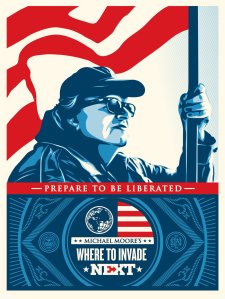
Michael Moore is a bit of a trial. He’s a ham who manages to insert quite a bit of himself into every documentary he makes, whether the subject warrants it or not (mostly not). I also think he’s a patriot in the truest sense of the word: he questions things, not to tear down the country he considers to be great, but to make it even greater.

Where To Invade Next sounds like another documentary about George W.’s cauv-s3ukaaf8io-1failed wars and his love of randomly selecting countries to pillage. It’s not. Moore is symbolically “invading” various European countries so that he may “steal” their best ideas and bring them home for implementation. He looks at labour rights, education, women’s reproductive health, the financial crisis, and prison systems – inarguably ALL things that the USA is currently getting wrong. Just all kinds of wrong. Moore visits countries to “pick their flowers”, not their weeds, and cherry picks the best reforms that seem workable and right.

And that’s the infuriating thing about Michael Moore. His methods aren’t exactly truthful, but he’s right. He’s not concerned about appearing unbiased. He doesn’t need to consider the other side. He presents things as he sees them, in a persuasive and personal way. Which is why Michael Moore is where-to-invade-next-body2perhaps the most well-known documentarian, at least in America. He makes documentaries that people care to watch. Hell, they sometimes even screen in theatres. Real theatres!
Unfortunately, Moore has never been good at converting people. Teaching us – sure. But he won’t convince anyone who’s not already on board. In Where to Invade Next, Moore visits 9 countries, and they’re all quite worthy. Unfortunately, some of the principles require more than 10 minutes worth of explanation. His ideas are sound, but like my math teachers would always tell me: show your work! Giving us the answers has only limited appeal. We want to know how you got there. This film is simply Socialism 101, a scratch-the-surface survey course with an affable, wheezy professor.

The Man Who Saved Ben-Hur

Johnny Alarimo was an assistant director on the classic masterpiece, Ben-Hur. The director, William Wyler, wrote him a letter of thanks. Charlton Heston drew his portrait on set and signed it “Chuck H.” But Alarimo received no credit, not for Ben-Hur nor any of the other numerous films he worked on because at the time studios only credited department heads. Johnny and many like him are lost to history.

Johnny was an old man living amongst relics of the so-called Golden Age of Hollywood when his second cousin, documentarian Joe Forte, showed up to make friends. Johnny’s lived a glamourous, star-studded life and had a successful career in film, but all that’s left is the dazzling detritus: a cigarette case engraved by Elizabeth Taylor, a stack of Christmas cards sent by Rock Hudson, a mention in a Gore Vidal book. Sure it’ll bring a bundle at auction, but it doesn’t keep you warm at night.

This film works on two levels: first and obviously, as a piece of film history. Johnny Alarimo saved lots of memorabilia from Ben-Hur and other sets, usually those filmed in Italy, where he provided invaluable translation. But it’s also just the story of two men, vaguely related, trying to forge a friendship. That’s harder than you might think considering one of them is a lonely old man. But it turns out that Hollywood may attract a certain kind of person: the kind of person who makes superficial friendship during the 3 or 4 months of shooting and then moves on. Johnny has never had a lasting relationship, and now, at the age of 89, does he have regrets?

I felt heart-broken for much of this film’s run time. Old people, like film credits before the 1970s, are often forgotten. He was the last surviving American crew member of Ben-Hur, but the L.A. Times refused to run his obituary because they choose not to honour those “behind the scenes.” This documentary very quietly shows you that you can have hundreds of bonafide celebrities on your rolodex but even all together they don’t add up to one real friend.

Film buffs will love this rare glimpse at little-seen memorabilia, but I think this movie speaks to all of us. The Man Who Saved Ben-Hur is available on VOD and with just an hour’s worth of viewing, you can do your bit to remember this man and his passion.

Ghostheads

Ghostbusters: a 1984 supernatural comedy starring Bill Murray, Dan Aykroyd, Harold Ramis and Ernie Hudson as brave, wise-cracking men trying to rid New York City of its poltergeists one slimy green ghost at a time.

Ghostheads: what the super-deluxe fans of Ghostbusters call themselves. Not the fans who watch the movie every time it comes on TV, or the fans who collect all the Venkman bobbleheads. Ghostheads are fanatical. They dress up. untitled.pngThey own proton packs. They drive Ecto Ones. They horde merchandise to the extent that it threatens their marriages. Ghostheads is the 2016 documentary that takes a good hard look at these amped-up fans. Ghostheads is the new Trekkies.
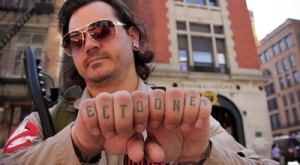
The delightful thing about this documentary is how earnest it is. It’s easy and maybe even tempting to make fun of a grown man who believes he is “more himself” when dressed up as someone else, but this film never does. These fans may be extreme, but the documentary aims to humanize them. Some interesting things I picked up from watching the documentary:

  • Ghostheads are not the ones hating on the 2016 film. Their enthusiasm for the franchise is all-encompassing. Paul Feig reached out to the community and included them every step of the way. They seem to embrace it.
  • In fact, “Everybody can be a Ghostbuster” is not just a tagline for the new toy line, but a credo that Ghostheads seem to have been living by for the past 30 years. At Comic Con, you’ll see dozens of people dressed up as Wolverine, Ariel, Walter White, Sailor Moon and Doctor Who. You’ll see plenty of Ghostbusters too, but more often than not their name tags don’t read Ray Stantz, it’s their own names on the patch. Because every body can be a Ghostbuster.
  • While Leias and Leeloos tend to stand alone at conventions, Ghostheads are almost always found in packs. These cosplayers aren’t just connecting with a movie, they’re trying to connect to each other.

I’m the first to admit that I don’t really get cosplay. I’m a huge movie nerd but I’ve never loved any one film so much that I decided to make it my life. I’ve never, as an adult, dressed up as a fictional character. But people at comic cons are doing more than trick-or-treating, they’re doing performance art. medium_GHOSTHEADS_web_1Suddenly shy geeks who rarely interact with the human species don these alter-egos and strut around like heroes.  In Ghostheads you’ll encounter one painfully shy man who doesn’t hesitate to walk up to total strangers to spout any of dozens of lines of dialogue memorized from his favourite movie. He’s happy to pose for pictures and merrily draws attention by flipping on the siren on his Ghostbusters car (his only car. He drives his daughter to school in it). Fandom has really kicked into high gear these past few years (we discussed FANdementalists on a prior podcast) but I think the Ghostheads embody the very best of it: a sense of community. Just like-minded people sharing something they love, a movie that happens to be about camaraderie and helping others (and mutant marshmallows).

Ghostheads is nostalgic and sweet – maybe too sweet. It deftly sidesteps the whole “girl Ghostbusters” controversy and chooses not to look at a darker side at all. So this may not be a balanced view. But with interviews with Ivan Reitman, Dan Aykroyd, and plenty of real-life Ghostheads, it’s an awfully compelling one.

For The Love of Spock

I know very little\almost nothing about the Star Trek universe, but I do know Mr. Spock. He’s a pop culture icon who transcended the television show with his message of peace and reason. William Shatner soon learned that though the captain’s seat was his alone, the spotlight would have to be shared. The man behind the pointy ears and the Vulcan salute was none other than Leonard Nimoy, hand-picked by Gene Roddenbury to portray this cool and calculated character.

tumblr_nv1msf7Hdg1ug3pr6o1_400The documentary For The Love of Spock was originally a collaboration between Leonard Nimoy and his son Adam but Nimoy Senior got sick and died very quickly, leaving his son to alter their plans somewhat, honouring the character, but also his father. It’s clear Adam Nimoy’s knowledge of the Star Trek universe is encyclopedic; the footage of the original series is a lot of fun, but also well-chosen and well-timed. A part of me badly wants to gush about all the cool things I learned watching this documentary, and I’m barely restraining myself so that you’ll have your own joyful moments of discovery upon seeing it for yourself.

Almost all of the original cast members are interviewed, and most from the new Star Trek movies as well (including J.J. Abrams), and everyone’s got glowing things to say. It’s nice when the man behind such a beloved character is a nice guy himself. In fact, the only person who seemed to have a problem with him was his son, the film’s director. So no, this isn’t a puff piece. It’s an honest look at intriguing and sometimes enigmatic man who put a lot of himself into his character, and gave a lot of himself to his fans.

Watch this documentary to see Jason Alexander to a spot-on Kirk impression, to hear Shatner Spock_Good_Evilpronounce who was the better singer, to get George Takai’s take on the Spock-Kirk slash fiction, to find out who came up with the Vulcan salute, to hear how Harry Belafonte inspired the character, to learn where Nimoy’s kids had to watch the show’s premiere, to note who once called it a “treadmill to oblivion”, and to discover who spent hours responding to Nimoy’s fan mail. You don’t have to be a Trekker to enjoy this movie, but by the end of it, you might just be one.

Adam Nimoy says that his father was eternally grateful to have created this character, never jaded by the experience or the fame. Clearly, the apple doesn’t fall far from the Vulcan tree. Though Leonard’s work kept him away from the family and Adam often felt he was competing tumblr_inline_nkfyuoaAP21rlqxn6with fans for his father’s attention, he still describes Star Trek as “hitting the lottery.” Creating this film was an act of mourning for the son, and absolutely an act of love. At the end of the documentary, Adam asks the many interviewees to describe his father in one word. People offer: hope, integrity, love, but the final word comes from Zachary Quinto who plays Spock in the rebooted version, with Nimoy’s blessing. Quinto throws it back to the documentarian and the son, asking “What’s yours?” Adam Nimoy was at the screening of this film at the Fantasia Film Festival, and he was able to answer that question for us in person.

He said “Passion.”

Leslie Caron: The Reluctant Star

Ms. Caron is the warm kind of story-teller that makes you fall under her spell. She on her sofa, you on yours, a pot of tea (and by tea I mean wine) between you, and you’ve got a lovely way to spend an hour catching up with an old friend.

Leslie Caron was a 17 year old ballerina in Paris where she’d just gotten her first solo, dancing in Oedipus and The Sphinx. Gene Kelly happened to be in the audience that night, and happened to think she was great. Hollywood was not on Ms. Caron’s radar and she had no ambitions to be a star, but agreed to a screen test “to be polite.” Two weeks later she was whisked away to L.A., signed to a 7-year contract with a major movie studio, and was starring opposite Kelly in An American In Paris.

In this documentary by venerable Canadian film maker Larry Weinstein, Ms. Caron is chatty, humble, engaging, and candid. As a young starlet, she rebelled against the Hollywood machine and bucked against the male-dominated industry. All these years later, you can still see the dancer in Ms. Caron, and the rebellious streak in her as well. Her posture is straight and proud, and her eyes positively dance recounting stories of all the men with whom she’s shared the screen: Fred Astaire, Cary Grant, Warren Beatty, and even Johnny Depp. Her career has had longevity and reach well beyond a dancer’s, having proven Gene Kelly’s hunch by earning Oscar nominations and Emmy awards as an actor in her own right.

Ms. Caron notes “I have a great deal of trouble imagining myself as an old lady” and watching her, so will you. She is alive, sparkling with insight, still an artist wanting nothing more than to practice her craft. Documentarian Weinstein has kept the story lean with a running time well under an hour, but every moment is filled with vigour. You will fall in love with Ms. Caron, and her little dog too, and if you’re anything like me, you’ll suffer intense cravings for the immediate screening of some 1950s cinematic history.


Raiders!The Story Of The Greatest Fan Film Ever Made

In the summer of 1981, Raiders of the Lost Ark hit theatres, impressing untold numbers of children, but three little boys in particular.

Chris, Jayson, and Eric collaborated in making a scene-for-scene recreation of the movie. Just 12 years old when they started, they spent every spring break, summer vacation, and Christmas holiday shooting scenes for the next 7 years. The next 7 years, guys! How many kids do you know with that kind of attention span? Or for that matter, how unusual to keep the same interests (and friends) all throughout puberty!

Filmed over 7 years, the kids get progressively bigger. The scenes, however, were shot out of order. It’s a real document of their childhood if not totally accurate to Spielberg’s vision. The stunts and effects were all kid-conceived and kid-supervised. They lit each other on fire, they leapt from moving vehicles. They kept their parents on the down-lo.

All these years later, they reunite (as adults, some of them with kids the age they were when they first started) to do the one scene that they never pulled off in their childhood: the airplane scene. Unwilling to compromise, they raise money to build an actual plane, and plan to actually blow it up. They’ve got 9 days to pull off 124 shots, and they’re already crazy over budget. Plus, their wives and bosses aren’t too happy with them. Is this the fulfillment of a childhood dream, or a case of you can’t go home again?

Either way, this is a cool movie. It puts you in touch with that joyful passion that maybe only kids can possess. This movie has champions in Eli Roth and Ernest Cline, author of Spielberg’s upcoming Ready Player One. It ignites the geeky fire in all of us, and angers the responsible adult in me. It might also make you a little weepy for the dreams you left behind.


Tell me: what weird thing did you spend a lot of time doing as a kid? I wrote plays, then directed them. I also devoted a lot of time to highly-produced lip-sync concerts where my friends and I covered Jem tunes.


The Witness

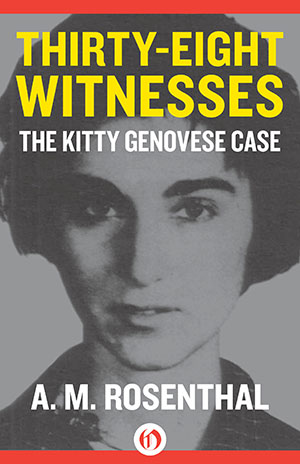
Bill Genovese was 16 years old when his big sister Kitty was stabbed to death in Queens, New York. Her 1964 murder shocked and scared the nation as news got out that 38 of Kitty’s neighbors watched and did nothing to intervene as the 28 year-old screamed for help and fought for her life.

It’s actually a horrifying image that has always stuck with me ever since I first read about it in Social Psych. How could 38 people watch from their apartment windows as their neighbor was in such immediate danger? This question inspired a new subfield of social psych research and was one of the main reasons why I continued to study (and pursue a career in) psychology. It inspired Bill Genovese to enlist in the Marines when the Vietnam War began because he vowed to never be the guy standing by and doing nothing. And I just found out that it’s a fucking lie.

Obviously and tragically, some of what I learned about Kitty Genovese in college was true. Yes, she was brutally murdered by a stranger outside her building as she screamed for help. Yes, police later interviewed 38 witnesses to the attack. But the claims that 38 people knew what was going on and (shockingly) even that no one tried to help her are erroneous products of some sensationalist and irresponsible journalism published in the New York Times.

The Witness follows Bill Genovese over a ten-year period as he attempts to separate fact from urban myth in the death of his sister. For forty years, the Genovese family believed the same fiction that I did. What that must have been like, to not only lose a daughter and sister to such a brutal attack but to believe that her own neighbors stood by and did nothing, I can only imagine. For a long time, the subject of Kitty’s death (even her life) was too painful for them to even talk about. Until one day Bill can’t take the silence anymore and starts looking for answers.

Sure, the Genovese case received national attention which may have brought about some real positive changes. And, no, that may not have happened had the story been reported as it actually happened. But The Witness makes a fairly strong case that the truth- in journalism as well as in healing from personal trauma- is always important. At some point while watching this documentary, you’ll probably start to wonder if Bill’s obsession with finding the truth is getting a little unhealthy. But by digging deeper into the details of his sister’s life and death, he’ll come to feel closer to her than ever and he honours her memory by reminding all who see it that Kitty was so much more than the last 30 minutes of her life.


.

Strike A Pose

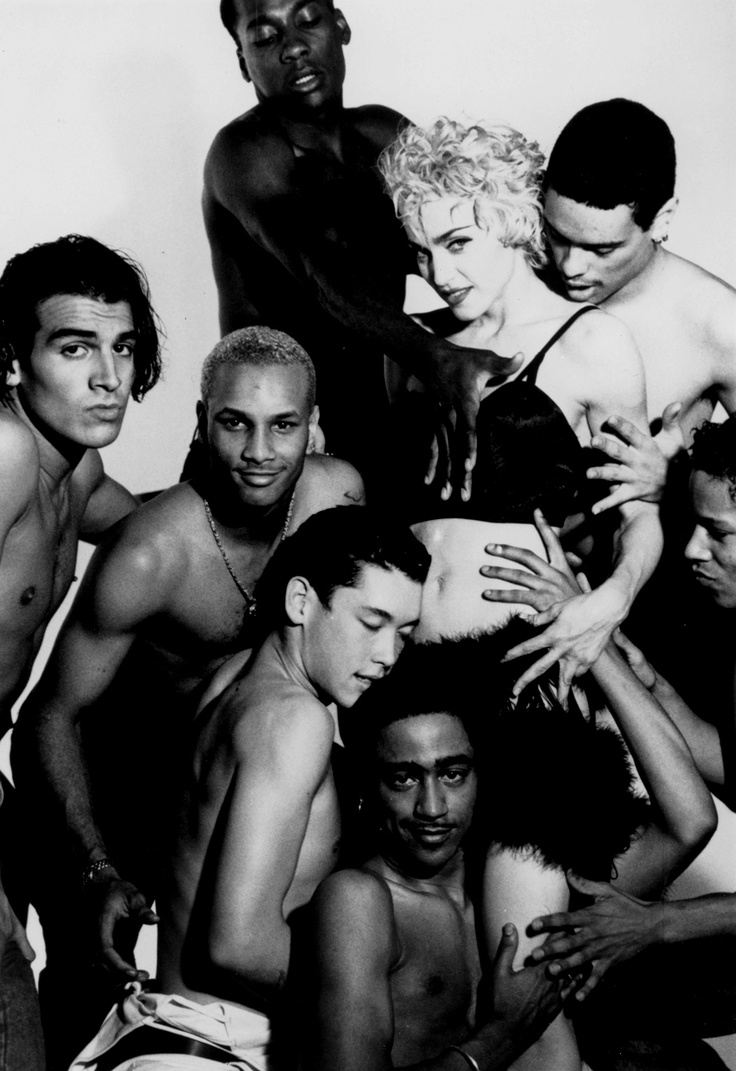
In 1990, an ad went out for FIERCE male dancers; 7 men were picked from obscurity and within months were surfing the zenith of fame alongside Madonna in her Blonde Ambition tour and Truth or Dare documentary.

All but one were gay, and Madonna, having recently lost friends to AIDS, madonna-dancers-02-800was outspoken about gay rights and safer sex. Madonna’s timing was excellent – she pushed buttons while at the same time humanizing homosexuality. In the days before Internet, this was a shot in the arm for the gay community. The kiss depicted in Truth or Dare was for some the first gay kiss they’d seen. It was the first real uncensored gay conversation for many.

But tours end. Fame is fleeting. These 7 men went their separate ways. 25 years later, filmmakers Ester Gould and Reijer Zwaa seek to reunite them, or at least the surviving 6. What has happened in the past quarter century? Drugs, alcohol, HIV, depression, homelessness, and lawsuits. Life outside the spotlight is cold.

There’s a nostalgia factor at play here, and the first third of the film is peppered with archival footage that will please even passing Madonna fans. Beyond that, the film only superficially delves into the successes strike-a-poseand\or failures of these dancers. Despite the prominence of Express Yourself as a theme and an anthem, much is left unsaid. What of these lawsuits? Fully three of the group sued Madonna after the tour ended, despite having been “a family” and having nothing but love for her, and owing her a debt of gratitude. In fact, the only reason offered for the lawsuits is being “caught off guard.” Not a single bad word is spoken against her, but her absence (other than in clips and videos) is distinct.

Is there life after Madonna? Yes. And it might even be interesting, but you’d never know it from this documentary. It’s content with skimming the surface and cashing in on the men’s iconic status. Their 15 minutes evaporated pretty quickly, but this documentary’s impact will fade even quicker.


This post first appeared on Cinema Axis as part of the coverage for the Inside Out LGBT Film Festival.