Tag Archives: female directors

TIFF20: Nomadland

Fern (Frances McDormand), an unemployed widow living in a ghost town so deserted its zip code has been discontinued, makes the very hard decision to pull up stakes and hit the road. In this economic climate, that’s all it takes to become a nomad: lack of opportunity + too broke to retire = living in a van. She heads to where there’s seasonal work, a large Amazon distribution centre that pays your camping fees while you ship goods to online shoppers over the holidays and then kicks them out when the shopping season’s over (a sadly real employment strategy called the CamperForce program).

This is an actual way of life for many people nearing or having achieved senior citizenship with a subpar pension and no social safety net. This is not our finest hour.

Director Chloé Zhao takes us on a quintessentially American road trip through 7 states over a four month shoot. She adapts Jessica Bruder’s book for the screen but lets stunning cinematography tell its own story, and allows real life nomads Linda May, Swankie, and Bob Wells to their stories from the fringes of society. Brilliant, brilliant McDormand feels like a fixture rather than a tourist in the landscape.

Zhao has an incredible aesthetic, her scenes like vintage postcards, but ultimately lets them be the backdrop to the stories lived and told by hardscrabble people. Zhao’s edits are generous, allowing the camera to linger over both the power and the pain of “having nothing in your way.”

These modern day nomads speak of rejecting the dollar, the 9-5 mentality, the conventional way of life, but between their words is a choking sense of loneliness and a sense that it is life that has rejected them, or perhaps capitalism has, or the American dream. There is solace in connecting with the earth, of living without encumbrance, but all are tied by the same tug of longing and belonging. Fern herself is an internal balance of grief and resiliency. This life isn’t one that she chose, exactly, it’s a compromise that she made, a way to go on when there was nothing left for her.

Frances McDormand has nothing left to prove. There is a quiet strength to her performance, indeed Zhao seems to have elicited nothing but, even from an amateur cast. There is strength and value in authenticity, even when the truth isn’t pretty.

TIFF20: One Night In Miami

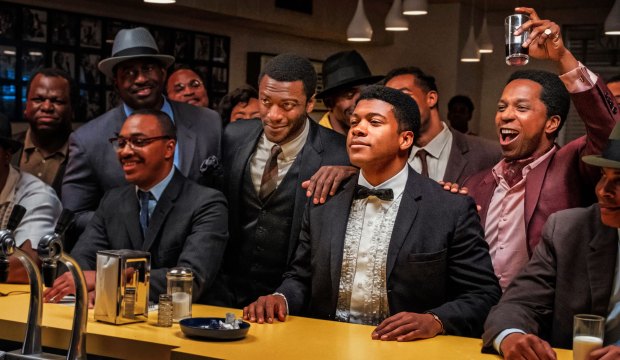
One night in Miami, Cassius Clay, not yet Muhammad Ali, is celebrating his heavyweight world boxing title rather quietly, in a seedy motel room, with a few of his friends. This is a fictional account, the way screenwriter Kemp Powers (who adapts it from his own play) imagined it, of one remarkable night where four Black icons – Clay (Eli Goree), soul man Sam Cooke (Leslie Odom Jr.), NFL star turned movie star Jim Brown (Aldis Hodge), and Malcolm X (Kingsley Ben-Adir) got together and inevitably discussed their roles in the civil rights movement, what they did or did not owe their people, the cost of their success, and the general cultural upheaval of the 1960s.

Of course, Malcolm X’s idea of a good time is vanilla ice cream and a lecture. He wants and expects his friends to be weapons in the cause. His expectations are sky high and everyone around him invariable feel as though they aren’t measuring up. They were young, black, famous, and unapologetic, but they had one thing that Malcolm X felt they took for granted, that he wanted for all his people, not just a few lucky exceptions: power. Black power.

One Night In Miami does an exceptional job of putting us in the mind frame of Malcolm X shortly he was martyred for his cause. His idea of brotherhood was strong if unconventional, and he was willing to push the Black compatriots who were positioned to effect change just as much as he was challenging the white people invested in keeping them down. This was not the time for people to sit on the fence, he believed, not with Black folks dying in the street. And with so simple a phrase, screenwriter Powers reminds us how timely this movement still is, even 60 years later.

Regina King choose this as her feature-length directorial debut, and what a time and place for her to come out swinging. Making full use of Malcolm X’s last days and last words, she pins us to the moment while tethering us to the movement at large, to its consequences and to the work still to be done. King and company reframe was at the time attributed to “militance” to passion, urgency, and prescience.

Regina King describes her film as “a love letter to the Black man’s experience in America.” Four cultural icons who may not be living the average Black experience, but who are open and vulnerable with each other, expressing fears and concerns. Knowing her film had a valuable contribution to make in the current conversation, King pushed herself to get the film made despite this year’s many obstacles, and made history on Monday night as the first African American woman to have her film be selected by the Venice Film Festival, notorious for its lack of diversity and gender parity. Her film is pushing more than one needle in the right direction, and TIFF audiences should be grateful to participate.

Cuties (Mignonnes)

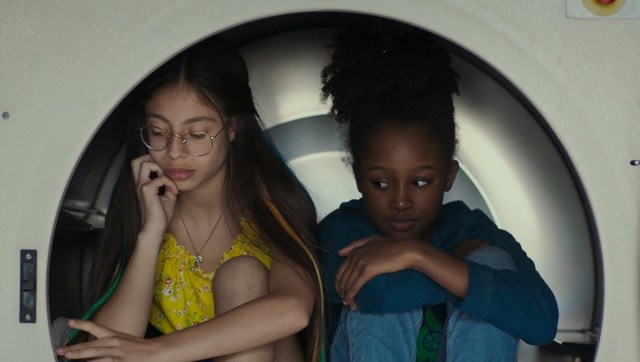
Amy is an 11-year-old Senegalese immigrant living in a Parisian apartment with a conservative mother, a strict auntie, and several siblings who await their father’s return with a second wife in tow. Her life is so different compared to the other girls at school, so seemingly easy with their bodies, dancing freely, hardly a care in the world. In Amy’s home, money is scarce, modesty is valued, and things are complicated.

Like pretty much every kid ever, Amy just wants to fit in. “The cuties” are a dance troupe at school that she’d very much like to belong to. They’re the cool kids of course, with maybe just a smidge of mean girls. They’re irresistible. Amy (Fathia Youssouf) is so desperate to belong she does whatever it takes: her baby brother’s tshirt is a crop top on her. A stolen cell phone becomes her portal to a world of gyrating, scantily clad girls, simulating sex and calling it dancing. She learns from them, in secret. And when the cuties have a sudden opening, she’s more than ready to step in.

You may have heard that Netflix has caught some major heat over this film, mostly from people who hadn’t seen it. They’ve called for Netflix to remove the title from its streaming platform, and threatened mass unsubscribing if they don’t. Their complaint: the movie hyper-sexualizes young girls. Is it valid?

Sure it is. But this is exactly the point film maker Maïmouna Doucouré is trying to make. Her film is a social commentary about the pressure young girls face not just from social media, but absolutely from social media, which they are exposed to from very young ages. And we are all in some way contributing to a culture that only finds value in females that can be sexualized, treating all others as if they’re invisible. If a girl wants to be seen, and has access to a tablet or a smartphone or peers, she won’t have failed to notice what her (lack of) options are.

Is it fair or necessary to sexualize these young actresses in order to prove a point? To be honest, I sort of hate putting kids in show business altogether. No matter how carefully a director isolates mature themes from the children on set, kids are notorious sponges and almost always absorb more than we think. Child actor turned director Sarah Polley was in the news this week reflecting on having to kiss a man twice her age on the set of a TV show when she was 13. A show Canada prided itself on for its wholesome family viewing. It’s a valid concern, even if it doesn’t have an easy answer.

If her film has inspired conversation, then Maïmouna Doucouré has done her job. You can’t move the needle if you don’t ask the hard questions. So I don’t think that muzzling Netflix or forcing censorship on an emerging female director flexing her voice for the first time is the answer. I know that Doucouré hasn’t included these scenes to entertain us; they are there to provoke discomfort. So let that be the starting point for the discussion that needs to be had. Let’s talk about why this makes us uncomfortable, and what we can do so this isn’t Amy’s story anymore. So the next time someone writes a movie about a girl like Amy, it won’t be about how the only currency she has is her body.

The Broken Hearts Gallery

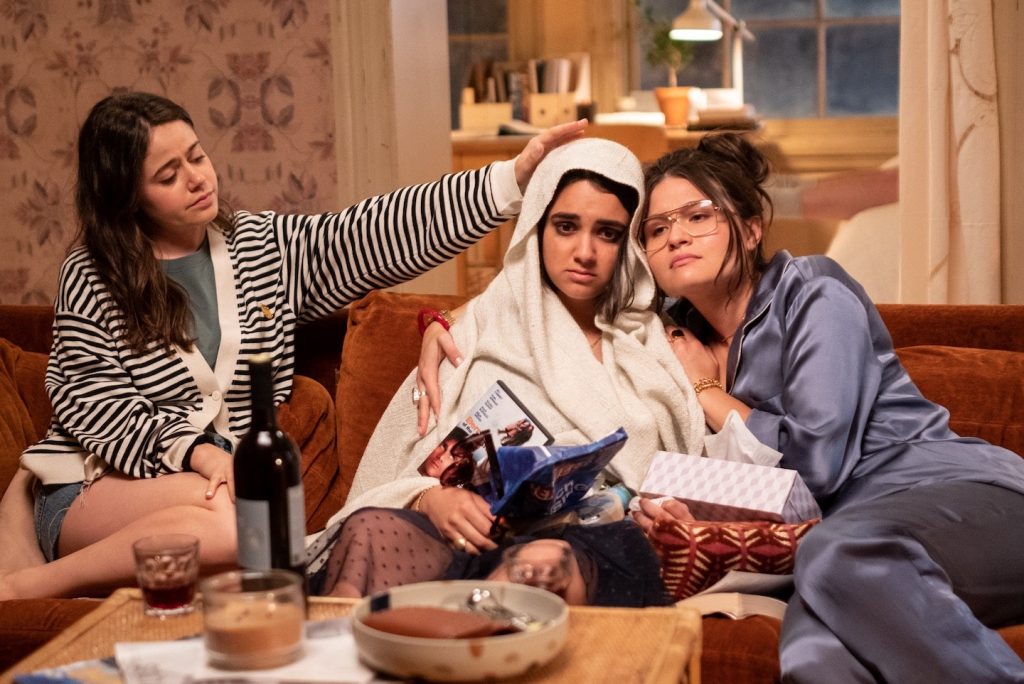
Lucy (Geraldine Viswanathan) moved to NYC to own a gallery. Has it worked out that way? Not so much. On the same night that she realizes her colleague/boyfriend Max (Utkarsh Ambudkar) is leaving her for an ex, she makes a drunken fool of herself at a work event and gets fired from her dream job working as an assistant to famed curator Eva (Bernadette Peters). Cue: black mascara tears and her best friends/room mates Amanda (Molly Gordon) and Nadine (Phillipa Soo) coming to the rescue, as best friends always do. Oh, and another entry into Lucy’s mausoleum of broken romances. She’s a memento keeper, you know, those little proofs of the love you once had, a love letter, a movie stub, a dried flower. Except Lucy is a memento hoarder. Her room is 90% shrine to love that didn’t last, and the piles are so high she’s lucky they don’t topple over and crush her. While her peers may be out documenting each day on the gram, she’s too busy memorializing the past to live in the now. Yeah, this is a pattern that’s repeated itself a few times.

Combining her breakup with her unemployment, she’s inspired to open a museum of heart break. After all, she’s hardly the only one who’s had her heart broken. Everyone’s got a story, and everyone’s got some little piece of evidence. Right? I, myself, am a bit of an emotional hoarder. I have every single letter anyone has ever sent me except from exes because this cold bitch leaves that shit fully behind.

Of course Lucy gets a little help and of course it’s from a cute boy, Nick (Dacre Montgomery), who is working on his own dream, turning an old YMCA into a boutique hotel, though at this point it’s still 96% disgusting old gym. And it smells like one too.

I have been looking forward to this movie for quite some time and I’m so, so grateful that it didn’t disappoint. Writer-director Natalie Krinsky knows what she has to deliver in terms of a rom-com that wary 2020 audiences won’t hate, but the main weapon in her arsenal is definitely Geraldine Viswanathan, who steals every scene she’s in and lights up every screen she graces. There’s an old fashioned charm to this film, and a very watchable ensemble cast. The movie’s roots may be in broken hearts but its emphasis is on healing them. This is easy, hopeful fare that goes down easy, like comfort food that’s good for you too. I wouldn’t mind a second helping.

Good Kisser

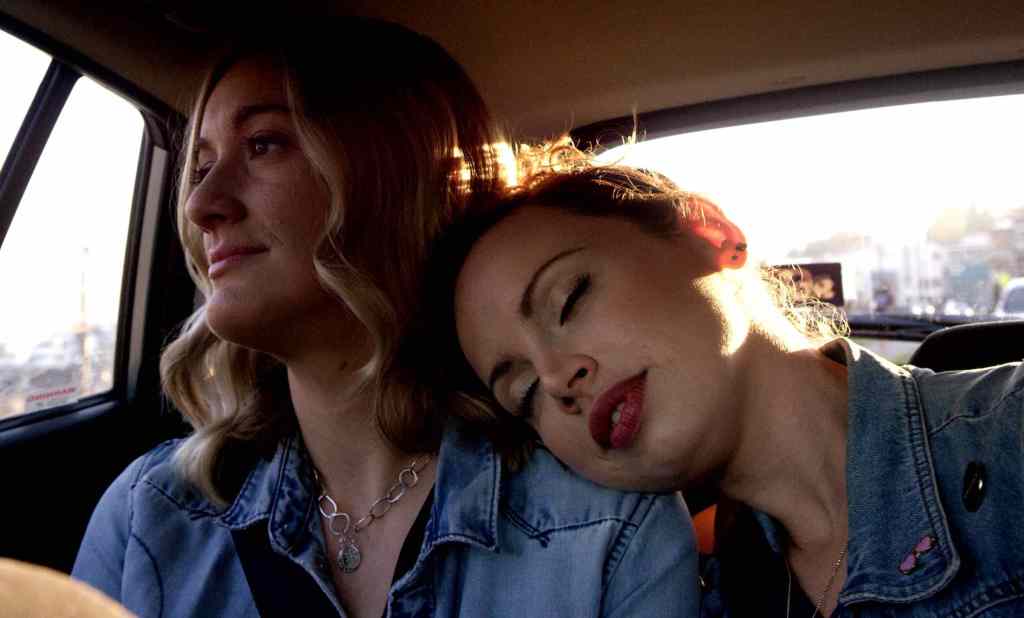
Jenna (Kari Alison Hodge) and Kate (Rachel Paulson) are ubering to their first threesome as a couple. Jenna is nervous, blabbering to their driver. Kate is excited, anxious to appease Jenna’s insecurities. They discuss code words and safe words and rules and limits but all that good stuff goes right out the door in the heat of the moment.

To Jenna, Mia (Julia Eringer) is a mysterious but seductive stranger. Kate and Mia, however, have some sort of history, one that Kate seems pretty intent on rekindling, pressuring Jenna to get those fires lit quick. But while Kate wants it more, it’s Jenna and Mia who seem to really connect, at least on an intellectual level. They have great chemistry outside the bedroom, but inside is another story, Jenna’s anxieties prevent her from really enjoying an intimate encounter with a random person, an issue that should have been clear to both Jenna and Kate, her partner of nearly two years, well before they got into bed with a third party. But it seems this was an effort to “spice up” their relationship, and is clearly a mostly one-sided endeavour. You’ll never see this coming but – spoiler! – turns out, a threesome isn’t a quick fix for a rocky relationship. In fact, it seems to be extra good at exposing the flaws in the foundation.

This is an indie movie with a pure, pure heart. Talented writer-director Wendy Jo Carlton has put her soul all over the page and the screen. None of the actors are completely natural on camera yet, but their professionalism and eagerness go a long way. And so does the spirit of the project itself, an LGBT movie that speaks to its own people. Far too often, movies about lesbian couples especially get made for the male gaze, the male hetero gaze, it probably goes without saying. That’s how you make a lesbian movie marketable. But Good Kisser isn’t afraid to deviate from the kissing. It’s talky, it’s neurotic, it’s questioning without being judgmental. What started out as a night billed as pleasure turns into one of pivotal evaluation and reassessment. If Good Kisser isn’t quite a Good Movie, it is at least obviously from a Good Director who deserves to have her next project have a Good Budget.

Mulan

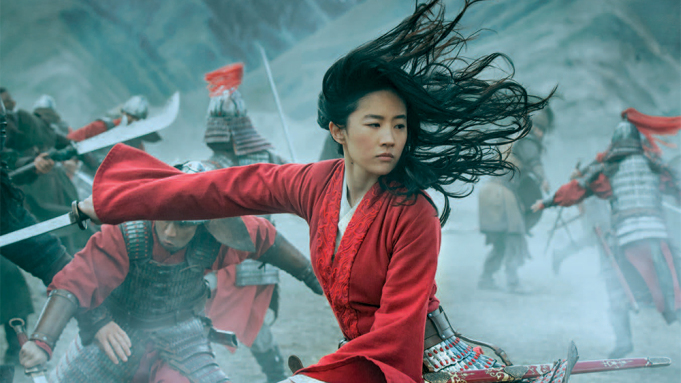
The reason why this Mulan live-action movie is better than its Disney predecessors is that it unyokes itself from the animated film and doesn’t attempt a scene-by-scene remake. The story is similar, but is more faithful to the Ballad of Mulan myth, with fewer Disney-fications. While Cinderella and Beauty & the Beast were meant to appeal to the little girls who watched and loved the originals, now grown up and ready to be dazzled all over again, they inevitably disappointed because you can’t recapture that magic in a bottle. Mulan doesn’t try. It’s not made for the little girls we used to be, but for modern audiences used to stunning cinematography and well-choreographed action. The movie doesn’t seek to appease our inner princesses but to waken our inner warriors. Don’t compare this to the animated Mulan, compare it to Wonder Woman, Atomic Blonde, Tomb Raider, Captain Marvel, Rogue One.

Mulan (Yifei Liu) is a spirited young woman whose childhood antics were somewhat indulged by her family but now that she’s of marrying age, she needs to dampen that fire in order to make an auspicious match and bring honour to her family. That is a woman’s place, a daughter’s place: honour through a good marriage and by being a quiet, elegant, composed, invisible wife. Her chi needs to be hidden away; it is meant for warriors, not women. But you know how this story goes. When the enemy Rouran threaten the Chinese empire, each family must send a man to fight, and since Mulan’s father has no sons, he himself is the only option, even though he’s disabled from the last war. To save him, Mulan steals away in the night, and poses as a man to take her family’s place in the Chinese army.

Niki Caro’s Mulan looks slick as hell. The colours are fantastic, the reds so vivid they’re nearly engorged, Mandy Walker’s cinematography bringing lush, diverse landscapes into sharp focus.

I love how grounded in history this movie felt; the animated film tread rather lightly on the reality of Mulan’s every day life, but here her mother reminds her (and us) of the dire consequences should her spunk be taken the wrong way, that such a woman would swiftly be labelled a witch and put to death.

At boot camp, sheltered Mulan is bunking among rough young soldiers. They do not sing their way through a snappy montage of training, they push their bodies to the limit trying to get battle-ready in time to save their country and their emperor. Friendships are made but they are also tested. This is not some summer camp – these young men know that their lives will soon be on the line, and they will need to count on each other in order to survive not to mention succeed.

The action sequences are stunning. Clearly Yifei Liu and company are the real deal, expertly trained and extremely convincing. Any movie that has the guts to bench Jet Li as the emperor and let others perform the martial arts had better bring the goods, and Mulan does. It’s not breaking new ground, but it’s well-executed and exciting to watch.

My one complaint is that the movie’s so intent on delivering incredible visuals and epic battle scenes, it devotes precious little time to developing its characters. We know that Mulan is fiesty and brave, but little else. We know even less of the others. Commander Tung (Donnie Yen) is a fierce leader and knows raw talent when he sees it but if he has any life or thoughts outside of war we aren’t privy. If Honghui (Yoson An) is surprised by the intimate nature of his friendship with the new, very handsome, very soft-featured soldier, he doesn’t show it, or shy away from it. He doesn’t mention it at all. And the other soldiers are just caricatures, filling up the ranks. But I think the real loss is in our villains, a duo didn’t inspire as much panic as their potential first teased. The one is just your run of the mill bad guy – his want and his greed are in opposition to China’s, and he’s pretty ruthless in his pursuit, but it’s nothing we haven’t seen before, in movies and in life. The other is by far the more interesting and I wish we could have known more of her, particularly because the final showdown between herself and Mulan is low-key amazing and I think understanding her a little better would only have strengthened that moment. Still, 1998’s Mulan had a villain, a Hun named Shan Yu, with eyes as black as his soul, who inspired not mere fear but terror, and we didn’t know anything about him. True, I was a child then, but I’ve rewatched it recently, and his menace is chilling, even without much context.

I enjoyed the 2020 Mulan. The cast was great. The film was incredibly shot and almost ridiculously beautiful. It evokes just enough of the first film through detail and musical cues. It was a treat, a rarity among Disney remakes, one that actually justifies its existence by incorporating the best of the first but improves upon it too, gives it a more mature and serious tone, one befitting a warrior, and that’s exactly what she is.


Jumbo

I’ve been trying all day to figure out how to break this to you, and I’m no further ahead now that I was this morning, and you’ll see from the time stamp that it very very late in the evening now. Assuming I get something put on the page and hit publish tonight, which is assuming a lot since I still have bupkis. Well, that’s an exaggeration. Not the bupkis, the bupkis is spot-on. It’s just that by “all day” what I really mean is “intermittently, for the past 13 hours, for a total of probably not more than 90 minutes.” Which is still quite a lot as I can usually bang these out with great efficacy.

But this is what you get when you attend the Fantasia Film Festival, a festival dedicated to the weirdest and most wonderful corners of the wide world of cinema. It’s not for blockbusters, and not generally for Oscar bait, although it has hosted its share of contenders, including South Korea’s A Taxi Driver, Japan’s The Great Passage, and our own Tom of Finland. It’s been visited by the finest film nerds, including Ben & Josh Safdie, Guillermo del Toro, Mark Hamill, John Carptenter, James Gunn, Nicolas Winding Refn, Eli Roth, Takashi Miike, Ben Wheatley, and me. It’s funny because it’s true.

I have seen lots of strange stuff at this festival: people pooping out their living, breathing, emotional baggage; humanoid cockroaches; sex cam horror; an impregnated bathtub; a frog-man serial killer; a hunt for bigfoot; cannibal grandparents… and I could go on but won’t, for both our sakes.

But Jumbo…is in a category all its own. It’s about a woman, Jeanne, bit of a weird duck that one. Still lives with her mother. Kind of a loner. Works at an amusement park. Falls in love with a carnival ride. Typical French woman, eh?

So yeah. She calls him Jumbo because his real name (slave name?) is vulgar (and let’s face it, it’s more of a descriptor than a name). It’s one of those tilty-whirly rides that make kids squeal and/or turn green. And it’s dead sexy. Well to Jeanne (Noémie Merlant) he is. He’s very attractive, smart, funny…well, okay, it’s hard to see what exactly she sees in him, other than he’s just about the only one who hasn’t called her a weirdo. At least not to her face. And he does seem responsive: he flashes his lights, he takes her for a spin, he blows smoke and leaks oil…oil that is sometimes good and sometimes bad. It’s a bodily fluid I suppose, which at times makes Jeanne orgasmic and elsewise makes her anxious.

You know who else is anxious? Everyone who knows about Jeanne’s little crush. Suddenly being “a little odd” is seeming a bit more pathological. Her mother (Emmanuelle Bercot) is not exactly lucky in love herself, yet she still feels empowered to criticize Jeanne’s choice of beau. And the human male coworker (Bastien Bouillon) who up until quite recently had a crush on our Jeanne feels a little stupid for coming in second to a garish attraction that plays 80s songs while stirring up puke.

Writer-director Zoé Wittock deserves an award for the pure audacity to take such a story to the screen, to present it to an audience and say “Yes, I made this. On purpose.” But we can’t help who we love. Unless it’s an inanimate object, in which case we should really, really try. I can’t help but admire a movie that subverts even the modern romance, I can’t help but love Jeanne for her genuineness, her sincerity, but I can’t quite get on board with Jumbo. It’s an experiment, a bold one, yet still reminds me of things I’ve seen before (Under The Skin!). Jumbo and I are not a perfect match, which is find and dandy with us both – after all, Jumbo’s already got a girl, and despite what I felt was a marked lack of chemistry, they seem to be quite serious about each other. Quite.

Hope Frozen: A Quest To Live Twice

Matrix wanted a younger sibling and was thrilled when little sister Einz was born. Einz means love, and she certainly was. But brain cancer ravaged her little body, spreading faster than her father, Dr. Sahatorn Naovaratpong, a Buddhist scientist, could research the disease that was robbing him of his beloved toddler. That’s why he and wife Nareerat chose what they did: cryo-preservation. Moments after she died, before even her third birthday, a team was there in her home to start the freezing process, and her preserved brain was sent to America for as long as it might take to find both a cure for her cancer and a way to regenerate her body.

Let me be clear: this is a documentary. This is a real family from Bangkok. You may already be familiar with their story, because at the time little Einz was the youngest person in the world to undergo cryogenics. Their story made international headlines and scandal wasn’t far behind – some angered that they’d taken the place of god, others worried for her soul, worried she’d be unable to find peace, and others still wondering what her life would be like should she wake up some vague time in the future when everyone she once knew, even if she remembered them at all, would be dead.

Sahatorn knows that the science will not catch up to him in his lifetime, so he’s bequeathed this rather large burden to his son, Matrix, in the hopes that he will continue down the scientific rabbit hole of bringing his baby sister back to life.

I’m not going to judge these people because obviously the pain of losing a child is unbearable yet must, sometimes, be borne. And I do understand, all too well, the yearning, the need, to have someone back.

Director Pailin Wedel does a great job of rounding up experts, from those that believe death is merely a problem to be solved, to those who see it as an ascension to the afterlife, but the heart of the film is with the family as they grieve a little girl who, to them, is not quite dead.

The Sleepover

Kevin’s having a bad day. First his teacher, the humourless Mrs. W, busts him for fabricating his family history for an oral presentation (hint: pick something less obvious than best-selling novel The Martian), then he gets caught on camera by the school bully dancing his pants off in the boys’ washroom, and then he gets saved by his mommy/lunch lady in front of the whole cafeteria. Could his day get any worse?

Yes. Yes it can. While Kevin (Maxwell Simkins) and nerdy friend Lewis (Lucas Jaye) are having a sleepover in the backyard, and big sister Clancy (Sadie Stanley) and her friend Mim (Cree Cicchino) are trying to sneak out to a party, their parents Margot (Malin Akerman) and Ron (Ken Marino) are abducted by what witness Lewis can only describe as “ninjas.” But the fact that Margot has left them a series of clues hints at another sort of life, one her family knows nothing about, but these intrepid kids are going to follow them into the city and a whole heap of trouble, all in the name of rescuing their parents.

The Sleepover plays like a kid version of National Treasure or The Da Vinci Code; director Trish Sie serves up some decent action sequences, but the tone and the humour do much to dilute the sense of peril and remains appropriate for family viewing. Ken Marino offers up his particular brand of wimpy wit, but it’s the kids who hog the spotlight. Maxwell Simkins is an especially wonderful addition; his bathroom dance is so charming and well-executed it’s hard to believe he’s bullied for it rather than praised – especially in the age of Tiktok, where this kind of thing would likely turn him into an overnight sensation. Actually, it sort of does anyway: the video posted to tease him goes viral, which is sort of what gets them into this mess.

Casting the right kids is imperative for a movie like this, but The Sleepover gets it right. It’s way too easy for a movie like this to go sideways, falling prey to either inauthentic child performances or an overly trite script, but Sie and screenwriter Sarah Rothschild manage a delicate balance of broad humour and credible adventure in crafting a fun ride fit for the whole family.

The One and Only Ivan

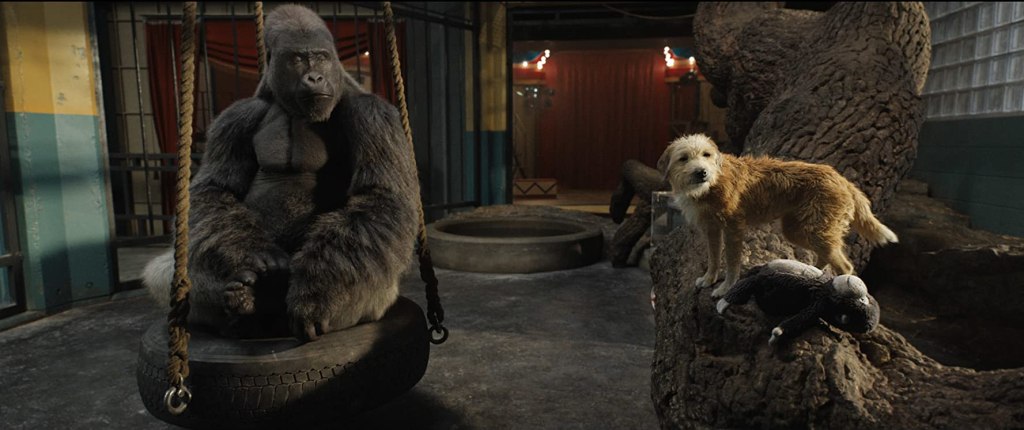
At the big top mall and video arcade at exit 8, Mack (Bryan Cranston) is the ringleader of a tiny circus inside a shopping mall. Home to animals including elephant Stella (voiced by Angelina Jolie), poodle Snickers (Helen Mirren), baseball-playing chicken Henrietta (Chaka Khan), mangy mutt Bob (Danny DeVito), Murphy the firetruck-driving bunny (Ron Funches), a neurotic seal named and most impressively, the headlining silverback gorilla, the one and only Ivan (Sam Rockwell). But the truth is, both the mall and the circus within it have fallen upon hard times. The crowds aren’t filling the seats anymore, and the circus is barely making enough money to keep the animals fed.

Mack brings in a baby elephant named Ruby (Brooklynn Prince) to reinvigorate the show, but even though she radiates cuteness, she’s not enoujgh to save the circus. That role, as ever, belongs to Ivan. But for the first time in his life, he’s wondering if maybe circus captivity isn’t the best or only option. He’s not concerned for himself so much as for baby Ruby, who deserves to be in the wild, a concept he can hardly recall or imagine.

This movie is based on the children’s novel by K.A. Applegate, which in turn is based on the true story of Ivan, a western lowland gorilla who spent 27 years living inside a mall enclosure in Tacoma, Washington, never setting foot outdoors. You don’t have to be good at math to figure how emotional this one’s going to be.

A live action/animation hybrid, this movie looks slick, and seamless enough not to detract from its sweet but simple story. The movie, directed by Thea Sharrock based on a script by Mike White (the very one who produced scripts as varied as Beatriz at Dinner and The Emoji Movie), isn’t quite sure where to take its darker themes but it draws some very sympathetic characters and a heartwarming tale about family and home. Cranston seems to be morphing into Ian McKellan before our very eyes, but it’s little Ariana Greenblatt who steals the show and all her scenes as Julia, the arty and intrepid zookeeper’s daughter who just wants her friends to be happy. The One and Only Ivan stole my heart and quite a few tears – a small price to pay for a solid, family friendly option new to Disney+.