
Dee Dee Blancharde had had a rough go: displaced by Hurricane Katrina, she was the sole care-giver for her severely disabled daughter, Gypsy Rose. Gypsy’s diagnoses were many: epilepsy, muscular dystrophy, asthma, sleep apnea, cancer, chromosomal and developmental defects. She was confined to a wheel chair, fed by a tube, often breathing with the help of an oxygen tank. She endured frequent surgery and chronic pain. She was brain damaged and stuck at the intellectual age of 7. Dee Dee, devoted to her daughter, didn’t work. They accepted charity in the form of a house from Habitat for Humanity, met Miranda Lambert through the Make-a-Wish Foundation, got free trips to Disney World, Gypsy’s favourite. Kindly neighbours pitched in what they could; the Blanchardes were community fixtures, and well-liked. Then one day Dee Dee’s Facebook status read “That bitch is dead” and when police investigated, they found her stabbed to death in bed. Gypsy was nowhere to be found.
This case caught my eye at the time and I read about it extensively. It turns out that 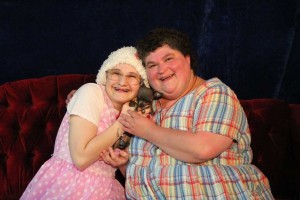 Gypsy was never sick, wasn’t even paralyzed. She had endured years of abuse, via ‘Munchausen by proxy,’ a condition wherein a caregiver fakes and actually induces health problems in their child in order to gain sympathy and attention for themselves. Gypsy, armed with a secret internet boyfriend, had had enough, and plotted her mother’s murder.
Mommy Dead and Dearest is a shocking documentary that explores this case in depth. People who knew them were shocked to see Gypsy Rose walking unassisted, and wondered how much she herself had been in on the deception. But even Gypsy Rose didn’t know her true age, or the extent of her health problems. Many of the medications given her to treat fake illnesses gave her real, troubling side effects. The documentary follows her trip through the justice system and asks us whether we must consider her to be a cold-hearted perpetrator, or a victim who finally fought back. Director Erin Lee Carr lets the story tell itself, giving the narrative time and space to unfold itself, deftly answering questions before we even ask them. This case is so astonishing that Carr’s guidance is particularly necessary, yet her presence is minimally felt. I was completely fascinated and absorbed by the story, and I bet you will be too.
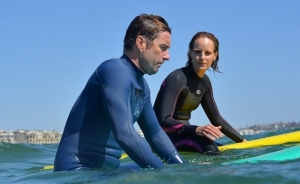 with her son Angelo (Brenton Thwaites), an aspiring writer just out of high school. He’s not too keen on post-secondary education, and when he fucks off to California for the summer (where his dad lives, and the waves beckon), she irrationally follows. Is young Angelo happy to have his Mommy along on his big independent adventure? No he is not. So to prove how cool she is, Jackie takes up surfing. When stubbornness alone isn’t quite enough, she reluctantly takes lessons from Ian (Luke Wilson).
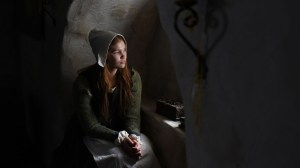 course his new and improved judicial system could use a steady stream of accused. Why not a good old-fashioned witch hunt (although to be fair, in 1600, it was simply just “the fashion”)?
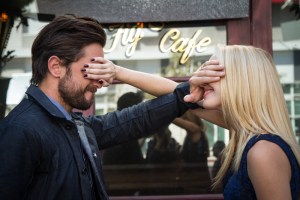 day. But then a mysterious older guy gives him some advice, and a mysterious older woman gives her advice, and they spend the night together, pushing each other in pools and falling in love.
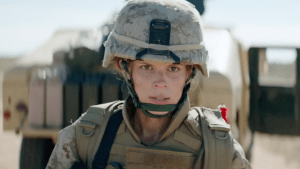 War is hell, but returning from war is really rough too. As we’ve realized the devastating effects of PTSD and how severely it has affected an entire generation of American soldiers, war movies have more frequently shown us the human effects of conflict. In my view, that is a welcome and long overdue change. I was somewhat apprehensive going into Megan Leavey, because I feared that it would try to glorify or justify the invasion of Iraq. That’s a non-starter for me because there was no legal basis for the invasion or occupation, and no glory to be had over there. You will never convince me that it was a good idea for the U.S.A. (and not just them) to send hundreds of thousands of troops to a no-win situation in the Middle East. Many of those troops didn’t come back and those that did were never the same.
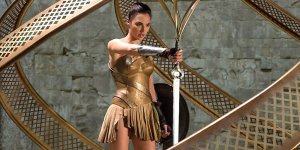 body. Her aunt Antiope (Robin Wright) is the fiercest of them all, the greatest warrior the Amazons have ever known, and she’s in charge of training. Though Diana’s mother Queen Hippolyta (Connie Nielsen) wants to protect her daughter and extend her childhood, Antiope teaches Diana in secret. Themyscira is hidden from mankind, but you never know when the enemy might arrive. Themyscira is lush and beautiful. Filmed on location in Italy, the production is fantastic. The opening scenes where the diverse population of Amazonian women are all training with Antiope are gorgeous. The fight choreography is top notch, with particular sequences slowed down to showcase athletic feats. But we all know utopia can’t last forever, and as soon as Diana (Gal Gadot) is grown, one man does penetrate their paradise: a pilot named Steve Trevor (Chris Pine) is shot down in their waters. Diana saves him from the wreckage but they’re pursued by Germans. An epic battle between Amazons and Germans unfolds on the beautiful beaches of Themyscira. The Amazons fight unlike anything anyone has ever seen, but the Germans are armed with guns and the Amazons suffer loss. Steve Trevor tells the women that the world is at war (WWI to be exact) and that millions of lives have already been lost. Aghast, Diana swears to accompany him back to where he came from so she can help bring peace, as is her sacred duty.
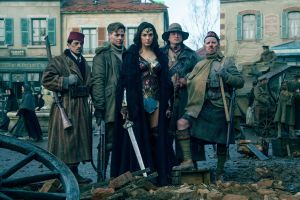 battle, there is no ego; they work together. The costumes are not sexualized as I feared, but instead they highlight muscular shoulders and toned legs. There can be no doubt that the Amazons are capable of truly anything. The fight sequences are among the best you’ve ever seen, the hand-to-hand combat precisely choreographed with as much grace as intensity. And it made me cry to see it. And I felt ashamed to cry, as a woman in 2017, ashamed that it’s taken this long to see a woman successfully take up the mantle of hero, and a woman behind the camera as well, capably directing a tentpole film. Patty Jenkins has so much unfair pressure placed on her shoulders but she’s made a movie that’s close to perfection, that far surpasses anything the DC Extended Universe has produced so far.
 superhero. The action sequences in this film are among the best, a delight to watch, full of energy, strength and ferocity, as good and frankly better than the stuff we we’ve seen from other comic book movies lately. And arguably, the reason she’s so strong is because she welcomes her softer side. Believing in fighting honourably, while looking your enemy in the eye, Diana never picks up a gun. She runs toward machine guns with only a shield and her cuffs to protect her. And she fights from a place of love. Not duty, not fury, not patriotism or revenge. She fights because she loves. Male superheroes seem to think that love is a weakness, but Wonder Woman knows better: love is the greatest motivator you could ever have.
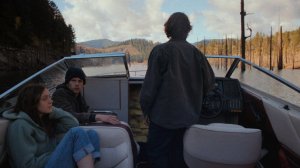 Night Moves isn’t so much about the environment as it is a character study between these three individuals trying to make a statement, and then living with the consequences. It’s slow, almost plodding. There’s no flashiness, just a creeping sense of guilt and paranoia.
 Cut to: a few years later, Sarah and Jessie are on the road again, headed toward Mindy’s wedding. Mindy’s future husband seems nice. Sarah’s husband seems to be out of the picture. And Sarah and Mindy? They haven’t seen each other since that road trip so things are suitably tense and complicated. Sarah might be trying to reestablish their earlier intimacy, but the day before Mindy’s wedding is probably neither the time nor the place. So if you’re hoping to see something awkward, you’re in luck!
 Leigh (Kristen Bell) is reliving her adolescence, but it doesn’t seem to be making her any happier. She’s too young for a midlife crisis, but that’s essentially what this is, an existential reckoning. She’s depressed and lost; she went after everything she was supposed to but is finding adulthood to be not all it’s cracked up to be. Of course, none of her friends seem all that happy either. What magic ingredient is missing?
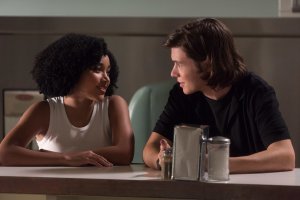 Their love story unfolds slowly, as it must when one person is physically removed from the other. In the novel they communicate by text or instant messaging. To make that play a little less boring on screen, director Stella Meghie imagines them within the architectural models that Maddy’s always working on. It’s a device that works while still reminding us that these conversations don’t actually take place in a face-to-face reality. Still, it’s a talk-heavy, plot-light movie that doesn’t move around too much. If you aren’t swooning over Olly’s too-long-locks, you’re probably going to find this long.
 things. Amandla Stenberg is very charming as Maddy, the brave, beautiful, but socially awkward girl next door trapped in a glass castle. She succumbs to the kind of romantic gestures no teenage boy would be caught doing and only a young-adult novelist could dream up. There’s some major eye-rolling to be had in this movie, and it starts rather early, when Olly first appears in his driveway, tossing his luscious locks in the unfiltered sunlight, shooting his pretty neighbour a cocksure grin while showing off on his skateboard. I was so sure he was about to eat it, and truthfully hoping he would, that it set a really weird tone to the movie for me. I guess my lusty teenage days are too far behind me. Your enjoyment of this movie will depend on the calculation between yourself and your own misspent youth.
 ASSHOLES WATCHING MOVIES