Tag Archives: female directors

The Story of My Wife

Man makes crude bet with friend, vows to marry the next girl who walks in.

Sounds like the premise of one of those beach-reads romance novels, or a cheesy teen romance, but in fact, this is writer-director Ildikó Enyedi’s latest period drama. So what’s the difference?

Sea Captain Jacob Störr (Gijs Naber) is ready to marry, he declares to his friend. “To whom?” the friend inquires, naturally. Jacob doesn’t know yet, so he proposes that he will marry the very next woman who enters the café. Lucky for him it’s the lovely Lizzy (Léa Seydoux), who proves surprisingly amenable to his plan.

Is it a good idea to marry so impetuously? Jacob and Lizzy will soon find that love and marriage are about as turbulent as the seas he routinely conquers as captain of a large vessel, and not so easily navigated. Marriage without courtship, indeed without even basic familiarity, does pose its challenges. The Story of My Wife is the story of a man discovering his wife after he’s already married her. She’s coy, and teasing, and he can never get a good read on her, and since we know Lizzy only through Jacob’s eyes, neither can we. Is she sincere? Serious? Unfaithful or just a flirt? Whatever charm resides in her mysterious character evaporates in the sheer repetitiveness of the film, Jacob’s jealousy coming to a head over and over again.

Jacob is awkward on land, and even more uneasy when he finds himself unable to captain his marriage and steer it in the direction of his choosing. Used to taking people at their word to a fault, Jacob cannot credit his wife’s womanly wiles. It’s mildly interesting but this clunker takes on water steadily but takes almost as long as Titanic (the movie, about 3 hours) to sink. I’m quite sure that you’ll have jumped overboard long before then. The Story of My Wife beguiles us with its pretty 1920s setting and Seydoux’s luscious ringlets, but it ultimately fails to hold the attention.

The Story of My Wife is an official selection of TIFF21.
As In Heaven

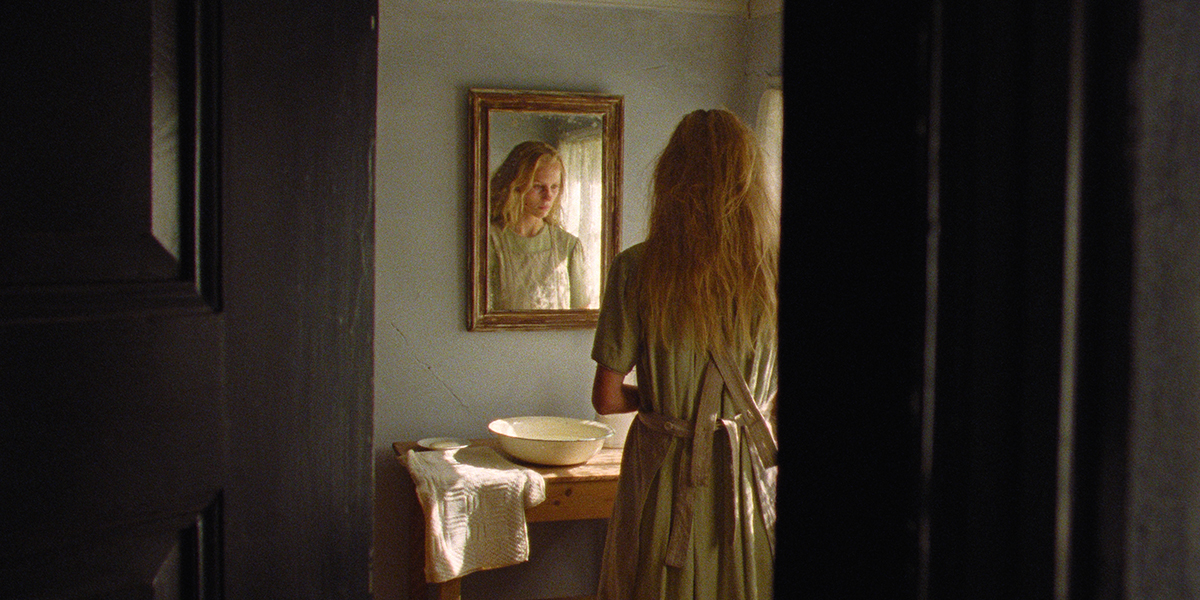
In 19th century rural Denmark, Lise is a 14 year old girl on the cusp of what her time and place would consider womanhood. Her father thinks educating girls is a waste of time, but Lise’s mother Anna sees her intelligence and her need for more, and insists she be sent off to school, which means leaving the farm, her family, and her crush.

Anna, at the end of a difficult pregnancy, goes into labour. It is bad, immediately bad, but Anna refuses to call for a doctor. She had a dream wherein a doctor was called, and she died. Her mother-in-law, the stern and taciturn Old Sine, presides over the birth, guided by her own portents, prayers, and visions. The hours drag on as blood soaks through the mattress and Anna’s moans grow increasingly savage. Meanwhile, Lise tries to comfort her siblings as they cower together just out of sight. They wonder what will become of them should their mother die, and Lise, as the eldest, considers that this might be a punishment from God – and that Lise herself might be the cause.

Director Tea Lindeburg was drawn to the material because its themes felt alarmingly contemporary. Anna’s poor choices are made out of fear and ignorance – these are uneducated farmers, established enough to have options but superstitious enough not to use them. Today ignorance doesn’t have to be an excuse, the science is there, yet we still see misinformation and dogma offered as reasons not to follow doctor’s orders.

As In Heaven is thoughtfully created but slow to watch. As young Lise, Flora Ofelia Hofmann Lindahl contains multitudes and stirs empathy, particularly as she begins to doubt herself, and her motivations. Contemplating her mother’s death is awful for many reasons, but selfishly, Lise wonders if this will affect her ability to go to school. As a modern audience, we understand the consequences more keenly, aware that if she doesn’t go, the cycle of ignorance continues. As In Heaven shows us the personal cost of ignorance, but more importantly, it hints at the greater social costs as well.

As In Heaven is an official TIFF 2021 selection.

Worth

How much is a human life worth?

As a philosophical question, it’s emotionally fraught and almost unbearable to contemplate. Can you put a dollar amount on a life? You can, actually. Uncomfortably. And people have. They do it all the time. You may even know how much yours is worth in the event of your death. Will you have an insurance payout? How do insurers decide how much you’re worth? What if you have an accident? What would a court of law determine to be your worth? Lawyers wrangle over this number all the time, but I doubt anyone’s every been satisfied with their answers.

When al-Qaeda hijacked four airplanes and carried out deadly suicide attacks 9/11, the loss was astronomical and the country mourned. But as weeks and months passed, that loss began to be quantified, and it fell to someone to develop a formula that would establish a financial settlement for each of the victims. Under the formula, the families of deceased CEOs would receive more than the families of deceased janitors. It wasn’t fair, but maybe fair wasn’t the point. Maybe it wasn’t possible.

Congress hand-picked Kenneth Feinberg (Michael Keaton) to lead the September 11th Victim Compensation Fund. Armed with a calculator, he and partner Camille Biros (Amy Ryan) had the unenviable task of calculating something incalculable while looking the victims’ families in the eye and hearing their devastating stories of heartbreak and loss.

One claimant in particular (Stanley Tucci) challenges Feinberg to confront the humanity of his job, maybe for the first time in his impressive career. Worth is a story about compassion. Given its content and context, it would be easy to turn maudlin and dramatic, but Keaton keeps the whole thing in check with a restrained, stoic performance – not unemotional, but an excellent counterpoint to Tucci, who eschews melodrama in favour of simple human connection. It’s a nice movie about a tragic event. Check it out on Netflix.

Cinderella

Did the world really need another remake of a classic, oft-told fairy tale? Apparently we did. I didn’t know it until I saw it, but I did. This one offers up convincing reasons for its existence, fitting itself into a uniquely shaped niche we didn’t know how desperately we wanted filled.

What is it: Live action but not Disney.

Who’s in it? Camila Cabello stars as Cinderella, but the entire cast is stacked: Idina Menzel as the wicked step mother; Pierce Brosnan as the King and Minnie Driver as his Queen; James Corden as the voice of one of Ella’s mouse friends; the venerable Billy Porter as the extra fabulous fairy godmother; and then there’s the lesser known but equally talented Nicholas Galitzine as the Prince. Well done all round.

What does it look like? While the exact time period is hard to pin down, costumer Ellen Mirojnick embraces the sumptuous silhouettes of the roughly Victoria era using rich fabrics and a bejeweled colour palette but she isn’t boxed in by them. Short hemlines and asymmetrical necklines are clearly anachronistic but who cares, everyone looks great, the mood is magical, the gowns sparkle, the choreography is light but on point. What’s not to love?

What does it sound like? Divine. Of course there’s the obligatory radio bop, an original song for the Cinderella soundtrack called Million To One, which we revisit if not repeatedly, then at least frequently. And there’s a couple of songs sung by the town crier that have to be written for the movie as they’re far too specific, referencing not just movie plot points but also random crowd activities. But many of the songs you’ll not only know, but I’m quite certain you’ll sing along to: the Eurythmics’ Sweet Dreams, Janet Jackson’s Rhythm Nation, and perhaps the greatest needle drop in a decade, Salt-n-Pepa’s Whatta Man. Practically perfect in every way.

Who had the balls to make this thing? Kay Cannon of course, as both writer and director. This is only her second film (after Blockers), but she does have some bona fides producing the Pitch Perfect movies. She’s got an eye for style, a keen ear for talent, and she writes a script that actually makes Cinderella relevant again. This Cinderella is going to be content being a wife and princess. She wants more. She wants a career. She wants fulfillment. She wants more comfortable shoes.

Should you watch it? Absolutely, without reservations. This isn’t a major piece of cinema or a must-see blockbuster. It’s just a well-executed musical that’ll put a little lightness in your heart. And who doesn’t need that?

Glasshouse

I am a fan of a post-apocalyptic/dystopian nightmare done well, and I wasn’t sure that’s what Glasshouse promised, but boy did it deliver. Glasshouse is an official selection of the Fantasia Film Festival 2021.

The Premise: Living in a glasshouse in total isolation, a matriarch helps her family survive The Shred, a dementia-like virus that steals memory. They take turns standing guard, growing food, maintaining the home, educating each other, and comforting themselves with ritual. It’s survival and subsistence, but with a certain peace that very few others would have encountered in this new world. The tenuous peace is inevitably shattered by the arrival of a Stranger, the first in a long time that they haven’t immediately dispatched. His presence stirs up an uncomfortable past, and it seems perhaps there are worse fates than forgetting.

The Verdict: Director Kelsey Egan takes her time introducing us to the unique social ecosystem of the glasshouse in which our family lives. A dangerous toxin in the air means there are no live animals and edible plants need to be treated with the same care and attention as human lungs. It’s a precarious way to live yet we are given to understand that they are the lucky ones, and have stayed that way thanks to vigilance, ritual, and an armed guard. Yet they allow a stranger to enter, and to stay. True, two of the sisters are young women, and quickly seduced by the only man who isn’t their brother. But it turns out their relative peace was a carefully balanced construct and the Stranger has shifted the dynamic simply by infiltrating it. It’s always juicy and fascinating to imagine how someone would survive the end of the world, and this particular family makes great a host for the apocalypse. Writers Egan and Emma Lungiswa De Wet make a convincing and absorbing case for their take, creating a world that’s innately creepy and inspires suspicion. Families are of course always a bounty for a story-teller; they are unique partnerships built upon jealousies, secrets, and competition, yet they are bound to each other with ties only they, and sometimes not even they, can understand. A fantastic young cast including Jessica Alexander, Anja Taljaard, and Hilton Pelser make us believe in the frailty of their survival, and warn us that the last one to succumb isn’t exactly the winner. While oblivion is bliss, remembering is a burden.

#Blue_Whale

#Blue_Whale uses a played-out construct to frame its frenetic story, but the tale it tells is still relevant, and horrifying in more ways than one.

The Premise: Teenager Dana is reeling and confused by her younger sister’s recent suicide. Unwilling to accept that her sister was truly suicidal, she searches through her computer for evidence to the contrary and instead stumbles across something much more sinister. Sister Yulya was involved in an online game that hooked teenagers with a series of challenging tasks meant to ultimately result in their suicides. Convinced that Yulya must have been compelled, Dana seeks the truth the only way she knows how: by joining the game and risking her own life – and that of everyone she knows.

The Verdict: #Blue_Whale fits undoubtedly within the horror genre, but it’s also alarming to note that the movie is inspired by real-life online suicide ‘games.’ Director Anna Zaytseva tells the story through screens (screenlife storytelling ) – cell phone live streams, social media posts, desk top messaging, desperate texts. While this format may have seemed novel and exciting at first, now it feels like an annoying contrivance, not to mention a not very honest one. If you’ve watched any live streams, then you know they’re 80% blurry, 40% shoes/sidewalk, 98% heavy breathing, yet thanks to the magic of movies, this girl is able to keep herself in frame despite literally running for her life. Anyway, Dana struggles through fifty tasks in fifty days, each more dangerous than the last, each designed to alienate her from friends, family, reality, and hope. While she tries to tease out the game’s admins, she’s also worrying about and falling for another player, a teen who is legitimately suicidal. The film is fast-paced, an immediacy which reflects the almost non-existent attention span of this online generation, and a sensory overload that breeds an overwhelming paranoia. Anchored by a brave and ballsy performance by Anna Potebnya, #Blue_Whale’s success is found in her vulnerability, indeed in the vulnerability of all these susceptible teenagers, so close to adulthood, yet still at risk of manipulation. The film is a horror first and foremost, but it’s also a life lesson worth heeding.

Martyrs Lane

Nightmares appear to become real in this female-directed British horror screaming at the Fantasia Film Festival.

The Premise: Little Leah lives in a vicarage; her father is a Father, and he welcomes lost and needy souls into their home, God’s home. If the house seems crowded by day, it gives ample space for Leah’s imagination to unfold into its dark corners at night. But while nightmares swirl around the old house at bedtime, a small visitor appears at Leah’s window. This ghost/apparition/whatever is also a little girl, and at first her presence is soothing to Leah, but soon we learn that this paranormal personality may not be as benign as first thought.

The Verdict: Horror movies have long since exploited the fact that a child’s perception can really amplify our experience of anxiety and fright. Leah is a fairly stoic little girl, surviving a less than stellar home life. Tinged by grief, trauma, and silence, Leah relates a lot to her ghostly guest, both harbouring a simmering anger and a desire to be heard by the adults determined to ignore and suppress them. Of course, the more you repress something, the more you’re guaranteed for it to pop out in surprising and unsettling ways. A reckoning is looming, but who is its target and how will the casualties come? As Leah is kept in the dark, literally and figuratively, to some of her family’s past and pain, we, the audience, are also left out, only putting together the story as Leah searches out clues and processes what they mean. While a supernatural spirit walks the halls of Leah’s home, it’s clear the house is also haunted by sadness and secrecy, grief becoming its own ghost. Writer-director Ruth Platt gives an old story new life, and elicits two very fine performances from young actors Kiera Thompson and Sienna Sayer.

Pray Away

The Premise: By now you’ve heard about conversion “therapy” – church groups with the audacity to not only claim that Jesus has no love for gays and that homosexuality is a sin, and inherently wrong, but that it’s also a choice, something that can be overcome through traumatic and soul-crushing “therapy” by unqualified, untrained individuals. This documentary gives survivors the chance to tell their haunting stories, but we’ll also hear from “ex-gay” leadership on the other side of the table, granting us a fuller picture of a story that’s been hiding in the shadows.

The Verdict: Director Kristine Stolakis isn’t afraid to confront both sides of the issue, nor does she overtly try to convince us that the notion of “praying away the gay” is wrong or stupid or impossible. She trusts that her audience has already come to that very obvious conclusion themselves. Her goal here is to let us hear directly from not just survivors, but the administrators of this very harmful practice – some who have seen the error of their ways, some who haven’t, all of whom are either ex-gay or ex-ex-gay themselves. What their stories amount to, rather importantly, is a reminder that this is not just some shameful part of the church’s history, of our history, but a continued practice that still takes place today – albeit underground. The truth is, almost no one commits suicide because they’re gay. Having warm, tingly feelings about another person is a thrilling thing – it feels good. Who wouldn’t want that? Only people who are then told that feeling this way about the same sex is somehow intrinsically bad, and that Jesus would deny his love because of it. People commit suicide because they experience virulent homophobia. They feel rejected by their communities and that their very personhood is corrupt and illicit. The only solution the church offers is dangerous and destructive. Conversion therapy has never had success in eradicating homosexuality; it merely creates trauma and scars and a lifetime of bad memories. It sounds barbaric and archaic, because it is, and through this doc you’ll find that the church has never stopped performing it, they merely got better at hiding it.

Jolt

The Premise: Lindy (Kate Beckinsale) suffers from Intermittent Explosive Disorder, which causes her anger, and indeed even mild annoyance, to turn into deadly violence. When provoked, she snaps, and good luck surviving her wrath as the extra cortisol makes her stronger and faster than any mere human. After a childhood spent as a lab rat, Lindy strives to live as normally as possible, experimenting with extreme shock therapy to keep her anger from detonating. But when the only man she’s ever cared for is taken from her, she’s going to embrace her inner demons in the pursuit of vengeance.

The Verdict: Jolt isn’t exactly a gem, but as an action-comedy, it’s surprisingly watchable. It depends a lot on Kate Beckinsale’s charms, but as they are indeed considerable, I didn’t mind this. The writing is sloppy but occasionally satisfactorily sardonic, and Beckinsale proves she can land a punch as well as a punchline. Yeah, it’s a little sexist (why are the shock pads stuck to her boobs?), and sure it pats itself a little too smugly on the back for being gender-bending, but the action’s there, if a little uninspired, and the character’s a lot of fun, and it’s sitting on Amazon Prime just waiting for you to give it a watch when there’s literally nothing else.

SXSW 2021: Recovery

I watched this movie on a whim as the logline hadn’t particularly called out to me. But you know what? A single sentence movie synopsis can’t convey the charm and warmth and quirkiness of its stars.

Two directionless sisters brave a cross-country road trip to rescue their grandmother from a COVID outbreak at her nursing home.

See? It doesn’t sound terrible but I’m not sure I’m terribly invested in another COVID story. They’re already a dime a dozen on the indie circuit and truthfully, we don’t even have enough perspective or even closure on this stupid pandemic to really tell its stories. But in Recovery, COVID quarantine is merely the setting. The true meat is this delightful road trip with two sisters who I wish I knew in real life. Blake (Mallory Everton) and Jamie (Whitney Call) are fun and funny, down to earth in offbeat ways that are interesting and endearing rather than annoying. The actresses each have their own distinct style but their chemistry together is effortless and effervescent.

I loved the writing, I loved the two leads. Recovery isn’t so much about plot as it is a showcase for two talented actresses, and an opportunity to hang out with friends. An actually funny COVID comedy: who saw that coming? Breathlessly paced with an almost manic energy, Recovery will be a fun time capsule some day, but it’s got a humour that transcends the pandemic. I can’t wait to see more from these two.