Tag Archives: female directors

The Kids Are All Right

First of all, of course the kids are fine. Kids are resilient, not that having two loving parents has ever been a problem in the history of the world.

But it’s the parents we should be keeping our eyes on. Nic and Jules have been together a long, long time – since Nic (Annette Bening) treated Jules (Julianne Moore) in the ER for a sex injury. And that’s how their coupling goes: Nic is the serious, perhaps even controlling one, while Jules is free-spirited. In their years together, each has given birth using the same unknown sperm donor. Nic gave birth to Joni (Mia Wasikowska), who really takes after her (biological) mother, while Jules gave birth to Laser (Josh Hutcherson), who mostly takes after his. With Joni about to depart for college, Laser talks her in to searching for their biological father, the sperm donor. Enter Paul (Mark Ruffalo).

Now, Nic’s and Jules’ relationship has been stale for a while. Jules is in the middle of MV5BMTY2MDU4Mzg3N15BMl5BanBnXkFtZTcwMjQyNDk1Mw@@._V1_SX1759_CR0,0,1759,999_AL_starting up yet another business (landscape design) and Nic is barely tolerating the effort. But Paul’s arrival is completely destabilizing. Not only is their daughter moving away, they also feel like they’re losing their kids to a new, cool parent who has never had to discipline them or hurt their feelings. When Jules goes to work for Paul, it’s kind of the last straw. No wait: when Jules sleeps with Paul, that’s the very last straw.
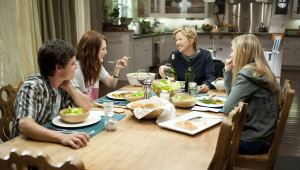
Like any marriage,theirs has highs and lows. There are no histrionics; Nic is too staid, too reserved, too in control of her own emotions. Everyone is very, very sorry. So this is not about the drama, this is about who they are now, as people, as a couple. Julianne Moore and Annette Bening are such excellent actors that they can convey a 20 year marriage with an ease between the two of them that feels real and also effortless. Bening gets to show real range here, though her character plays things a little close to the chest. Moore is luminous as Jules and seems to really enjoy the freedom of playing someone so open and available.

Director Lisa Cholodenko is excellent at showing you a slice of life and making you feel like you’ve had the whole cake. An exceptional ensemble comes together to give this film emotional resonance. The couple is going through their own unique problems but their struggles of love, commitment, friendship, and family – those are universal. And in The Kids Are All Right, they’re memorably, endearingly executed.


 

Bend It Like Beckham

Jesminder, aka Jess, a good Indian-English girl and Sikh, defies her traditional parents and secretly joins a girls’ football team. There she meets her new BFF Jules and together they chase their common dream of moving to America to lay professional soccer.

Jules’ (Keira Knightley) mother is not too pleased to have a tomboy for a daughter, and she’s horrified to think Jules may be one of those lesbians (“All I’m saying is, there’s a reason why Sporty Spice is the only one without a fella!”) but it’s Jess who suffers the most from her parents’ expectations. She gets cultural, religious, and filial guilt and shame heaped upon her – her soccer skills even threaten her sister’s marriage, somehow.

tumblr_oisvumHTWr1u495o7o1_500

In 2002, this was a fun movie about female friendship and gender stereotypes. ‘A 2018 re-watch is not particularly kind to it. It feels dated. Very dated. Which is great, obviously. Even as we burn in our collective dumpster fire, at least we can look back to the cultural touchstone that is Bend It Like Beckham with just a touch of smugness that we no longer say things like “Mother, just because I wear trakkies and play sport does not make me a lesbian!” and (white man to Indian woman who was just called a Paki) “Jess, I’m Irish. Of course I understand what that feels like.” If you wondered what those sounds were the other night, that was me, winning the world cup in groaning.

I still don’t know what it means to “bend it” like Beckham but I’ve been imagining that he has a crooked penis. This was the movie that introduced American audiences to Keira Knightley, and I didn’t find her completely awful yet. Parminda Nagra was the real stand-out, as was the man who played her father, Anupam Kher, an illustrious and dashing Indian film star. Jonathan Rhys Meyers is even creepier than I remembered. Like, unmanageably, unforgivably, career-killingly (you’d think) creepy. I don’t want him in the same movie as anyone’s juicy, juicy mangoes. He’s nearly as terrible as the 00’s club wear these ladies are sporting. It’s like a fashion show of my biggest regrets.

Laters!


Monster

This movie came out in 2003. I bought the DVD and watched it once and never again – until now. Fifteen years later, it’s as rough as I remembered.

Aileen “Lee” Wuornos is a hooker past her prime. She meets Selby at a bar one night and it’s the oddest case of love at first sight. Lee (Charlize Theron) is smitten, and self-centered Selby (Christina Ricci) loves the attention she lavishes upon her.

Anyway, girlfriends are expensive. Pretty soon Aileen has to start working the highways again. One night, a trick goes wrong. Not that they’re ever right, but more wrong than usual. A john drives her int the woods and beats her unconscious before waking her back up with sodomy. Oh god. I can’t believe I just described that scene so flippantly! It’s HORRIFYING and I’m traumatized and I’m coping by being weirdly light hearted about it. Anyway, Aileen is in a bad way, but what he doesn’t know and she does is that she’s armed. She manages to to break away just long enough to shoot (and kill) him.

Is it weird to describe murder as empowering? Aileen is unsuitable for any other kind of work and though she’d like to quit prostitution, she and Selby can’t quite partying, so it’s back to working truck stops, only this time she only uses sex as the bait, and then murders them for cash and cars. This becomes another one of her addictions.

Aileen Wuornos is a real-life serial murderer. A lot has already been said about Charlize Theron’s physical transformation to play her, so I’m going to concentrate instead on what an interesting character she is. I mean, there’s no denying that Aileen herself is a victim. She even convinces herself it’s a justification for her increasing blood lust. What she does is undeniably wrong but society had already left her in the dust. Where, exactly, was Aileen’s place? That’s what earned Charlize her Oscar. She didn’t try to excuse away her crimes, but she did find empathy for her. Theron is intense as hell in this movie. Her eyes shoot laser beams with such focus you’d think her life depended on it – and in fact, for Aileen, it did. A moment’s inattention could have cost her her life. But otherwise she’s not at home in her body. Theron prowls as Aileen, her shoulders curling, discomfort in her very posture. Her performance is one for the ages.

Director Patty Jenkins treats Aileen with compassion, and she might be the first to do so. Monster doesn’t feel exploitative. Aileen might have had the morals beaten out of her, but we haven’t, and Jenkins’ framing of her always keeps this in mind. The first time Aileen kills, it’s in self defense. Subsequently though, she kills for every time a man has done her dirty, and that’s a very long list. When a tiny sliver of redemption offers itself, Aileen is unequipped to take it. But Jenkins refuses to objectify her; she treats her humanely, which is possibly more than Wuernos ever got in life.

We Need To Talk About Kevin

Actually, we need to talk about Lynne Ramsay.

When a twisted movie comes out of the mind of Quentin Tarantino, we look at him and think – yeah, that makes sense. But Lynne Ramsay? You wouldn’t see it coming. But she does make these amazingly dark, fucked up films. And more often than not, she sticks kids into these movies, which makes them feel even bleaker, even blacker. She likes to make a film that is completely hers, and if she’s not happy, she walks (as she did with The Lovely Bones, and Jane Got A Gun) . She’s fantastically outspoken and she’s not afraid to leave a project if she doesn’t feel comfortable signing her name to it.

We Need To Talk About Kevin is adapted from the shocking novel by Lionel Shriver. we-need-to-talk-about-kevin-image-2Tilda Swinton plays Kevin’s mom, Eva. Eva always struggled to bond with Kevin, who cried incessantly around her but was rather sweet with others. Can a baby deliberately antagonize his own mother? As a child, Kevin finds ways to blackmail his mother into getting his way. When Eva and husband Franklin (John C. Reilly) have a second child, accidents escalate and Eva becomes fearful of Kevin while his father can always excuse his behaviour. This fundamental disagreement puts a strain on their marriage. As a teenager, Kevin (Ezra Miller) commits a massacre at his high school, murdering many students. Eva transforms her life to support him in prison.
This story is the most fantastic, uncomfortable episode of nature vs nurture that we’ve ever seen. Was Kevin born “bad”? How early can we detect evidence of psychopathy? How early can a baby pick up on his mother’s ambivalence?

As his mother, Tilda Swinton steals the show. Of course, the events are her own recollections, offered in retrospect, so she’s the mother of all unreliable narrators. But is she wrong? Despite its title, this isn’t really about Kevin, it’s about his mother. She’s never been perfect, sometimes openly hostile, and we experience the film through her broken mind. Swinton is volcanic – so much bubbling underneath, perhaps ready to blow. It is criminal that she didn’t get an Oscar nomination. That she didn’t get the win.

But the most interesting and surprising thing about the film is that Ramsay takes our darkest society impulse – a child slaughtering other children, and ultimately marries it with themes of redemption. Just whose redemption is perhaps unclear as nothing is overtly stated. Kevin is failed by the system and possibly by his parents. Eva knew what was coming and failed to do anything about it. The film is so troubling it veers into straight-up horror at times, and Ramsay is always there, confrontational, unblinking. Her close-ups dare you to look away.

You Light Up My Christmas

When star and executive producer Kim Fields had a few extra roles in this Lifetime film to fill, she called on her old Facts of Life costars for a little help, and they answered, so keep your eyes peeled for some extra fun cameos, and even some nods to the late Charlotte Ray who played Mrs. Edna Garrett on the show.

You light Up My Christmas is about realtor Emma (Fields) who returns home for the holidays to ensure that her late father’s house sells. But as she decks its halls for increased curb appeal, she discovers that her father’s Christmas light company isn’t doing as well as she thought, and the lights in her small hometown have dimmed of late.

Kim Fields waltzes through scenes in a series of serious lady boss costumes, most of them trimmed in faux-fur, a one-woman winter wonderland, ready for some serious cuddling. Cuddle candidate: former boyfriend and current Christmas light company manager Ben (Adrian Holmes) who’s very handsome and likely still interested

Christmas Unleashed

Becca (Vanessa Lachey) has a pretty good life: she’s a very busy and successful lawyer with a great apartment and a super loyal and handsome best friend/boyfriend combo named Henry. Is Henry her dog? Yes he is, technically speaking. But he’s really the only companion she needs, even if Grandma isn’t quite on board with the notion. Anyway, Gram’s in no position to rock the boat since this is the first time Becca, literally her only relation left in the world, returns home for Christmas in four years.

Unfortunately, Henry goes missing on Christmas Eve, which forces Becca to do the one thing she most abhors in the world: call up ex-boyfriend Max (Christopher Russell), a vet, and ask for help. It’s an awkward reunion, and about to get very confusing since god knows Max is a much better dog name than Henry.

Henry (the dog) is a very good boy, despite his recent escape, but he’s also a bit of a schemer. Apparently this little adventure of his is an effort to play matchmaker; Henry leaves a trail through all of Becca and Max’s most romantic couple spots from when they were together. Which is how we come to learn Becca and Max’s history, through flashbacks – their beginning and their end. But if Henry’s doing his job right, there may just be a new beginning.

It probably goes without saying that the dog steals the show. Big time. I found myself itching to fast-forward through all the human parts. Now, I’ll acknowledge that Henry is a bit emotionally manipulative, but I also felt that his humans didn’t stay on task as much as they should have, sprinkling their so-called frantic search with things like romantic carriage rides.

Anyway, then Henry gets run over by a car and Becca goes back to the city, alone and heartbroken. Just kidding, obviously. This is a romantic Christmas movie and it can be counted upon not to deviate from the formula.

A Cinderella Story: Christmas Wish

Sean has called this movie the Coyote Ugly of Christmas movies. Um. Coyote Ugly might be aspirational for this movie. But it’s kind of a funny statement for a film that tells you its biggest influence right in the title. And yet.

Kat (Laura Marano) is in fact both a Cinderella type AND a Violet (that’s Piper Perabo in Coyote Ugly, in case you’re wondering – yes I had to look it up) AND part elf. Kat is an aspiring singer-songwriter who works in Santa’s Village, dreaming big and biding her time until she turns 18. Meanwhile she lives with her step-mother and step-sisters, who are truly awful to her and make her do all the chores. But at work she’s falling for Santa, which is probably as weird a that sounds because at first they only know their costumed selves. But eventually Santa reveals himself to be Nick (Gregg Sulkin), the son of Mr. Winterbottom, the richest man in town. But Kat closely guards her true identity (though let’s be honest: it consists solely of a wig…Nick must be pretty dense), vowing only to reveal it at the charity gala. Of course, if you know the fairy tale, you know Kat’s “steps” aren’t about to let that happen.

The step-mother and step-sisters have excessively, wonderfully gaudy costumes and hair but the characters are so over-the-top there’s just no basis in reality and it’s hard to guess where on the spectrum the filmmakers were aiming for. And that’s if the cheaply-executed music videos and song & dance numbers (auto-tuned within an inch of their lives) sprinkled throughout don’t get you down. And then there’s the ball charity gala, which was clearly and achingly shot with so little budget they were forced use a high school auditorium for the set. And a very hokey elf dance can only mean that for all Mr. Winterbottom’s wealth, the man has no taste.

I can’t imagine any grown human being liking this movie, but Sulkin is cute enough that this movie may fit the bill for tween girls looking for some PG romance.

Hometown Christmas

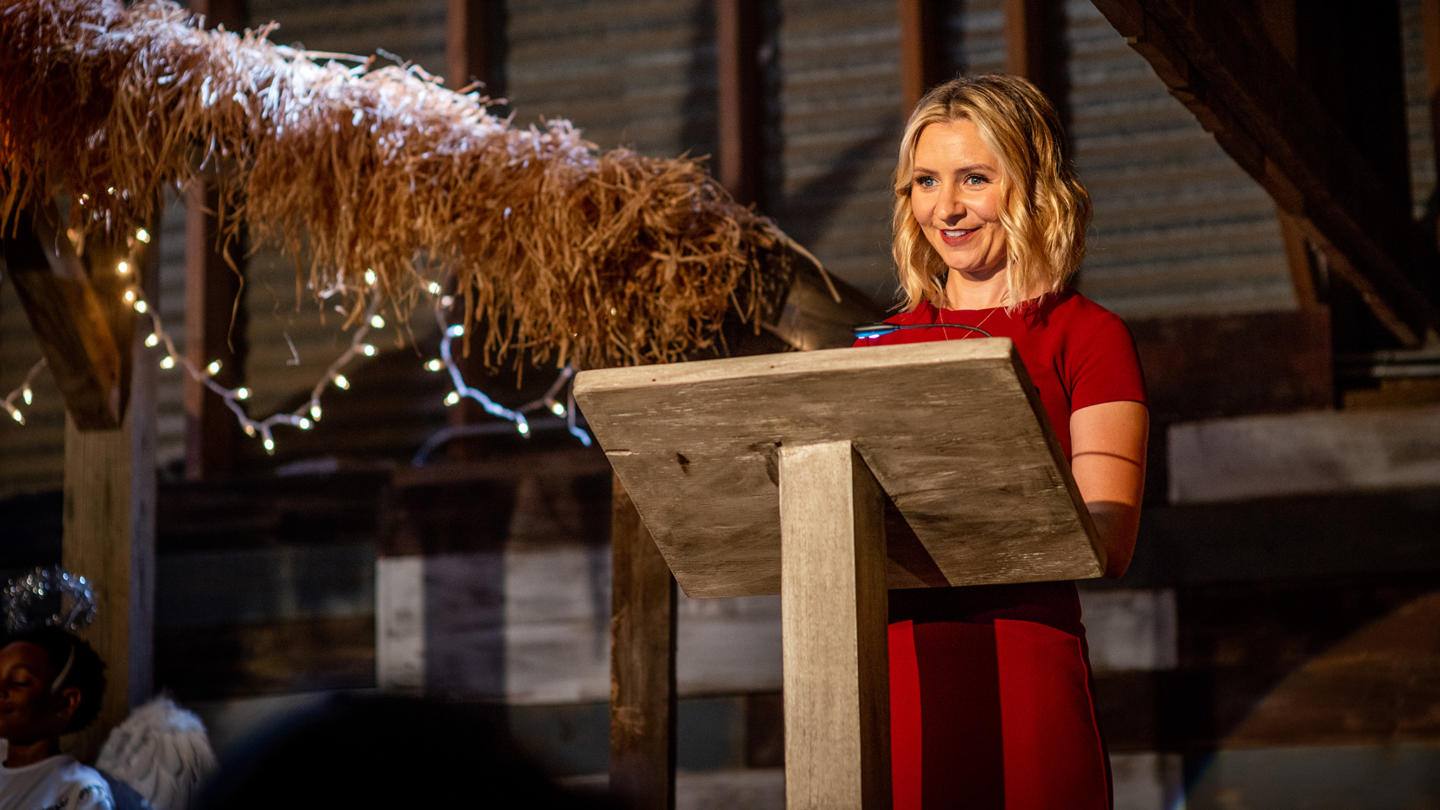
Noelle (Beverley Mitchell) is back in Louisiana for good, with a medical degree to practice alongside her father. To honour the occasion, Noelle decides to revive one of her late mother’s most loved traditions, the town’s live nativity. In fact, the log-line of the film calls it the “resurrection of the nativity” which seems like an unfortunate choice of words. I’m picturing a Franken-Jesus, but I guess that’s Easter.

Anyway, things go swimmingly for about ten seconds before Noelle finds out that her dad has her new girlfriend, and the new girlfriend (Melissa Gilbert!) is the mother of Noelle’s old boyfriend – who, incidentally, is also back in town after an injury derailed his baseball career. Noelle’s still smarting from their senior year break up but that was a decade ago and the magic of Christmas (or at least her horny dad) is making sure they spend a lot of time together lately.

Is the angel Gabriel really the MVP of heaven? What exactly is a southern snowman? Do matching pajamas make you smug or just smarmy? Will they be able to turn a barn into a stable in time? How many Little House on the Prairie references does a Hallmark Christmas romance need? Does a living nativity really need a pig AND a camel? And will this small town have enough marshmallows for both sweet potato pies AND hot cocoa????

The answers will surprise you. Make a date with Hallmark to find out.

Cranberry Christmas

In a slight detour from the usual Hallmark formula, Dawn (Nikki DeLoach) and Gabe (Benjamin Ayres) are already married. In fact, they’re already separated. Well, they’re “taking some time apart” as Gabe stays on the cranberry farm , ensuring its proper management, and Dawn travels the world promoting their lifestyle brand and business, Cranberry Lane. Dawn returns home in time for the holidays to help out with the town’s annual Christmas festival, with a huge talk show host, Pamela (Marci T. House), in tow. She’s proposing to feature them on her show, a huge get for Cranberry Lane, obviously, but pretty awkward since the planned segments would focus on Dawn and Gabe as the perfect Christmas couple. They agree that for the business’ sake they will pose as a happy couple for as long as the TV show’s around, but nobody’s fooled into thinking it will be easy.

Honestly, it won’t be nearly as difficult as they think. There isn’t a lack of love between Dawn and Gabe, but their lives are taking them down different paths and they’ve been growing apart. Of course, acting like a cozy couple kind of gets their romantic juices flowing again. They’ve still got their issues but they seem willing to work on things – until Pamela throws a much bigger wrench into things. Their segments have gone so swimmingly (shall I say sleddingly since it’s Christmas?) that Pamela (think Oprah, she’s apparently that big) is offering them their own national TV show…which would require them to move to NYC, where it tapes. Gabe has recently poured more of himself into the farm, and bought more land, to expand. He’s committed at home, not interested in TV shows or moving. He’s actually ready to step away from Cranberry Lane altogether. Pamela is willing to take Dawn on her own, and it’s an amazing opportunity, and neither of them wants Gabe to stand in the way of her dreams.

Cranberry Christmas is refreshing for its variation on the Hallmark theme, and truly, the falling in love part is the easy part, isn’t it? It’s the staying in love that can be a challenge: growing together, sharing a life, making the compromises. Marriage is hard work, and this is a rare Hallmark romance that admits that love and commitment come with bumps in the road. Hallmark movies ask you to buy into a certain romantic fantasy, but a movie like this helps normalize the truth of real relationships. The beginning of a relationship is easy to get right; it’s the considerable territory between ‘I do’ and death parting you that really matters, and while it may not be the passionate, feet-sweeping good times of the falling in love part, the heart-warming, soul-expanding, truly knowing another person and relying on their steadfastness middle that makes love the most sought-after of things.

The Road Within

Oh man. If you watch one questionable movie (Welcome to Me), Netflix immediately believes the worst in you and starts recommending movies for the hidden loser in all of us. I assume this is what led me to watch something as painful and thoughtless as The Road Within.

First, that smarmy title. If it sounds like a non-selling self-help book, maybe leave it at that.

road-within-the-sceneSo the formulaic story is this: three young adults find themselves at a treatment centre under the care of Kyra Sedgwick for their various ailments. So they steal her car and go on an oddball road trip while the good doctor apparently abandons all other patients in order to search for them.

Vincent (Robert Sheehan) has severe Tourette’s – he tics and swears his way through this film; the-road-withinMarie (Zoe Kravitz) is painfully thin and painfully anorexic; Alex (Dev Patel) is as OCD (obsessive-compulsive, emphasis on obsessive) as they come. Though competently acted, I often felt their afflictions teetered on being played for laughs, and this set me on edge for the duration of the film.

Writer-director Gren Wells is remaking a 2010 German film, Vincent Wants to Sea, which is slightly better but didn’t exactly scream to be remade. The thing that kills me is that lots of real-life people live with these diseases, and they The-Road-Within-Gallery-1tend to do it with a lot more grace than this movie possesses. How does it both trivialize and make a mockery of these afflictions? And why are their characters allowed to be completely defined – and even overwhelmed – by their respective challenges? Because none of them seems to have a personality. They just have illness. And that rings false.

It seems to want to avoid the sentimental ending but can’t quite resist. The trio of young actors do pretty impressive jobs considering the patronizing material they’re wrestling with, but it’s not enough to uplift the movie or to make me feel comfortable with the way it treats some pretty serious issues.

One good thing I’ll mention in regards to this movie:

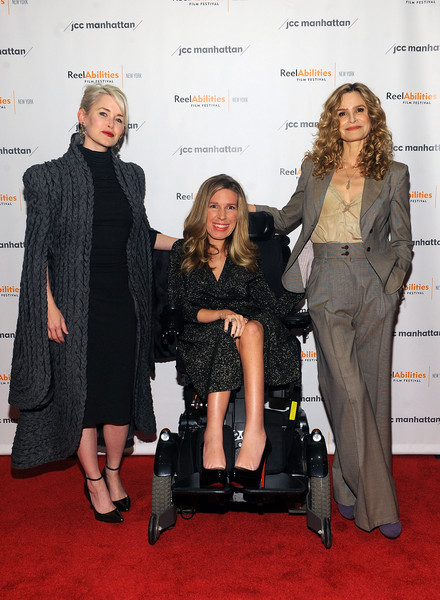
REELABILITIES+JCC+MANHATTAN+Present+Special+W244hpYwfT-lREELABILITIES hosted a special screening of the movie in April 2015, which was attended by Dr. Danielle Sheypuk. REELABILITIES is a film festival dedicated to promoting awareness and appreciation of the lives, stories, and artistic expressions of people with different disabilities, which is a beautiful idea and a cause near and dear to my heart.

Danielle Sheypuk, if you don’t know her, is a ground-breaking busy-body: a licensed psychologist, media commentator, disability-rights advocate and fashion model. She’s also worn the crown of Miss Wheelchair New York and was the first woman in a wheel chair to grace the catwalk at New York fashion week, February 2014 (a year later, fashion house Carrie Hammer tapped American Horror Story Jamie Brewer to walk their show, marking the first woman with Down syndrome to appear at fashion week). Dr. Sheypuk specializes in the problems of dating, relationships and sexuality among the disabled, a necessary but taboo subject I’ll be covering in my upcoming review of The Sessions.