
Martin Scorsese has finally married the two sides of his personality: the one who delights in showing us the excess of sin (think: Wolf of Wall Street) and the one who is concerned about the state of our souls (think: Silence). It has taken him some 25 films and 77 years to get here, which is possibly why this film lacks the verve of his other gangster movies. The Irishman is mournful – perhaps even an elegy.
The films revolves around Frank Sheeran (Robert De Niro) in his position as hitman for the Bufalino crime family. There are three distinct timelines in the film: 1. old man Sheeran recounting his crimes at the end of his life; 2. middle aged Sheeran on a road trip with mob boss Russell Bufalino (Joe Pesci) and their wives; 3. “young”ish Sheeran as he meets Russell, befriends Jimmy Hoffa (Al Pacino), starts a family and makes a living putting bullets through people’s heads. Scorsese navigates between these timelines with relative ease (shout-out to editor extraordinaire Thelma Schoonmaker!), though it does take some time and attention to get used to. He keeps the camerawork clean and businesslike, almost as if the camera were just a fly on the wall, observing unobtrusively.
De Niro et al are given the “de-aging” CGI treatment so they can play the parts in all 3 timelines, which is not my preference. I’ve seen de-aging used well (meaning sparingly, like Carrie Fisher in Star Wars) but De Niro always looks a little off, and the trouble doubles when he’s got his shirt off. Plus it’s startling when De Niro is meant to be doing something more physical. When Frank is meant to be stomping on someone lying in the street, De Niro may have a young face but his kicks are that of an old man (the actor is 76). But his performance is quite good, and complex, and possibly the least showy of his career. Which is polar opposite to what Al Pacino does in the film, and I’m still not certain what to think of that. On the one hand, I do believe Hoffa was a bit of a ham himself. On the other hand, Pacino’s acting seems to have devolved into an over-the-top impression of himself. I’m not even sure it’s conscious. I’m not even sure he could stop. Although I confess I could watch him scrape the bottom of an ice cream sundae while screaming “cocksucker!” all day long, and at 3.5 hours, I pretty much feel like I did. His volume’s turned up to 11, and when it crashes into De Niro’s coiled repression, gosh, what a sight. What a symphony.
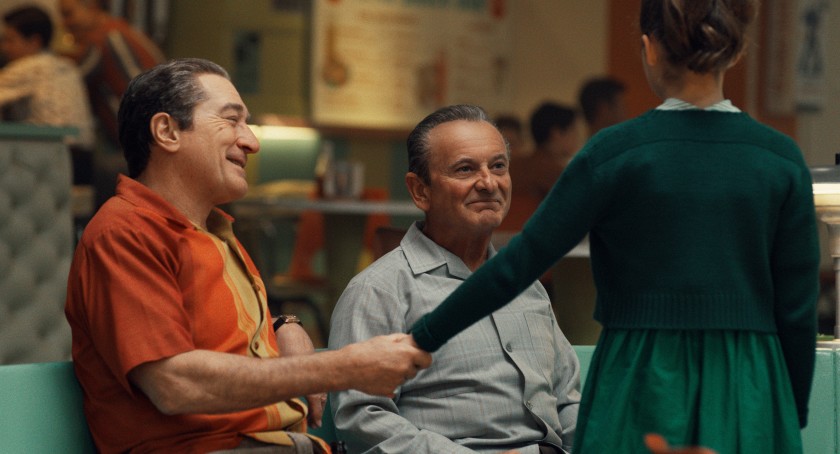
Scorsese seasons the story with all kinds of various wiseguys and goombas (Bobby Cannavale, Jesse Plemmons, Stephen Graham, Ray Romano, and not least of all, Harvey Keitel) and it makes a fair point about how Frank views the world: there are friends, and there are acquaintances. He can make peace with having to whack a mere acquaintance. But tighter ties would be a problem. He keeps people at a distance, or at least that’s the justification. The truth is, Frank is a sociopath and throughout the film we watched as his humanity is leeched from him. The money might be good, folks, but the job does take its toll. But Sheeran is such a stoic, melt into the background guy that we never see it. He is scary because we don’t ever know what makes him tick, what motivates him. If he has any inner life at all, we can only guess.
Meanwhile, mortality emerges as Scorsese’s other major theme, and it’s one we imagine hits quite close to home for him. Frank is looking back on his life, confessing his sins – but does he feel remorse? Can he feel anything at all? Frank has four daughters but at the end of his life, he’s fixated on Peggy (Anna Paquin), the one who won’t speak to him. Peggy is one of the few female characters in the film (sure there are “wives” but they’re about as important and present as background actors) and she says almost nothing. Her silence is judgment, revulsion. She has seen her father for who he is and she wants nothing to do with him. Even as a small child she has always felt the same about Russell Bufalino no matter how hard he bribe her with gifts; Peggy is in many ways the moral centre of the film, alarming since she’s on screen for about a total of 4 minutes out of the film’s 209. Speaking of Bufalino, Pesci does a startlingly good job of portraying a man who has completely blurred the boundaries between work and evil that he is absolutely, coldly, rotten to the core and doesn’t even seem to know it. This may be the stand-out performance of the film for me.
This all sounds like some pretty epic, pretty heavy stuff, and it is, but at times it’s also funny, surprisingly so. Most of the characters are introduced to us with one important statistic: the date and manner of their death. On their own it’s often quite comedic, but time after time, bullet after bullet, death clearly stalks them all. And when the bullets run out, time starts cutting them down, and old age is often more brutal than violence. It’s slower, and crueler. In the end it’s coming for Frank too, and he’s left to face it alone, everyone else either dead or just done with him. Does he regret his choices? Does he even believe they were choices? The story is based on a memoir that’s fairly contested in terms of facts, but Scorsese isn’t interested in the history, he’s interested in the allegory, and, at this stage of his career it must be said, the legacy. Whereas his earlier gangster movies left a more glamourous impression, The Irishman leaves no room for doubt: mob life is no life at all.
 Oh boy. But you know what? Even with terrific advice like “be impossible” and “don’t talk like a maid,” it turns out the biggest risk is not that they’ll be found out, but that the lie will be too well accepted – a Brit described as a “dandy” falls for Maria, and pretty soon it’s Anne is in hot pursuit of her own maid, who’s being courted all over town.
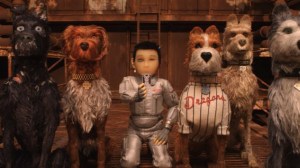 sometimes wonder if I prefer dogs to people, and I certainly do prefer my dogs to most people. I think dogs are so much better than we deserve. They are 100% heart. So it’s hard for me to imagine a bunch of dog owners so willing to sentence their dogs to a terrible, lonely, miserable life and death. Of the thousands (hundreds of thousands?) of dogs sent to live and die on Trash Island, only one is lucky enough to have an owner come looking for him – a 12 year old boy named Atari. When Atari becomes stranded on the island, a scruffy pack of dogs generously decides to help him find his beloved Spots. Duke (Jeff Goldblum), King (Bob Balaban), Rex (Ed Norton), Boss (Bill Murray), and even the reluctant Chief (Bryan Cranston) band together to reunite boy and dog on a journey that you might just say belongs in a Wes Anderson movie.
 docile woman who is pushed to do violence when she finds her man in bed with another woman. This unlikely pair bonds over their mutual sentence, and agree to do each other a solid: she’ll attend his niece’s wedding with him – he owes money to his brother (Danny DeVito) and his sister-in-law (Patti LuPone) never quits breaking his balls – and he’ll attend a birthday dinner for her disapproving father (Harvey Keitel).
 he uses a crinkled piece of porn to rub himself off against a book case in his school library, defiling some nearby books with his teenaged cum. You can’t help but see the symbolism as his parents are both bookish (a professor and a writer), a rejection of them and an assertion of himself. Oh Noah Baumach, there are some things we just can’t unsee you know.


![Main Quad_AW_[26611] Grand Budapest](https://assholeswatchingmovies.com/wp-content/uploads/2014/12/characters.jpg)
 ASSHOLES WATCHING MOVIES