2016’s summer blockbuster season is just getting started but is already getting crowded. With competition between franchises getting fierce, is there really room for a stand-alone action movie from an original screenplay? How about an R-rated comedy that is in no way connected to Judd Apatow?
Apparently not so much, considering its unremarkable performance at the box office so far, despite generally good reviews and two big stars. It can be hard to find the time to see everything that’s out there and I know priority has to go to seeing the latest installment of all your favourite franchises but I am quite sure you won’t regret making some time for The Nice Guys.
A thug-for-hire with a heart of gold (Crowe) and a cynical private eye (Gosling) team up to search for a missing girl who seems to be connected to a murdered porn star and has somehow caught the attention of the justice department. And it all takes place in 1977 Los Angeles with an excellent sense of time and place.
After A Good Year, Crowe’s last attempt at headlining a comedy, it’s a pleasure to see one finally play to his strengths. The Nice Guys uses his tough guy image to its advantage instead of trying to make us forget about it. Paired with the ever-versatile Gosling, they are just as hilarious as writer-director Shane Black’s previous pair of detectives in Kiss Kiss Bang Bang.
The Nice Guys works because the escalating insanity rarely feels contrived or forced. As a team, Crowe and Gosling are just dysfunctional enough to be funny but competent enough to be almost believable. Best of all, the movie has just enough darkness to it that it’s not easy to forget.
The body’s not even cold before Doris’s brother is talking about selling their dead mother’s house, which means Doris is about to be homeless, and even worse, divulge an embarrassing secret: it wasn’t Mom who was the hoarder.
And while we’re on the topic of embarrassing subjects: Doris is nursing a secret workplace crush on a younger man. A much, much younger man. And boy do her fantasies get away on her!
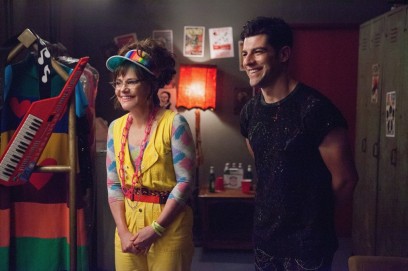
She takes a little dating advice from a millennial and suddenly she’s adopted by a whole crowd of hipsters who fail to recognize that her “retro chic” look isn’t exactly ironic.
Sally Field plays Doris and it’s a BRILLIANT comedic role. But because it’s Sally Field it’s so much more than that. In any other hands, Doris may have appeared clownish but Field injects the character with kind if flawed humanity. Max Greenfield and Tyne Daly add excellence to the mix, but that’s already 10 words not talking about how utterly wonderful Sally Field is. She embraces and embodies the late-blooming Doris, deftly managing some awkward shifts between drama and comedy, painting the character with shades of tragic hero, coming-of-(old)age, endearing quirk, eccentric wallflower, emboldened risk-taker, sympathetic neurotic: a woman tired of being laughed at who starts laughing along with them and wins. It is a complete joy to watch her on-screen, from the very first minute to the last.
The movie unpacks a lot of issues – ageism, desire, resentment, mental illness – and to its credit, it doesn’t attempt to fit them back neatly into a box. The ending is bravely open-ended. But it also suffers from perhaps taking on more than the writers really understood what to do with (Michael Showalter directs and shares writing credit with Laura Terruso). But any bumps along the way are filled in with Field’s gloss. She makes this movie glow. And watching her do an eletro-pop jitterbug is hands down the best thing I’ve seen at the movies all year. Keep an eye out for this one; it’s in select theatres now.
Moral dilemma: one couple hosts another for a pleasant, mostly-vegan dinner party, and a little light snooping on the part of the guests turns up a suicide note.
What to do, what to do? Obviously the visitors, Penn (Lindsay Hicks) and Jasmine (Brittani Nichols), themselves a newish couple, are concerned for their friends, who up until now have been role models for a happy relationship. But you can’t be blunt about a note you just stumbled upon, can you?
The brilliance of this film is that it makes you question what you would do, and it challenges our notions of propriety.
The quality’s a little wonky. It doesn’t quite have the production values you might hope for, and during the dinner scene the camera jitters around so much I had to look away to settle my stomach. Luckily, the conversation is jaunty and captivating enough to conquer some of the flaws. It flows authentically, and you’ll feel like they should have set a 5th place setting for you, the guest who definitely would have went for some wine.
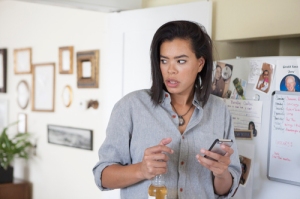
The trick is that there’s a subtext that we’re aware of but not everyone at the table is. Penn and Jasmine know a dark secret and are steering things to play sleuth. Billie (Jasika Nicole) and Jordan (Brianna Baker) know that something’s up but the note is the furthest thing from their minds. They’re just trying to navigate this incredibly uncomfortable encounter – and we’ve got front row seats!
So it’s noticeably an indie, but it’s also smartly written and well-acted and I’m very glad I gave it a chance because it’s quite endearing, and an interesting little slice of life.
This review first appeared on Cinema Axis as part of the Inside Out film festival coverage, a festival dedicated to showing LGBT movies.
Maybe I’m a little hungry, but to me, finding a good movie on Netflix is like finding the juicy peach hearts among all the other loser gummies. Fucking jackpot!
Autism In Love is, you guessed it, a documentary about people in love or looking for love, who also happen to be autistic (to varying degrees). Director Matt Fuller does an impressive job of teasing out a narrative that rarely gets seen in mainstream media: they’re on the spectrum, but they have needs and desires too.
We’ve tended to categorize autistic people as being emotionless, but that’s not true at all. They struggle to recognize and express feelings, but they’re there, and the more I learn about autism, the more I see similarities instead of differences. Autism in Love follows 4 individuals who I have to thank for their openness and bravery. It’s not easy for any of us to expose our vulnerabilities, and I can only hope they know how moved their audience has been.
Lenny is a young man in his 20s who, not unlike his peers, is struggling to find himself. He’d like to find a girlfriend, preferably a very independent one, but he feels strongly that they’re all out of his league. There’s anguish here. Lenny will break your goddamned heart. Lenny is a smart guy in his way, and he’s aware. He’s aware of how much his differences have set him apart and all he wants is to be “normal.”
Stephen is a middle-aged gentleman who’s been married for several years to a woman with her own disabilities. Though not a classic love story, you can see how much love and care there is between them. His wife knows how to get him talking, and how to recognize his affection. It’s incredibly endearing.
Lindsey & Dave are a young couple who are high-functioning professionals navigating a romantic relationship that’s just a little bit harder when both partners are autistic. But when you watch them together, it’s embarrassing, but you start to think that they’ve got it right, because in recognizing their weaknesses, they’re actually working harder at overcoming them than a lot of the rest of us. Their communication is open and honest, even if it’s a bit of a trial. Everyone should be so lucky.
What Fuller puts together is a piece that’s stereotype-shattering. It’s personal and intimate; you’ll laugh, you’ll cry. And you’ll come away with a better understanding of what it means to be autistic, and what it means to search for love no matter who you are or where you fall on a spectrum.
In 2007, writer-director-musician John Carney released one of those rare films that literally everyone loves. Sure, Once featured unprofessional actors and didn’t have much going in the way of plot but the music and characters struck such a chord mostly because of the unpretentious sincerity that everyone involved seemed to bring to the project.
In 2014, Carney tried to top himself in the acoustic meet cute musical genre with Begin Again, which had a considerably bigger budget and an all-star cast. Though not without its charms or hummable songs of its own, Carney’s second film about writing and recording songs just wasn’t nearly as relatable as his first effort, largely due to the presence of Keira Knightley and (worse still) Adam Levine.
Carney does his best to get back to basics, returning to Ireland with mostly unknown actors, in Sing Street. Cosmo (Ferdia Walsh-Peelo) has just started at a new school and, though he hasn’t made any friends yet, instantly falls for an older girl (Lucy Boynton) who aspires to be a model. Based in part on Carney’s own memories of the mid-80s, Cosmo decides to start a band inspired by The Cure, Duran Duran and Hall & Oates. For Cosmo, this project is mostly an excuse for him to film music videos starring his crush at first but the opportunity to write and play his own music soon becomes about much more. Music, he’ll soon learn, can be the perfect outlet to express his feelings about the tension between his parents, their financial troubles, and the restrictions at his strict Catholic school.
Sing Street is no Once.
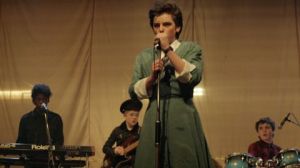
Maybe that’s a good thing. While Once had a more improvised feel, Sing Street has a more insightful and considerably funnier script. (I laughed myself into a coughing fit twice and I don’t even have a cold)..It is much better acted and more imaginative. The dream sequence of Cosmo’s ideal video for Drive It Like You Stole It is my favourite scene by far but there are so many perfect moments in Sing Street.
But it doesn’t always feel like a good thing.Ironically, for a movie about the agony and the ecstasy of first love, Sing Street underestimates the attachment that so many of us feel to Carney’s first attempt at the indie-rock musical. Once may not have been perfect but it felt real. Its dialogue never distracted from the story by being either too lame or too witty, it just felt natural. With more experience and a bigger budget, he has clearly made a more polished film with Sing Street. But I prefer the rawness of his first effort.
Note: when this film premiered at Tribeca, it was called Geezer.
Perry is the Geezer in question, a middle-aged suburban dad with edgy hair and a family he loves, but he’s just a little bit checked out of his ordinary life. As he turns 40 he’s stewing in what-ifs, foremost among them, what if I hadn’t left my punk rock band just as it was maybe about to take off?
He’s no semblance of a musician now. He works in a hardware store and only manages to sneak in a few chords around his kids’ morning routine. But on the occasion of this milestone birthday he decides to treat himself to the wildest party a has-been can muster before noon and he runs in to an old flame who reignites old dreams.
It’s not exactly ground-breaking material but here’s the gimmick that’ll put butts in theatres: it’s Green Day’s Billie Joe Armstrong playing Perry. And is it pretty effing cool to see him play the guy he might have been had his own post-punk outfit not taken off when it did? Yes, yes it is.
So then the question you’re next going to ask is: Holy shit, can Billie Joe act? And the answer is no, no he can’t. I mean, the director, Lee Kirk, told us he was a great actor, but the movie seemed to indicate that the Kirk’s pants were on fire. Sean thought he was okay – inoffensive, but he never forgot for a moment that he was watching Billie Joe Armstrong. I, on the other hand, thought it was a scootch worse than that. Unnatural. Self-conscious. Very “you can tell I’m acting because my hand is over here on my hip, which means I’m going through some internal conflict I’m not subtle enough to convey any other way.” And yet I’m not going to condemn him because the movie really is a vehicle for him. He’s what makes it cool and relevant, makes the movie rise above the other mid-life-crisis\path-not-taken meditations. Plus, Kirk pads the cast with some better talent: Judy Greer as the old flame, Selma Blair as the current wife, Chris Messina as the scowling brother, Fred Armisen as an ex-bandmate.
The theme may be familiar, but I still admired the writing. Kirk tries to take a fresh perspective, never blaming the wife and kids for Perry’s lack of success. The regret without resentment shows maturity I’m surprised to see in a character like Perry. Billie Joe never quite transcends the role, but there is an honest vulnerability there that’s a little charming. And Billie Joe is not just a casting liability, he’s an asset to the soundtrack because he’s written some original music for it, and the movie is never more confidant than when Armstrong is performing. In this he excels. The songs he wrote are great and I imagine they’ll be invading your radio waves sometime soon, lending the movie some major credibility.
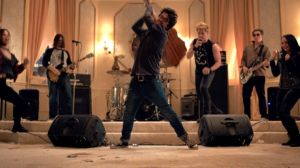
I can be certain about the music because we were treated to a concert immediately following the screening. Billie Joe had Green Day drummer Tré Cool backing him up and Jesse Malin on rhythm guitar. They launched into the film’s first song, Devil’s Kind, with an energy that defies the fact that Armstrong is in fact a middle-aged father of two. They played a couple of Green Day tunes as well, Scattered and then American Idiot, which morphed into Bad Reputation. Oh, did I not mention that Joan Jett was in the house? Yeah, she has a small cameo in the film but she got up on stage and showed the boys what a scene-stealing badass she still is. Her voice hasn’t aged a single minute and the woman’s still sporting leather pants. Armstrong closed the night with Ordinary World, the film’s acoustic ballad, and I couldn’t help but wonder at the twinkly goodness of my life. In the movie of my life, there is no path not taken.
Note: Geezer has since undergone name change. Now known as Ordinary World, it will see a release October 14 2016 – on DVD\streaming and in select theatres.
So I finally saw the rest of Hardcore Henry. I completely stand by my review of the first 45 minutes and am only disappointed in myself that I gave this inexcusably boring failed experiment of an action movie a second chance.
Despite receiving some very generous reviews from some of our Honourary Assholes, Hardcore Henry didn’t quite draw the crowd that I was expecting. In fact, for the first time in my life, I found myself alone in a movie theater for a full 96 minutes.
Having the room to myself had its advantages. I didn’t have to glare at anyone for eating noisy nachos or checking their phone and could even feel comfortable to check my own phone whenever I wanted. I also got up and changed seats twice. I didn’t enjoy the Coming Attractions though.
Have you seen the preview for Lights Out?
It’s fucking scary!!!! Now imagine watching it in a big dark room all by yourself where the speakers are so loud that nobody outside would be able to hear you scream. I couldn’t help but look over my shoulder throughout the previews. They actually make these previews way too scary if you ask me. Here I am sitting down to watch a guilty pleasure action movie and am stuck watching terrifying clips of scary movies that I never would have consented to see.
This trailer didn’t have the same effect when I was forced to sit through it again, this time with twenty or so other people who came to see Green Room. There seems to be a feeling of strength in numbers when dealing with the paranormal. I didn’t know anyone else in the theater but I felt safer knowing that they were there.
That feeling of security didn’t last once Green Room started. If you haven’t heard of this (by my count) third feature from writer-director Jeremy Saulnier (Blue Ruin), it features a young punk band who barricade themselves in their dressing room after a controversial set to protect themselves against neo-Nazis. It’s the kind of movie that makes you fear your fellow man and wondering what the guy sitting behind you is capable of.
Saulnier takes his time at first to give us a chance to start to like this struggling touring band. As the story unfolds and the sense of danger continues to intensify, it becomes harder and harder to guess what’s coming next. Which isn’t to say that there is any real mystery or even any major twists. Saulnier isn’t nearly lazy enough for that. He just presents believable characters in a credible (at least credible for this genre) situation and dares to ask “Now what?”. It’s a violent film with terribly violent things happening to its characters on both sides of the door. Somehow, however, it never feels sadistic or exploitative. Every act of violence in Green Room is presented as a terrible thing and, for once, there isn’t a single character that seemed to want this situation to turn this bloody.
So, to sum up, see Green Room if you don’t mind a tense and occasionally punishing 95 minutes, don’t see Hardcore Henry, and don’t watch the trailer for Lights Out alone.
Nuts: a pejorative term indicating insanity; a slang word for testicles. In the case of “Nuts!”, it’s both.
J.R. Brinkley was a doctor in small town Kansas who, through the grace of his revolutionary goat-testicle transplant surgery, cured many men of impotence and infertility while bringing vitality and prosperity to the town. Brinkley had to build hospitals just to deal with the growing demand, and almost accidentally became a radio pioneer simultaneously, broadcasting ads for his services and answering write-in medical questions between blasts of good ole country music. Despite exponential interest and a horde of faithful followers, the American Medical Association accused Brinkley of “quackery.” Just as they set out to discredit him, he came out with an elixir just as effective as the goat-testicle procedure but with much less risk. And then he ran for governor, with a slogan borrowed from a laxative commercial. True story.
How have you never before heard of this broadcasting maven and trailblazing doctor? Whatever the answer, Nuts! director Penny Lane will make sure you never forget him. Her mixed-media documentary uses his official biography as a jumping-off point, and whatever archival footage and modern day interviews can’t cover is brilliantly animated. And I do mean brilliantly: not only is the animation a perfect match for this strange and whimsical tale, it’s also impeccably timed and used judiciously. Different animators are used for each segment, but there’s a uniform style that injects a lot of kinetic energy into a story hilariously but dryly narrated. You won’t believe how quaint goat fucking can look.
Eventually the film moves from eyebrow-raising to downright subversive, with enough old-timey euphemisms for erections (or the lack thereof) to keep you in patter for your next hundred dinner parties. Lane has already shown herself to be a thoughtful and engaging filmmaker (Our Nixon) but with Nuts! she proves herself worthy of a Brinkley-esque empire. You can’t help but admire the way she weaves the story together; she examines what amounts to an American folk tale but she does it with modern tools that turn the story on its head. Penny Lane is her own brand of documentarian, and quite possibly on to becoming this generation’s best. Nuts! is not to be missed.
This post was first published over at Cinema Axis, where you can find lots more great Hot Docs coverage.
An Inuit community in Canada’s northern territories faces an interesting challenge. How can a culture, that prides itself on a patient and understated expression of anger, make themselves heard when their opponents are famous for a more aggressive approach?
Canadian seal hunting has gotten a lot of media attention since the late 1970s thanks to well-funded animal rights groups and their celebrity spokespeople. The brutal clubbing of baby seals in Newfoundland and Labrador may be the most common image associated with seal hunting but, for many Inuit people living in Nunavut, the practice looks very different. Traditional seal hunting, in a culture well-known for a humane and non-wasteful approach to killing animals, can be a matter of survival in some parts of northern Canada. Not only do they eat the meat and wear the fur, the latter of which is a necessity with the region’s frigid temperatures, but they also need money to survive just like the rest of us. One way they can earn money is by selling products made from seal fur.
Although the laws related to seal hunting make exceptions for the Inuit, decreased demand due to such laws, and the propaganda put out by Greenpeace and other organizations, have driven prices down, making it harder for them to survive economically. In Angry Inuk, filmmaker Alethea Arnaquq-Baril follows fellow Inuit activists to Ottawa, Toronto, and Europe as they try and tell their side of the story.
Alethea Arnaquq-Baril, using fantastic footage of northern Canada, gives us a behind the scenes look at traditional seal hunting and the preparation of furs. More importantly, she takes the time to lay out the historical and political context that can limit the options of First Nations communities. And finally, by focusing on a social media campaign designed to educate people about traditional seal hunting, she gives hope for a more constructive dialogue in the future.
It’s a side of the story that is so often drowned out by extremely vocal activist groups that have the money and resources to make themselves heard. At my day job, I work as a social worker with First Nations and Inuit people and even I have never heard the story of seal hunting told quite like this. Regardless of your position on animal rights, Angry Inuk is a fascinating film, one that offers a perspective that we don’t usually see.
When you get to see a movie like this, it’s kind of a privilege to get to talk about it.
Life, Animated is a documentary featuring the amazing Suskind family. Actually a fairly typical, loving American family who happen to have a son named Owen who’s autistic.
Owen, the youngest of two boys, was a happy and rambunctious little 3 year old when autism reared its head, and suddenly the Suskinds had a boy who wouldn’t talk and who’d lost many of his newly-acquired toddler abilities and motor skills. He remained quiet and withdrawn for many years until his mother recognized a pattern in his gibberish – it was actually a line of dialogue from The Little Mermaid.
Owen was a big fan of Disney cartoons and often watched them with his family. What they hadn’t realized until then was that Owen wasn’t just watching them, he was studying them. He’d already memorized the complete scripts of several movies, and was learning to equate emotions with the exaggerated facial features on his favourite cartoon characters. One day Owen’s father is able to hold his first conversation with him in years simply by pretending to be Iago, the talking parrot from Aladdin.
Fast forward to today, and Owen is a bright young adult. He’s learning skills to help him be more independent, and when he graduates, he’ll be moving into his own condo in a group home. Owen has flourished because his family was able to communicate with him through his beloved Disney movies. Disney canon became their family bible and Owen came out of the autism shell because of it. The Suskind family knows that Disney films won’t do it for all autistic kids, but they are encouraging families to find that one thing their child is passionate about, and to make it family culture. This is how they brought back their son and they only wish the same for others.
Owen’s dad Ron met the filmmaker, Roger Ross Williams (technically the first black Oscar-winning director, for a short he did in 2010), when both worked at Night Line. Ron had just written a book about his family’s experience and thought it might make an interesting documentary. Williams agreed. So do I.
I don’t know about this film’s potential to “save” other autistic kids. Owen is of course still autistic, but his parents and his brother can reach him now, they can express their love and see it reflected back, even if it’s a line originally quoted by Belle to the Beast. What I do know is that this film opens a lot of doors. This isn’t just a talking-head piece, we actually get to visit with Owen in his new situation, and his family as they continue to take on new challenges. We get to see autism in action, impacting a family and influencing a community. And we get to see that Owen is a guy with wants and needs like any other. He expresses them differently, and once you get the hang of his language, it’s not necessarily even worse, it’s just different.
Now as a young man, there’s still nothing Owen likes better than to chill with a Disney flick. When he’s feeling anxious, it’s 3 scenes of Dumbo. When he needs to overcome odds, Hercules will do the trick. When he grapples with growing up, it’s The Lion King to the rescue. It’s a code, but once deciphered, it’s actually pretty ingenious.
I do hope loads and loads of people will see this, and be encouraged to start a dialogue about what autism is and how we can all be part of a workable solution. Autism is a spectrum disorder, which means not all are like Owen. Some will be more or less affected, but I think the takeaway is that perhaps all lives could be improved if only we were looking for the right kinds of answers.
This isn’t the first documentary to look at autism, but what makes this one so interesting and watchable is Owen himself, a very dynamic individual. He’s at his best at the helm of his Disney Club, where other learning-disabled young people gather to watch and discuss Disney animation. They may even run lines afterward, or play the score, and once in a while Jonathan Freeman, voice of Aladdin’s villain Jafar, drops in to lend a hand, and even Gilbert Gottfried, voice of Iago himself, has attended, but nobody knows the lines better than Owen himself.
Owen proved this at our screening at the Tribeca festival where he proudly put his skill on display, playing opposite Gilbert Gottfried, and even feeding him the lines. Many of the film’s crew were on hand, as well as the entire Suskind family, to launch this movie into orbit. There’s a lot of love and care gone into this work, and some of the best bits are when Owen’s own stories are beautifully animated (by Mac Guff). Owen identifies more with the sidekicks rather than the heroes of his beloved films, and he brings them to life in a very moving way.
They hope to take it to theatres this summer and I hope that you will all take the time to see it – it’s something special.

 ring its unremarkable performance at the box office so far, despite generally good reviews and two big stars. It can be hard to find the time to see everything that’s out there and I know priority has to go to seeing the latest installment of all your favourite franchises but I am quite sure you won’t regret making some time for The Nice Guys.
 She takes a little dating advice from a millennial and suddenly she’s adopted by a whole crowd of hipsters who fail to recognize that her “retro chic” look isn’t exactly ironic.
 screen, from the very first minute to the last.
 The brilliance of this film is that it makes you question what you would do, and it challenges our notions of propriety.
 and Jasmine know a dark secret and are steering things to play sleuth. Billie (Jasika Nicole) and Jordan (Brianna Baker) know that something’s up but the note is the furthest thing from their minds. They’re just trying to navigate this incredibly uncomfortable encounter – and we’ve got front row seats!
 Lenny is a young man in his 20s who, not unlike his peers, is struggling to find himself. He’d like to find a girlfriend, preferably a very independent one, but he feels strongly that they’re all out of his league. There’s anguish here. Lenny will break your goddamned heart. Lenny is a smart guy in his way, and he’s aware. He’s aware of how much his differences have set him apart and all he wants is to be “normal.”
 woman with her own disabilities. Though not a classic love story, you can see how much love and care there is between them. His wife knows how to get him talking, and how to recognize his affection. It’s incredibly endearing.
 it’s embarrassing, but you start to think that they’ve got it right, because in recognizing their weaknesses, they’re actually working harder at overcoming them than a lot of the rest of us. Their communication is open and honest, even if it’s a bit of a trial. Everyone should be so lucky.
 are films that literally everyone loves. Sure, Once featured unprofessional actors and didn’t have much going in the way of plot but the music and characters struck such a chord mostly because of the unpretentious sincerity that everyone involved seemed to bring to the project.
 Carney does his best to get back to basics, returning to Ireland with mostly unknown actors, in Sing Street. Cosmo (Ferdia Walsh-Peelo) has just started at a new school and, though he hasn’t made any friends yet, instantly falls for an older girl (Lucy Boynton) who aspires to be a model. Based in part on Carney’s own memories of the mid-80s, Cosmo decides to start a band inspired by The Cure, Duran Duran and Hall & Oates. For Cosmo, this project is mostly an excuse for him to film music videos starring his crush at first but the opportunity to write and play his own music soon becomes about much more. Music, he’ll soon learn, can be the perfect outlet to express his feelings about the tension between his parents, their financial troubles, and the restrictions at his strict Catholic school.
 insightful and considerably funnier script. (I laughed myself into a coughing fit twice and I don’t even have a cold)..It is much better acted and more imaginative. The dream sequence of Cosmo’s ideal video for Drive It Like You Stole It is my favourite scene by far but there are so many perfect moments in Sing Street.
 It’s not exactly ground-breaking material but here’s the gimmick that’ll put butts in theatres: it’s Green Day’s Billie Joe Armstrong playing Perry. And is it pretty effing cool to see him play the guy he might have been had his own post-punk outfit not taken off when it did? Yes, yes it is.
 moment that he was watching Billie Joe Armstrong. I, on the other hand, thought it was a scootch worse than that. Unnatural. Self-conscious. Very “you can tell I’m acting because my hand is over here on my hip, which means I’m going through some internal conflict I’m not subtle enough to convey any other way.” And yet I’m not going to condemn him because the movie really is a vehicle for him. He’s what makes it cool and relevant, makes the movie rise above the other mid-life-crisis\path-not-taken meditations. Plus, Kirk pads the cast with some better talent: Judy Greer as the old flame, Selma Blair as the current wife, Chris Messina as the scowling brother, Fred Armisen as an ex-bandmate.
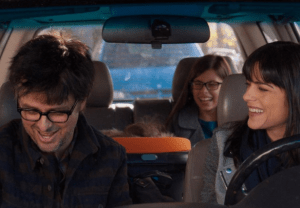 The regret without resentment shows maturity I’m surprised to see in a character like Perry. Billie Joe never quite transcends the role, but there is an honest vulnerability there that’s a little charming. And Billie Joe is not just a casting liability, he’s an asset to the soundtrack because he’s written some original music for it, and the movie is never more confidant than when Armstrong is performing. In this he excels. The songs he wrote are great and I imagine they’ll be invading your radio waves sometime soon, lending the movie some major credibility.
 an energy that defies the fact that Armstrong is in fact a middle-aged father of two. They played a couple of Green Day tunes as well, Scattered and then American Idiot, which morphed into Bad Reputation. Oh, did I not mention that Joan Jett was in the house? Yeah, she has a small cameo in the film but she got up on stage and showed the boys what a scene-stealing badass she still is. Her voice hasn’t aged a single minute and the woman’s still sporting leather pants. Armstrong closed the night with Ordinary World, the film’s acoustic ballad, and I couldn’t help but wonder at the twinkly goodness of my life. In the movie of my life, there is no path not taken.
 J.R. Brinkley was a doctor in small town Kansas who, through the grace of his revolutionary goat-testicle transplant surgery, cured many men of impotence and infertility while bringing vitality and prosperity to the town. Brinkley had to build hospitals just to deal with the growing demand, and almost accidentally became a radio pioneer simultaneously, broadcasting ads for his services and answering write-in medical questions between blasts of good ole country music. Despite exponential interest and a horde of faithful followers, the American Medical Association accused Brinkley of “quackery.” Just as they set out to discredit him, he came out with an elixir just as
  effective as the goat-testicle procedure but with much less risk. And then he ran for governor, with a slogan borrowed from a laxative commercial. True story.
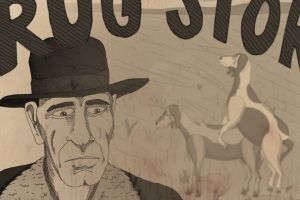 used for each segment, but there’s a uniform style that injects a lot of kinetic energy into a story hilariously but dryly narrated. You won’t believe how quaint goat fucking can look.
 exaggerated facial features on his favourite cartoon characters. One day Owen’s father is able to hold his first conversation with him in years simply by pretending to be Iago, the talking parrot from Aladdin.
 can express their love and see it reflected back, even if it’s a line originally quoted by Belle to the Beast. What I do know is that this film opens a lot of doors. This isn’t just a talking-head piece, we actually get to visit with Owen in his new situation, and his family as they continue to take on new challenges. We get to see autism in action, impacting a family and influencing a community. And we get to see that Owen is a guy with wants and needs like any other. He expresses them differently, and once you get the hang of his language, it’s not necessarily even worse, it’s just different.
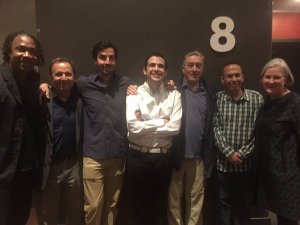 interesting and watchable is Owen himself, a very dynamic individual. He’s at his best at the helm of his Disney Club, where other learning-disabled young people gather to watch and discuss Disney animation. They may even run lines afterward, or play the score, and once in a while Jonathan Freeman, voice of Aladdin’s villain Jafar, drops in to lend a hand, and even Gilbert Gottfried, voice of Iago himself, has attended, but nobody knows the lines better than Owen himself.
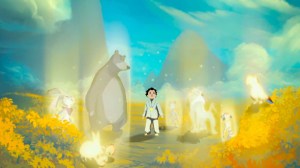 the lines. Many of the film’s crew were on hand, as well as the entire Suskind family, to launch this movie into orbit. There’s a lot of love and care gone into this work, and some of the best bits are when Owen’s own stories are beautifully animated (by Mac Guff). Owen identifies more with the sidekicks rather than the heroes of his beloved films, and he brings them to life in a very moving way.
 ASSHOLES WATCHING MOVIES