Tag Archives: mental illness in movies

I Smile Back

I Smile Back is tough to watch from the start, and it only gets worse.  It tells the story of Laney (Sarah Silverman), a housewife struggling with “drugs and daddy issues”, whose primary question of her therapist is, “which do you want to talk about first?”  Laney is married with two young children, so her apparent drug and sex addictions are significant problems for a whole number of reasons.

I am by far the least qualified asshole to diagnose Laney, being the only one who’s not a mental health professional.  But since Jay’s in a pain and morphine-induced haze right now, and Matt hasn’t seen the movie, you get stuck with me as your tour guide!  So here we go.

First, the easy part.  Silverman is excellent in the lead role, and is well-deserving of the acclaim she has received so far (nominated for a SAG Award for Best Actress).  I found her very believable as a woman who loves her family and truly wants to be part of it despite struggling with all sorts of stuff.  That Silverman is so good makes the movie all that more difficult to watch.

Beyond that, it gets much tougher.  Because of how difficult the movie is to watch, looking at I Smile Back critically is very hard for me.  I did not like watching it but I know I was never supposed to.  Nothing that happens in Laney’s life gives us a lot of hope that things are going to get better, and the movie does not end on a happy note (in fact, at the end things are at their very bleakest).  Silverman has made us care about Laney by then.  I wanted Laney to get better and repair her relationship with her husband Bruce (Josh Charles), so I was hoping for a typical Hollywood ending.

Suffice to say, I did not get a happy ending, and after reflection I think that was the right decision by writers Paige Dylan and Amy Koppelman (the latter of whom wrote the book on which the movie is based).  But something still was missing, and after staring at this computer screen for a while, I think I have put my finger on it.  In a meta sense, the movie is worthwhile because it gives Silverman the chance to show a whole other dimension to her acting.  But within the movie itself, I Smile Back didn’t give me anything meaningful.

The only meaning I can find within the movie is that anyone may be struggling with mental health and it’s not easy to recover even if he or she really wants to.   And while that’s something I agree with, it’s something I already felt coming in and the story in I Smile Back really didn’t go beyond that basic notion.  Everything in the movie was consistent with that idea but it felt like we were on a fixed path because of it.  Looking back, almost all the characters we meet other than Laney are primarily plot devices to give Laney a chance to make another bad decision, and she rarely misses the opportunity.  The opportunity that feels missed is on the part of the writers, who rather than fleshing out characters or situations, just keep things moving by giving Laney more chances to do bad things.   Because of that, I never felt that seeing these awful things happen onscreen was worth the pain.  I never felt any payoff for my discomfort within the movie and I needed there to be something.

Overall, this movie was worth checking out for Silverman’s performance but it’s really not great otherwise.  I give it a score of six out of ten.
Concussion

Concussion makes you sick with guilt for being an NFL fan.  As the movie unfolds, the names and stories of these tormented souls bring back memories of news articles you’ve read, and you know that even if some of the details are fictionalized, all the important ones are true.  And even though Sony’s leaked emails reveal they toned down the movie to avoid kicking the “hornet’s nest” that is the National Football League, the watered down version is horrifying enough.  Concussion makes you feel dirty for ever having watched a Super Bowl, let alone having bought a ticket, because involvement as a fan means you actively contributed to the destruction of so many lives.

Mike Webster really died in his pickup truck.  Justin Strezelczyk really died in a fiery crash because he drove into oncoming traffic while being chased by the police.  Terry Long really drank antifreeze.  Andre Waters really shot himself in the head.  Dave Duerson really was an NFLPA executive who fatally shot himself in the chest so he could

US PRESSWIRE Sports Archive-Historical

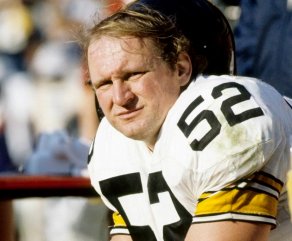
The real-life Mike Webster.  RIP.

donate his brain to science (and Junior Seau really did the same).  All of these former players were 50 or younger when they died.  All have been diagnosed with chronic traumatic encephalopathy (CTE), which is a degenerative brain disease that causes symptoms of dementia including memory loss, aggression, confusion and depression.  The scariest thing is that these are just a few of the former players who have died from CTE, or are living with CTE-like symptoms (a CTE diagnosis cannot be confirmed until after death), and there are thousands more who almost surely are living with the same symptoms and/or other neurological conditions like Lou Gehrig’s disease, Alzheimer’s, Parkinson’s or dementia.

That alone would have been enough for Concussion to make me uncomfortable but a personal connection made these issues all too real.  Growing up, I was a good athlete but my brother Bryan was better.  He was good enough to be playing both basketball and rugby on provincial teams at age 16, and then it was time to make a choice.  He chose rugby because he loved hitting people (which makes sense because he’s kind of an asshole too).  Focusing on rugby made him even better at it, and after high school he went out west to play for the Canadian junior national team.

And then everything went south in a huge way.  His first concussion was well in the past, suffered at age 14 while playing quarterback.  We didn’t think of it at the time but as the hits piled up, every big hit hurt him more and took him longer to recover from.  By the time he was playing national-level rugby, and getting hammered repeatedly by other 6’5″, 240 pound monsters like himself, he was also experiencing blackouts, memory loss, chronic pain and who knows what else.  When he came to at the top of a mountain and had no idea how he had gotten there (turns out he ran the mile from his house then continued all the way to the top), it was a rude awakening in more ways than one.  That was the end of his rugby career but only the beginning of his suffering.  He lost years to pain, headaches, and nausea, he lost his desired career as a firefighter, and he almost lost himself.

Bryan’s story has taken a better turn lately, as he has found treatments and medications that help him manage his pain and live his life. But for me, Concussion was a terrifying reminder that Bryan could have been Mike Webster.  He may still be.  Bryan’s only 36, which is how old Justin Strezelczyk was when he drove into a tanker truck.  Mike Webster was still playing football at 36, so 50 is still a long way off for Bryan and countless others.

Will Smith is decent in the role of Dr. Bennet Omalu, the coroner who autopsied Mike Webster and brought a lot of these issues to light after so many years of darkness and denial.  His accent is not as distracting as in the trailer but I couldn’t escape the feeling that the script was designed to include the phrases that Smith was better at saying in an African accent (“Tell the truth.  Tell the truth!”).  The same accent probably would have been more palatable coming from an unknown actor but does this movie get made or seen if Will Smith isn’t starring?  So while I probably wouldn’t have nominated him for a Golden Globe, I can see how he got one.  He is obviously trying here and maybe that was the problem for me.  In my view Albert Brooks (as Dr. Omalu’s mentor) and Gugu Mbatha-Raw (as his wife) both gave better performances than Smith.

Concussion makes sure to note the similarity between the NFL’s treatment of concussions and big tobacco’s treatment of cancer, and the comparisons are apt.  They still ring true, especially when the class action settlement between the NFL and 4,500 former players was conditional on the NFL never having to admit what it knew about the danger of concussions, or how long it’s known.  It’s easy to read between the lines.

The hits these players took (and gave) are going to kill many of them.  And we watched and cheered.  For me, Concussion made me realize that I’m long overdue to stop cheering and stop pretending that any of this is okay.

For that, I’m glad I saw Concussion.  I’m not sure the movie works as well as it should, because it seemed at times to soften its message in an effort to not seem too preachy.  I’m thinking particularly of a speech Smith’s character gives where he says he doesn’t hate football after being persecuted by the NFL for his research, which to me rang false.  Still, despite that scene and a few similar missteps, Concussion got to me and made me think, and that’s worth something.

Concussion gets a score of seven (six for the touchdown and one for the PAT) out of ten.


Some Independent Titles to Look Out For, Courtesy of the NHFF

A Light Beneath Their Feet – Taryn Manning plays a bipolar mother who has worked hard to get her life back on track. After a severe episode left her hospitalized, she lost custody of her LightBeneathTheirFeet-W1-210x157daughter for several years and only with diligent, close work with a doctor did she earn back that custody and now has a very close relationship with her. The daughter (Madison Davenport), however, a high school student in her senior year, is feeling the pressure of that relationship. This is really the daughter’s story. She dreams of going away to college – to California, where the weather is “stable,” but knows that her mother remains medicated only for fear of losing her. If her daughter is gone, what’s the point? I liked this for the portrayal of bipolar disorder – not always done well or compassionately or truthfully or fairly in the movies. Yes, Hollywood likes to dramatize. But at this film’s poignant core is a loving mother who would do anything for her daughter. And she happens to have a disorder that’s really tough to manage – tough on her, and tough on her loved ones. And yet we’re able to talk about the daughter’s challenges without vilifying her mother. It’s an honest conversation that I wish we’d see more often.

Director Valerie Weiss is also the kind of film maker we need to see more often. With a dual passion for both art and science, she majored in Molecular Biology at Princeton while earning a Certificate in Theater and Dance.  “It was at Princeton that I transitioned from acting to directing plays and really felt that I’d found my niche.  Directing was so much more suited to my personality and my desire to think about the whole picture as well as the minutiae.  So, I decided to keep going with these dual interests and went to Harvard Medical School to do a Ph.D. in X-ray Crystallography (the 3-D photography of molecules) and founded a film program for graduate students so I could continue directing and learn to make movies.  I made my first film while I was writing my dissertation, and two weeks after we wrapped production, I had to defend my thesis.”

The Second Mother: I enjoyed this movie even more in the discussing than the watching. Brazil’s official submission to the 2016 Oscar race for best foreign language film, The Second Mother (actual title: Que Horas Ela Volta) tells the story of Val (Regina Case), a long-time a28cdd43-1308-4ed2-b04b-3d862cf7263a-1020x612housekeeper to an affluent family, who spent years caring for someone else’s child while her own daughter is raised “back home”, the recipient of Val’s hard-earned paycheques but not her physical presence. After a decade’s absence, her daughter moves into the employer’s home, and cracks open the class system, exposing hypocrisy. The film is quite subtle, and I struggled with the fact that I actually found the daughter to be quite abrasive, which made it hard for me to admit she was making some valid points. The film is character-driven, but I suspect that you’ll find afterward that it has provoked the heck out of your thoughts at the same time. What’s interesting is that eschewing the drama, this film is actually quite mild in tone, and often more than a little comic. It’s not lecturing you, but there’s a subversive undercurrent that builds. The writing is taut and the acting on-point; Regina Casé is so good that we inhabit her shabby shoes despite the fact that the action belongs to everyone else.

Director Anna Muylaert (that’s right, two female film makers in a row! – good job, New Hampshire!) co-wrote the piece with star Casé and held two special screenings in Brazil. The first was for housekeepers and nannies, including the woman who worked for her parents for 30 years. There were lots of tears at this screening. The second screening was attended by friends of family, many of whom felt uncomfortable watching the film, and recognized themselves in the mirror staring back. The country’s social dynamics are persistent, Casé remarks “If you cannot change the world, at least you can change the situation that is close to you.”

Bridgend: Sara and her dad move to a small village in the county of Bridgend (Wales) where the quiet teenaged girl starts to make friends with a group of kids her cop father doesn’t approve of, and not because of their clothes or manners or grades or attitude. It’s because this small town is having an epidemic of teenaged suicide, and now his daughter’s smack in the middle of Bridgend_PresseStill_0000346it. If that’s not unsettling enough, this film is actually based on real events – between 2007 and 2012, 79 suicides were reported in the tiny borough of less than 20 000. The movie never explains why these suicides are happening because the real world was never able to either. Cult mentality? Small town boredom? Irresponsible press? Teenaged rebellion? Bad parenting? It was disorienting and I felt helpless and scared – one by one these kids just disappear. There’s a communal depression that’s oppressive, and yet it’s pain-stakingly well-shot, at times visually beautiful, a jarring juxtaposition to what we’re experiencing emotionally. The memorial rituals and obsession with mortality deteriorate near the end into what I can only describe as a fever dream, because I honestly don’t know what to make of it. I’m desperate to know one single other person in the world who’s seen this movie and who can guess as to why I felt this movie was so…aggressive. Grounded sadly in reality, this film still has the shivery feel of a horror, and it’s been hard to shake.

Touched With Fire

We saw four movies on Friday at the New Hampshire Film Festival, and this was Sean’s favourite of the bunch. Starring Katie Holmes and Luke Kirby as two bipolar poets who meet in group therapy while unhappily committed to a psychiatric ward, they feed each other’s mania and explore the possibility that maybe their illness is actually a gift.

imagesCAVJ8VDGThe movie derives its name from the book that examines the relationship between bipolar disorder and creativity, citing lots of artistic minds assessed as probably having suffered this or a similar disorder: Ernest Hemingway, Edvard Munch, Jackson Pollock, and Vincent van Gogh, to name a few.

Two things about bipolar disorder:

  1. It’s a serious disease. But it is a disease, and like many diseases, it can be managed with lifestyle choices and medication. It used to be called manic-depression but those two moods are misleading because not everyone experiences them like they’re often depicted in the movies. The mania is not always energized3d Bipolar disorder backgroundfun – some people get very irritable and paranoid during their manic phases. And other people will be angry and violent during the down phase, rather than depressed and sad. Medication and psychotherapy help a lot, but just like a diabetes, it’s a hard illness to manage. It’s a life-long commitment, and they’ve got the disease actively working against them at times – often just when they’re doing well, it starts whispering that they’re fine, they can get off the meds. That’s not really the case, but since the medication can make people feel sluggish or not quite like themselves, it’s really difficult to battle against those thoughts. And just like someone with heart disease who knows darn well they should cut down on red meat and stress, people who suffer with bipolar disorder can relapse, but for some reason we’re always harder on people with mental illness compared to other bodily illnesses. Bipolar disorder doesn’t get cured, but I have known people to live happy lives with it. I really salute them because it takes a lot of care and diligence and support.
  2. There does seem to be some kind of link between bipolar disorder and genius\creativity. I can’t tell you what that means because science has no fucking clue what it means. I can tell you that it doesn’t guarantee anything, and it isn’t true of everyone with bipolar disorder, or even most. But during the manic episodes, people have racing thoughts that can lead to all kinds of ideas and links and thinking outside the box. If you are a writer or musician who gets inspired and does your best work during this phase, think about what it means to have to give it up in order to “get well.”

touchedwithfireSo that’s what this movie explores: that fine line between wanting to get well, but also wanting to keep the aspects of the disorder that make you unique. Carla and Marco, in the movie, are both poets of a sort, and are transfixed by this sacrifice they’re being asked to make.

I am happy to report that this movie was not reckless. It did place value on medication, but it did it within a questioning context, which I think is important.

Let’s consider, for a moment, Vincent van Gogh. He’s one of the most acclaimed and famous artists ever. Was he bipolar? His “diagnosis” is only in retrospect since the disorder wasn’t even named or classified during his time. He certainly showed many of its dispositions. You know that during one of his “episodes” he mutilated his own ear, after which he checked himself into an asylum and spent there a fruitful year during which he painted many of his most prominent pieces, including the irises, his blue self1280px-Van_Gogh_-_Starry_Night_-_Google_Art_Project-portrait, and this one, A Starry Night, which was the view from his asylum room (minus the bars on the window, of course). This is what a night sky looks like to a “sick” brain. Isn’t it something? The world, our culture, places great value on this remarkable painting, and yet it would not exist had he been “well.” Doesn’t that make you think?

On the other hand, manic episodes are often accompanied with impulsivity, and poor judgement; sometimes even psychosis. About half will experience delusions or hallucinations, which can lead to violence. And the higher the high, the lower the low. The depressive state can include feelings of sadness, anxiety, anger, guilt, self-loathing, helplessness, and morbid thoughts of suicide. You wouldn’t wish this part on  your worst enemy, and it makes it tough to maintain the relationships and support network so crucial to health. Half of those suffering with bipolar disorder will attempt suicide or self-harm.

I valued this movie for asking the right questions, even if we don’t have all the answers. It felt like a pretty honest look at the disorder, the good and the bad, and the fallout that hits those that love them (Christine Lahti contributes a solid performance as a mother constantly on the brink), and I can see it being enlightening for audiences, and a good conversation starter for a disorder that’s often misunderstood.

MV5BODY2MjUzNzQ2NF5BMl5BanBnXkFtZTgwMjk0MDc4NDE@__V1_SX640_SY720_This film was written and directed by Paul Dalio, who was going to school in the Graduate filmmaking program at NYU, where he was discovered by his professor, who just happened to be Spike Lee (Lee believed in the work so much that he’s the executive producer on this film). Dalio made this film after overcoming his own struggles with the disorder as a way of reconciling the beauty and horror that comes from it, and dedicated it his fellow suffering artists.


Infinitely Polar Bear

Jordan over at Epileptic Moondancer wrote about this great film he saw, and he made me want to see it too, only, it never came. Well, not quite never, since it’s here now, only it’s just playing at our local art-house theatre (shout out, Bytowne, we love you!) and as far as I can tell, didn’t get much in the way of a release.

And that’s too bad because Mark Ruffalo, whom I normally loathe, does a bang-up job of portraying a husband and father who struggles with the mental illness that is now known as bi-polar (not so much in the 70s, when this film is set). His wife (a strong Zoe Saldana) married him optimistically and learns about his disease the hard way. In the throes of a manic phase he’s erratic at best, and scares his wife and two young daughters. They lose him to a psychiatric ward, and a FIPHD1iOek65hl6LdUL2HQhalfway house, and to loads of mood-altering medications, and in his quest to come back to them, he agrees to care for his girls while his wife goes off to NYC to get a business degree and a real shot at a job. She’s putting an awful lot of faith in a man who, most days, doesn’t seem capable of caring even for himself, but this is what he needs, and what their family needs, and needs must.


It’s easy to applaud this intimate and sympathetic look at a challenging illness. Writer-director Maya Forbes cast her own daughter in the fictionalized version of herself, a young girl caught between a father she dearly loves and a disease she doesn’t fully understand. This is clearly a deeply personal movie, stemming from a deeply personal place. And if this is how she experienced her father’s mental illness, then good for her. The movie makes it seem more like a quirky inconvenience than the devastating illness I know it to be, but if you ever have the misfortune of this diagnosis, then I fully hope that you get the bi-polar that Forbes lived with, and not the one I did.

Coming out of the theatre, Sean asked what I thought. And I genuinely thought it was a brilliant kq-infinitely-polar-bear-videothumbmovie, so well-acted by all involved. I also think it makes bi-polar look kind of fun. And the thing is, like any mental illness, and like many illnesses period, I suppose, the symptoms and severity and experience will vary from person to person. So while some may enjoy riding bicycles in bathing suits as their low, when I lived with someone who was bi-polar, I spent long months in a sad, scary, violent, life-shattering space. It’s not always as fun as it looks in the movies.

But Mark Ruffalo does an excellent job of hitting both highs and lows with some subtlety, playing each note, finding the heartbreak. Saldana is vulnerable, and even though I never stopped asking myself how she could leave her kids alone with this man, I still felt warmth toward her for trying so hard to make bi-polar just another thing to live with. I’m still queasy about movies that romanticize mental illness, but I’m also blown away by some fantastic performances that thrive and come alive despite a saccharine script.

Mary and Max

I hardly have words for how much this movie charmed and delighted me.

It premiered on the opening night of the Sundance festival in 2009, the very first animated film to do so, but it’s taken me all this time to learn of it and watch it.

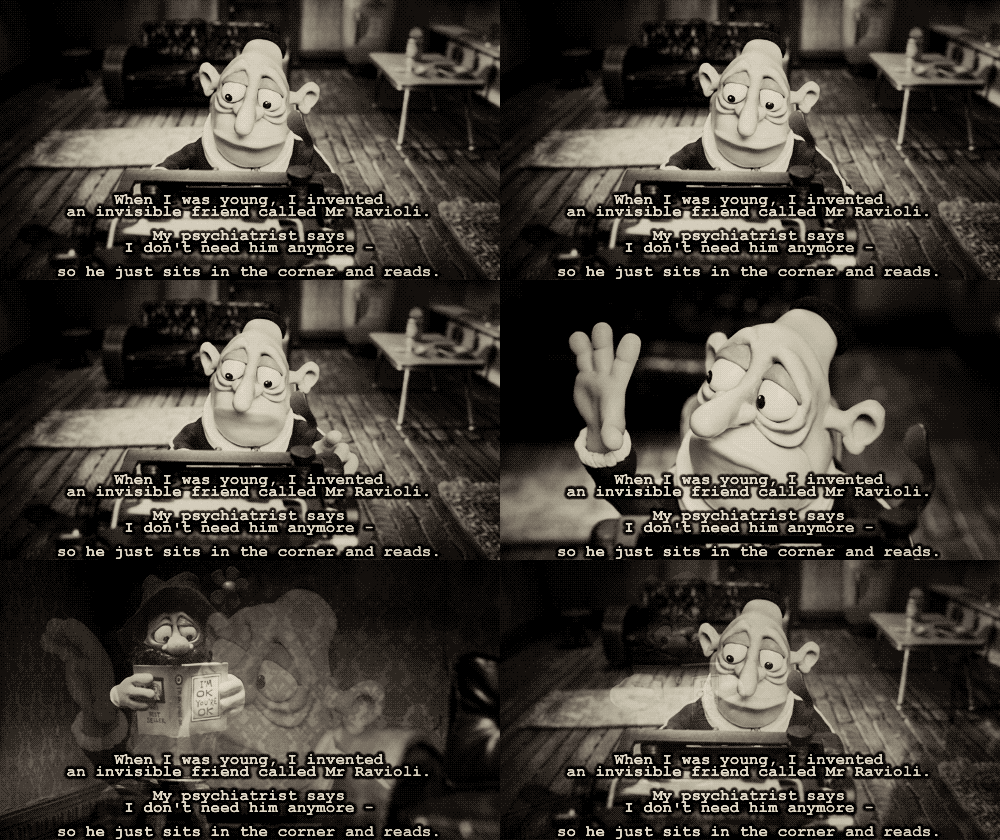
mary-and-max_154214It’s beautifully animated in very nearly black and white stop-motion, rich in details. Truly, I could have watched this movie in slow motion just to appreciate all of the work that went into each and every piece. You can see the love and attention that went into this; artists laboured for over a year, building 133 separate sets, 212 puppets, and 475 miniature props, including a tiny but fully-functional Underwood typewriter that took 9 weeks to design and build.

Mary (Toni Colette) and Max (Philip Seymour Hoffman) are unlikely pen pals – one, a young and ostracized young girl from Australia who believes babies come from beer steins, and the other, a morbidly obese New Yorker who is autistic in a time before that diagnosis is really made or understood. They are each in desperate need of a friend, and somehow manage to find one in each other.

This movie very deftly and sensitively tackles all kinds of issues, from Max’s fragile mental maxhealth, to atheism, childhood neglect, even to Mary’s war vet neighbour who is agoraphobic (“He’s scared of going outside which is a disease called homophobia.”)

The film is tragic at times, but has this pervasive sweetness to it that makes everything bearable. The story is often told via letters exchanged between the two, which some may find a little quiet, but I’m a sucker for animated films made for adults, and this one I’m all over. The characters have this bold honesty that I couldn’t get enough of (In her first letter, Mary encloses a drawing of herself  with the caveat “I can’t draw ears properly but I’m great at teeth”; in one of his responses, Max asks, in typical random fashion, “Have you ever been a communist? Have you ever been attacked by a crow or a similar large bird?”) Honestly, I watched this movie like it was my favourite book, or the greatest dessert – savouring it, delighting in it, racing toward the culmination but dreading the end.

Lots of the visuals are their own little jokes, but blink and you’ll miss them (keep your eyes peeled for clever epitaphs on the graves). One of my personal favourites was that some of the mary and maxstamps used by Mary featured Dame Edna, whom I love, have loved since childhood, while it was Barry Humphries himself who narrates the film. So delicious.

Director Adam Elliot is also behind the Oscar-winning short Harvie Krumpet – worth a viewing all on its own, but also a good barometer for the tone of Mary and Max. It never got a theatrical release in North America but it’s available on Netflix right this minute, and if you check it out now, I guarantee it’s not a minute too soon.

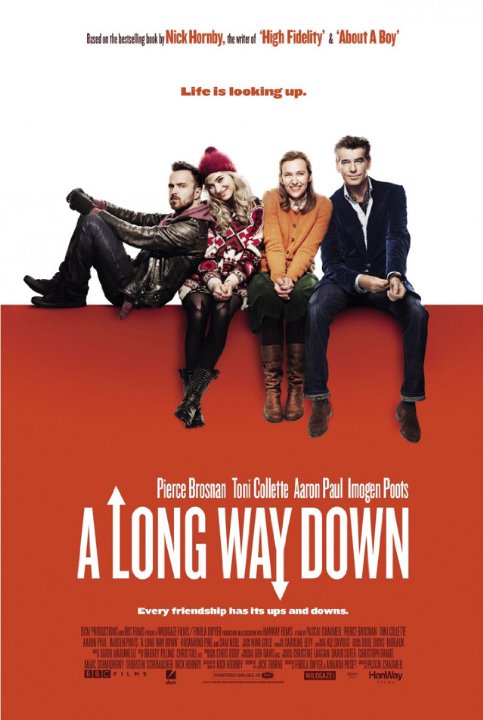
A Long Way Down

The movie’s opening line, uttered by Pierce Brosnan: “Anyway, to cut a long story short, I decided to kill myself.”

This is a New Year’s movie for everyone who isn’t as bright-eyed and optimistic about 2015 as your typical holiday movie forces you to be.

As a humiliated ex-talk show host recently disowned by his family because of his conviction of a sex crime with an underage girl, Pierce Brosnan’s character trudges resolutely up a very tall building in order to throw himself off but there encounters a pizza delivery man with cancer (Aaron Paul), an overwrought, emotional wreck (Imogen Poots) and an exhausted caregiver (Toni Collette) all with the same intention – to commit suicide.

Imogen Poots is young and upset but the others see quickly that hers is a temporary problem and they work together to stop her attempt and she pays them back by making everyone agree to stay alive until Valentine’s day. They agree but the next six weeks only make their lives more tumultuous as the press gets ahold of their pact and they get dragged into the worst kind of fame.

This movie has a really strong A Long Way Downcast so it’s hard to believe how bad it is. Nick Hornby is often golden at the cinema (About a Boy, High Fidelity), and Johnny Depp snatched up the rights to this novel before it was even published. Having read the book, I knew it didn’t stand up to his other work but still wasn’t prepared to be so underwhelmed by this film.  The movie ricochets between total bleakness and ooey gooey moments it doesn’t quite earn. The actors, to their credit, bring some moments of true emotion to this uneven film but aren’t really able to save it, not even the excellent, bar-raising Toni Collette and the surprisingly good Poots, who are over-directed and under-trusted to do what (it felt to me) their instincts were begging to do. Pascal Chaumeil directs this charmlessly and fails to breathe any life into this story that is about so much more than death.

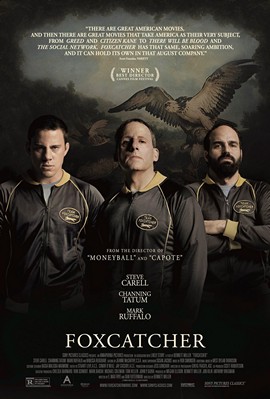
Foxcatcher

In the sprawling Du Pont family home, there is a room referred to as the trophy room. Its walls are lined with ribbons and medals and a bounty of trophies featuring gleaming silver horses. “Horses are stupid” says John Du Pont (Steve Carrell), who prefers wrestling, though his dear, ultra-wealthy mother considers it a “low sport.” It’s funny he has such a disdain for horses since he seems to treat his own pet wrestler no better than a dog.fox

Mark Schultz (Channing Tatum) is an Olympic gold medal winner but has lived his life in the shadow of his older brother, Dave (Mark Ruffalo), also an Olympian, and arguably the better wrestler. Mark’s living the unglamorous life of an amateur athlete, surviving on one $20 cheque at a time when Du Pont swoops in to offer him not just sponsorship, but mentorship. Desperate, Mark accepts.

Steve Carrell is nearly unrecognizable as Du Pont, and I don’t mean the prosthetic nose. I mean he walks Du Pont and talks Du Pont and hunches his shoulders and has this stillness and almost emptiness about him that’s kind of chilling and really restrained and very well done. Matt played the Oscar card in his review and I can’t help but agree. Every time he’s on screen, he’s giving out a vibe that makes you uncomfortable but prohibits you from looking away. Du Pont is basically soulless and he attempts to buy himself a biography with cash. He’s got an interest in sports but no qualifications – luckily, as long as you embroider ‘coach’ on your jacket, no one second guesses you when you’ve got millions in the bank. Carrell and Tatum both spend much of the movie in silence, so much so that a coked-up scene on a helicopter where the two repeat polysyllabic words is one of the “funnest” scenes in the movie. For the most part, it’s slow and mumbly and dark, dark, dark.

I actually think Tatum was the perfect choice to play the physically strong but emotionally stunted athlete. He comes alive in the gym, on the mat, but seems subdued and uncomfortable in almost any other setting. We see him as vulnerable and feel that somehow Du Pont has taken advantage of him, even though it’s clear he’s an adult. The movie relies on what’s not said between these two, because Du Pont is socially inept and Schultz is a dull bulb. But wordy or not, I needed something more from this movie. We never know the true nature of the relationship between Du Pont and his protégé. There’s a lot of tension and creepiness and stuff we don’t feel good about, even some erratic behaviour from Du Pont, but nothing that can really explain the drastic event at the end. I mean, what the hell? It’s not fair to spring that on us, you need to earn it, even if we knew all along we were in for some violent end.

The movie works best as a commentary on America and on social inequity than as a true-crime caper. Director Bennett Miller makes his movie as if he’s a journalist, not a story-teller. We are presented with facts; emotions are observed but not delved into. The whole thing is cold. And when shit hits the fan, we knew it was coming, but we still don’t know why.


As Good As It Gets

tumblr_m1ehh5O2Z81rra86mo1_1280It’s impossible to tell if it’s this movie that’s not aging well, or if it’s me. Maybe I’m just getting more curmudgeonly with every passing year, but this movie seemed better in my memory than it did in the re-watching.

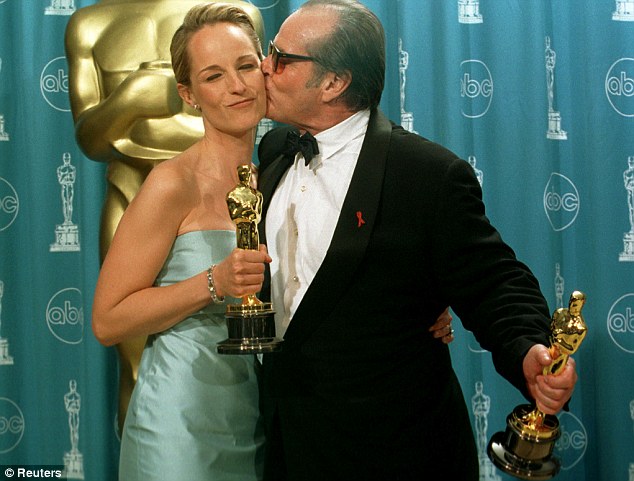
Jack Nicholson, who is superb, plays Melvin, an obsessive-compulsive gentleman who lives an extremely regimented life until two things stop him in his tracks: a diner waitress, and a mangy dog.

The first: Helen Hunt is, playing a martyr named Carol, or you know, just doing the Helen Hunt thing. I’m immediately annoyed with her character. Being a single mom is so hard, guys! And article-1350653-000B108A00000258-682_634x481asthma: the worst! She got an Oscar for this, so I guess I’m just being hard on her. She plays the only waitress that will serve Melvin at the only restaurant he’ll eat in. When she doesn’t show up to serve him his usual three eggs, over easy because her son is sick, he shows up at her house hungry with a doctor in tow.

The second: Greg Kinnear plays Simon, Melvin’s arty neighbour. Melvin is not what you would call a sociable man anas-good-as-it-getsd has no love for any of his neighbours, or their acquaintances, or their pets. In fact, Simon’s pup Verdell takes a trip down the trash chute early on because Melvin can’t stand the sight of him. But once Cuba Gooding Jr. brow-beats Melvin into caring for the dog while Simon recovers from a vicious attack, certain aspects of pet ownership start to feel enticing – particularly when little Verdell starts to imitate some of Melvin’s idiosyncracies.

Always worth a mention: Jack Nicholson was also awarded an Oscar for his work on this film, and this one I can get behind. Melvin’s only communication with the world is a series of as-good-as-it-gets-41-4degrading insults – racist, sexist, homophobic, you name it, he spits it out. And yet we love him for it, almost. We certainly forgive him. Just a lift of his bushy eyebrows and we’re his. The fact is, there’s great dialogue between these players, full of irony and thoughtful observation. It really makes you wish the plot didn’t follow such a conventional path. If only the film makers were brave enough to follow the characters down their authentic, quirky paths instead of playing it safe.

The dog, by the way (played saucily by “Jill the dog”), never received an Oscar for her stellar work on the film, but did pick up a UK Shadows Award, presented to the best dog actor, and I think a imagescase can be made for hers being the most charming role of them all. Technically Verdell was played by 6 dogs (Timer, Sprout, Debbie, Billy, and Parfait) but Jill was undoubtedly the star – Greg Kinnear (who was nominated for an Oscar but lost to Robin Williams for Good Will Hunting) describes being “upstaged by Jill”: “She’s got these lashes and big eyes… and when she walks onto the set everybody just says ‘oooh’.” Jill and company are Brussels Griffons and terribly cute. I’m sure she could melt the heart of any obsessive-compulsive, and I don’t know that there’s a higher compliment I can pay than that.

The Road Within

Oh man. If you watch one questionable movie (Welcome to Me), Netflix immediately believes the worst in you and starts recommending movies for the hidden loser in all of us. I assume this is what led me to watch something as painful and thoughtless as The Road Within.

First, that smarmy title. If it sounds like a non-selling self-help book, maybe leave it at that.

road-within-the-sceneSo the formulaic story is this: three young adults find themselves at a treatment centre under the care of Kyra Sedgwick for their various ailments. So they steal her car and go on an oddball road trip while the good doctor apparently abandons all other patients in order to search for them.

Vincent (Robert Sheehan) has severe Tourette’s – he tics and swears his way through this film; the-road-withinMarie (Zoe Kravitz) is painfully thin and painfully anorexic; Alex (Dev Patel) is as OCD (obsessive-compulsive, emphasis on obsessive) as they come. Though competently acted, I often felt their afflictions teetered on being played for laughs, and this set me on edge for the duration of the film.

Writer-director Gren Wells is remaking a 2010 German film, Vincent Wants to Sea, which is slightly better but didn’t exactly scream to be remade. The thing that kills me is that lots of real-life people live with these diseases, and they The-Road-Within-Gallery-1tend to do it with a lot more grace than this movie possesses. How does it both trivialize and make a mockery of these afflictions? And why are their characters allowed to be completely defined – and even overwhelmed – by their respective challenges? Because none of them seems to have a personality. They just have illness. And that rings false.

It seems to want to avoid the sentimental ending but can’t quite resist. The trio of young actors do pretty impressive jobs considering the patronizing material they’re wrestling with, but it’s not enough to uplift the movie or to make me feel comfortable with the way it treats some pretty serious issues.

One good thing I’ll mention in regards to this movie:

REELABILITIES+JCC+MANHATTAN+Present+Special+W244hpYwfT-lREELABILITIES hosted a special screening of the movie in April 2015, which was attended by Dr. Danielle Sheypuk. REELABILITIES is a film festival dedicated to promoting awareness and appreciation of the lives, stories, and artistic expressions of people with different disabilities, which is a beautiful idea and a cause near and dear to my heart.

Danielle Sheypuk, if you don’t know her, is a ground-breaking busy-body: a licensed psychologist, media commentator, disability-rights advocate and fashion model. She’s also worn the crown of Miss Wheelchair New York and was the first woman in a wheel chair to grace the catwalk at New York fashion week, February 2014 (a year later, fashion house Carrie Hammer tapped American Horror Story Jamie Brewer to walk their show, marking the first woman with Down syndrome to appear at fashion week). Dr. Sheypuk specializes in the problems of dating, relationships and sexuality among the disabled, a necessary but taboo subject I’ll be covering in my upcoming review of The Sessions.