Tag Archives: Netflix original

Go Karts (aka, Go!)

It’s called Go Karts on Neflix Canada, it may be called Go! on yours, but either way it’s a movie you can see this weekend from the corona virus-free comfort of your living room couch (presumably – sorry to those of you who may be self-isolating at home with symptoms; get well soon!).

Go Karts is an Australian film about, well, go karting. Yeah, I’m not sure where they came up with the name either, but I bet they spent OODLES of time on it. Oodles should totally be a measurement of time, and not just noodles.

Anyway.

Jack (William Lodder) and his single mother (Frances O’Connor) move to a small town in Western Australia where there’s literally nothing to do other than go karting. Which is convenient because a lot of Jack’s memories of his dead father are tangled up in driving and/or racing. So not only will go karting confront his grief, it’ll teach him to control his recklessness as well.

Oh, and did I mention that Jack is a cute boy and the “chief engineer” of his go karting team is a pretty girl? So Jack’s got the talent and Mandy (Anastasia Bampos) has the technical know-how and best friend Colin (Darius Amarfio-Jefferson) says dumb stuff and/or falls over things, hopefully providing a laugh or two (it never really works out that way, so Amarfio-Jefferson’s presumed talents are wasted). Oh and the tortured go kart track owner Patrick (Richard Roxburgh) sprinkles his grizzled wisdom throughout. It’s like every sports movie you’ve ever seen, only lamer because it’s go karts. In fact, it’s like a sad live-action Cars but not affiliated with Pixar in any way, lest they cast their litigious little eyes this way.

Anyway, Jack is going to overcome “all the odds” and defeat “ruthless racer Dean” who, to be clear, is another teenager who’s also a little too into go karting. And Patrick is going to Mr. Miyagi him all the way. I bet you can’t guess how it turns out.

But now that I’ve been sarcastially dismissive of this movie, I will say that the kids have kind of a natural charm, and director Owen Trevor sort of shines during the “action” sequences (again: go karts). If you’re looking for a warm-hearted movie to share with your kids this weekend, you could do worse than Go Karts.


Lost Girls

When Shannan runs screaming from a home in a gated community on Long Island and places a frantic call to 911, it takes police an hour to respond. They find nothing amiss but Shannan is never seen again. The cops’ lackluster investigation accomplishes very little but coincidentally they stumble upon a dozen bodies in this very same community, all of them sex workers fitting Shannan’s general description, but none of them her. And the police do truly treat it like a coincidence; they announce that her disappearance is unrelated and are largely unconcerned.

Shannan’s mother, Mari (Amy Ryan) doesn’t fit the profile of a grieving mother. Her family isn’t made for television. There’s precious little sympathy extended to victims like Shannan. They live a “high risk” lifestyle so when bad things happen, the victims are blamed, the police are unimpressed, the culprits allowed to disappear, or worse, to re-offend. Certainly in this case, the Long Island serial killer appears to have more than a dozen victims, and those are just the skeletons police have accidentally stumbled upon. Imagine if they were actually looking.

Shannan Gilbert was a daughter, a friend, a big sister. She was a real person. This is a true story. Her short life was filled with pain and because there were no easy choices for her, her death was not a tragedy worth investigating. This movie doesn’t have a real ending because Shannan’s murder remains unsolved. Director Liz Garbus allows us to sit with this reality, a small and meager tribute to a life cut short. The film flirts with different suspects only to highlight that the police do not. This entire investigation (or lack thereof) is either gross incompetence or a complicit coverup. The truths here are ugly, the endings aren’t happy. But the film is suffused with a roiling anger that is perhaps the important take away of Lost Girls – a sense of injustice for young, vulnerable women, whom society has judged not worthy of its concern.

Spencer Confidential

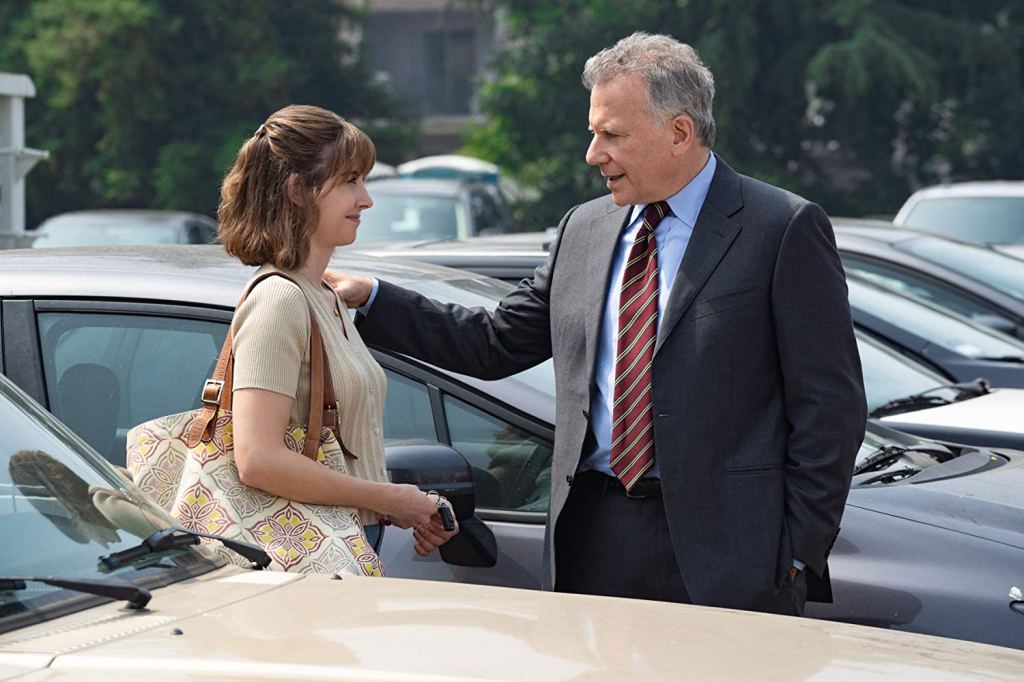
Some directors just have their muses: Scorsese has DeNiro, David O. Russell has Jennifer Lawrence, Tim Burton has Johnny Depp, Wes Anderson has Bill Murray, and Peter Berg has…Mark Wahlberg. Spencer Confidential is another Peter Berg – Mark Wahlberg collaboration, the fifth in a lineup of increasingly forgettable films: Lone Survivor, Patriot’s Day, Deepwater Horizon and Mile 22 and it feels like it was cobbled together by an AI that’s been programmed to write screenplays based solely on other Berg-Wahlberg collabs. It has thrown together all the B(b)erg cliches: Wahlberg inexplicably shirtless, Wahlberg sporting a sexy black eye, Wahlberg sticking up for the working man, Wahlberg just wailing on a guy, driving cars, crashing cars, and just generally acting macho.

He plays Spenser, a Boston cop who’s so dumb he spells his name wrong. He suspects his superior officer is a dirty Boston cop so he shows up at his house and beats him silly. You know, not exactly a rule follower. So he goes to prison to cool his heels, as you do when you assault a police officer. And when he gets out he lies low, drives transport trucks for a living, takes vacations in the desert.

Haha, just kidding. Spenser is out of prison for less than 24 hours when the cop he assaulted winds up murdered, and guess who’s the prime suspect. And even though he’s very much not a cop anymore, he still works the case. Out of the goodness of his heart?

Anyway, he’s got two buddies backing him up: an old man named Henry (Alan Arkin) and a complete stranger who’s also his new roommate, Hawk (Winston Duke). Conveniently, Hawk is a tank of a man who’s an amateur MMA fighter and knows a little computer, so he actually comes in handy when he’s paying attention. But believe me, you don’t want to be Mark Wahlberg’s friend. I mean Spenser’s friend. Okay, I mean both. Spenser has a knack for finding trouble. He’s never even heard of minding his own damn business.

Anyway, Spenser Confidential is a new kind of forgettable that’s actually forgettable even whilst viewing. Luckily there’s no real plot to keep track of and there’s no character development because no characters were drawn in the first place. Which is super convenient if you mostly watch Netflix for the white noise.

The Boy Who Harnessed The Wind

There’s flooding in Mozambique, and when the rains finally come in Malawi, they come heavy. The farmers have been struggling for years, unable to cope after the big tobacco farms went elsewhere. The wealthy estates take advantage, offering a lump sum in exchange for the lumber on their lands. Cash-strapped, many are tempted, but the village chief warns that these trees are they only resource they have to protect from serious flooding.

William (Maxwell Simba) must drop out of school when his family’s money runs out. The harvest is poorer than anyone predicted; his father Trywell (Chiwetel Ejiofor) manages less than 70 ears of corn, and that’s all the family will have for the entire dry season. The government denies a food shortage but hunger makes people do bad things. Whole villages are starving.

William thinks he can generate power by building a windmill that would operate a water pump, extending the growing season, but to do so he’d need to sacrifice the family’s only possession, a bicycle. Trywell refuses. You might guess from the title that William will prevail. And if a movie is willing to spoil itself right in the title, then you know it’s about the journey, not the destination.

The Boy Who Harnessed The Wind is about hunger. Not just an empty belly, but a need for something, a strong desire. And that kind of hunger can be very motivating. But a child surpassing his parent is hard on both.

Chiwetel Ejiofor directs himself in the film; he bought the rights to the book after reading it and set to learning Chichewa, the Malawi dialect spoken in the film. He shot it on location in Malawi, helping to bring authenticity and context to a true story. Farming is getting harder for everyone, everywhere. Global warming makes weather unpredictable, too wet, too dry. In Africa, where so many have so little, there is little margin of error. A thirteen year old boy saved his village from famine by cobbling together a wind generator built out of garbage. He was self-taught from books he wasn’t technically allowed to read, not having paid his school fees. He makes it look easy, but for him, it was simply and urgently necessary. This impressing directorial debut from Ejiofor communicates both the hope and the despair, but above all, ingenuity.


All The Bright Places

Violet and Finch meet atop a bridge. He is running across it, she is teetering on its ledge. He offers her a hand, and she takes it.

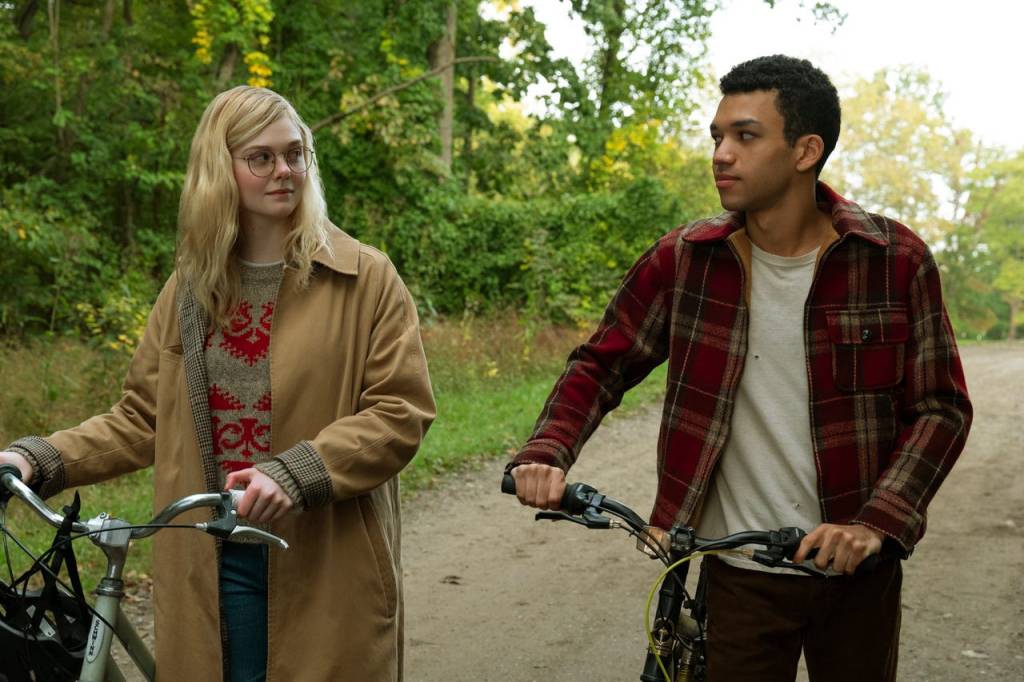
It’s a powerful and awful way to start a relationship, saving someone’s life. Violet (Elle Fanning) goes to Finch’s school. She is struggling with her sister’s death, a car accident Violet was in the passenger seat for. Finch (Justice Smith) sort of takes her under his wing, coaxing her out of her comfort zone under the guise of a school assignment. They travel to the wondrous places of Indiana, which will kill any thoughts of tourism you may have been harbouring because the wonders are underwhelming at best but Finch presents them with whimsy and charm, and how can Violet resist? But for all his saviour posturing with Violet, Finch has some pretty deep emotional scars of his own.

Despite its title, All The Bright Places can go to some very dark places. The leads are meant to be 17 but the story gives their characters some pretty heavy burdens and some serious sophistication. Fanning and Smith have great chemistry and give grounded performances, saving the film for what might have been maudlin or overwrought. Still, with Violet and Finch confronting grief, abandonment, and struggles with mental health, All The Bright Places is quite weighty for a teenage romance. I’m not sure the film quite handles itself correctly all the time; at times it feels a little superficial and easy. But on the whole I found it quite enjoyable. It’s based on a YA novel by Jennifer Niven and it feels like it. Which is not a criticism, actually, and it does deviate quite a bit from the book, it’s just that it wants to impart some wisdom, it wants to make some profound discoveries, and it doesn’t mind being rather obvious about it, like a parent or a guidance counselor might. Like, if you wanted to extrapolate that you should become your own bright place, the film will nod at you encouragingly while quietly nudging a box of tissues in your direction. Take the box.

The Last Thing He Wanted

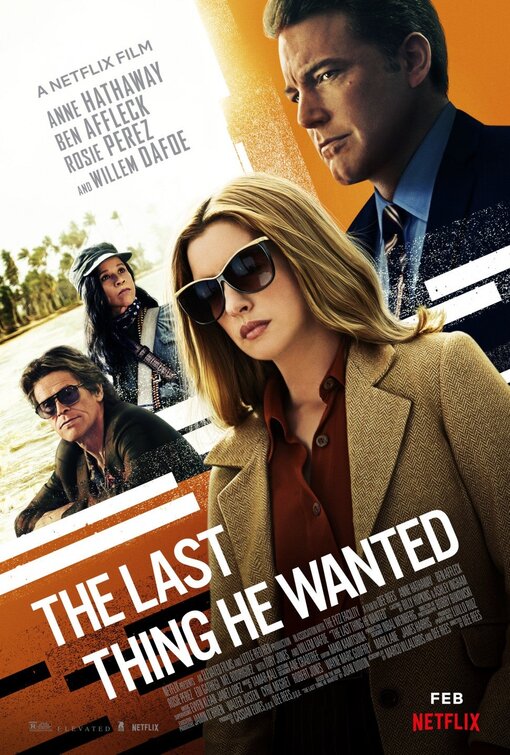
Do you like drama and intrigue and secret ops and exposing deeply classified cover-ups? Oh that’s too bad. This movie has none of that. The Last Thing He Wanted is the last thing anyone wants when they sit down to a movie. It’s sort of counting on you to turn it on and either take a two hour nap take a nap or walk out of the room for a snack and never come back.

Elena (Anne Hathaway) is a journalist who…covers foreign correspondence. She has a kid in boarding school since she’s never home and I have no idea what happened to the kid’s father other than he is indeed alive. Rosie Perez plays her friend/photographer. I think they get reassigned to cover the election at home, which pisses off Elena. She has a kooky father (Willem Dafoe) who is definitely into some shady business and possibly has dementia. He implores Elena to take care of a deal he’s sunk half a mil into but now cannot himself follow through. She does. Or she tries. And things get really shitty. Ben Affleck is around…pretty sure he’s CIA, possibly also into politics? Hard to say.


So this is a brand new Netflix Original that did two things very well: it confused me and it bored me. Granted, those aren’t generally things movies are trying to do, and maybe this one isn’t either, but that’s hard to believe given what a big fat mess it is.

IMDB seems to think it’s about a veteran D.C. journalist (that would be Hathaway) who loses the thread of her own narrative when a guilt-propelled errand for her father (Willem Dafoe) thrusts her from byline to unwitting subject in the very story she’s trying to break. So it turns out I did have the gist. I just didn’t give a fuck. I’m horrified to see this has been adapted from a Joan Didion novel. I hope she doesn’t have a Netflix subscription.

This isn’t a swing and a miss because it was never going to be more than a bunt. I lost track of motivations first, then plot. Anne Hathaway is…dogged. Either survived breast cancer or had a horrific boob injury. Her signature look is a chest covering scarf. She’s mad at everybody. She’s suspicious of nearly everyone but not suspicious enough. It’s so hard to get a handle on this and yet it was so underwhelming I can’t even be bothered to look it up.

Despite the brand name cast and director Dee Rees’ other successes, The Last Thing He Wanted is a real dud. It’s too late for me, but save yourself.


To All The Boys: P.S. I Still Love You

Lara Jean and Peter are officially girlfriend and boyfriend.

You may recall in the first film, Lara Jean’s little sister sent out a bunch of love letters that she’d been writing to her crushes to release some of your tortured young passion. The love letters were personal and confessional and never meant to be read by anyone, but most of all not by the people to whom they were addressed. And yet they were.

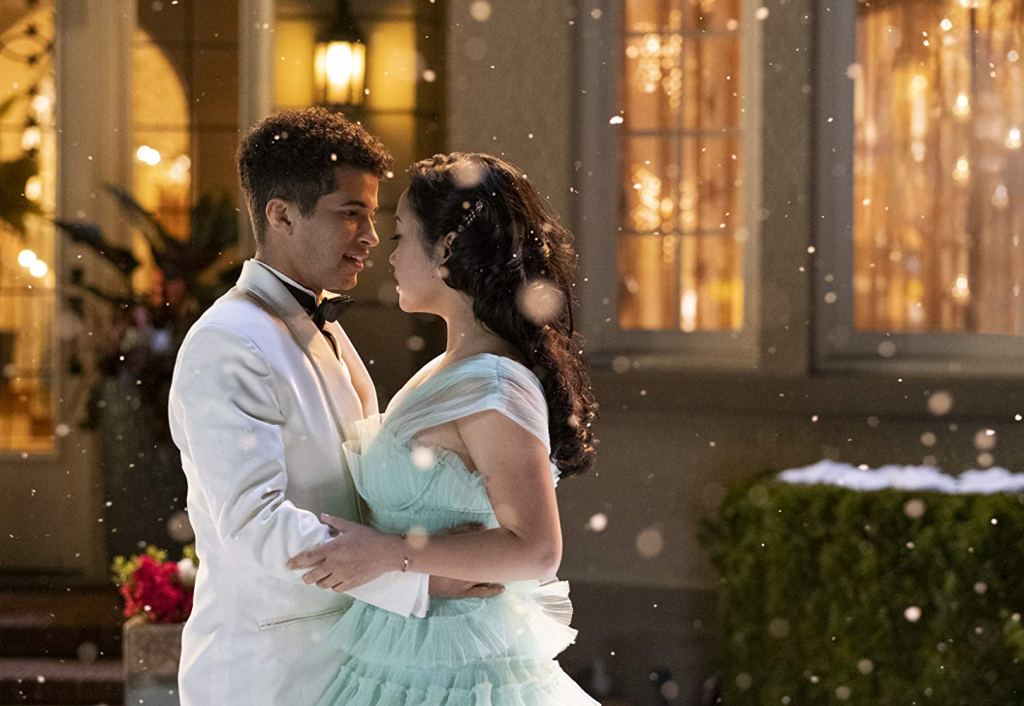
Which brought Lara Jean (Lana Condor) and Peter (Noah Centineo) together, superficially at first. They pretended to date because they each had certain needs their high school hearts could justify but you might guess that they eventually found themselves falling in love. Cue the sequel!

Everything is right with the world, except for the fact that Lara Jean can’t quite forget Peter’s ex and jealousy doesn’t exactly become her. But there are worse things to come. One of the other love letter recipients finally resurfaces: John Ambrose (Jordan Fisher) and man is he cute. In fact, he and Lara Jean end up volunteering together and circumstances are perfect for dying embers to reignite.

There’s a sweet innocence to these movies that holds some sort of universal appeal – perhaps because we’ve all had a first love and not only can we relate, but it’s sort of fun to revisit. But we also get wrapped up in Lara Jean and Peter’s romance because it’s a lived fairy tale. How does Peter have money to take dates to 5-star restaurants and why does Lara Jean have a series of cocktail dresses? They’re babies. They should be going on awkward group dates to the movies, getting dropped off by whomever’s mom had the biggest mini van, or hanging out in each other’s living rooms with their siblings not only watching but actively trying to humiliate.

Anyway, I’m finding it impossible not to be charmed by this franchise. The leads are exceedingly likable and the whole thing goes down as easily as a box of chocolates on Valentine’s day, so why resist? To All The Boys is one indulgence I’m not going to feel guilty about.


Top 5 Netflix movies to watch on Valentine’s Day.

15 quirky romance movies that don’t suck.

Valentine’s movies for single people.


Horse Girl

Sarah (Alison Brie) is a socially awkward woman who never really grew out of her girlhood horse phase. It’s clear to everyone but her that she’s not really welcome at the stables anymore, but she visits her old horse Willow even more diligently than she visits her childhood friend who was injured in a riding accident.

But horses are the least of Sarah’s problems. She’s a sleepwalker and she’s finding that her troubling lucid dreams are starting to leak into her waking life. She’s losing time, finding her body bruised, and since she’s a big fan of supernatural shows, she’s prone to those kinds of explanations. Is she a clone? An alien abductee?

And what’s really interesting is when she meets a guy and he had to decide if he’s horny enough to put up with her crazy. Because it’s clear that her mental health is deteriorating. Whereas before she seemed quirky if cringy, now her behaviour is getting harder to ignore or excuse. Her boss Joan (Molly Shannon) hardly knows how to help her but she doesn’t have many other non-equine friends.

As things fall apart, so does the narrative structure of the film. It’s clear Sarah has been an unreliable narrator, but for how long? What’s real? We doubt ourselves and her story far more than she does.

The very talented Alison Brie produces and is co-writer as well; she owns this story because she has created it, crafted it. Sarah slides down a slippery slope, and the descent is gives Brie a chance to show a muscularity in her performance that we haven’t seen before.

I wish the film were a little more sure of itself. Director Jeff Baena is reluctant to come down on one side or the other but the ambiguity starts to wear thin and push the bounds of credibility. It was thoughtfulness and sensitivity that pulled us in, and we lose a bit of that toward the end. Horse Girl is for an audience comfortable with oddball films and open endings.

A Fall From Grace

Grace is a grandmother, a devout church lady, a steadfast volunteer. Also a murderer. Also a murderer? That one doesn’t fit. But she’s in jail and she confessed. So how come no one believes she did it?

Jasmine (Bresha Webb) is a young public defender. She’s already questioning whether the law the right career path for her, so to get throw this case as her first murder trial is a little daunting. She’s inching along cautiously but Grace (Crystal Fox) isn’t making things easy for her. She’s more concerned with protecting other people than herself.

In court, her story unravels: after a post-divorce depression, Grace meets an artist, a younger man who sweeps her off her feet. This is her alleged victim. But obviously things are not what they seem or else they wouldn’t have bothered to make a movie. Well, they hardly bothered to do even that. It’s pretty bland as courtroom dramas go, with a pedestrian script by writer-director Tyler Perry.

And yet this movie was fractionally entertaining to me, for a few reasons.

  1. The boring reason: the performances were good. Ish. If you can look past the bad wigs.
  2. It’s always fun to watch Sean, an actual real-life lawyer, squirm through what Tyler Perry (or whomever) thinks is the law. As a non-lawyer myself, there was plenty of objectionable content that even a lay person could easily point out, but yelling “I object!” from my bed hasn’t persuaded a single Netflix judge yet.
  3. Perry boasted that this film was shot in just 5 days. What he didn’t say was that he edited in just 5 minutes. At least that’s how it feels. You could play a very saucy drinking game just pointing out the plot holes, continuity errors and other fun editing mistakes of which there is a continuous parade.
  4. My grandmother, who turns 87 this week, recently received a jury summons. God bless her little heart but even IF she could drive there and then by some miracle find the right place, and let’s be clear that I do not believe she could do either of those things, she would then not hear any single thing that anyone said. Not a thing. But let’s for a minute pretend she somehow gets there, and somehow hears things. She’s still not going to understand them. Not a damn thing. My grandmother speaks a hybrid of French and English but understands neither. For the past three decades she’s been getting by on the popular “nod and smile” technique. Later she’ll ask my mom, if she remembers. Which she probably won’t. So I’m mentally inserting my grandmother into the jury box, picturing her confused scrunched up nose, picking invisible lint off her slacks, balling up kleenex and putting it in her sleeve, and if she thinks anyone’s looking, smiling vaguely and nodding uncertainly in the direction she thinks is appropriate. Wouldn’t you be pleased to have her on a jury of your peers?

But wait just a minute y’all: my daddy is sleepin and mama ain’t around. There’s a twist!

The Operative

Rachel (Diane Kruger) calls Thomas (Martin Freeman) and says “My father died. Again.” It’s code for: get me the hell out of here. She is the operative, he is her handler, and she worked undercover in Tehran for the Mossad where things got…sticky. Her subject, Farhad (Cas Anvar) becomes her entanglement and if things were complicated before, well, they only get more so. Is she working both sides? Have her allegiances shifted? Dude it’s hard to trust a spy. Now, years later, she’s bringing Thomas back in. But why?

And also: who cares? The truth about spy work is that it’s probably boring like 99% of the time. Lots of sitting and waiting. Reading. Researching. Waiting some more. Blending in. Not getting up to much. Waiting for the phone to ring. Movies cut that shit right out. To be fair, The Operative edits out those same things as well, gets right to the getting-the-hands-dirty in the field bits. And yet it still, amazingly, manages to be incredibly boring. Incredibly.

Neither the story nor the characters were compelling. I love Martin Freeman but despite him being as animated as this movie got, I still couldn’t muster much enthusiasm. Diane Kruger was as remarkable as a boiled potato. More than once I asked Sean how much longer this movie had left, and more than once that Netflix progress bar seemed barely to have moved.

Yuval Adler’s film is unflashy and unstylish. Calling it forgettable is an insult to films I’ve merely forgotten. This one caused a fair bit of frustration even as I forgot it. I could hardly keep my attention even half on the film, snapping it back only to be disappointed by instant boredom yet again. And then it ended. Well, not so much ended as stopped. It just stopped being a movie exactly when it seemed it might have justified its existence. But no. The thing you’ve hung in there for 2 hours for…it never materializes. And yet you’re only half mad because even if you didn’t get a satisfying ending, at least it’s over.