Tag Archives: Netflix original

Eurovision Song Contest: The Story of Fire Saga

I will give it this: it is the funniest comedy of 2020. Is it (so far) the only comedy of 2020? Basically yes. But as this movie teaches us: sometimes you win just by showing up.

Lars (Will Farrell) has been obsessed with Eurovision since he was a little boy.

[For us non-Europeans, a crash course in Eurovision Song Contest, which is a real thing: it’s an annual international song competition, held every year since 1956, with participants from many of the 50 eligible countries (confusingly, some eligible countries are not European, and one, Scotland, is not even a country). Like the Olympics, each country holds internal trials and sends their best delegation to the competition, where an original song is to be performed on live TV and radio. Then people vote on their favourite. Countries cannot vote for themselves; each country awards two sets of points, one set decided by a panel of music industry experts, and the second decided by viewers voting by phone and text. Occasionally the winner achieves success outside of the broadcast area; Abba won for Sweden and Celine Dion won for Switzerland *record scratch* wait, what? That’s right: for some reason you don’t have to be from the country you’re representing. Some people compete multiple times by singing for different countries. Dion, who is ours (Canadian), was a good horse to bet on, but it does smack of cheating. Although, to be fair, so does every other thing about the contest. Russia won’t vote for queer performers and China won’t even show them. Jordan won’t show Israeli entries because they don’t recognize it as a country, and neither does Lebanon. And it seems that neighbouring countries tend to vote for each other; geographical and even political alliances pop up, and reciprocal votes are exchanged. You could even allocate points to an unpopular performance in order to boost your own relative success. 2020 was to be the show’s 65th anniversary, with this film’s release set to coincide with it. Alas, COVID has other plans, and for the first time, the contest was cancelled)]

Back to Lars (Will Ferrell), a little Icelandic boy who fell in love with Eurovision the day he first heard Abba sing Waterloo, much to his father’s disapproval. Many, many years later, Lars is now a middle-aged man but his dream is the same. His father’s (Pierce Brosnan) stance hasn’t changed, if anything, he’s more critical of his son’s “wasted life.” But his Fire Saga bandmate Sigrit (Rachel McAdams) has more than enough enthusiasm and encouragement to go around, and in their own heads, they’re already stars (the local pub tells an entirely different story, interrupting their original music to request Ja Ja Ding Dong, a silly but exceedingly catchy piece of shit – think of it as Iceland’s Chicken Dance). They’ll never get sent to compete on Eurovision on their own merits, but luckily the elves are on their side and something happens to tie up literally every other singer-songwriter in the country.

Off to Scotland they go: cue some fish out of water humour, some anti-American jabs, an oversexed Russian (Dan Stevens), and some pretty bizarre on-stage theatrics (which apparently are also a real thing – it’s a visual medium, and performers do their utmost to stand out). Iceland is basically the laughing stock of Eurovision.

This is the movie Will Ferrell was born to write. Scratch that: it’s the movie his wife was born for him to write (She’s Swedish – her family introduced him to the contest and he’s followed it rather ardently since 1999). That’s a pretty serious investment. He planted those comedy crops last century – does he harvest the rewards in this movie? Well, not exactly. His family won’t starve to death, but it’s a meager little crop, and a little mealy to boot. Sean thought it was pretty fun, and I won’t deny the film does have its merits. Will Ferrell is a larger than life comedian. His bits are always big so they either fail big or they win big, and with a 2 hour run time, the premise doesn’t quite have enough steam to keep paying out. Still, considering it’s on Netflix, your risk is small. If you’d paid to see this in a theatre, you’d probably leave feeling disappointed, but it’s just good enough for a Netflix view.

This is the second collaboration between director David Dobkin and stars Will Ferrell and Rachel McAdams. They had no scenes together in Wedding Crashers, in fact Ferrell had a pretty small part, but it was a wildly and unexpectedly successful movie. Perhaps Will Ferrell in small doses is the key here, and it’s one that’s definitely lacking in this prohibitively-long-titled movie. As troubling is his character is, we’re doomed to follow him around through all his lows and lowers. Rachel McAdams is basically inoffensive. She’s not exactly known for her comedic chops, so she provides an earnest counterpoint to Ferrell’s hammy, over-the-top antics. It’s not a match made in heaven. It’s not even a great match for Iceland, whose couplings tend to be a touch inbred. But like the proud and wonderful Icelandic people, this movie is unabashedly, embracingly weird. And like Iceland’s relationship with Europe, Eurovision Song Contest: The Story of Fire Saga is not the best that Netflix has to offer, but occasionally it surprises you.
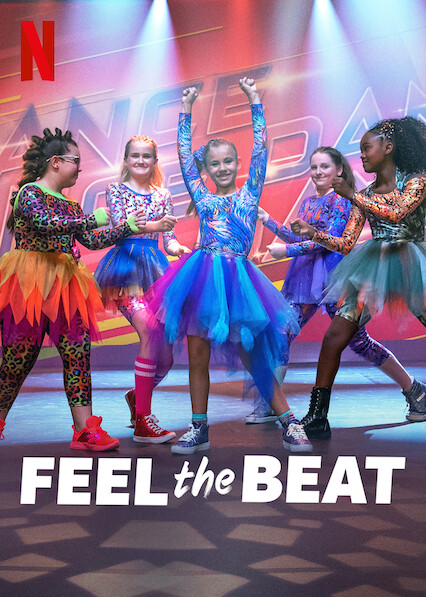
Feel The Beat

Not only did I fail to feel the beat, I couldn’t even find a pulse.

But that’s me, discerning movie viewer, critic without a cause. I won’t deny that it may hold some cachet as a family-friendly offering for the tween set. For the rest of us, it’s exceedingly missable.

April (Sofia Carson) is a hometown success story, having left for stardom on the Broad Way. She didn’t find it, of course, and slinks back home, tail between her legs. Luckily the small town where she’s from is sufficiently square that their twitter feeds have sme sort of hillbilly 3 day delay (a mild scandal brews on social media). To them, she’s still Impressive April, and the (very) humble dance studio where she got her start fawns over her terse, uninterested, one-word replies to their burning questions. This they call a “master class.” But when April gets a whiff of redemption (ie, a national dance competition with a handy dandy “teacher feature” which could put her in front of a judge’s panel including a top Broadway producer), suddenly she’s interested. Sure her interest is self-serving and mostly takes the form of verbally abusing an eager if unskilled dance troupe. They’re a bunch of misfits, as dictated by the trope, with a lineup including a deaf girl, a chubby girl, a poor girl, and a boy.

As you might venture to guess, the road to nationals is predictably paved with teachable moments and personal growth for our girl April, who never quite got to likable with me, which is just fine since I also found her unwatchable. Absolutely nothing personal with any of the cast, who were dancing their little tushies off. This is merely a trite script and a small budget and a green, though not necessarily untalented, crew. Which adds up to a harmless but ultimately subpar, forgettable movie that I did not need to see.

Da 5 Bloods

The Vietnam War. Yeah, we all flinch at the words. As a Canadian, I actually didn’t learn about this in school as we were “non-belligerent” (what a term!) (also, we were busy learning about our contributions in WW2, a war America remembers fondly by screaming at random Europeans “we saved your asses!” but Canadians remember as the war we joined immediately because we “thought Nazis were bad” and America ignored for two whole years because “Nazis were maybe okay” and finally joined when “something bad happened to us, on our soil.” Ahem) and I was born long enough after it that there was already a hit Broadway musical about it. But we can’t help having absorbed quite a bit about it, through pop culture of course, and by sheer proximity to our war-mongering neighbours to the south. I knew that it was a tough war because many Americans came to oppose it, which was probably the right attitude, but it meant that a lot of returning vets didn’t get the respect they deserved or the help they needed – which is an American hallmark, actually, by no means exclusive to the Vietnam war. And I knew that bad shit had happened there: we called it the My Lai Massacre; the Vietnamese call it the Son My Massacre, but either way you slice, it meant that 500 unarmed civilians – men, women, children, babies – were slaughtered by U.S. soldiers. Women were gang-raped and their bodies mutilated, as were children as young as 12. When their cover-up was eventually busted, 26 soldiers were charged with criminal offenses but only Lieutenant William Calley Jr. was convicted. Found guilty of killing 22 villagers, he was given a life sentence but served only three and a half years under house arrest. And for me, the Vietnam war was oddly muddled up with hippies and their peaceful sit-in protests and with civil rights and their peaceful marches. And historically, that’s correct. Some were putting daisies into guns for peace and others were being sent to war, and those things were happening concurrently but not equally. Young black men were being sent to Vietnam in disproportionate numbers while young white men could easily avoid it simply by attending college: Bill Clinton deferred once for college, Joe Biden and Dick Cheney each deferred 5 times. And if staying in school indefinitely wasn’t your bag, your wealth and privilege could work for you in other ways; Donald Trump avoided the draft 4 times with educational deferments but the 5th time Uncle Sam came calling he out and out dodged it – his father called in a favour from a Queens podiatrist who wrote up a false diagnosis of “bone spurs” even though he’d been found physically fit to fight just two years prior and has since said it just “healed up on its own” with no treatment necessary!

Anyway, black civil rights leaders, including Martin Luther King Jr., were opposed to the war for exactly this reason. Once again, black men were being asked (well, told) to serve their country, and there weren’t any colleges or doctors writing bogus deferrals for them. They were asked to protect the freedoms of people in other countries when they still didn’t have that at home for themselves. They were called up in greater numbers of course, and were a higher proportion of combat casualties in Vietnam, and African American soldiers encountered bigots in their ranks, discrimination in the field, disadvantage when it came to promotions and decorations, and fewer services if and when they returned home. That’s a whole lot to untangle, but have no fear: Spike Lee is reaching back into the baggage of his righteous anger, and he’s not afraid to tackle these iniquities.

In Spike Lee’s Da 5 Bloods, Norman (Chadwick Boseman), a soldier in 1970s Vietnam, tells us “War is about money. Money is about war. Every time I walk out my front door, I see cops patrolling my neighborhood like it’s some kind of police state. I can feel just how much I ain’t worth.” Spike Lee always ends up sounding prescient in his films, but his trick is simply having the temerity to acknowledge that the patterns in our shameful history march on today.

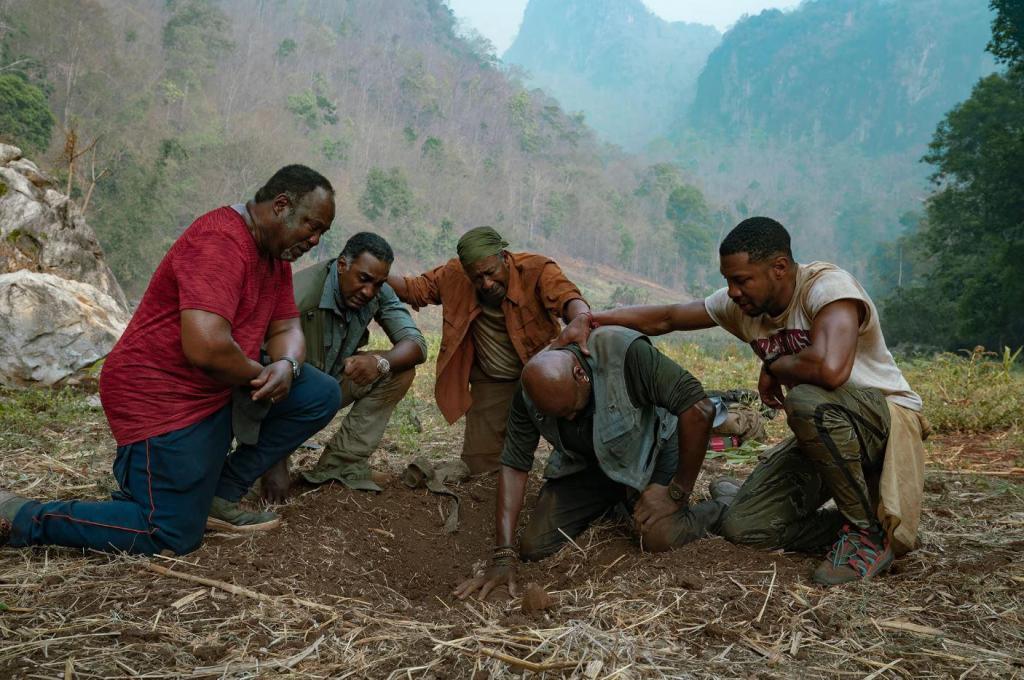
Many years later, four Vietnam vets, Paul (Delroy Lindo), Otis (Clarke Peters), Eddie (Norm Lewis), and Melvin (Isiah Whitlock Jr.) return to Vietnam to repatriate the body of their fallen comrade and 5th Blood, Norman…and also the pile of gold they stashed along with him. Now surely worth millions of dollars, you might guess that this buried treasure is not going to bring out the best in even the most devoted of brothers in arms. Greed, guilt, nostalgia, regret – these we understand, but Paul’s motivation is particularly murky. Unabashedly sporting a MAGA hat, prone to racist outbursts, he’s convinced himself that he’s doing this for Norman’s honour. But propelled by fury, by a barely-restrained rage for the many ways he and his African American servicemen were vilified for their role in Vietnam, that pile of gold bricks starts to feel like reparations. And this recovery mission starts to feel more like one of revenge – against an enemy that Paul can no longer distinguish.

Delroy Lindo’s performance is the sun around which all the other planets orbit, and like all bright balls of fury, Paul is flirting with supernova. And for his part, Spike Lee has of course never been known for his reticence. As a director, he’s prone to flourishes, allowing Paul’s stream-of-consciousness mutterings to morph into a rousing monologue, staring down the barrel of the camera, staring us down, charging us with his passion and urgency. Lee splices the story of his 5 Bloods with real life footage – Muhammad Ali’s conscientious objections, the Kent State massacre, the Black Lives Matter movement (yes, his film is once AGAIN that prescient, he’s taking the pulse of America right from the jugular, right from its crushed windpipe, his alarm and his agitation a perfect reflection of today simply by being unafraid to hold an honest mirror up to the ugliness of yesterday). His script stresses the cyclical nature of the violence without letting anyone off the hook. Spike Lee’s strength as a filmmaker has always been his point of view, his authorial voice resonating backwards and forwards through time, the immediacy of his plea undiminished.

Da 5 Bloods is as potent as anything Spike Lee has ever done, and possibly the boldest feather in Netflix’s cap. The film is visually arresting, the aspect ratio in constant flux as we travel through time (and our four main actors embody their characters in both timelines, a choice I can only assume is deliberate since Netflix has proven willing to splash out for de-aging, perhaps a nod to these men wanting and needing to believe they are still heroic, still capable, still virile, or a symptom of having glorified the time in their heads, and wanting to recapture that now, before it’s too late). But most of all I admire Da 5 Bloods as an allegory for reparations. Not even an allegory, really, but a template what financial amends might look like and how we can begin to take the next steps forward.

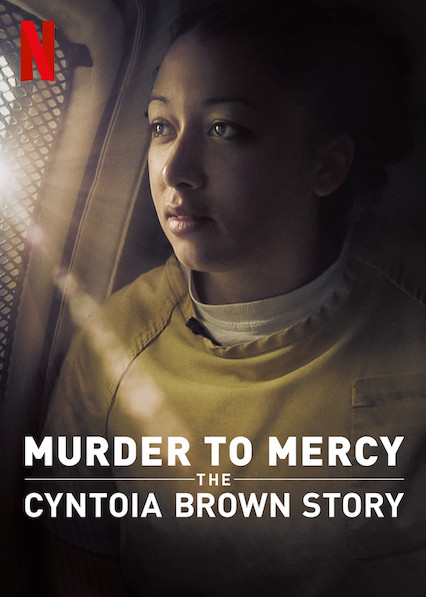
Murder To Mercy: The Cyntoia Brown Story

Netflix is crowded with documentaries just like this one: someone, often a person of colour, has been completely failed by the so-called justice system. And for every documentary made, there are hundreds? thousands? of unnamed prisoners going through the same thing. It’s hard not to burn out on these stories, and we feel so helpless to do anything about it.

Cyntoia Brown was failed many times before the justice system ever had its chance. Her mother Gina was just 16 when Cyntoia was born, already addicted to alcohol and crack. She struggled to raise her for a couple of years, but Gina was herself the victim of childhood molestation and rape, as was her mother before her. When Cyntoia was 2, she was given up for adoption, but she struggled to fit in, and her undiagnosed fetal alcohol poisoning made it impossible for her to thrive in settings that were hostile to her. By the time Cyntoia was 16, she was being pimped frequently by her “boyfriend” and one night, during an encounter that had her feeling particularly vulnerable, she shot the man who had picked her up, fearing and believing that he was about to do the same to her.

The justice system spent very little time deciding her fate: first, to be treated as an adult in court, despite her young age, and second, to sentence her to life in prison for a crime she committed as a scared child in an impossible situation. In 2004, when she was arrested and charged, the court called her a prostitute. Today, it would call her a child sex slave, the victim of human trafficking. But that does her very little good when she’s already been behind bars for 14 years.

But you know what? Some of director Daniel H. Birman’s footage went viral, prompting social media users to retweet #FreeCyntoiaBrown until someone finally paid attention. Her cause went up for review, and Brown pled for a second chance though most of us can see that she never really got her first. Her sentence was commuted and after 15 years in prison, she finally walked free. Now she spends her time advocating for prisoners in similar circumstances, but I think her story is particularly powerful in that it proves that actually we can make a difference. Hearing these stories and sharing these stories is how we begin to mend a broken system.

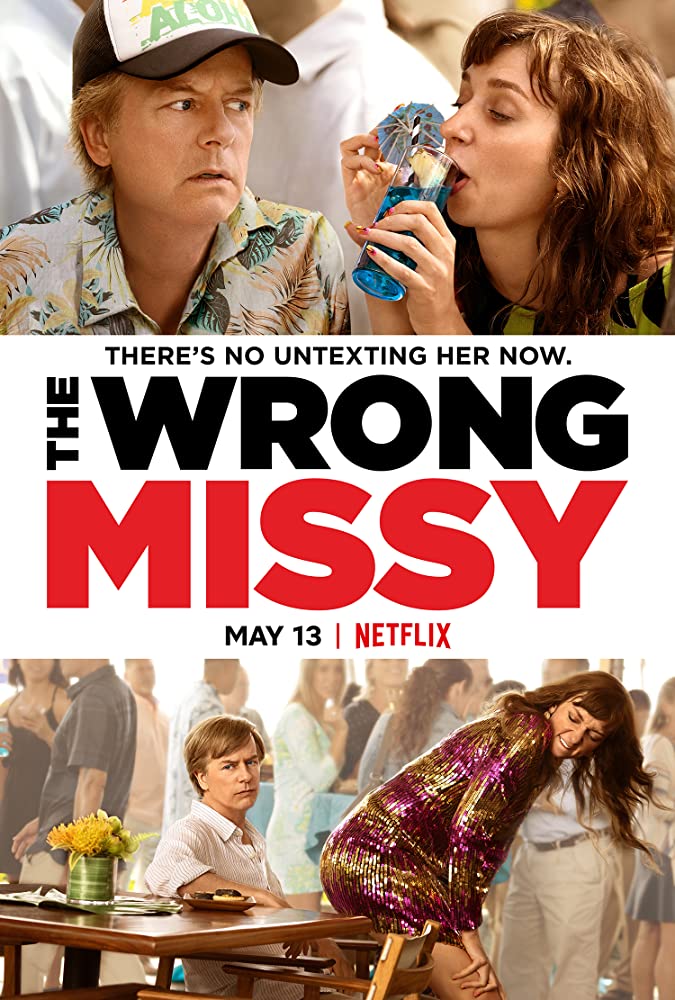
The Wrong Missy

Adam Sandler’s recent filmography has largely been an excuse to write off travel as a business expense. How many of his films have been unnecessarily set in Hawaii? Many. Here’s one more!

First, let me be upfront: for better or worse, this film does NOT star Adam Sandler. Actually (not to mention improbably), that is most definitely for the worse. He does produce it, and it does star each and every one of his homies, plus many of his non-actor family members (wife, kids, nephew, and brother-in-law, and those are just the ones I can spot unassisted). The Wrong Missy stars David Spade, because the universe needed reminding there are worse things than Adam Sandler.

David Spade plays “Tim,” a super cool guy. Haha, just kidding obviously. Tim is a wiener with a bad haircut. When we first meet him, he’s on a blind date with an unarguably batshit woman – honestly and completely insane. And yet we don’t really feel sorry for Tim because who is he to want more? This is probably the best he can do. And yet not only does he feels entitled to sneak out a bathroom window, he dares to look an attractive woman (Molly Sims) in the eye as if they are equals. In the Adam Sandler Cinematic Universe, dorky guys are always landing impossible women way out of their leagues. This feels plausible to Adam Sandler because in real life, he is rich and he is funny and he married a model. In real life, David Spade is…comfortable and, um, Adam Sandler’s friend, which at the very least guarantees steady employment and lavish, write-offable travel. But Tim? Tim is not funny. Tim is not successful. Tim does not have any rich best friends. But Tim is off to a Hawaiian corporate retreat, so he plays the best card he has and invites her along.

Except while he thinks he’s inviting the exceptional Melissa (Molly Sims), he’s actually texting his crazy blind date Missy (Lauren Lapkus), who is nuts enough to follow a guy who fled their first date all the way to Hawaii on a second. And when she starts to bleed her insanity all over his helpless coworkers, threatening his outside chance at a promotion, we once again fail to feel the least bit sorry for him. He is miles away from being a sympathetic character. And Missy’s zany antics are miles away from funny. They’re so over the top she’s not a believable character, but more unforgivably, she’s not an entertaining one. It doesn’t make you laugh, it makes you feel uncomfortable, makes you pray for the end. There’s no one to root for, no relationship to endorse. It’s painful, it’s distasteful, and the only reason to watch this movie is if a certified doctor has given you only 89 minutes left to live, and you want those 89 minutes to feel like 3 years.

Have A Good Trip: Adventures in Psychedelics

IMDB would have you believe that mixing comedy with a thorough investigation of psychedelics, ‘Have a Good Trip’ explores the pros, cons, science, history, future, pop cultural impact, and cosmic possibilities of hallucinogens. But that’s a bold-faced lie. You want to know how little science there is? The scientist is played by Nick Offerman, that’s how. Have A Good Trip is a terrible way to learn about psychedelics academically, but a pretty entertaining way to learn about psychedelics anecdotally.

Several first-rate story-tellers, mostly comedians (as theirs is the only career path that couldn’t be negatively impacted by admitting this on tape), offer up fun tidbits from past trips. Lewis Black, Sarah Silverman, Nick Kroll, Rob Corddry, David Cross, Will Forte, Paul Scheer, Marc Maron…this list goes on for quite some time, so perhaps I’ll let you be delighted with the surprise of so many familiar faces (and just fyi, a couple of recently departed ones – Carrie Fisher and Anthony Bourdain).

Acid trips are like dreams (as I write this I realize this is true in more ways than one): nobody wants to hear about yours. And even from the mouths of our favourite funny people, sometimes accompanied by clever little animations, or less clever reenactments, most of these takes still land in the awkward category of “you had to be there.” Acid trips are not movies. They do not have plots or characters or crucially, a point. Of course, neither does this movie, which again, IMDB has generously categorized as a “documentary” but actually feels more like someone’s answering machine after they spent a weekend at work while all their buddies went to the desert to munch through a bag of mushrooms.

If you’re predisposed to liking the comedians involved, it’s not such much “worth your time” as “a semi-entertaining time waster” – bonus points if you’re 35-45, because the drug references are pretty dated.

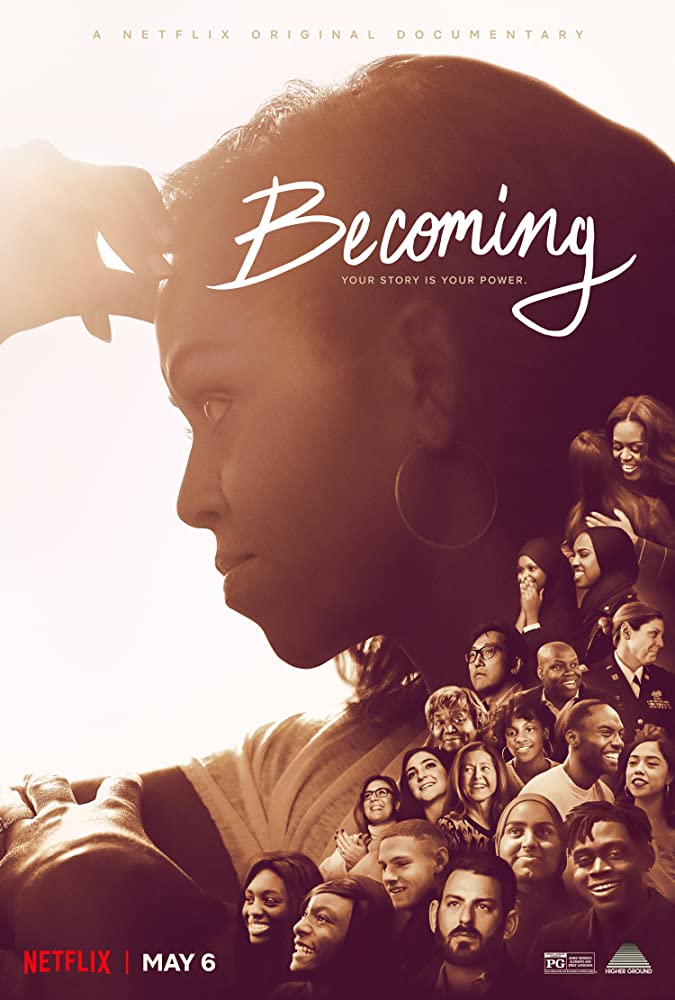
Becoming

Michelle Obama’s post-White House memoir Becoming explored her roots and the path she followed to become the formidable woman we know and respect today. Her new documentary on Netflix, also titled Becoming, shadows her on her massively successful book tour, and focuses more on the role and the identity she’s forging for herself as a former First Lady who still has a lot to give.

Director Nadia Hallgren crafts the sort of documentary that will have you asking why this incredible woman won’t just run for President herself – but if you’re paying attention, Michelle Obama answers that question in every word and sigh. It’s clear that her eight year sentence in the White House has taken its toll. For America’s first black First Family, the presidential spotlight meant constant scrutiny and a constant need for carefully modulated perfection. The First Families that preceded and succeeded them have been allowed far less criticism for far greater blemishes. The Obamas knew that theirs would be treated differently and they played the part. But while Michelle Obama’s poise seemed effortless, Becoming shows the emotional impact, even the trauma, incurred for an accomplished and intelligent woman to mute her voice. And while she was a beloved First Lady for her husband’s entire term in office, it’s clear that she has now stepped confidently out of his shadow, and that the country, and even the world, has a thirst and a fervor for this new, less filtered, more authentic Michelle Obama.

While the documentary isn’t revealing any deep dark secrets, it does allow Michelle Obama to let down her hair – sometimes literally, into luscious curls, and to step out of the First Lady’s shoes – carefully curated by a stylist who understood her White House role as a costumer projecting class and elegance and respectability – and into gold, glittery, thigh-high boots, if that’s what she wants. The White House has changed her but it hasn’t silenced her. It hasn’t convinced her mother to stop favouring her brother, or her staff to stop teasing her, or her daughters to stop needing her. Seeing her nestled amongst any and all of these people gives us a clearer sense of who she is. And while those of us on the outside can’t help but respect and admire her, we see how much that holds true, and in fact truer, for those who know her more intimately.

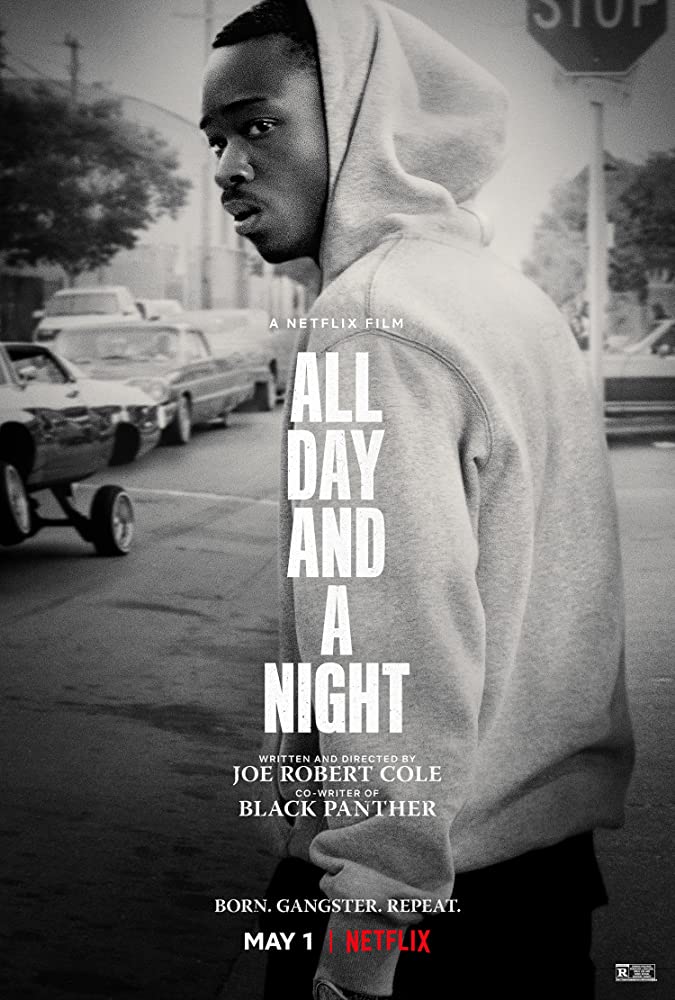
All Day And A Night

Soft-spoken Jahkor Lincoln (Ashton Sanders) struggles to keep his dream of rapping alive amidst a gang war in Oakland. It’s hard to have dreams in his neighbourhood. It’s hard to see outside the box you’re born into, to believe there are options for you, to believe your life isn’t fated by the colour of your skin. But no matter how hard he tries, his responsibilities seem to push him further and further across a line he never wanted to cross.

Jakhor lands in prison beside his father J.D. (Jeffrey Wright), the man he spent his whole life never wanting to become. But prison gives him lots of time to reflect, to explore the ties that bound them inextricably, and to dream of ways to beak the cycle for his own newborn set, whom he’s never met.

All Day and A Night is a title I still haven’t figured out and a film that’s a bit of a mixed bag. It slides backwards and forwards through time, which can get a bit sloppy. And it recycles a lot of material about young black lives that we’ve seen before. But it gets a few things really right – the sense of foreboding, for one, almost of inevitability that is heavy and depressing, and I’m just watching a film, not trying to live my life. Writer-director Joe Robert Cole clearly has a lot to say on the subject but I almost feel it was several movies’ worth, making this one a little disjointed. For example, there’s a very powerful scene in which Jakhor is visiting a friend in the hospital, a friend who will never walk again after a stint in the army. Jakhor is wearing a jersey, the NFL logo visible just below his pained face, reminding us of not one but two institutions that eat up and spit out the bodies of young black men.

I’ts not a perfect film but it has a voice and it has intention and if it’s not a string of hits, at least it’s a string of meaningful swings, and that’s a lot more than the other new releases on Netflix this week. All Day And A Night co-stars Isaiah John, Kelly Jenrette, Shakira Ja’Nai Paye, Regina Taylor, Christopher Meyer and Yahya Abdul-Mateen II.

The Half Of It

The Half Of It is not the kind of teenage romance we’re used to. Ellie Chu (Leah Lewis) is a small town high school outcast but for the fact that she writes term papers for hire and nearly all of the student body has bought an essay or two from her. She is the most well-rounded teenager you’ll ever meet; she works hard, studies hard, writes eloquently, plays several instruments and composes music, she knows old movies and French philosophers and somehow manages to keep her household running. In service of this last item, she breaks her own rule and accepts a different kind of paid writing assignment – a love letter from shy jock Paul (Daniel Diemer) to the school’s prettiest girl, a pastor’s daughter, Aster (Alexxis Lemire), who is already dating the school’s most popular jerk-off. Normally Ellie would refuse on moral grounds, but the electric company’s put the squeeze on so she accepts, unable to anticipate the complicated web she’s just started spinning.

Basically: Ellie’s letters are a little too convincing. A few are exchanged back and forth, and both parties, Aster and Ellie-as-Paul, are literary junkies and deep thinkers, and there are plenty of sparks on the page. But when Aster agrees to meet Paul in person, he comes off as a bit of a dud. He’s a nice guy, but he’s got nothing but blank stares rather than banter. The chemistry from their letters seems to dissipate in person. But Ellie keeps saving things with witty texts and thoughtful letters, so Aster’s falling for the Paul on the page, who is actually Ellie, while Paul is starting to feel like maybe he likes Ellie rather than Aster, and Ellie is starting to wonder if maybe she likes Aster. Like, like likes Aster.

Which is why I say this isn’t the kind of teen romance we grew up on. It isn’t light hearted fun, or sexy cat and mouse. It’s a rather mature meeting of minds, a slow-burn wooing. And Ellie is a new kind of 21st century protagonist who never needs to take off her glasses and let down her hair to be appreciated. She can be our hero just as she is, in overalls and chapped lips. She doesn’t have to play dumb or be oversexualized.

Sean felt the movie was slow to get going and a bit of a drag but I really felt refreshed by this story line, by the credit writer-director Alice Wu gives to her characters. And by turning the film into a tribute to all kinds of love, including platonic, she brings an emotional complexity to the concept of soulmates is are rarely if ever witnessed in a teen rom-com. The future isn’t just female: it’s queer, it’s intellectual, it’s responsible, it’s proud to be different. And isn’t that inspiring?

A Secret Love

If you’ve ever seen A League of Their Own, then you already know a bit about Terry’s youth. She was a Canadian ball player who went to America to try out for the American Baseball League, an all-female league that played in the 1940s while all the men were at war. She made the roster and played for them all four years, the ladies proving quite adept at baseball and the league gaining surprising popularity, a worthy distraction during difficult times. But when the war was over, so was baseball, at least for women.

Instead of returning home to a farm in rural Saskatchewan, Terry and her cousin, hockey player Pat, bravely decided to move to Chicago together, safety in numbers. Further bucking social norms, both ladies went to work and had careers. Though they each had their share of beaus, they stuck together, building a home in Chicago and to the shock of their families, they lived there contently for decades. But now, in (nearly) present day, Terry and Pat are both elderly ladies, and Terry in particular is suffering declining health. Her beloved niece is begging them to come home to Canada, to move into a nursing home near family where they can be cared for. But after a life of independence, Pat in particular is loathe to give it up. When they are finally persuaded, they decide to move into a retirement home together, and for the first time in their almost 70 years together, to live openly as a lesbian couple.

This film is really an attempt to document their love story, a beautiful story that they kept secret for longer than most of us have been alive. Some family members are shocked, some are not, and some feel an ounce or two of betrayal. But within their own community, Terry and Pat have a robust social life, a second family of their choosing, and it’s very sad to see them leave it. Even sadder is the packing up of their home together, mostly because of the shreds of mementos the packing uncovers, touching love letters saved but also anonymized, the signatures torn off just in case it should be seen by the wrong eyes.

Terry and Pat were rebels. They chose happiness, and they created it together, on their own terms. There’s no doubt you’ll fall in love with them yourself, Terry the sweet one, Pat just a little saltier, but so devoted to and solicitous of her longtime love. Director Chris Bolan offers contextual evidence that reminds us why the lies were necessary, but the joy of finally living their truth is right there on their faces. This is a love story for the ages.