Tag Archives: Oscar winner

Citizenfour

Filmmaker Laura Poitras’ documentary on the scope of NSA wiretapping and surveillance worldwide is the first of the Oscar-nominated documentaries that I’ve had the chance to see. (Thanks Bytowne for making it available). Poitras was already working on the film when she lucked out and got an encrypted e-mail from the mysterious Citizen Four, who we all know by his real name Edward Snowden. Snowden met with Poitras and journalists Glenn Greenwald citizenfourand Ewen MacAskill secretly in a hotel room in Hong Kong where he provided them with proof of the extent to which the NSA had been spying on its own citizens. Poitras’ footage of thiese meetings take up a large part of the film’s running time.
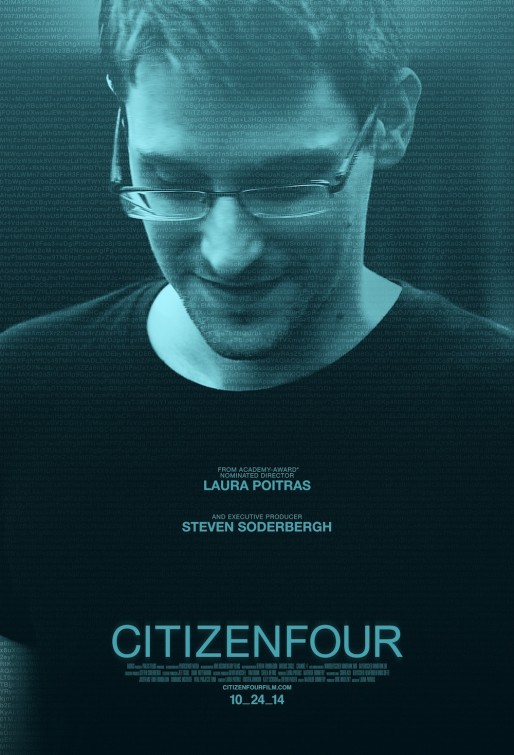
If you’re unfamiliar with Snowden or his revelations, this is definately a movie worth seeing. And if you have taken the time to follow this story as it happened, you probably care enough to wan to see this movie given that it gives you the rare opportunity to watch history as it happens. So, in short, it’s a movie I’d recommend for anyone.

“I’m not the story!” Snowden repeatedly insists. It’s hard to tell if Snowden’s desire to focus on the message instead of the messenger is admirable or self-serving (I’m leaning towards admirable). Either way, Poitras often ignores this and wisely puts the focus on Snowden and the parts where she does are the best parts of Citizenfour. These scenes offer a rare chance to get to see a little bit of who he is. We’re with him when he gets e-mails from his girlfriend about agents showing up at her door. We’re even with him as he prepares to come forward, watching him as he fixes his hair and kills time in his hotel room. He keeps saying that he’ knows and accepts that there will be consequences but his body language can’t lie. We can see that he’s scared.

Being at the right place at the right time is a big part of what makes a documentary and, by that standard, Citizenfour is a great documentary. Poitras was fortunate enough to have Snowden citizenfourcome to her and let her film him as he broke one of the biggest and most important news stories of 2013. It’s worth mentioning also that she was taking on some level of risk herself just by being involved.

I’m not so sure that Citizenfour is a great movie though. There’s not enough footage of Snowden to fill a full-length documentary and Poitras spends a lot of time scrambling to fill the rest. There are a lot of establishing shots, lots of text on the screen, and a few too many shots of Snowden sitting in his room watching tv. It feels like a missed opportunity, especially given that Americans are divided on whether Edward Snowden is a hero or a traitor. Poitras is leaning towards hero, maybe a little too heavily. She’s not wrong and documentaries certainly aren’t obligated to tell every side of the story. All I’m saying is, since Poitras had so much time to fill, maybe she could have filled some of it by asking him some questions.

For more on Citizenfour, read Jay’s discussion here.
Whiplash

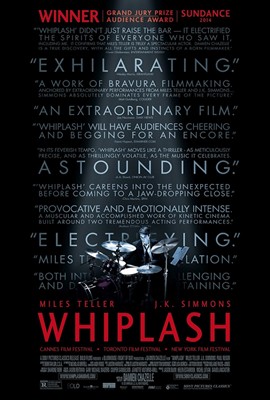
This movie was on fire. Both Miles Teller and JK Simmons are AMAZING but even the director (Damien Chazelle) was an unseen stand-out, somehow crafting a movie about drumming into an intensely psychotic thriller. The editing is almost violent,infusing the movie and the music with a crazy amount of energy.

Miles Teller plays a kid at an exceptional music conservatory who gets taken under the wing of a  teacher (JK Simmons) so exacting that he moulds his students into better musicians, or else. And you’d better believe that threat is real. The kids in his class certainly do. Blood, sweat, and tears are all part of the visceral experience of this film.

I watched this movie wracked with Whiplash_postertension, the kind usually reserved for a movie where the villain wields a knife, not a conductor’s baton. JK Simmons is absolutely brilliant, stunning and revolting. Each time he pulls back his hand to halt the band, it’s like he has a super power that sucks the energy out of the room. He’s like a general in front of his army. He’s erect, he’s controlling, he is bubbling rage personified.

But for me, the most fascinating thing about this movie is the way it presents such a cracked view of an abusive relationship. This man is sadistic. He doesn’t throw chairs at people’s heads just to make them play better (although he seems to believe in this motivation), he also does it because he likes. He has power, and he abuses it, and he enjoys abusing it. That’s sick, but it’s also not unusual. What’s really wrenching is that it’s not just Teller buying into it, he’s just one of three guys who are ready to be absolutely destroyed by this man, competing for his abuse, killing themselves to please an unpleasable man. They keep going back for more and it’s just so fucking despicable. And I ate it all up.


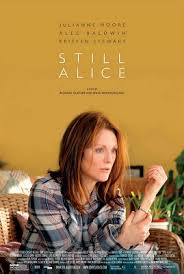
Still Alice

I first discovered Lisa Genova through her excellent book, Left Neglected. Wanting to read more of her work, I came upon Still Alice, an earlier work that she actually self-published. She’s got a great handle on neurological disorders but her stories aren’t clinical. They’re very human, and almost too relatable.

Julianne Moore is Alice, a 50-year-old woman with loads on her plate: she and her husband (Alec stillaliceBaldwin) are both ambitious, workhorse academics. She’s a Columbia professor who travels around giving talks on her research in the field of communication. They have three children, a son still in med school (Hunter Parrish), a daughter newly married and trying to conceive (Kate Bosworth), and a starving-artist daughter trying to make it as an actor (Kristen Stewart). It’s hard to see who’s more lost at sea when Alice is diagnosed with early-onset Alzheimer’s. There’s pain for everyone as they all come to terms with losing a vibrant, strong woman who’s been a big influence on each of their lives, but of course it’s Alice’s pain we witness the most, even as her disease progresses quite quickly.

It’s hard not to make this review just about Julianne Moore because of course she’s going to make or break this movie, and she’s made it. We see her go from competent, and sharp, and slide into more watered versions, more confused versions of her former self. Her gaze changes as her disease worsens, becoming flatter, disengaged, but it never goes blank. Maybe it would be better if it did; we still see hints of Alice and so feel the chasm between her old and current selves more keenly as she struggles to know herself, remember herself, lose herself.

It’s heartbreaking, but I have to give mad props to directors Wash Westmoreland and Richard Glatzer, who used a heck of a lot of restraint in filming this movie. The subject is pregnant with the potential to be self-pitying and cloying but it never even comes close. I still don’t Geneva’s work here is her best, nor does the script elevate it much, but it earned some tears and some thought and much admiration for a career-high performance.

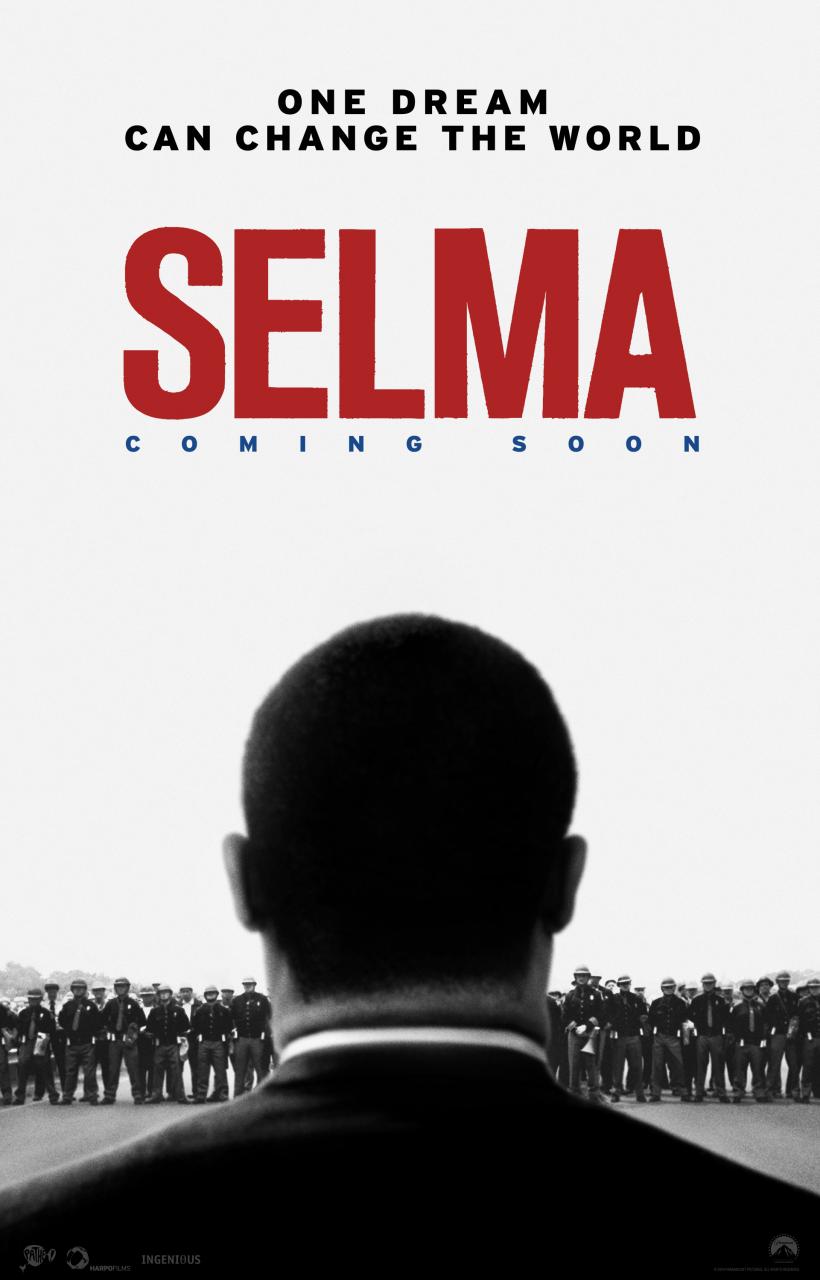
Selma

Ooof. I confess, I don’t really know how to review this movie. Why does it feel different from any other movie? Because it’s a piece of art? A piece of history? No, it’s because this is a piece of heart, of our collective hearts. This story is an act of remembrance, an act of grace.

Matt, Sean and I attended the screening of this film at Silver City last night and I’ve been sitting with it ever since, wondering how I can add my voice to what’s being said about this movie. This is not just a history lesson. The images of protest, of indignation, of police brutality, of black people being gunned down for no reason, these could just as easily be ripped from today’s headlines as from 50 years ago. That’s the part that will scrape raw at your conscience, as it did mine.

selma-movie-posterAnnie Lee Cooper is an older black woman registering to vote, as is her right as a supposed American citizen living in Selma, Alabama. The registrar is white, and resorts to dirty tricks in order to deny her once again. She leaves, slump-shouldered and dejected. Annie Cooper is played by Oprah Winfrey in the movie. I’m not normally a fan of stunt-casting, but in this case, using America’s sweetheart, a respected, powerful and highly successful personality who is also a black woman, to remind us just how far we’ve come in just 50 years, is pretty much the most perfect casting in the history of the world. Winfrey plays it winningly, with all the dignity the role deserves.

Insert Dr. Martin Luther King, Jr (David Oyelowo). He and his crew arrive in Selma to unite the people, to stir up activism, to attract the attention of the president (LBJ, played ably by Tom Wilkinson) and force him to do something about this supposed right to vote. Of course the president is reluctant, has his own agenda, and so King and company use their non-violent protest to force action in a genius and tragically necessary way.

The cinematography is a subtle tip of the hat toward realism. The costuming, particularly the suits worn by LBJ (those shoulders!), is pitch-perfect. The casting is strong. On paper it seems a bit weird to employ so much British talent to portray American icons, but it works. Oyelowo does a great job of shouldering the man and the spirit, the hero and the human being, without impersonating him.

It is hard to sit and watch this film. Director Ava DuVernay knows this and even uses it, with a stirring montage of Americans of all kinds watching horrified as the events unfold across their evening news, mirroring our own choking dismay.

DuVernay succeeds in stringing together a lot of different plot points in the course of the Selma events – the internal struggles of the organization, King’s problems at home, his grief and self-doubt, and government apathy or outright hostility on all levels. The film works so brilliantly because, while it stays humble in its scope, it becomes a representation for the movement as a whole, and for all the smaller victories along the way that led to real change. This flexibility in her story-telling is skillful and impressive and I can’t wait to hear her name announced as an Oscar nominee  (I won’t even say if), the first black female director ever to make the list.

Please see this movie. I can’t say that enough.


Boyhood

Boyhood is a really cool concept for a movie. You have to admire the film makers who set out to film a movie over the course of twelve years. Twelve years! That’s a long time to be committed to a project but it really pays off. Ellar Coltrane, who plays the titular boy Mason, was 7 when they started, and 18 when they wrapped. Imagine signing that kind of contract at such a young age. You can’t, because such a thing would be illegal in the US. The producers would have just had to cross boyhoodtheir fingers, but everyone kept showing up, year after year. I’ve heard the kids maybe regretted their involvement at times, and who can blame them – hello, awkward years and teenage rebellion!. I’ve never had the same job that long, and few people of my generation ever will. Amazing. Richard Linklater, the director, was known for making movies that took place all in one day. This one, obviously, blows that right up. He even made a pact with Ethan Hawke that if he died during filming, Hawke would take over.

The time lapse is not the only naturlistic aspect of the movie. The family exchanges feel authentic; some of the footage feels almost home-movie-ish, like when the kids are lined up to get the most recent edition of the Harry Potter series. These kids went through everything that normal kids their age did – they experience Britney Spears, the Bush administration, and skinny jeans. Patricia Arquette really elevates her game as a struggling, single mother who raises her son and daughter and works to make better lives for them. Ethan Hawke, aging visibly o camera, plays the deadbeat father with a lot of growing up to do himself. Their lives feel real, like they could be your neighbours. Their cars and their sneakers are not mysteriously above their station. Real life happens to them, they repeat clothing, grow ill-advised mustaches, date the wrong guy, take up and then discard hobbies.

The script must have had to evolve as they filmed because a family is dynamic. It reacts and is influenced by the world around it. Politics and trends are woven deftly and interestingly into the story. Linklater was directing his own daughter for these twelve years and watching her grow in front of his lens. The kid actors are quite good, fortunately; they’re not hammy or too old for their age. I was beginning to think that for whatever reason only British kids could manage not to be annoying on film, but these two may have turned things around for the Americans, and it must have been difficult to cast someone who’s not just right for the part now, but will continue to be for years to come.

So we know the span is quite large (12 years!) but the scope is actually pretty tiny. We just stay focused on this little family, following this kid during those formative years of his life, all those little things that will eventually add up to the man. There’s not a lot happening. Yes, childhood is tumultuous, but these are pretty normal lives. Nobody adopted a pet dragon, or got adopted by a dog, or took home a giant inflatable robot. He just went to school, watched his mom divorce and remarry, learned to tolerate his sister, tried beer, masturbated to the Sears catalogue. Regular kid stuff that’s only interesting when you add it all up and realize that this is it. This is childhood. And at the end, it spits out an adult that we hope will go off and do well. This movie was the scrapbook of his life, and a running time of nearly three hours doesn’t cover more than an episode or two at each age, but even at that, this movie can feel a bit draggy. It’s not an action-packed movie, but I was moved by it. It’s not depressing by any means, but I guess I felt a bit sentimental about it, probably because I truly felt like I was given the chance to really get to know these people. In fact, it was hard to remember that this is fiction, it feels that much like just watching through someone’s window.

This is an experiment of a movie that needs to be seen. I’ve certainly never seen anything like it. Will anyone attempt it again? The door’s open now, but it’s such an undertaking, and such a risk, that I believe this movie is one of a kind.

Birdman

Birdman opens with C-list celebrity Riggan (Michael Keaton), a superhero has-been trying to reclaim glory as a serious Broadway actor, meditating and levitating before rehearsal of his play. Wait – levitating? Yes. It seems that Riggan has picked up some super powers along the way.birdman

But this movie is so subtly engrossing, its rhythm unrelenting, that I actually forgot this little nugget of information until the next bit of surrealism came our way, presented just as slyly as the first. Some remnant of his Birdman alterego remains, and narrates Riggan’s present tense in a voice reminiscent of Christian Bale’s Batman, driving home the satirical meta-performance at work here. Director Iñárritu gets right up in his grill, nursing long but very intimate shots that show unflinchingly every wrinkle, every worry line ever earned by these actors.

Set almost entirely behind the scenes at St James theatre and shot in long, loooooooong takes that keep the film moving briskly, there’s a beauty and a mystique that really locked me in. Finally  Iñárritu has found his element. Cinematographer Emmanuel Lubezki floats the camera down corridors and ascends smoothly through the scaffolding and the balconies like an unobserved peeping tom. We take our cues from this camera work. We race to find new action, we catch our breath when travelling down darkened hallways. In this way, the movie feels serene yet is in constant motion. The music helps us keep pace and is sometimes so coolly frenzied that musicians forget they aren’t supposed to be seen!

Riggan, meanwhile, is crippled by all the nay-sayers in his life: the junkie daughter (Emma Stone), the anxious lawyer (Zach Galifianakis), the guilt-tripping ex-wife (Amy Ryan) – but none more so than that voice in his head that slowly cannibalizes him by the end of the film. When one of his actors is put out of commission, he’s forced to bring on board stage actor Mike Shiner (Edward Norton) who immediately threatens to outshine him. With his own superhero baggage (Hulk, anyone?), Norton threatens to casually steal the spotlight from Keaton as well with a brilliant send-up to Method acting, and a nod toward his own reputation for being difficult on set, but Keaton reminds us why he left the Batman franchise in the first place – dude is a first rate actor when he plays crazy.

The movie is ambitiously self-aware and asks smart-aleck questions like, why bother making a $20 million dollar movie when you can go viral for free? This may not be ground-breaking material but as long as Keaton is in on the joke, the monster egos and insecurities, the fraud and the acerbic wit, it’s all part of a complex self-examination that’s fascinating to witness.

Matt and I saw this movie nearly a week ago and it’s taken me this long to even begin unpacking my feelings about it, and this after an all-you-can-eat-sushi session in which we debriefed and compared notes. As Matt will tell you, the movie is also  Iñárritu’s excuse to poke back at the critics who have called him out on his self-important, self-conscious work in the past (Babel, Biuitiful) even though this movie actually seems to acknowledge that these criticisms may have been valid.

I really enjoyed this movie. It’s a pleasure to watch, a puzzle to figure out, and a commentary just begging for feedback. Please, give us yours. Assume spoilers in the comments.

Birdman or (The Unexpected Virtue of Ignorance)

I walked out of Birdman last night feeling exhilarated, confused, and unqualified to review it.

The film, nominated for seveon Golden Globes including Best Picture- Musical or Comedy and Best Director), follows (literally, through most of it) Riggan Thomson (Michael Keaton), a fictional ex-movie star most famous for playing a superhero called Birdman as he tries to re-invent himself as a Broadway star in a play that he wrote, directs, and stars in. The production is shaping up to be a disaster throughout rehearsals as it’s star must not only deal with his own demons but also with his eleventh-hour replacement co-star who threatens to steal the spotlight (Edward Norton), a high-maintenance actress afraid of spoiling her one chance to be in a Broadway show, his high-strung lawyer (Zach Galifanakis), and his resentful daughter who is straight out of rehab.

Whenever possible, director Alejandro Gonzalez Inamitu gives the appearance of one long continuous take as he follows his actors from backstage to Times Square to a nearby bar. Some of this was accomplished through fancy editing tricks but the film’s stars apparently would have to shoot up to 15 pages of dialogue at a time. That and the complex choreography of the walk make what would otherwise be a pretty talky movie feel action-packed. Even those with little interest in cinematography and editing are likely to be impressed. And the cast, with Keaton and Norton being clear stand-outs, seem grateful for the challenge.

I feel shy about reviewing Birdman because it’s more surreal touches involving Thomson’s frequent arguments with the voice of Birdman in his head left me scratching mine. Many scenes are ambiguous and are probably meant to be but sometimes left me feeling like I wasn’t understanding what was going on. But mostly, I feel shy to review it because few seem to be able to escape its brutal honesty as it takes aim at Hollywood, Broadway, critics, bloggers, Twitter, awards season, and self-importance in general. I felt like I was being dared to love this movie- or to hate it- only so it could mock me for it. The script and acting feel refreshingly honest even as it seems to question its own ability to do so. Keaton and Norton contribute to the multi-layeredness, both playing parts that are so close to their real-life public personas.

My review of this is all over the place. Sorry about that. I’m still not sure what to make of this movie. I can tell you that you I doubt you’d regret watching it. And that (I never thought I’d say this) someone should nominate Michael Keaton for an Oscar. Even if the makers of Birdman would laugh at them for it.

The Goodbye Girl

In 1977. A 30 year-old Richard Dreyfuss became the youngest ever to win the Oscar for Best Actor, a record he held until 2003 when a slightly younger Adrien Brody dethroned him. He was awarded this honour not for Close Encounters of the Third Kind, which was released that same year and still considered a classic, but for this rom com (I hate this movie already for making me use that term) from playwright Neil Simon. Marsha Mason plays Paula who arrives home to discover that, not only has her actor boyfriend left her, but he’s also has sublet the apartment to another actor named Elliot (Dreyfuss), leaving her and her ten year-old daughter homeless. Paula and Elliot reluctantly agree to share the apartment and they clash for awhile before falling in love.

What it’s lost with age. As soon as The Goodbye Girl begins, it ffeels old. The score, dialogue, and hammy acting all seem to come from a 70s cheesy sitcom rather than a Hollywood classic. I’ve always admired Simon as a writer and, when I don’t feel like cooking, I can sometimes be found in my local Indian restaurant reading one of his plays while I eat- often laughing out loud. But his lines are too often fumbled by the actors here and it’ll only be when playing some of them over in my head moments later that I realize that it was actually a great line.

What still holds up. Honestly, not much. Things pick up a llittle when Elliot shows up and, whether or not the performance is Oscar-worthy, Dreyfuss has a lot of fun with the dialogue and is almost always interesting to watch. Even he, though, is sometimes a little over-the-top for my taste. The funniest lines and the funniest moments are all his though. Watching him attempt to reluctantly play Richard III as flamboyantly gay is probably the highlight.

Bottom line. I hate to pick on a movie that is so old and inoffensive but I can’t see The Goodbye Girl having much to offer a modern audience. I don’t disagree with the Academy for giving Dreyfuss the Oscar that year, I just wish it was for Close Encounters.

The Grand Budapest Hotel

Full disclosure: I am Wes Anderson’s twin sister, and thus, incapable of impartial movie reviews.

Fuller disclosure: That was a bold lie. I’m just an uber-fan, but upon reflection I don’t want to accuse myself of impartiality. Yes, I love his movies fervently, I wish to live in them, but my esteem is earned. Wes Anderson never takes a night off. He earns it every time.

I was going to watch something new, and maybe I was going to like it, but this little delicacy presented itself as an alternative, and therefore it was the only alternative.

budapestWes Anderson introduces us to Gustave H, a legendary and well-perfumed concierge at the famous Grand Budapest Hotel, and Zero Moustafa, the humble lobby boy who becomes his most trusted friend. The story involves the theft (and recovery) of an invaluable painting and the battle over a will and a vast family fortune.

Immediately Anderson’s aesthetic draws you into this world, the colour palette is sumptuous and alive, and it’s like stepping into someone’s well-appointed dream. As always, the details are meticulously executed: the hotel’s shabbiness, the gritty grout, the choice of fonts, the embroidery, the mustaches, both real and drawn-on, the crest worn by Edward Norton and his army men of a little fox head greatly resembling a certain Fantastic Mr. Fox.

The movie is shot with three different aspect rations to help the audience differentiate between the time periods. The adventure is rapid-fire and the dialogue is virtually spat out.  In fact, the rapid gunfire of dialogue is a problem when viewing the movie in a theatre: the laughs are so close together it’s sometimes hard to hear whatever comes next.

The characteres are vividly drawn and always so much fun to get to know – in this case, Ralph Main Quad_AW_[26611] Grand BudapestFiennes plays a character playing a character who makes pretension feel absolutely charming. Tilda Swinton makes a grand dame indeed in her voluminous old age spots, old lady lipstick, and ridiculously piled hair. There are actually so many stars jam-packed into this movie that I’ll never be able to name-check them all. The enjoyable thing is that these cameos rarely (if ever) feel forced, instead it’s intoxicating and energizing.

It’s a caper-y type film and the plot covers a lot more ground than most of Wes Anderson’s films. But the crime is nestled within a sumptuous frame work and the whole film eats like one of Mendl’s delicious little cakes that are turned our so perfectly that Saoirise Ronan, who plays Agatha, said that making those little pastries convincingly was by far the hardest stunt she’s performed in any movie.

I’d like to say that this is possibly Wes Anderson’s best movie to date, but I feel that such an assertion would be a betray of sorts, like choosing my favourite among my dogs (which reminds me – great little Anderson in-joke moment: after killing a dog in nearly every other movie, Anderson finally sticks it to a cat in a manner so abrupt and cruel it can’t help but get a big, suprised laugh). It’s hard to find a movie that’s this entertaining, this varied and layered, and even if you watch it as a George Clooney edition of Where’s Waldo, you can’t go wrong.


Stay tuned for more Wes Anderson reviews – I won’t be able to resist.

Gandhi

I spend a lot of my movie-watching time with old movies- “classics” as most DVD rental stores call them, so I thought I would post some online reviews of films that have been around longer than online reviews to see how well they hold up. This week I rented Richard Attenborough’s 1983 Academy Award for Best Picture Winner Gandhi, a movie I’ve always meant to see because I thought I “should” but never got around to. Maybe it was it’s 190 minute running time. But I sat through Interstellar twice over the last two weeks so I decided I was ready.

This is, of course, the story of Mohandas K Gandhi, who I’ll assume needs no introduction, beginning in South Africa in 1893 until his death in 1948. So, 55 years of history over 3 hours. Get comfortable.

What it’s lost with age. Or maybe this was always a problem. I was a year old when Gandhi was originally released and my parents wouldn’t take me to see it at the time as much as I begged. Watching it today though, I thought Attenborough’s perfectly understandable reverence for his subject might have gotten in the way. Gandhi is potrayed more as saint than complex human being and we never really understand why he did the things he did. I’m not usually one to complain about length but it is tough to hold an audience’s attention for three hours when the main character does nothing but humble and self-sacrificing things.

What still holds up. Gandhi is played by Ben Kingsley (Sir Ben now but back then I think it was just Ben). Ben won a well-deserved Oscar for the part, beating out Tootsie’s Dustin Hoffman who ironically turned down the chance to play Gandhi, making me shudder to think how bad this movie could have been. As both the young hopeful Gandhi and the exhausted and starving older one, Ben’s eyes, voice, and posture are almost perfect. His performance is by far the best reason to see this movie.

Nice surprise for modern audiences. Early in the film, Gandhi is stopped on the street and mocked by three young punks (although they probably wouldn’t have been called that in the 1800s). My first thought was “These guys are so over the top. They have to be the worst actors in the entire movie”. My second thought was “Is that Daniel Day-Lewis?” It was. I guess everybody has to start somewhere.

Bottom line. When I’m watching a movie about a real guy, I tend not to like movies that try to cover too much. 55 years is a lot and I would have liked a movie that focused on a smaller, more manageable window in greater detail. Still, the old school production (real human extras instead of CGI ones, for example) give you that “they don’t make ’em like this anymore” feeling. And then there’s those performances. Ben Kingsley at his best, Daniel Day-Lewis at his worst. Who could ask for more?