Tag Archives: queer cinema

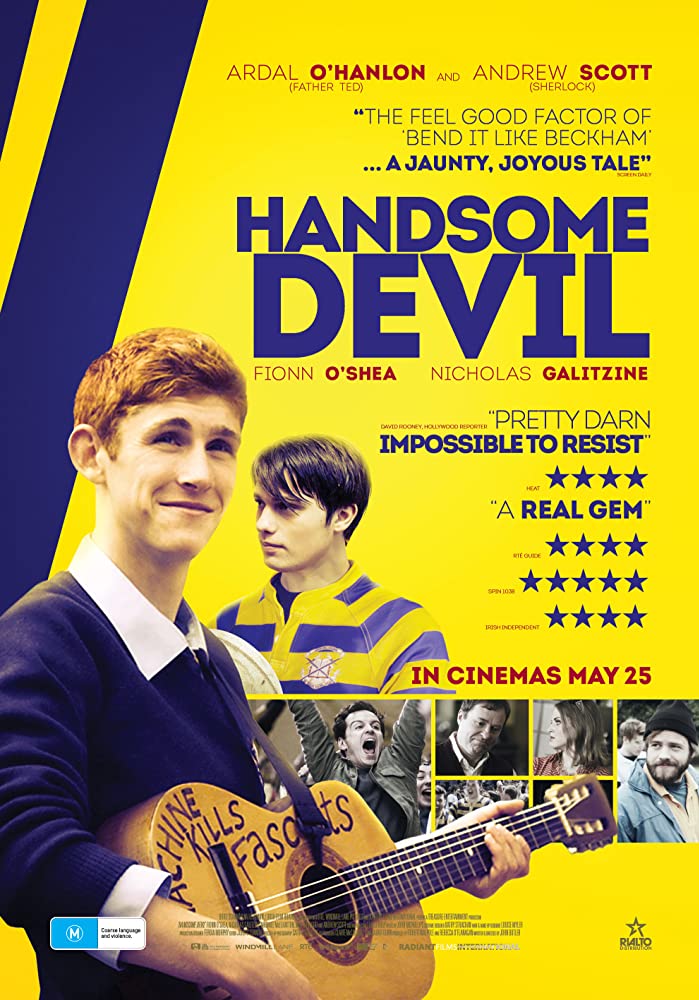
Handsome Devil

Like many of you, when I heard the title, I naturally assumed the movie was about this guy:

His name is Herbie but he literally answers to Handsome Devil, a name he lives and breathes every single day.

It’s quite effortless, and quite evident in his swagger. But anyway,contractually I have to eventually boomerang this runaway movie review and get back to the topic at hand: handsome devils who are not my verygoodboy Herbie.

Enter: Ned (Fionn O’Shea). He’s a teenager at boarding school, a constant target of bullies because he’s gay. And then the worst thing happens: the new kid Conor (Nicholas Galitzine), star rugby player, rooms with him. Which means all the jocks (aka bullies) now have an open invitation to hang out in his bedroom, and Ned no longer has a single safe sanctuary on the entire campus. Nor does he own enough boxy furniture to build an adequate barricade around his bed, but that doesn’t stop him from trying.

As you might guess, the proximity does eventually break down their defenses (literal and figurative), and Ned and Conor start to bond. They’re not so different after all! With the encouragement of the new English teacher (Andrew Scott), who challenges students to find their own voices, the two boys find common ground in music.
A simple message, but one we apparently still need to hear. People fear what they don’t know, but all it takes is one friendship outside your normal social circle to expand your horizons and overcome some of the invisible barriers between us. The differences between skin colour. sexual orientation, gender, etc, are superficial at best. Friendships, relationships, even just basic respect – these are based on our shared values and interests.

School is not always a safe space for queer kids (or different kids, or kids), and we’ve been telling them ‘it gets better’ for a long, long time. Which is true: it does get better. But it’s nice every once in a while to hear a story where better starts happening NOW. Queer cinema can often be a bit of a tragedy fest, and while it’s important to remember those experiences as well, it’s really nice to celebrate the victories. O’Shea and Galitzine have a wonderful, subtle chemistry, and give their characters an authenticity I know a lot of us will relate to.
God’s Own Country

God’s Own Country is the poor man’s Brokeback Mountain. Well, that’s not fair. It’s not just the men who are poor, even the mountain is more of a hill, or just, you know, fairly flat land, maybe?

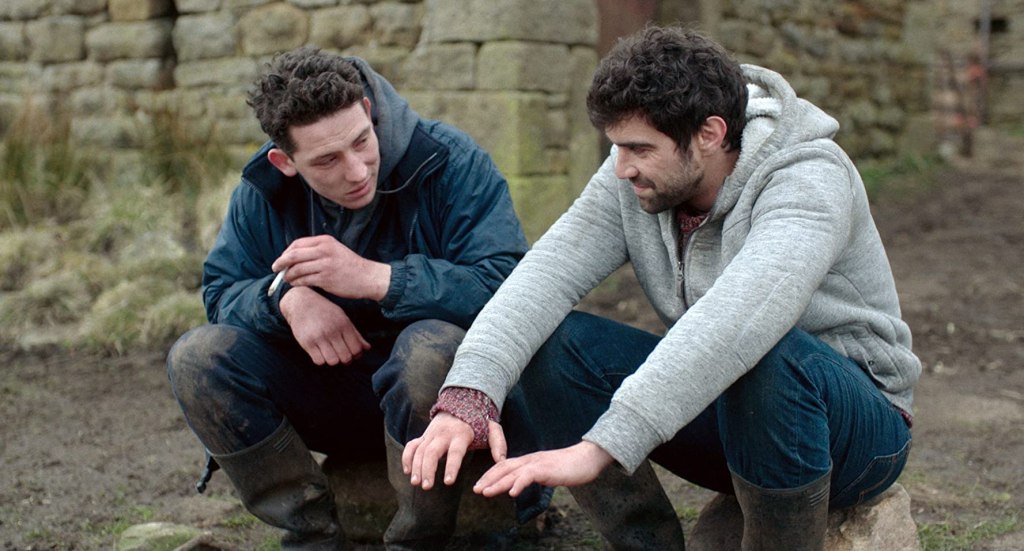
It is spring on the Yorkshire farm where Johnny (Josh O’Connor) works from dawn until dusk. It is perhaps not anyone’s first choice to waste one’s youth doing backbreaking work on an isolated farm, but for Johnny, there’s not much choice at all. The family farm is in disrepair and he’s the only labour, the only other inhabitants being his disabled father Martin (Ian Hart) and his elderly grandmother (Gemma Jones), who shower him with love and gratitude. Just kidding. What would be the movie in that? Johnny toils ceaselessly only to be met with criticism and an ever-growing list of tasks. It’s no wonder he escapes into town at night, to numb his frustration with shots and casual sex. He’ll be wrecked in the morning, and take abuse for it, but there is literally no other joy in his life.

And then lambing season comes. Johnny will spend it camping in whichever remote location the ewes have chosen. They hire Gheorghe (Alec Secareanu), a Romanian migrant worker, to help out, and as we know from Enis Del Mar and Jack Twist, those cold and forbidding nights inevitably end in some hot hot heat. They fall upon each other roughly, their early lovemaking looking a lot like rodeo calf roping, as only sex between cowboys and farmers can. Their initial passion is hungry and desperate but eventually makes way to an intense but intimate relationship.

Writer-director Francis Lee is speaking to us from experience. His story is not about forbidden love or being different, or searching for acceptance. His theme is much more universal: it’s about loneliness. It’s about how love can give meaning to your life if you let it. It’s about the bravery necessary for letting love in even when you feel like a garbage person. I’m paraphrasing of course, but Johnny doesn’t feel ashamed to me, or all that concerned about hiding. Mainly he seems broken and helpless and angry.

The setting is of course thrillingly authentic, painted in graphic, gritty detail. Cinematographer Joshua James Richards does amazing work, allowing Johnny to literally come into the light.

O’Connor and Secareanu give performances filled with achy longing; even as they repair holes in the farm’s fencing, they are dismantling their own barriers. Francis Lee delivers his romance with a dose of reality; we don’t smell roses, we smell manure. But there is beauty in honesty, and underneath the grime and filth is transformative vulnerability.

Despite my initial impression, God’s Own Country is not some poor relation of Brokeback Mountain. It is its son, born of a generation more hopeful and more tender. Jack and Enis would be proud.

Pride, Prejudice & Rainbows

Everywhere, there are rainbows, co-opted to bring hope and cheer to a world self-isolating from a deadly virus. Normally, a rainbow spotted in June meant Pride Month was being celebrated and acknowledged. This June, however, things are more sedate. Pride events have been cancelled, or moved online at best, to be observed virtually, from one’s home computer. Except home isn’t always a safe space for queer folk. Many have been forced back in the closet, or back into the wrong gender’s clothes and pronouns for the duration, not daring to risk being caught on the wrong website, further isolating an already marginalized population. This pandemic has deprived the queer community of the few safe spaces they can comfortably exist in their own skin: queer bars, sexual health spaces, support groups. Worse still, many of these spaces were already teetering on the brink of inadequate funding when COVID forced shut downs. Many will not reopen. In fact, many queer and trans services rely on Pride Month events for essential fundraising, especially since members of the LGBTQ community were already at higher risk for unemployment, food insecurity, and lack of insurance even before the pandemic hit.

Most of all, though, a pride event is about visibility. It’s about celebrating the victories and honouring the sacrifices and acknowledging the gaps. It’s about giving people a sense of community and belonging. There are still countries where homosexuality is illegal, and even punishable by death. But even many “progressive” countries are still getting it wrong; Trump’s Affordable Care Act rule would allow health care to discriminate against LGBTQ people, the Supreme Court is deciding whether employers can fire people just for being queer or trans, the UK’s Women and Equalities Minister has considered revising the Equality Act to keep trans women out of women’s spaces.

If you are cis and straight, do your part to create and maintain safe online spaces for queer people. Reach out to queer friends and ask if they are really okay. And check out some queer stories because yes, representation matters.

A short list of a rare genre: happy LGBTQ movies

  1. Fourth Man Out
  2. Maurice
  3. Imagine Me & You
  4. G.B.F.
  5. Pride
  6. Jongens
  7. Handsome Devil
  8. Kiss Me
  9. Beautiful Thing
  10. To Wong Foo, Thanks For Everything! Julie Numar
  11. Were The World Mine
  12. The Handmaiden
  13. Moonlight
  14. Laurence Anyways
  15. God’s Own Country

The Half Of It

The Half Of It is not the kind of teenage romance we’re used to. Ellie Chu (Leah Lewis) is a small town high school outcast but for the fact that she writes term papers for hire and nearly all of the student body has bought an essay or two from her. She is the most well-rounded teenager you’ll ever meet; she works hard, studies hard, writes eloquently, plays several instruments and composes music, she knows old movies and French philosophers and somehow manages to keep her household running. In service of this last item, she breaks her own rule and accepts a different kind of paid writing assignment – a love letter from shy jock Paul (Daniel Diemer) to the school’s prettiest girl, a pastor’s daughter, Aster (Alexxis Lemire), who is already dating the school’s most popular jerk-off. Normally Ellie would refuse on moral grounds, but the electric company’s put the squeeze on so she accepts, unable to anticipate the complicated web she’s just started spinning.

Basically: Ellie’s letters are a little too convincing. A few are exchanged back and forth, and both parties, Aster and Ellie-as-Paul, are literary junkies and deep thinkers, and there are plenty of sparks on the page. But when Aster agrees to meet Paul in person, he comes off as a bit of a dud. He’s a nice guy, but he’s got nothing but blank stares rather than banter. The chemistry from their letters seems to dissipate in person. But Ellie keeps saving things with witty texts and thoughtful letters, so Aster’s falling for the Paul on the page, who is actually Ellie, while Paul is starting to feel like maybe he likes Ellie rather than Aster, and Ellie is starting to wonder if maybe she likes Aster. Like, like likes Aster.

Which is why I say this isn’t the kind of teen romance we grew up on. It isn’t light hearted fun, or sexy cat and mouse. It’s a rather mature meeting of minds, a slow-burn wooing. And Ellie is a new kind of 21st century protagonist who never needs to take off her glasses and let down her hair to be appreciated. She can be our hero just as she is, in overalls and chapped lips. She doesn’t have to play dumb or be oversexualized.

Sean felt the movie was slow to get going and a bit of a drag but I really felt refreshed by this story line, by the credit writer-director Alice Wu gives to her characters. And by turning the film into a tribute to all kinds of love, including platonic, she brings an emotional complexity to the concept of soulmates is are rarely if ever witnessed in a teen rom-com. The future isn’t just female: it’s queer, it’s intellectual, it’s responsible, it’s proud to be different. And isn’t that inspiring?

A Secret Love

If you’ve ever seen A League of Their Own, then you already know a bit about Terry’s youth. She was a Canadian ball player who went to America to try out for the American Baseball League, an all-female league that played in the 1940s while all the men were at war. She made the roster and played for them all four years, the ladies proving quite adept at baseball and the league gaining surprising popularity, a worthy distraction during difficult times. But when the war was over, so was baseball, at least for women.

Instead of returning home to a farm in rural Saskatchewan, Terry and her cousin, hockey player Pat, bravely decided to move to Chicago together, safety in numbers. Further bucking social norms, both ladies went to work and had careers. Though they each had their share of beaus, they stuck together, building a home in Chicago and to the shock of their families, they lived there contently for decades. But now, in (nearly) present day, Terry and Pat are both elderly ladies, and Terry in particular is suffering declining health. Her beloved niece is begging them to come home to Canada, to move into a nursing home near family where they can be cared for. But after a life of independence, Pat in particular is loathe to give it up. When they are finally persuaded, they decide to move into a retirement home together, and for the first time in their almost 70 years together, to live openly as a lesbian couple.

This film is really an attempt to document their love story, a beautiful story that they kept secret for longer than most of us have been alive. Some family members are shocked, some are not, and some feel an ounce or two of betrayal. But within their own community, Terry and Pat have a robust social life, a second family of their choosing, and it’s very sad to see them leave it. Even sadder is the packing up of their home together, mostly because of the shreds of mementos the packing uncovers, touching love letters saved but also anonymized, the signatures torn off just in case it should be seen by the wrong eyes.

Terry and Pat were rebels. They chose happiness, and they created it together, on their own terms. There’s no doubt you’ll fall in love with them yourself, Terry the sweet one, Pat just a little saltier, but so devoted to and solicitous of her longtime love. Director Chris Bolan offers contextual evidence that reminds us why the lies were necessary, but the joy of finally living their truth is right there on their faces. This is a love story for the ages.

Trixie Mattel: Moving Parts

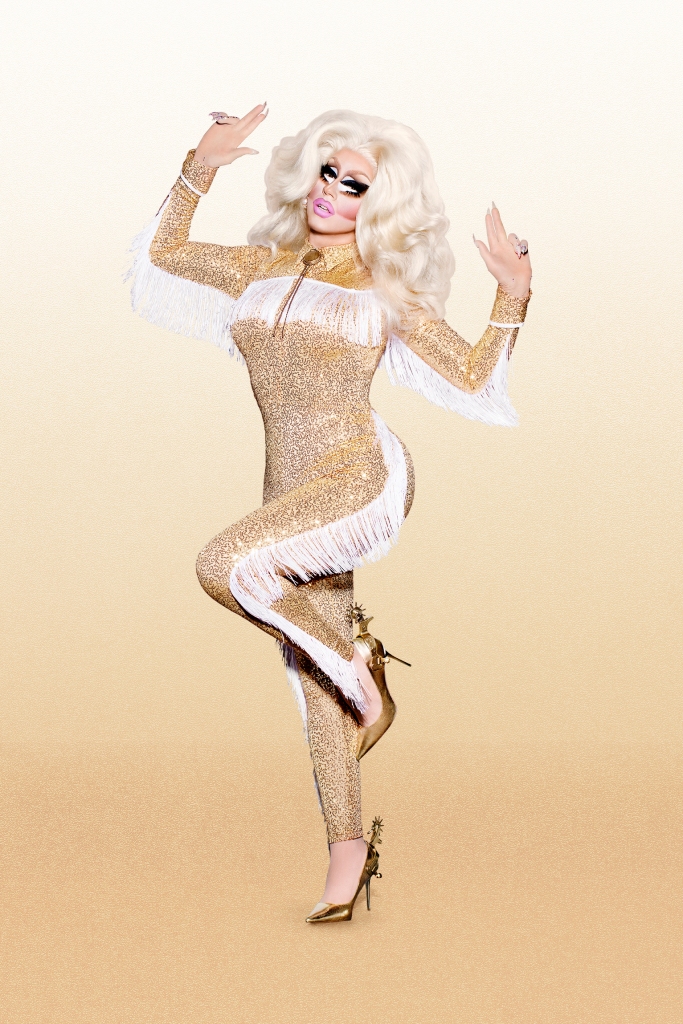
Sean and I are so movie-intensive that we don’t leave a lot of room for TV and we don’t mind that one bit. But we make exceptions for the exceptional, and if nothing else, Rupaul’s Drag Race is just that. Squirrelfriends, if you’re not watching it, I simply cannot fathom why. This is not mere reality television, it is LIFE. Over its many seasons we have had many favourites – and truly, with so many outsized personalities, it’s hard not to fall just a teensy bit in love with them all. That said, Trixie Mattel’s all-star win just about knocked our fishnets off with sheer delight. But with this documentary, Moving Parts does one better: it gives us a glimpse of the man behind the makeup.

Brian Firkus doesn’t get recognized often. Without a wig and heels, you might not guess that this mild-mannered, handsome man is capable of confidently captivating an audience, but in Trixie’s shape-wear and rhinestones, there’s nothing but sass and sparkle. Trixie is clearly the more dominant side of Brian’s personality; even outside of drag, he seems to reach for her persona and distinct speech patterns when he’s uncomfortable. But to give Trixie her own special trademark, he’s made accessible a more vulnerable side, channeling his life experiences into music. On stage, Trixie is vivacious and funny, but when she’s strumming a guitar, or playing an autoharp, she is somehow more than the sum of her (moving) parts. Like any great artist, from David Bowie to Dolly Parton, there’s a certain amount of glitter and pizzazz, but behind the warpaint is someone willing to take risks.

Director Nick Zeig-Owens documents Trixie’s enormous success, but if he catches her at her highest, he also catches her at her lowest. Trixie is a fantasy and a character, not built for disappointment, so it’s Brian who handles the blows. And perhaps the most revelatory nugget from the documentary is that Brian, unlike alter-ego Trixie, seems to be a bit of an introvert. So no matter how many people line up outside the venue just to shake her hand, or how many tiaras she’s crowned with on stage, Brian is at heart a humble guy trying to navigate the same murky waters as everyone else.

Trixie Mattel: Moving Parts is a nifty little peek behind the curtain of one of drag’s most successful performers – but climbing to the top always comes with a cost.

The Garden Left Behind

The Garden Left Behind is about a woman and her grandmother, both undocumented immigrants, living together in New York City. Abuela Eliana (Miriam Cruz) dreams of returning to her beloved Mexico while Tina (Carlie Guevara) dreams of the day she can complete her transition. Without papers, money is scarce and medical insurance unheard of, so it’s been a long path for Tina. But she has a second family in the trans community, and a strong circle of fiercely protective women surrounding her, so you want to believe she’ll be all right.

Director Flavio Alves situates Tina in a city filled with love and support, but also hatred and violence. Even the slightest decisions she makes may threaten her personal safety, not to mention her mental health. Meanwhile, her gender identity must be performed for an elderly doctor (Ed Asner) who ultimately gets to decide whether or not she’ll get to be a candidate for transition. Not that his pronouncement either way would save her from judgment or brutality if it came to that. Which is why Tina takes to the streets in protest for a friend beaten by police. Her status makes activism risky, but her very existence is a risk in a world where cruelty is an answer to otherness.

As much as I admired the greater context offered by Alves, it was the grandmother-granddaughter relationship at the heart of the story I responded to most. Abuelita does not understand, but she learns she doesn’t need to. She learns that her love is enough. It’s also relatively rare in this kind of story, so it’s as remarkable and inspirational as it is welcome.

The cast, made up of actual trans people, is refreshingly authentic, and I believe this casting is what really sells the story. What also really works is that Tina is at peace with herself. The world may have problems with her, but the conflict is never internalized. She knows who she is, and while perhaps feeling resentful at having to demonstrate it, she never wavers. But the outside world brings more than enough conflict to make up the difference.

Carlie Guevara, like Tina, is a young trans woman of colour. She is a target for hate but also a symbol of hope; she, and others like her, persist. Guevara is luminous and magnetic. But what makes this movie feel really truthful on top of watchable is that it’s not just hardship and struggle. It rises above the bleakness to deliver pure authenticity.

Knives And Skin

Carolyn Harper makes out with a football player but when she pushes away his roaming hands, he leaves her alone in the woods and she’s never seen alive again. Her disappearance disrupts her high school and the entire community, as the disappearances of beautiful young white women often do.

In the aftermath of her disappearance, we watch things unravel for her friends, her fellow bandmates and classmates, her mother, and the well-intentioned but inexperienced local sheriff. More than that, though, we experience the way that grief accelerates the coming of age for a group of teenagers, which makes it rather obvious that their parents’ haven’t exactly completed the growing up process either.

Writer-director Jennifer Reeder creates a very atmospheric teen noir that pulls from a lot of sources but manages to be its very own thing. The closest thing I can compare it to is Twin Peaks for its eerie tone but believe me when I say Knives And Skin is its own gothic soup – a horror broth steeped with many surprising flavours. Reeder brings in familiar tropes and mixes them with haunting song and feminist references and the result is hard to categorize but fascinating to watch, even if it is uneven, a little long, and prone to meandering. If it occasionally feels a little piecey, it also feels dreamy, surreal. The story is less concerned about finding Carolyn than it is about exploring the various ways people feel trapped, and subtle reminders that escape is possible. Although it starts off with a dead girl in the woods, it subverts the expectations of that genre over and over with its confident female leads and the weaponization of sex. It’s like a parody, but self-aware and dead serious.

Reeder may value style over narrative, but Knives And Skin interesting, beautiful, and unforgettable.


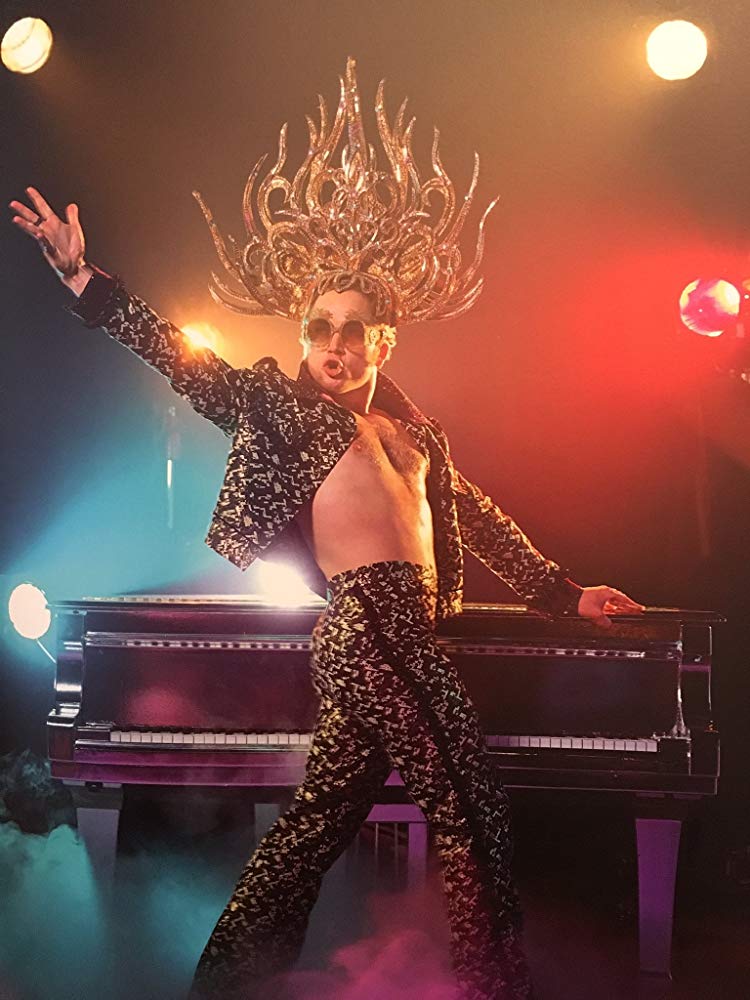
Rocketman

Elton John has had a life full enough to fill many biopics, but Rocketman shines its spotlight on his most troubled years, as he shot to success and earned the world’s respect and adoration but struggled to know and love himself.

Little Reggie Dwight was a brilliant but shy piano player. His parents were by times abusive and neglectful in their own unique ways, and he retreated into the safe space created by music. As a young man, the self-styled Elton (Taron Egerton) could compose music easily but the lyrics came hard. So his meeting Bernie Taupin (Jamie Bell) was a special gift from the universe – together, they wrote pop songs that would change and infect the world with catchy, raucous tunes.

Elton developed an on-stage persona that was larger than life: in costume he could be brave, and better still, he could be merry. He could play for thousands despite being torn up inside by grief and self-doubt. He was tormented by the possibility that he would never truly be loved – this, even as he continued to seek the approval from parents who could never give it to him, and affection from a man who would use and abuse him.

Rocketman chronicles both the highs and lows of Elton’s life, whether plumbing the depths of his despair in group therapy or lifting an entire audience off its feet – this latter shown quite literally through the magic of cinema. These fantastical elements really elevate the material beyond the standard biopic and help establish a sense of the unreal. In other parts, the film’s a little draggy, and though his unhappiness is obviously a recurrent theme in his life, I wish it was a little less returned to in the film.

The monstrously successful, deeply conflicted, young, gay addict Elton is brought to life on the big screen by Taron Egerton, doing all his own singing, dancing, wallowing, and dazzling. He may not be his physical twin, but he embodies his spirit and he nails his tight-lipped grin. He manages both the bravura and the pathos, and nails them both.

Director Dexter Fletcher’s Rocketman is a bedazzled piece of inventiveness and daring. The movie truly thrills when he embraces his creative vision, translating the highest of emotions into visual delights that pair amazingly well with songs we still want to sing along to. While it’s by no means an exhaustive list of his hits, the movie folds them into itself with purpose and delight. It’s easy to get swept along by this engaging, vulnerable, triumphant story.

Valentine Road

Larry King (not that Larry King) had a pretty rough life. His adoptive parents had 22 complaints about abuse against them. Larry wore jackets at school to hide the bruises. But no one came to save him. When he was finally removed from the home, it was because he had “stolen” food from his adoptive parents’ refrigerator. How hungry was Larry? How sore? He went to a shelter for abused and neglected children where he struggled to identify his orientation. Small for his age, biracial, he experimented with makeup, crocheted scarves, and wore heeled boots to school. Everyone knew him as the gay kid, though he was possibly more accurately transgender, and it didn’t sit well with everyone.

On February 12, 2008, Larry King was shot and killed by a fellow 8th grade classmate – the classmate he’d chosen as his Valentine. A classmate who was so provoked by Larry’s sexuality that he brought a gun to school and shot him in the head, a hate crime that “shocked the nation” (except not really, as Americans have decided that adopting school shootings into their culture is just easier).

The documentary interviews not just students who discriminated against Larry, but teachers as well – one who is religious piece of shit and believes that Larry’s “actions” had “consequences” and a special ed teacher obsessed with weapons. The one teacher who supported him was summarily fired, and now works as a barista. The school has done nothing for grieving students and is tried its best to bury the execution that took place on school grounds.

Yeah, this shit is really difficult to watch. There are too many failures, too many shitty grownups doing nothing. Not just excusing homophobia, but espousing it. It made me sick. But this documentary does something unexpected. It has two victims, not one.

The boy who shot Larry was a white supremacist. But he was also occasionally homeless, with an abusive father and a drug-addicted mother. At the time of the shooting, he was living with his grandfather, who had a lot of weapons lying around. Is he just as much a victim as Larry?

The documentary looks behind the headlines but how much compassion can we really afford to expend here? This shit is unbelievable, and I think we all need to confront what goes on in it, because this film from 2013 was a better predictor of the 2016 election than any of the polls.

This movie made me mad, as it should. It upset me, as it should. It shocked me, as it should. But stories like these continue to fail to galvanize the dirty half of America who breed hatred and value guns over human life.