
High school funding for sports, and girls’ sports in particular, is on the decline, but fundraising isn’t the only issue for the members of the Salmon River High team. As the first all-Native girls lacrosse team in their section, they’ve got something to prove, and 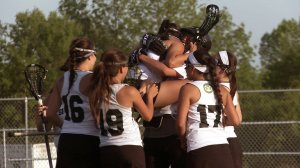 not just to their rivals, but to their own community as well. Lacrosse was born on their land, the Akwesasne Mohawk Territory, but it’s a game traditionally reserved for men. Considered a gift from their Creator, lacrosse was meant as a way for men to settle disputes among tribes. The community is split as to whether women should be allowed to play this sacred game at all. Some believe that like all surviving culture, theirs too must grow and change to meet the needs of the people. Others cling to tradition. But all agree that this game is medicinal and can be used for healing. When the girls play, they take it seriously; they too want to honour their culture. Is it really such an abomination to take up their Nation’s sport?
Lacrosse is Canada’s national sport (or its summer sport, hockey being our winter one), and it so happens that I grew up on the Canadian side of the Akwesasne Mohawk Territory. The fact that none of this was unfamiliar to me didn’t make the documentary any less watchable – that’s a real credit to the movie. I have a deep respect for Aboriginal people, for their values, culture and beliefs, but there’s still a big part of me that struggles to see any woman being shut out of, well, anything in 2017. So I’m going to remind myself of some pretty important cultural context: the 2012 Olympic Games in London were the first games in which every participating country included female athletes, and in which women were able to compete in all sports. The very first Olympics were of course men only, and when women did start competing last century, it was only in golf and tennis. Women didn’t curl or play hockey in the Olympics until 1998. Weightlifting, pentathlon, taekwondo, and triathlon weren’t added until 2000. Also new to women in sports this century: bobsled, wrestling, and BMX. And finally in 2012, boxing and ski jumping were added to make women competitive in every sport. Isn’t that crazy? Of course, just because those sports are now included doesn’t mean you’ll get to see them played. NBC still spends more time covering men’s sports than women’s, particularly in winter (women fare a little better in the summer because American women win more medals than their male counterparts – BUT EVEN THEN IT’S STILL NOT EQUAL). TV time for women’s sports are still mostly dedicated to thinks like gymnastics and figure skating rather than say, judo or shotput. Women’s beach volleyball seems to get quite a bit of coverage, but I’m not sure that’s about pride in athleticism so much as the REGULATION uniform of bikinis. Yes, American women do quite well in beach volleyball. In 2008 both the men’s and women’s teams medaled but more coverage went to the women’s teams. The women’s indoor team also medaled that year but it wasn’t covered at all. So before we get on our high horses about a culturally-held belief, we need to remember that the sports most associated with women today – figure skating, swimming, gymnastics, beach volleyball – are all sports in which women are non-aggressive and scantily clad.
Back to the movie. Director Judd Ehrlich does an excellent job of sitting back and letting the girls speak for themselves. It’s clear from footage that there is no lack of skill or athleticism, but the girls are also thoughtful and expressive. Ehrlich frames the documentary as one season’s push to defeat a rival team, win a championship, and change hearts and minds along the way, but this documentary, part of the programming at the Canadian Sports Film Festival, is also an exploration of culture and identity. School sports do not exist in a vacuum. The girls attend a public school where the curriculum is very light on, and sometimes misleading about Native culture. They are taunted with racial slurs. They play competitors that have racist mascots. The film is much more than the game. And thanks to nimble editing and savvy camerawork, it’s a thrill to watch, too.
 injustice, and people’s pain, and she decided to do something about it. She was threatened and abused because she was exposing some very dirty secrets covered up by some very powerful people. The only help she ever got was from the adoptees themselves, all of them different shades of broken, harbouring the wounded children within. The real Margaret was awarded the Medal of the Order of Australia in 1993, and Commander of the British Empire in 2011 for her work, but as this film can attest, life was not made easy for her.
 Night Moves isn’t so much about the environment as it is a character study between these three individuals trying to make a statement, and then living with the consequences. It’s slow, almost plodding. There’s no flashiness, just a creeping sense of guilt and paranoia.
 Shortly after we are introduced to Master of Fine Arts candidate Noelle (Francesca Eastwood), she is raped by a classmate. When she confronts him the next day, he denies doing anything wrong and winds up dead in a mostly-accidental way. Somewhere during the events that caused Noelle to be a victim of sexual assault and a murder suspect, she snaps. Formerly introverted and a loner, Noelle starts going to frat parties in order to seduce and murder other rapists who, due to a faulty system, got away with their crimes.
 Once in a while I wish I had a more literary mind. When I write, it’s pretty direct and while I used to attempt subtext I’ve pretty much given up on it at this point – too much effort for too little payoff. But that’s for my writing, where no marks are given for artistry. All that matters is the end result.
 trial aren’t wrong, they’re explored with new understanding, through a lens of his being a black man, sort of, but not really.
 the LAPD be acquitted in he Rodney King beating. Here was a chance to right that wrong and make the system work for a black man for once. Everyone conveniently forgot that OJ had spent his entire adult life distancing himself from the black community and they made him a civil rights hero. His lawyer, Johnnie Cochran, played the race card and he played it hard “dealt it from the bottom of the deck” it’s said. And he got off. But instead of relishing his incredible good luck, OJ’s life continued to derail until he found himself in court once again, this time found guilty and sentenced to some 33 years in prison, whether or not his crimes truly warranted it. This, again, was retaliation rather than justice.
 multiethnic descent. Before I watched this documentary, I didn’t understand that these matches tend to be found within one’s own race, and how limiting that can be for all kinds of people. Multi-ethnic backgrounds are the fastest-growing demographic, but the waiting lists aren’t keeping up, leaving multi-racial patients struggling to surmount complex genetics on top of everything else. It’s already tragically unlucky to be struck by a stupid disease, but to fail to find a match because you’re losing at a numbers game? That’s just unacceptable.

 ASSHOLES WATCHING MOVIES