Tag Archives: social issues

Imitation of Life

Two single mothers combine their households to help support each other through difficult times – one, an aspiring actress with a cute blonde daughter, the other a homeless black woman willing to work for her keep, and that of her-light-skinned daughter.

There are two important mother-daughter relationships at play here, but the way those relationships intersect is also pretty astonishing for a movie made in 1959. As Lana Turner as Lora Meredith begins her ascent to fame, Annie (Juanita Moore) becomes relegated to loyal employee. It’s obvious to all the two are friends, and that Miss Meredith depends fiercely on imitation-of-life-18Annie, but this can never be a relationship between equals. The two little girls, raised under the same roof as playmates and friends, are on more even footing, but though young Sarah Jane can pass as white, she isn’t. Point blank. And in 1959, that’s quite an obstacle.

Annie is a maternal presence to both young girls, running the household and being available for physical affection whereas Miss Meredith is more keen on being the provider. She’s not exactly cold, but she is focused on her career and willing to send her daughter away to school for her own convenience. Together these two women manage to fill out each other’s strengths and weaknesses but there’s one sticking point that neither can hope to change. Sarah Jane prefers imagesto deny her mother, her roots, and her own race. Since she can pass as white, she plans to, and does everything she can to reject her mother and keep her secret safe.
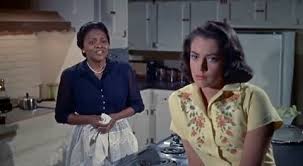
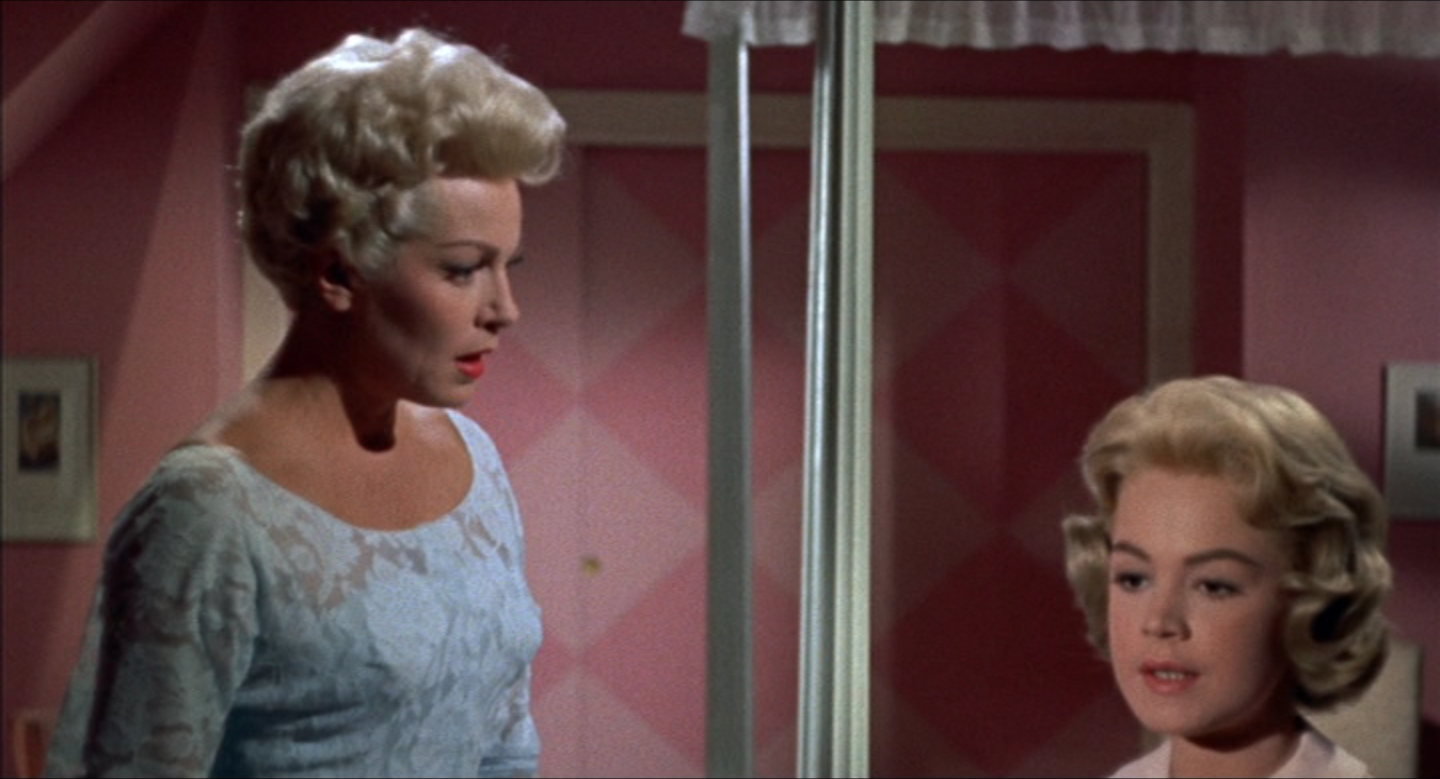
Meanwhile, the biggest problem that Lora and daughter Susie (Sandra Dee) eventually face is having fallen in love with the same man. It feels like director Douglas Sirk is actually daring to draw attention away from Lana Turner by giving more screen time, and juicier plot lines, to the film’s two black characters (Susan Kohner, as Sarah-Jane, is actually of Mexican-Jewish descent). The audience never experiences Sarah-Jane’s identity crisis from her own point of view but rather we’re forced to interpret it through a 1950s lens. We do feel it personally, though, through a mother’s heart ache. This earned both Moore and Kohner Academy Award nominations for best actress that year, though of course neither won.

This movie requires some analysis, and there’s a level of hypocrisy that must be navigated. picture-81Actually, I think Sirk was a bit of a cynic because there’s a hopelessness to this movie that really got to me.  He presents us with racial tensions and materialistic values that both pale in comparison to the underlying vibe that families are being torn apart, their bonds degenerating even in the time it takes to make a film. Lana Turner’s real-life 14 year old daughter Cheryl had just fatally stabbed Turner’s boyfriend (she was let off, justifiable homicide they called it, since the boyfriend was beating her mom up at the time). Nevertheless, this caused a serious rift between mother and daughter, and threatened Turner’s career until Sirk convinced her to channel her pain into a movie about the struggle between mothers and daughters. And here we are.
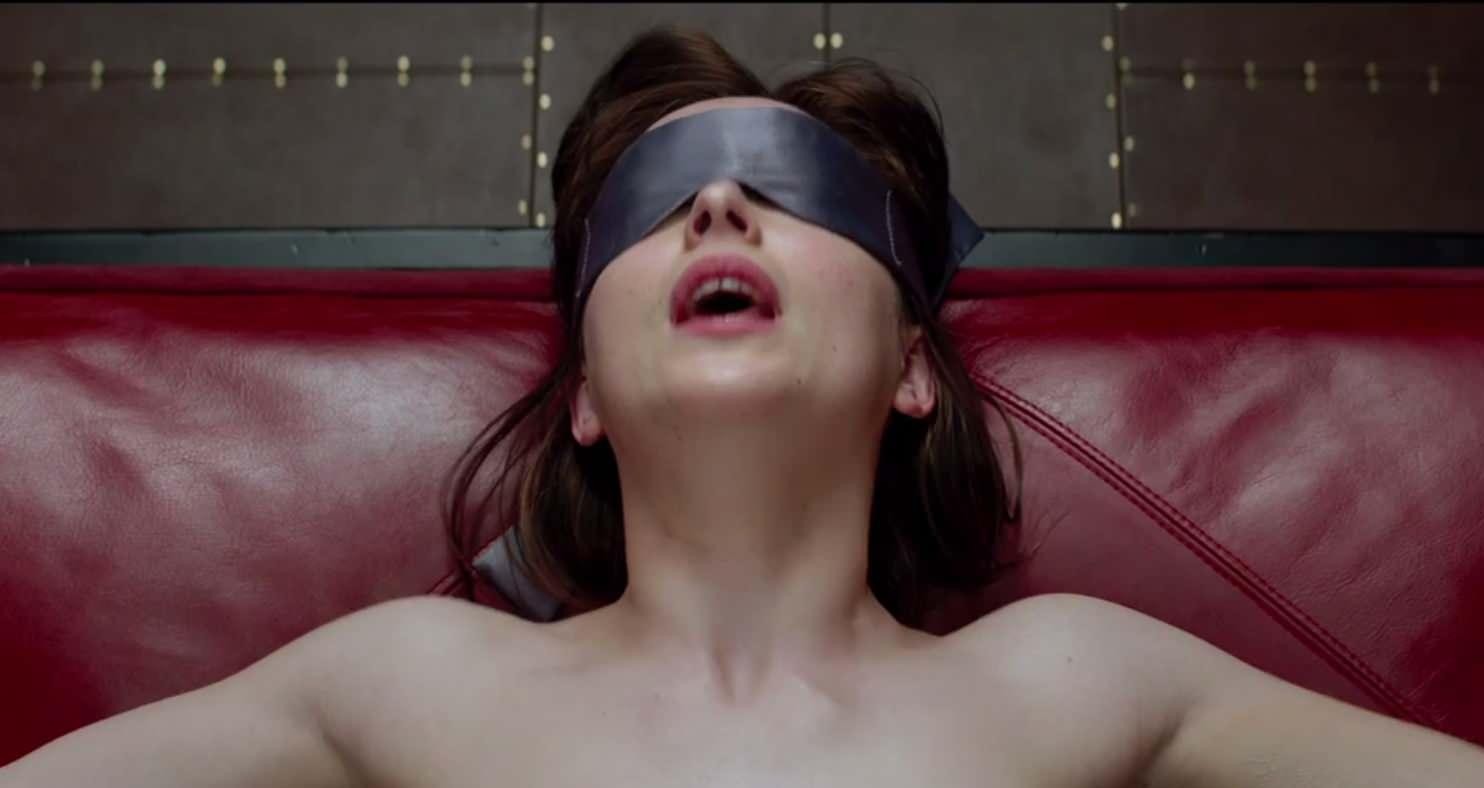
50 Shades of #BlueAboutGrey

Fifty Shades of Grey is a sad testament to the dumbing down of America. The source material was written by a middle-aged woman who read books meant for teenage girls about twinkly vampires. The boy vampire was such an under-aged thrill to her, she started writing erotic fan fiction about him, and other bored housewives were so titillated by her stories that for copyright reasons she changed the Edwards to Christians and before you know it, one underachieving trilogy had spawned another.

It’s garbage. It was embarrassing enough when grown adults read books found in the youth 50shadessection, but now we’ve got women lining up to glorify an abusive relationship. Because the thing about the sex in 50 Shades of Grey is that it’s not really consensual. She’s a very young girl, and a meek one at that. He’s older than her, and a very powerful man. She’s intimidated, and he’s manipulative. He makes her sign a contract that he of all people knows is meaningless. Meanwhile, he stalks her, plies her with alcohol, and even though she’s constantly expressing doubt and stress, he violates her boundaries to get what he wants.

This is not my opinion, by the way. This is based on scientific research that’s been done in the wake and the fall-out from these books. But even real-life practitioners of BDSM don’t like the book because they feel it depicts an abusive relationship too, and colours their lifestyle negatively. S&M may have a healthy place in some people’s bedrooms, but they insist that this series confuses BDSM with abuse, and uses dangerous techniques. Researchers meanwhile, are concerned about the prevalence of intimate partner violence (IPV) in the books and movie. The study finds that almost every interaction between the two leads is emotionally abusive in 518649740-Domestic-Abuse-Protest-at-London-Premiere-of-Fiftynature, including isolation, sexual violence, and the circumvention of consent. Meanwhile, Ana, the young woman in question, exhibits classic symptoms of an abused woman – the constant perceived threats, the stress, the altered identity. There is no equality in this relationship. We’re talking about a controlling narcissist and a vulnerable, insecure woman. This is the breeding ground of the worst domestic abuse.

Why are real-life women paying to romanticize sexual violence and the emotional abuse of women? Not only is this not a love story, it’s not even “kinky” sex. It’s a bad situation, and if this was your sister or your friend, you would want to get her the fuck out. And the movie? Even worse.

When Christian whales on Ana with a belt until she cries big fat tears of pain and humiliation, finally forcing her to angrily ban such a practise ever again, that’s not romance. RED FLASHING LIGHT: that’s not romance! That’s coercive sex. It’s rapey. It is NOT a date movie and mistaking it for something naughty and fun is dangerous to your own sexual health.

50shadesgreyPeople rushed to theatres on Valentine’s day to see this and were so turned off that the movie suffered the second biggest week-to-week drop ever (only Gigli did worse). But the damage is done. Opening box office was huge. The books have sold in the millions. And the poor theatres screening the movie have had to put up with some really disturbing viewers:

– One woman in Mexico slapped on her own handcuffs and proceeded to masturbate.

– Two women in Scotland got so rowdy and drunk they barfed in the aisles and when they were shushed, they stabbed the shusher with a broken wine bottle.

– In England, a woman was so into the movie she lost control of every last bodily function. Probably made the stabbed dude in Scotland be glad all those women did was puke.

– Foot fetishists in the UK used their own socks to blindfold themselves during the movie. The moans were very disruptive but it was the bad foot odour that lead to the most complaints to management.

These are (I hope) extreme reactions to the movie. But I can’t figure out for the life of me why the reaction is not one of disbelief and disgust. There is nothing sexy to see here (and I don’t just mean the lack of passion reported by people who actually saw it). This isn’t sex. We need to label it correctly and we need to be more responsible about what we as a society consume.

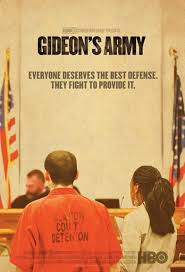
Gideon’s Army

I set out to review Gideon’s Army last night with a quick comment on the best documentary Oscar race. My quick comment became a long comment as I got a little carried away thinking about what makes a documentary great. Should we hold theGideon's Army 1m to the same standards as we would fiction in terms of style or is it enough to just tell the truth about an important subject?

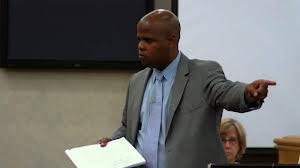
Gideon’s Army is a fantastic documentary no matter how you look at it. Screened mostly at film festivals in 2013 but now available on Netflix, it follows three young and hopelessly overextended public defenders working in poor areas in the southern US. Anyone who’s ever watched Law & Order knows the Miranda rights, probably by heart. “You have the right to an attorney. If you cannot afford an attorney, one will be appointed.” Everyone has a right to legal representation, even if your lawyer is taking on up to 180 clients at a time as Brandy Alexander (not even thirty years old yet) has to. A statistic at the beginning of the film states that there are 15, 000 public defenders working in the US right now and together they represent millions of defendants each year.

Gideon's army 2

Gideon’s Army gets the statistics out of the way quick and then puts all its focus on people. The three lawyers that we get to know in the film have to defend both people that they firmly believe to be innocent and people that they know to be guilty and proud to be guilty of unspeakable crimes. They lose sleep over the cases that they are terrified to lose and the lives they are afraid of ruining. In Brandy’s case, she had to represent at least on person who threatened to kill her. The work is so stressful that they have a support group.

One lawyer described being regularly asked “How can you defend those people?”. This is not a popular subject for a doc. Lawyers don’t get much sympathy, especially criminal lawyers, and Gideon's army 3neither do defendants. The film makes a strong case that the system that claims “Innocent until proven guilty” is really stacked heavily against the accused, especially if the they don’t have money. The system puts tremendous pressure to take a plea bargain, not being able to afford to stay in prison while their house and job slip away as they await trial.

Gideon’s Army potrays those that do their best to keep burnout and pennilessness at bay to defend those that can’t afford to pay them as heroes. Director Dawn Porter’s admiration is understandable. As a social worker, I can cheer for anyone who will take the time to listen to and stand up for those that the rest of the world has seemed to have given up on. I highly recommend you check out this movie.

Gender Inequality in Film

Yes, there are movies made with a female in the lead. But has Oscar ever heard of them?

This year’s Best Picture nominees are as follows: a story about a man who goes to war and loves it; a man on Broadway as actor\director\schizophrenic; a little boy growing up to be a man; a man running a crazy hotel; a brilliant gay man; a brilliant black man; a brilliant man with a degenerative disease; a devoted male student and his sadistic male teacher.

So, a big time sausage fest. These are the stories of men. Felicity Jones, Emma Stone, and Keira Knightly are all nominated for their roles as pretty accessories. None are real players in their films; they are passive actors in someone else’s story. Julianne Moore in Still Alice, Reese Witherspoon in Wild, and Marion Cotillard in Two Days, One Night are all the driving forces in movies told from their (female) points of view, and none of those movies earned best picture nods.

2014’s highest grossing movies include:

1. Transfomers: Age of Extinction

2. The Hobbit: The Battle of the Five ARmies

3. Guardians of the Galaxy

4. Maleficent

5. X-Men: Days of Future Past

6. The Hunger Games: Mockingjay, part 1

7. Captain America: The Winter Soldier

8. The Amazing Spider-Man 2

9. Dawn of the Planet of the Apes

10. Interstellar

Women fare a little better here – females take the lead in 2 of the 10, which, in case your math is  weak, is exactly 20% of the top-earners and 0% of the most lauded. And women, in case you haven’t looked around in a while, make up a good 50% of the population. Does that make any sense to you? Only 12% of protagonists were female in 2014 movies, which is down 3% from the previous year. THAT’S THE WRONG WAY, PEOPLE!

a0e86469192b5ac4b68c392aa7ee39b1Yes – you’re reading that right. Only 9% of directors are female. Only 4 women have ever been nominated as Best Director, and of them only Kathryn Bigelow has won (for The Hurt Locker – a movie with basically no women in it). It would seem that to be taken seriously, a woman has to direct a masculine film; Angelina Jolie made war movie Unbroken this year, and Ava DuVernay tackled the most iconic man in American history with Selma. Both were locked out of the Best Director category but Selma scored 2 men nominations for Best Song while Unbroken garnered 3 nominations spread among 5 men and 1 lone woman (Becky Sullivan, for sound editing – we salute you!).

In 73 years of Academy history, only 8 women have won best adapted screenplay, and only 8 have won best original screenplay. In 85 years, only 7 women have taken home Best Picture Oscars as producers, and all of them were co-producers with men.

77% of Academy voters are male. Another big surprise: the average winner in a female acting category is 36 years old compared to 44 for men.

The top 10 highest-paid actresses made $181 million in 2013 while the men made more than twice that – $465M!

The worst part is that the stats are worse when it comes to movies made for kids – in top-grossing G-rated family films, there is almost a 3:1 ratio of male characters to female characters. And how many of those are industrious go-getters? What are we telling our daughters, or for that matter, our sons? And what does it say about us as a society that animated female characters tend to show more skin than male ones – even the little girls – and are portrayed with tiny little waists and sexy features. Even the non-human females are sexualized in children’s cartoons!

In G-rated family films, speaking parts are 70% male. Characters with jobs are 80% male.

In 2012, Pixar released Brave, its first movie (out of 13) with a female protagonist. While Merida provides a positive female role model to its young audience, behind the scenes things were a little less progressive. Brenda Chapman, who spent 6 years working on the film, was stripped of her directorial duties and for the 13th time in a row, a Pixar movie was helmed by a man.

Check out the Geena Davis Institute on Gender in Media to find out more.


Belle

First off, thank you to all my fellow film-lovers who brought this movie to my attention. It seems to have slipped under the radar over here but I’m infinitely glad I had the chance to watch it.

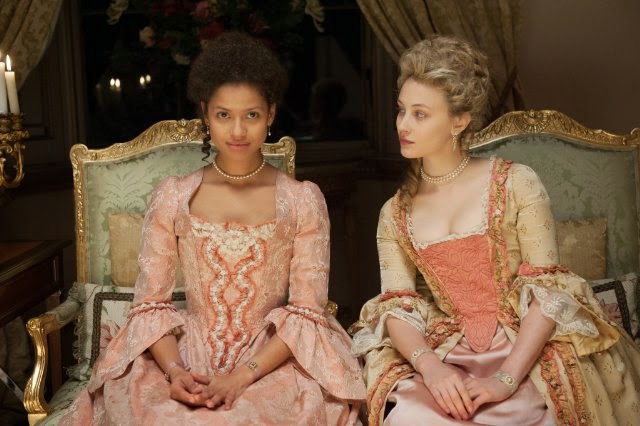
Belle recounts the true story (in broad strokes – little is known of her life) of Dido Elizabeth Belle, the half-black, bastard child of a Royal Navy Captain in 18th century (slave-trading) England. Her gugubellefather loves her deeply (as he did her deceased mother) and when he ships out to India, he appeals to his uncle to care for her in his absence. A Lord and Chief Justice, the uncle tries to raise her, along with another (white) niece, with the privileges she is due while teaching her the important barriers of her skin colour. “Too high in rank to dine with the servants, too low in rank” to dine with her family. She has enough to feel a sense of belonging, and just enough to feel left out. At court, her uncle must decide an important case about slaves as he resists acknowledging their similarity to his beloved niece.

I just watched Gugu Mbatha-Raw in Beyond The Lights and thought she was a stand-out, but this film makes clear that her career will be one to be reckoned with. She’s very subtle and belledeliberate and saves Belle from being merely a curiosity. Instead she is painted as a woman conflicted, a woman carrying the weight of her race for everyone to see. And this movie is also about class, and (perhaps even foremost) about gender. It would seem that her skin colour can be compensated for with enough money, but her gender leaves her with few options. She must either find a good husband or be invisible like her aunt (Penelope Wilton, tragic and invisible). In the film, Belle’s uncle (Tom Wilkinson, formidable) is challenged to draw a parallel between his niece (who is constantly referred to by the ugly word “mulatto”), and slaves insured as human cargo. Are they not worth the same? Is Belle Movieshe not worth the same as any other debutante? The film asks the same question of us but poses it too lightly. I can only imagine the controversy her presence in the family home must have caused, and yet I must imagine it because the script glosses right over the indecencies that certainly occurred. The story focuses on romance, or lack thereof, as befits their station and the time, and covers social implications inadequately. Belle lacks the self-starting spark that would make her the pioneer the script so badly wants her to be.

The script has been controversially attributed to Misan Sagay, despite director Amma Asante

The artwork that inspired the movie

The artwork that inspired the movie

having written 18 drafts over 3 long years. Sagay is an American member of the writer’s guild and took it to her union, which decided in her favour against non-member Asante (who is based in Great Britain). Wilkinson and Wilton have expressed ‘incredulity’ at the decision, because they had “only seen and worked from a script written by Amma”, With or without accreditation, this is an imperfect but impressive first full-length feature and Asante is sure to give voice to more great stories over time.

Love Is Strange

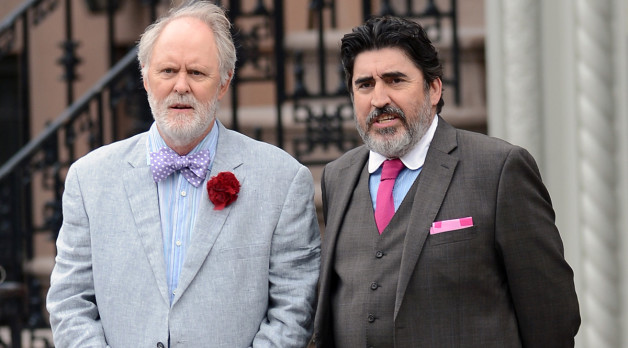
Film Set - 'Love Is Strange'Ben & George have been together forever but are newly married. Their wedding is small and joyous, and also the catalyst for George’s dismissal from the catholic school where he teaches music. They can’t afford their home on Ben’s pension alone, and the two suddenly find themselves homeless. Friends and family scramble to take them in but this being New York City, where no apartment is bigger than a breadbox, Ben and George are separated. This is a love story that shows us how patient and enduring love must be. With no prospects in sight, people who were happy to toast them at their wedding are less happy to share their homes. There’s chafing on both ends (Ben clashes with his nephew’s wife, played by Marisa Tomei, when they’re both trying to work from a cramped home every day). They feel displaced and disoriented; their hosts feel increasingly put-upon. It’s sad and sweet and melodic – the soundtrack is divinely full of Chopin.

Director Ira Sachs is slow and meandering. It’s painful to watch the tenderness and the intimacy lithgowloveisdecline into homelessness and despondency. Just when they’ve vowed to share their lives with each other, they can no long afford to share so much as a bed. This is a pretty bittersweet movie, more universal than you may think. The husbands grapple with their emotional health, and aging, and navigating the strange and complicated NY housing market, which is what finally made me realize how mis-titled this movie is. Their love is a lot of things, but it is never strange.

Obvious Child

I hated the first 3 minutes of this film, and then loved the next 81.

Donna (Jenny Slate) is a confessional comic; she spills the dirty details of her life to a small obviouschild__jennyslateaudience in the back room of a dingy place. Not everyone in her life can handle being the subject of her standup, and the truth is, I could barely tolerate it myself. It was the usual stuff: I have a vagina, I’m Jewish, etc etc. But. But when she leaves the stage, she’s enormously funny. You get the sense that her stand-up will in fact take off one day, maybe even one day soon.

But not today.  Because today she’s been “dumped up with” and she’s drinking and she’s oversharing, which is the only kind of sharing she knows how to do. With a microphone and a whine. And like, 17 shots. Cut to: drunken one-night stand, which leads to pregnancy, which leads to an abortion.

obviouschildBut a funny abortion! Okay, it’s not so funny. It’s actually dealt with pretty realistically, but with the kind of wit and truth that bathes the subject in a new light. Refreshingly unapologetic. And oddly becomes something of a romantic comedy, because who doesn’t take a date to the abortion clinic on Valentine’s Day? And P.S. – if you do, do you bring flowers?

I really like Slate on the Kroll Show, and director Gillian Robespierre knew she had the chops to handle a title role. Donna is a sometimes exasperating character but Slate pulls it off and is magnetic in every scene, whether petulant, snarky, or earnest.

I jotted down so many brilliant lines, all worth quoting, but I’m refraining for your sake, so that you may enjoy them from the right voice. But there are also fart jokes, which have no business even existing. So this is not a perfect film, but I was really won over by it. I’ll take the lows with the highs. I was charmed by Obvious Child, even if there was very little obvious about it. And I expect big and bigger things from both Robespierre and Slate in the future.


The Good Lie

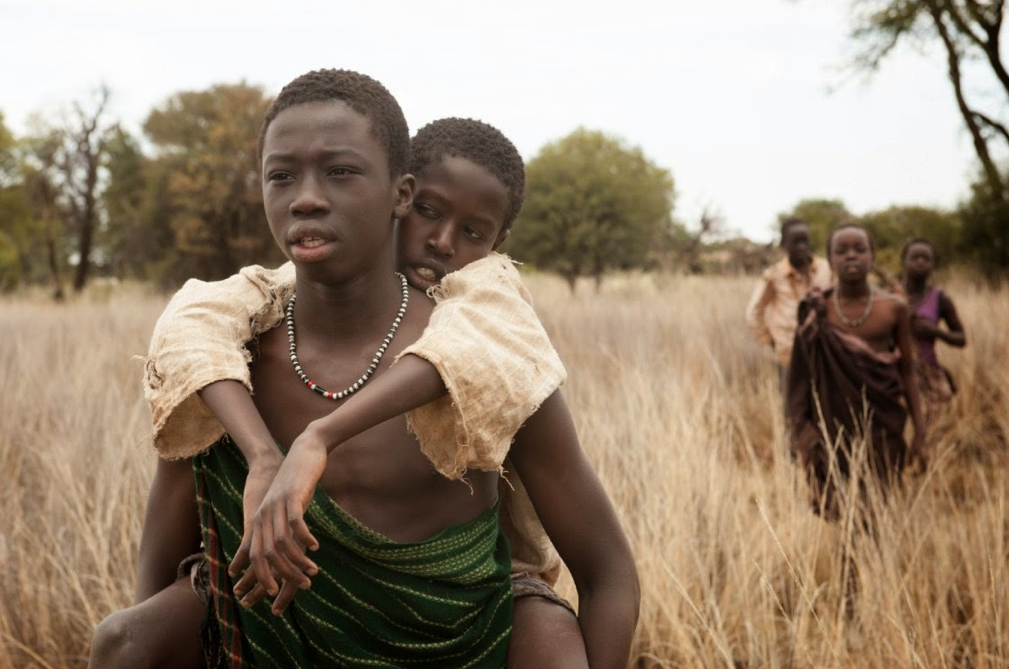
I have read and watched as much as I could about the Lost Boys – their story, though beginning in such tragedy, usually ends in quiet triumph but you never stop marvelling at it. One of my favourite books about the subject is called What Is The What by Dave Eggers, but if you’re more of a watcher than a reader, I think The Good Lie is faithfully rendered (by Canadian director Philippe Falardeau) and really quite moving.

It follows 5 of the Lost Boys (one actually a girl) who watched their parents, their village, and The-Good-Lie-3millions of their fellow Sudanese be slaughtered (though the movie goes a little “light” on these atrocities). Displaced from their homes, these orphaned children walked for hundreds of miles to reach a refugee camp where they grew up in temporary shelters wearing Americans’ cast-offs. After 13 years in camp, this group, now in their early 20s, are fortunate enough to land on one of the last flights to American (these flights dried up after 9\11).

Once in Kansas City, you can imagine that there is culture shock and a certain amount of homesickness. Reese Witherspoon eventually appears to help them find employment (a condition of their refugee status). Although technically billed a Reese movie to appeal to Western audiences, she’s in a supporting role. She is not there as a white saviour, but as a witness and sometime facilitator who can’t  save them, but can certainly root for them as they save themselves. The actors portraying the Lost Boys are actual Sudanese refugees and what they lack in experience they make up for in earnestness.

the-good-lie-toronto-film-festivalThis movie seems like one you ‘should’ see but it’s not a chore, it’s actually a really uplifting and heart-rending trip to Africa that  you can make from the comfort of your own couch with a surprising amount of light-heartedness about it (ie, Matt kept shooting me weird, judgy looks every time I giggled). It’s actually one you’ll want to see and be glad you did.

Selma

I know who Martin Luther King was. But this movie made me realize how little I know about what he went through as a leader in the civil rights movement, and it was just a tiny sample of what must have gone on throughout the 1960s (and beyond). It made me want to learn more and I think that is an important accomplishment. It has now been 50 years since the events in the movie actually took place, and I think the horrors that went on need to be remembered so we can try to learn from them (because we do still have a lot to learn). All of this is in the background. This movie would be notable for that alone, and it is hard to separate out the fact that what we are seeing actually happened, which I have been trying to do so I can then judge Selma as a movie and not just as something that needs to be seen as a record of important events.

The events in this movie are horrific. It is difficult to imagine that any of them could ever have happened, but then you remember that things like this still DO happen, that for some reason the USA still can’t or won’t indict cops who kill black people (and it is not just a US problem, the recent incidents just happened to take place there). And still that is only a small part of the big picture, because it is not just “white, black and other”. There are lots of concurrent struggles for equality going on, still, with no resolution in sight. We have made some progress but not nearly enough (and as a straight white male what I would consider enough may not even actually be enough, which makes it even clearer that 50 years later we still aren’t close to achieving real equality).

I would not likely have thought about any of this today if I hadn’t watched Selma, and it goes to show again that regardless of how well this movie was made, I am glad I saw it.  But here’s the thing: this movie is incredibly good. David Oyelowo IS Martin Luther King. He is phenomenal. He would have carried this by himself but he does not need to. Everyone involved is intent on making this movie the best picture of the year. Their love and respect for the subject matter drew me in from the very start. I do not think this movie could be any better. Because of the subject matter I cannot promise that you will be entertained but I can promise that you will be moved.

Ten out of ten. See it.

Guess Who’s Coming to Dinner

Matt and Christina Drayton (Spencer Tracy and Katharine Hepburn)’s daughter has come home from university with some exciting news: She’s met a guy! She’s only known him for 10 days but she thinks she’s in love and would like to get married. They’ve never seen her so happy so, even though this is pretty sudden, this is great news. What’s his name? Dr. John Prentice. Oooohh, a doctor? What’s he like? Well, Mom and Dad,  There’s just one little thing. It’s not a big deal but you might want to sit down. He’s, well, he’s black.

You probably still could pull enough drama out of this concept to make a movie today but, in 1967, no one else had really tried to make a movie about inter-racial marraiges in a positive light. Hell, it was even still illegal in 14 states when they started filming. Guess Who’s Coming to Dinner was a huge success, disproving the conventional wisdom of major studios at the time that films with black actors and black themes would not be interesting to mainstream audiences. It was also nominated for 10 Oscars. But how does it hold up today?

Guess Who’s Coming to Dinner has been the subject of some controversey in recent years. Both Herman Koch’s novel The Dinner (read it if you get the chance) and Lee Daniels’ The Butler feature impassioned dinner table debates over the film’s message. Dr. Prentice is played by the great Sidney Poitier as polite, well-spoken, and successful. Of course her parents learn to love him, modern haters claim. Prentice is as non-threatening as can be, with some criticizing the character as too “assimilated” or even “too white”.

I will not address these criticisms except to suggest that they may miss the point. This was a pretty forward-thinking movie for 1967 but it was still 1967 and it was made with a white audience in mind and it’s what’s going on with Tracy and Hepburn’s characters that make things interesting. A less interesting movie would have potrayed them as a couple of overt bigots, leaving it up to Poitier’s character to shatter their prejudices. Instead, Matt and Christina are San Fransisco intellectuals ( he runs a newspaper, she runs an art gallery) and self-appointed liberals. Matt’s daughter describes him as a “life-long liberal who has spent his entire life fighting discrimination”. But what happens when a black man asks him for his daughter’s hand in marraige? One friend of the family watches the whole drama with amusement, “watching a broken-down phony liberal come face-to-face with his principles”.

The haters aren’t wrong. It is dated. The music is corny, the backyard scenes are so obviously filmed on a set that it’s almost hilarious, and a couple of scenes are just plain silly. But the dilemma that Matt and Christina face still rings true. Spencer Tracy is especially compelling as he lashes out at everyone, angry mostly at himself as he comes to realize that maybe he wasn’t as enlightened as he thought, now that he himself has to make the changes that he keeps insisting America must make. Maybe because Poitier has such screen-presence, it can be easy to put the focus on Dr. Prentice but the film’s main struggle is really between the Drayton’s and their own values. Watching this unfold is what makes Guess Who’s Coming to Dinner a Hollywood classic, one that I make a point of revisiting every couple of years and that will endure long after we’ve all forgotten about Lee Daniels’ The Butler.