Tag Archives: Streaming on Netflix

Oscar-nominated shorts 2020

Hair Love: nominated for short film (animated), directed by Matthew Cherry, Everett Downing Jr. & Bruce Smith

A father does his daughter’s hair. Normally I’d be extremely dismissive – these types of videos go viral all the time, the world falls over itself to applaud dads for attempting the things mothers are expected to do on a daily basis. HOWEVER. Hair Love is not really about a father patting himself on the back, it’s about a little black girl named Zuri who wakes up wanting to look extra nice on this special day. She follows an online tutorial from her absent mother’s hair blog, but wrangling her hair is challenging and things don’t go well for Zuri or her dad. A black woman’s hair is a special thing indeed, tied up in her identity and her culture, a symbol of her status, perhaps fraught with difficulty. But Zuri just wants to honour her mother; she already knows that hair does not make the woman. Inspirational and sweetly animated.

Kitbull: nominated for short film (animated), directed by Rosana Sullivan

A scrappy young street cat (well, kitten) and a pit bull trained to be vicious form an unlikely bond and experience friendship together for the first time. It brought a tear to my eye. Though it’s by Pixar (SparkShorts), the 8 minute film is 2D, every frame hand-drawn and hand-painted. Available now on Disney+.

Brotherhood: nominated for short film (live action), directed by Meryam Joobeur

Mohamed, a shepherd, is deeply shaken and a little suspicious when his estranged eldest son Malek returns home from Syria to rural Tunisia with a mysterious young wife in tow. The black sheep of the family returns on the same day as an actual sheep is found slaughtered. Families are tough things to navigate and Mohamed’s is no different. He is mistrustful of this new woman, covered head to toe in a niqab, and even of his son, one of 3 red-headed brothers played by real-life red-headed brothers, a jarring sight out in this hard-scrabbled land. He doesn’t approve of Malek’s decision to fight in Syria but it’s clear their relationship has always been fraught. Brotherhood has stunning cinematography and a meaty script but neither will soften the blow when Mohamed learns how costly assumptions can be.

Walk Run Cha-Cha: nominated for documentary (short subject), directed by Laura Nix

Paul and Millie recall their youth in Vietnam, where ‘foreign music’ was so romantic and sexy, and dance parties at home were illegal. They fell in love but were separated when Paul’s family fled the communists. They lost their youth and their young love to the aftermath of the Vietnam war, but 40 years later they have reunited in California and are rekindling their romance on the dance floor. Through one couple’s love story, Laura Nix teaches us about the immigration process and what it takes to relearn the language of love and make up for lost time. In their golden years, Paul and Millie finally have the time, energy, safety and security to learn what it means to enjoy life.

Nefta Football Club: nominated for short film (live action), directed by Yves Piat

In the south of Tunisia (again with Tunisia!), two young brothers and ardent football fan brothers bump into a donkey just chilling out in the middle of the desert on the border of Algeria. Oddly, the donkey is wearing red headphones (and yes, listening to music). The donkey is carrying bags of white powder (flour, they wonder? laundry detergent?) – they ditch the donkey and bring the powder back to their village, where their friends are playing football.

The Neighbors’ Window: nominated for short film (live action), directed by Marshall Curry

Exhausted, frazzled, middle-aged parents Alli and Jacob are mesmerized by their curtainless neighbours in the next building. While they breastfeed and wipe up poop and serve up meals that don’t get eaten, the two pine for their youth by spying on their young, horny neighbours across the street. This film is about envy more than voyeurism, well-acted and slick as hell, two people who are so busy that they’ve forgotten the grass isn’t always greener on the other side. This is Curry’s third nomination so it seems unwise to discount him.

Life Overtakes Me: nominated for documentary (short subject), directed by John Haptas and Kristine Samuelson

Over the last 15 years, hundreds of traumatized refugee children in Sweden have become afflicted with Resignation Syndrome. Life is so hard they withdraw into a coma-like state, unresponsive, sometimes for years. It’s like their little bodies can only take so much. Children need security, not uncertainty, to recover after a trauma, but for refugees, security is a long time coming. Watching these kids waste away is tragic. What is happening here? And the scariest part is that their families are still facing deportation. Imagine caring for a comatose child as a refugee? Those kids are frankly not likely to survive. But with anti-immigration sentiment growing in Sweden, and asylum laws getting stricter, the outlook isn’t positive. This documentary had me asking questions I’d never even thought of before, and combing the internet for answers. Stirring and urgent, Life Overtakes Me is available on Netflix.

Some of these are available to watch on Youtube, legally and for free – check out my Oscar-nominated films playlist.

The Edge of Democracy

Brazilian film-maker Petra Costa is in her 30s, and just a little older than democracy itself in her country. Her parents were activists and briefly jailed for their convictions when military regimes still governed the country. This film blends political documentary with personal memoir as she recounts her family’s political and social entanglements while studying the dramatic collision between two Brazilian presidencies.

Costa voted for Lula da Silva but watches in dismay as scandal and corruption engulf his presidency and he scrambles to compromise and resort to alliances with the oligarchy that he’d always railed against. And yet Brazil prospers: the economy thrives, the poor are lifted up. When he leaves office two terms later, his approval rate is at an all-time high. He anoints a predecessor, Dilma Rousseff, and she is elected thanks to an even stronger alliance with PMDB, who appoints her vice president. She starts her presidency strong but the socio-political climate of Brazil is changing, as it is in many of the world’s democracies. The people are waking up, and Rousseff scrambles to regain credibility by initiating a sweeping investigation into corruption.

As one president is impeached and another imprisoned, the country is further destabilized. It is clear as Costa narrates this film in the first-person that she is watching her country descend into turmoil and worries that democracy itself is crumbling. When you witness some of the illogical but fervent rhetoric being flung around in its media, it reminds us rather alarmingly of Trump’s disregard for the rules of democracy and the parameters of the presidency.

Brazil is on the edge of democracy, perhaps teetering back toward dictatorship. Costa narrates an angry and intimate portrait of this tumultuous time; it is one-sided to be sure, personal and impassioned. And yet the country’s split into two seemingly irreconcilable factions feels all-too familiar and if nothing else, The Edge of Democracy should be viewed by Americans as a warning shot against the increasing polarization of their own country. This documentary is a portrait of democracy’s demise, but Brazil isn’t the only country in danger of rolling down this hill.

The Edge of Democracy is nominated for an Oscar in the documentary (feature) category, alongside American Factory, The Cave, For Sama, and Honeyland. Which do you think will win?

Sword of Trust

Cynthia’s a little disappointed to learn that she won’t inherit her dead grandfather’s house. In fact, the only inheritance Cynthia (Jillian Bell) and her wife Mary (Michaela Watkins) will receive is an old civil war-era sword that they can’t wait to dump at a pawn shop.

Mel (Marc Maron) owns just such a pawn shop. He isn’t overly impressed with the sword, or with Cynthia’s story about her GrandPappy, but when he learns that this sword may be of value to a certain kind of collector, his assistant Nathaniel (Jon Bass) puts him in touch with a man crazy enough to shell out big bucks. So now these four people are going to partner up and travel down to the deep south where a “proofer item,” ie, a sword that purports to prove that the south won the civil war, is high in demand.

You can imagine what kind of idiocy you invite into your life when you start hanging out with someone who vehemently believes in a southern victory. What other conspiracy theories are you likely to wind up in?

Sword of Trust is slow in the good way – it takes its time getting to know folks, and really probing the dirty corners of people’s wildest speculations. This is the kind of movie where the players just get in a room and hang out. Even when they’re locked in the back of a U-Haul they’re pithy and quippy and full of spunk.

We got to see Marc Maron at Just For Laughs this summer, and while I expected to be entertained, I wasn’t prepared to see a truly energizing and exciting set. This film gives him the space to act and react. Writer-director Lynn Shelton crafts the perfect opportunity for him, and then casts people around him with similar improvisational aplomb, especially Jillian Bell who has really blossomed in her last few roles. By the time Dan Bakkedahl makes his appearance, we’re already sold, and the rest is just icing on a confederate cake.

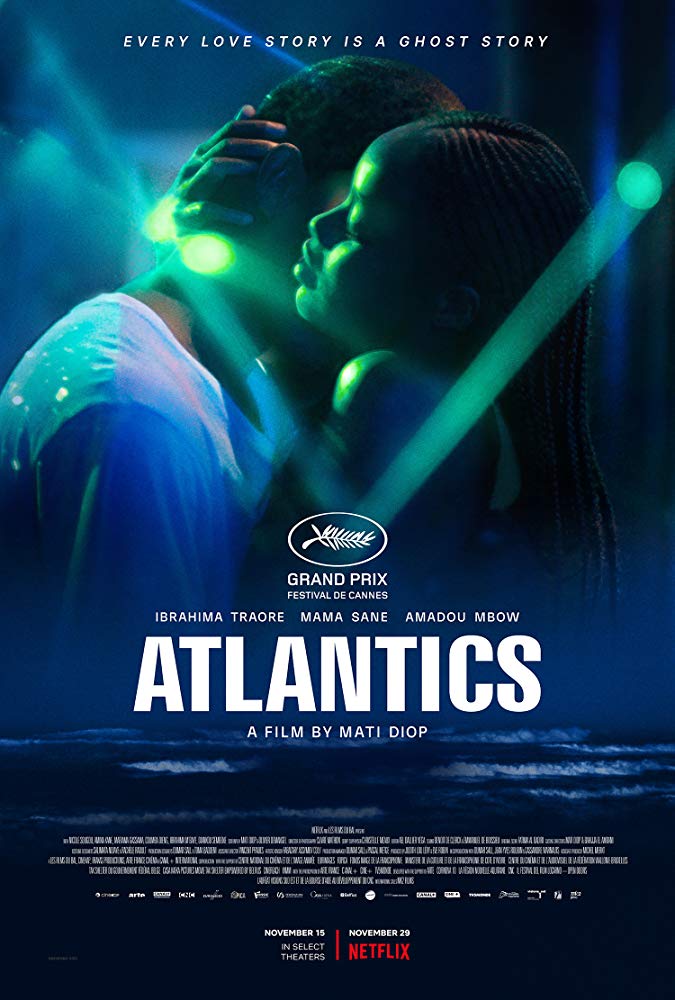
Atlantics

In a suburb of Dakar, workers on a construction site go without pay for months. They decide to leave the country by boat for a better future in Spain. Among them is Souleiman (Ibrahima Traoré), Ada’s lover. But the men never reach Spain. They are presumed dead, lost at sea. Poor Ada (Mama Sane) cannot afford to spend time pining or mourning for her lost love because she’s betrothed, by arranged marriage, to someone else. Omar is wealthy and handsome. The only problem is that Ada’s still thinking of, and worried about, someone else. Oh her wedding day, Ada is withdrawn, depressed, but her friend Fanta (Amina Kane) is seduced by Omar’s beautiful home and its furnishings – particularly what is to the marital bedroom, outfitted in new, luxurious furniture. The wedding is interrupted by a fire, thought to be an act of arson: Omar’s beautiful bed burns.

The next day Issa (Amadou Mbow), a young detective, arrives to investigate. Ada soon finds herself under suspicion, subject to invasive interrogations and even a virginity test. But as Fanta, Issa, and others fall sick, certain people wonder whether this mysterious illness is actually the spirits of the lost men possessing their bodies to exact revenge.

Mati Diop’s film addresses economic disparity and gender inequality but first and foremost it remains a love story, beautiful and ethereal. Claire Mathon’s cinematography gives the film a distinctive feel. Mixing social commentary with the supernatural, Diop may be Senegal’s Jordan Peele, crafting a film that is unexpected and unpredictable, like nothing you’ve seen before.


Observe and Report

When we were in Mexico I was reading a book about cyber warfare – not your typical beach read mind you but very informative and interesting (David Sanger’s The Perfect Weapon). Among many things it discussed the Sony hack. Basically, North Korea was very mad about a Seth Rogen movie called The Interview that involved the assassination of their leader. Apparently North Koreans can’t take a joke. I mean, lots of North Americans don’t find Seth Rogen particularly funny either, but most of them don’t commit cyber crime in retaliation. They released a whole bunch of very embarrassing emails for Sony but it actually had the opposite effect. Whereas the big whigs had been debating pulling the plug on The Interview, now they HAD to release it so that the terrorists didn’t win or some such American flag-waving sentiment. So they got a theatre and VOD release and a bunch of us watched it just to see what the fuss was all about.

I rewatched it out of curiosity but found that I’d already reviewed it on this site and I was shocked to find that we’ve been at this that long (it came out in 2014) but my opinion hasn’t wavered much. It is profoundly dumb and yet if you’re a fan of Rogen’s, you will find a chance or two to chuckle. But the movie really did benefit from North Korea’s interference, spurring a marketing campaign that money couldn’t buy and Hollywood couldn’t think up.

On a Seth Rogen kick, I gave Observe and Report a second chance as well. And the truth is, I found it even harder to laugh at this one. Rogen plays mall security guard Ronnie, hopelessly in love with makeup counter girl Brandi (Anna Faris) and even more hopelessly determined to be a real cop. When a flasher starts haunting the mall, Ronnie sees it as his opportunity to shine and does not take kindly to a real detective, the surly detective Harrison (Ray Liotta), stealing his thunder.

Possibly it’s hard to genuinely laugh at Ronnie because he’s dubbed bipolar and his single-minded delusions just come off as illness. Or possibly it’s because the film has a real mean streak. But probably it’s because the script is bad and director Jody Hill didn’t have the chops to wrangle his cast and crew. The film is simply too sloppy to guess whether Hill’s script is subversive or actually deeply racist and misogynistic. I can tell you that it feels like laughter borne in ignorance and I’m just not comfortable joining in. We deserve better, and frankly, so does Ronnie.

Brewster’s Millions

Monty Brewster (Richard Pryor) is a minor league relief pitcher who still dreams of the majors even though he’s a little long in the tooth. His best friend and catcher, Spike Nolan (John Candy), seems a little more content with their lot in life, just happy to still be playing ball alongside his best bud. But life is about to change.

A long, long, long, long-lost uncle of Monty’s has just died, leaving him, his sole living heir, millions of dollars. But there’s a catch:

  1. He has 30 million dollars to spend in 30 days.
  2. He MUST spend the entire 30 million, and if he does so, he’ll inherit a further $300M.
  3. But he can’t acquire assets. At the end of 30 days, all the money has to be gone, to the penny, but he can’t have a single thing to show for it.
  4. He can’t willfully destroy the stuff either.
  5. He can donate 5% and gamble 5% but that’s it – the rest must be spent.
  6. He can’t tell anyone what he’s doing. Not his best friend Spike, not even the paralegal Miss Drake (Lonette McKee) hired to keep tabs on all his receipts.

Ready, set, go! Imagine. Imagine leaving that meeting with a frothy sense of urgency. Imagine leaving the bank vault (this is 1985: it’s all cash) with a pile of money. What’s the first thing you’d do?

Monty makes a valiant attempt: he buys priceless stamps and slaps them on postcards, he prepares his minor league team to play the New York Yankees, he runs a phony mayoral campaign, he treats a lot of people to a lot of champagne lunches. But some of his attempts backfire; his high-risk investments somehow pay off, even his long-shot gambles hit big. Now he’s got to spend those dividends as well!

But the real comedy is that the people close to him look on in horror. To them, he seems to be burning through his windfall at an alarming rate. He seems crazy. And he is, more or less: this mandate to burn through money recklessly is crazy-making. Richard Pryor is a lot of fun to watch in these moments. He can hardly believe his “luck.” And the chemistry with John Candy is pure pleasure. But it leaves you wanting more: more Pryor, certainly, and more unfiltered Pryor in particular. Brewster’s Millions is a PG comedy, and Pryor is not at his best at that rating. So there are times when you’re almost seeing him reigning himself in. I’m certain that a very exciting director’s cut of this movie exists somewhere – or at least out-takes worth their weight in gold. Still, this is a fun, silly movie, not quite as good as others in its genre, but worth it for Pryor alone.

Meet The Robinsons

Lewis is abandoned by his mother on the steps of an orphanage. By the age of 12, he’s been through over a hundred adoption interviews with no luck, so he spends his time on inventions that never quite work out. One day his school science fair is interrupted by two interlopers: a weird dude in a bowler hat, and a kid named Wilbur who claims to be visiting from the future. It seems like a pretty dubious claim until his space ship whisks them away.

In the future, Lewis meets the Robinson family, a wacky bunch of people he bonds with instantly. Which is too bad, because for the good of the space-time continuum, he really will have to go back.

This movie feels like it was designed by committee if that committee was a classroom full of kindergarteners shouting out their most favouritest things: robots! dinosaurs! food fights! And Disney’s feeling generous enough to stuff the movie with every last ounce of feedback it received, no idea too outlandish or sporadic to include. A story can be weaved around them all, and it involves time travel and one genius kid with big ideas.

It’s not the best film that Disney has to offer, but it’s got rapid-fire visual gags and a riot of crazy ideas and eccentric characters brought to life by some vivid animation. And eventually it circles back on sweet themes, like family and imagination, things you might expect that Walt himself would have been proud his legacy continues to endorse.

Matilda

Matilda is a precocious little girl who just doesn’t fit in with her family. Her father’s a crook, her mother’s a bingo hound, and her brother is a bully and a dullard. Six year old Matilda is mostly left to her own devices, which is probably for the best. She devours books from the local library but isn’t sent to school until the elementary school’s principal buys a lemon from her sleazy salesman father and her fate is sealed. Now poor Matilda’s got three adults on her case: her buffoon of a father (Danny DeVito), her flighty mother (Rhea Perlman), and the horrid Mz. Trunchbull (Pam Ferris).

It turns out Principal Trunchbull doesn’t just terrorize the students at her school, but the teachers too, and Matilda’s sainted teacher Miss Honey (Embeth Davidtz) in particular because it turns out Trunchbully is also the mean old aunt who raised her. So Miss Honey and Matilda have loads in common, aside from the fact that they both read at the same level. They’re both looking to replace the misfit families they were born into.

As a story for children, Matilda is a bit of a weird one. It turns out that Matilda has special powers that come in handy when an adult in her life treats her unfairly. And objectively, the adults in her life are deserving of her scorn, but they’re wildly drawn caricatures, sadists and criminals. I suppose Roald Dhal wanted to acknowledge that sometimes children feel powerless and small and Matilda gets to confront this imbalance in a way that most little kids never will. They’ll simply wait to grow up and hopefully do it to their own kids one day. Such is life. Matilda gets to exact her revenge now, and it’s exactly the kind of revenge a 6 year old would think up.

Danny DeVito directs this little ensemble and though the effects have aged incredibly poorly, it must be said that the casting of Mara Wilson as the eponymous star was a stroke of genius. She is believable as a little know it all but somehow always sweet, never obnoxious. She never seems like a brat. She’s the kind of kid you might just want to scoop up and take home – so it’s almost understandable when the lovely Miss Honey does just that. Okay, not really. In real life I think it’s much harder to adopt a kid who has two living parents. But in the movie, both Matilda and Miss Honey get their happy ending, and it’s hard to argue that.

However, it’s easier to argue other things. Like when Miss Honey confides in Matilda that her father’s suicide was actually probably murder, and Principal Trunchbull the murderer. Which is a weird thing to unload on a kid. And to not share with the authorities for decades. But Miss Honey isn’t exactly the angelic teacher we’re led to believe she is. She rather passively stands by and watches her wee tiny students get abused on a regular basis. She actually seems a bit like an idiot. But who’s counting?

Arctic Dogs

Swifty is an arctic fox. His cautious parents liked to dress him all in white to make sure that he always blended in with the arctic snow. Blending in is safe. Standing out is dangerous. But Swifty dreams of being seen. He’s tired of being invisible.

Unfortunately, the movie bigwigs have conspired against poor Swifty, hiring the blandest of the Avengers to voice him. That’s right: Jeremy Renner, who does not have a distinctive voice (some, meaning me, would argue he does not have a distinctive bone in his body). Not all actors can or should be reduced to just their voice: Christopher Walken for sure. Definitely Tiffany Haddish. Patton Oswalt. Sam Elliott. Maria Bamford. Not everyone can do it. If you’re hiring Jeremy Renner, you may as well hire Joe Blow, who’s a heck of a lot cheaper. Well, he’s somewhat cheaper. I can’t imagine Renner commands all that impressive of a salary. You might hire a well-known actor with a boring voice because you need a big name up on the marquis. Again, Renner isn’t exactly fitting the bill. If anyone, ANYONE, goes to the theatre especially for Renner, it’s not a kid who likes mediocre animated dog movies. But the people who made Arctic Dogs don’t cast movies based on “good reasons” or “talent” because Heidi Klum is also voicing a fox named Jade. I suppose it makes as much sense for an arctic fox to have a German accent as an American one, but nobody in the whole history of the world has accused Klum of having a face for radio. Or a voice. She has other assets, and they’re better appreciated in still photographs, or, I imagine, live in person, preferably rolling around on a white sand beach but let’s not be greedy.

Anyway, back to our pal Swifty who wants to be noticed and isn’t. He works in the arctic mail room, sorting packages but he dreams of being on the front lines where the Top Dogs, a team of husky couriers so well-known and respected they’re practically celebrities, are the ones making the deliveries. One day Swifty decides to make his big move, and he highjacks a sled to deliver a package to a secret location, perhaps persuading his curmudgeonly boss Magda (Anjelica Huston) that he’s up for the job.

Anyway, Renner turns out to be the perfect guy for the job because the movie turns out to be just as bland as the man. Had they hired, say, Robert Downey Jr. or Chris Hemsworth, we might have expected something good. Best to temper our expectations with a second (or third) tier celebrity and call it a day. The story and animation are just good enough to satisfy most little ones, but it has little else to recommend it and won’t be memorable for anyone. Is that a plus? Your kid won’t get obsessed with this movie and demand you rewatch it 14 dozen times: GUARANTEED.

Poseidon

Although we’ve very much enjoyed the cruises we’ve taken (once, in the Caribbean, around the Bahamas, the other one around the Hawaiian islands), we were happy last night to be celebrating at a resort on land because when we got back to our room, Sean chose Poseidon for its New Year’s Eve setting but this movie might have made us think twice before getting on a boat.

The unsuspecting guests on that boat had just rung in the new year, with Fergie leading them in a countdown to midnight (the Shakira of the sea, we renamed her, since Shakira had played at our sister resort). But then a rogue wave hits, flipping the boat upside down. Of the 5000 or so passengers who must have been on board, most die instantly (and not on film). Mostly just the hundred or so survivors of the ballroom are given any airtime: Fergie of course, and the ship’s captain, Capt. Raymond Holt (Andre Braugher, again!), a degenerate gambler named Lucky Larry (Kevin Dillon, also again!), a suicidal man named Richard (Richard Dreyfuss), Robert, the former mayor of New York (Kurt Russell) and his daughter Jennifer (Emmy Rossum), newly and secretly engaged to Christian (Mike Vogel), a mother and young son, a stowaway, and of course the fearless leader Dylan (Josh Lucas), whose dimples will surely keep them afloat for hours. The ship’s captain is trying to keep everyone calm and contained within the airtight ballroom until help can arrive, but squirrely Dylan is not content to stay put. He leads a small handful of the survivors “up” (which in this case means travelling down into the ship’s bowels since it’s currently bobbing upside down in the ocean). They’re battling flash fires, rising waters, and of course gravity to get out in time.

Like most movies of its ilk, Poseidon (this is the 2006 remake of a 1972 classic) is big on the epic disaster set pieces and meager on story and character. It’s not going to make any logical sense, so leave that in life raft for later. You’re not going to know or really care about the people either. Remove your humanity, wrap it in a personal flotation device, and move on. The movie delivers a bloated sense of claustrophobia and a bad case of Murphy’s law, which impressively follows them right down to the bottom of the ocean. The camera dwells on the dead bodies as we swim by them so if you’re hoping for some campy fun, think again. There are corpses everywhere, and not all of them float. Not unlike this movie, which sinks under its own self-importance.