
Roma is the kind of movie that births film criticism. It will be used as the golden example in so many future texts I ache to think how many words will eventually be written about it and can’t quite fathom it.
Mexico City, 1971, a young family is having a rough time. Mom and Dad were fighting a lot, before he left, and now they do it on the phone, when he remembers to call. Four young kids are feeling vulnerable and acting out. Two young servants are trying to keep it all from falling apart. But one of them, Cleo (Yalitza Aparicio), is going through her own private crisis as well. She’s pregnant, and the father has run off. Fearing for her job but unable to return home to her religious family, her current situation is tenuous and her future uncertain.
This is the semi-autobiographical work by Alfonso Cuaron about that crazy time in his 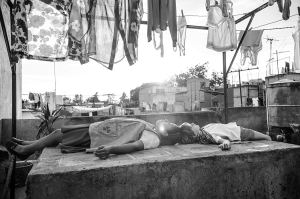 childhood when his beloved maid’s unexpected pregnancy collided with his parents’ bitter divorce. It marked him for life, and all these years later he’s strung together the haunting images from that period and used his memory to paint in the rest. He’s only a minor character in the film, it’s really an ode to the women who raised him: his mother, the two servants, and Mexico herself.
Cuaron immerses us in Mexico circa 1971. Filmed in starkly beautiful black and white, you can’t help but drink it all in, everything from the airplanes overhead, to the geese in flagrante delicto, the muddy markets and the local cinemas, the grassfires and New Year’s Eve traditions, rooftop laundry and candlelit chores, every scene is packed with loving details to a time and place Cuaron clearly treasures. His camera moves slowly, soaking up detail, lingering lovingly in quiet places. His trademark long takes emphasize time and space – the big house compared to the servant’s quarters, and the time Cleo devotes to undoing the naughty work of busy children. The sound design is incredible. At times I was overwhelmed by the layers of noise in the city – hawkers, vendors, tradespeople, cars, trucks, buses, dogs barking, children playing, marching bands tooting their various horns in seemingly random parades.
Roma is of course shot in Spanish and subtitled with care. It is obviously composed with great care as well, with so many interesting angles and viewpoints (a Christmas party filmed at child height, for example) and depths of field. Lensed by Cuaron himself (Emmanuel Lubezki was unavailable, but his collaboration in pre-production means his DNA’s all over it, Cuaron assures us), he often keeps his entire shot in crisp focus, with as much going on in the background as the foreground – but when the focus goes soft, it’s for good reason. Take note.
This film brims with the kind of personal detail that makes it truly unique. I especially liked seeing the young boys clearly obsessed with outer space – posters, toys, and astronaut costumes – you can’t fail to think that these are the origins of Gravity. Indeed, Cuaron has left a little piece of his heart on the screen. It is not sentimental, but it is affectionate, made with love. And I think it will be received, by audiences and the Academy, with nothing but.
 beautiful model. So he seeks comfort in his precious laws of thermodynamics to reassure himself that love is just another quantifiable thing, an equation he can puzzle out and make sense of. But the more that real life seeps in, the harder he has to spin things to keep the laws working for him.
 dust settles, 130 people are dead and 413 more are injured in a series of coordinated attacks at a number of locations throughout the city. The investigation quickly determines that the attackers are from Molenbeek, Brussels, the very neighbourhood where this barbershop is located. Of course, the attack becomes the main topic of conversation here, just like it was everywhere else.
 they were toeing a very thin line. Still, it was hard for me not to be offended by some of the stereotypes, and I’m sure that men would feel the same. But it’s not until you’re fully submersed in this alternate world that you start to appreciate how ridiculous it all feels, and how the inverse, which is the world in which we live every day, must be equally ridiculous. Except we accept it because it’s what we know. It’s not just about income equality, or splitting household chores – it’s both bigger and smaller and more all-encompassing than that.
 were, surviving in that beautiful but frigid (-70C) land. We are introduced to one main in particular: Sergei is a horse breeder, and even his horses will look strange to you. The Yakutian horse has of course evolved to weather the icy temperatures. They are small but sturdy animals, with shaggy coats that hopefully keep them warm. Their thick hair and manes are not unlike those of Shetland ponies but when you see one completely coated in ice, you know you’re in unfamiliar territory. The breeders de-ice the horses the way I de-ice my windshield. It’s a way of life I can’t really comprehend: solitary, isolated. No telephone, no electricity. No cash. No cars (none that can run you through ice and snow anyway – sleds get the job done).
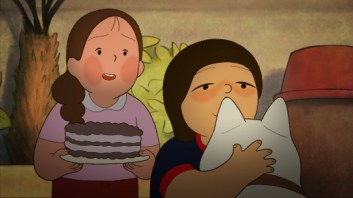 Director Cho Jong-Duck sets his adventure story amid the backdrop of the rapidly changing South Korea of 1983. It’s developing economically but Jaeyoung’s father still works in the fishing industry of a small village. There are lots of such conflicts crossing Jaeyoung’s path. Western influences are crowding in but the traditional Confucian Korean culture still has a stronghold on its people. All of these things put strains on a family already in transition.
 Cambodian population died from malnutrition, forced labour, and mass murder in the time period between 1975-1979. Almost all Cambodian artists, actors, and film makers were killed during this regime, so getting the story out has been a difficulty. Cambodia’s film community had all but expired and is only now starting to recover. With Netflix fronting $24 million for this film, First They Killed My Father is the biggest movie shot entirely in Cambodia, and director Jolie was careful to use as many Cambodian cast and crew as she could (she herself is a Cambodian citizen since 2005). Some of them are genocide survivors themselves (such as producer Rithy Panh), so therapists were on standby on the set to avoid re-traumatizing the people who’d already lived through events depicted in the film. Jolie’s son Maddox worked on the film as well.
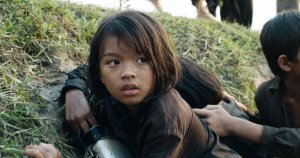 adsorb all that is happening around her, like she herself must have been at that young age. The film also engages our inner protectors: watching this little girl plant land mines and fire guns is just too much to process.
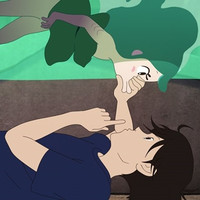 is discovered that he makes really interesting beats with his computer, and he gets recruited into a band by Yuuho and Kuniko. The band practices on a deserted island away from the mainland so that Kuniko’s family won’t discover his dirty little secret (he’s destined to be a temple keeper, not a rock star). But out there they stir up the myth that has shrouded their town for decades: that of merpeople.
 tough and the tender, the blurring of the line between the two. Adi (Adrian Schiop) is a fish out of water, and Alberto (Vasile Pavel), rough as heck around the edges, provides interesting if skewed insight. Soon their companionable partnership turns into something sexual, quasi-romantic. It’s a quite modern gay love story from behind the poverty line and director Ivana Mladenovic’s lens is intimate and gritty.
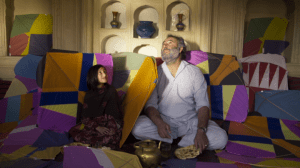 Afghanistan is the last place I’d expect to find a kid flying a kite. After watching Black Kite and seeing kites be such a prominent part of life, bringing a tiny bit of joy to those who are trapped in this war-torn land, it seems strange that I ever had a presumption on kites one way or the other. The smallest of assumptions, something taken for granted without basis, led me to think I knew more about another’s circumstances than I do. Being wrong about kites reminded me that actually, I know absolutely nothing about what it’s like to live in Afghanistan! I have Black Kite’s writer/director Tarique Qayumi, a Canadian who came from Afghanistan as an eight-year old refugee, for brilliantly and effortlessly challenging my preconceptions.
 ASSHOLES WATCHING MOVIES