Tag Archives: subtitled

Invisible

Director Pablo Giorgelli has it in for us. His protagonist, Ely, is a marginalized teenaged girl who finds herself pregnant by  the adult, married son of her after-school employer. She’s brilliantly played  by Mora Arenillas, no small accomplishment because much of what is conveyed is done in total silence. Arenillas must constantly reach into her bag of tricks in order to portray the insight and the mental toughness, and the resilence shown by her character.

For his part, Giorgelli sets his gaze upon the social margins of Argentina with a sparse aesthetic that will test your limits. He likes agonizingly long, silent shots in which we contemplate our heroine as she stares out the window of a moving bus [which, by the 35482-invisible__2_way, why do movies always make this seem so peaceful? If you’ve ever rested your forehead on a bus window in real life, you’ll know it feels more like going through the wash with a bunch of rocks, but whatever, don’t mind my grumbling, that’s neither here nor there]. The point is: looooooooong shots with little to no action, little to no dialogue, little to no plot. The whole movie can be summed up as: She’s pregnant. Oh jeez. How to get an abortion in a country where abortion is illegal? It’s only 87 minutes long but it feels more like 87 hours. Case in point: Sean fell dead asleep.

Invisible is a love letter to spartan film making. Although Ely dominates the screen in almost every shot, the things that remain unseen are as significant. We don’t know much about her home life, and glimpses are enigmatic. Her living situation and long commute suggest poverty but Giorgelli doesn’t rub our noses in it. His lens is sympathetic but we get a sense of her loneliness as she faces the biggest decision of her life.

There’s no pointed political criticism to the film but Ely’s exploration of the underground abortion scene is chilling. She is so matter of fact, so responsible, it’s easy to forget that Ely is still a young student. The actress is formidable as she bravely, stoically faces down an impossible situation. But as interesting as I found the topic, I couldn’t forgive the long, boring stretches of just watching her mute in her daily routine. It felt stagnant, bled of life, like a carnival ride that pelts you with boredom.


Free and Easy

To be honest, it took me a while to adapt to the pace of this movie. It is slow, deliberate, and very measured. There’s no getting ahead of yourself. But the unusual story and glimmers of humour hooked me and I was glad I stuck it out. Free and Easy is genuinely something that feels new and unique.

It’s about a “soap salesman” who never sells a single bar but does encourage people to sniff his product (“a different scent on all 4 sides!”) because doing so induces loss of consciousness. Once his would-be customers are asleep on the ground, he frisks them for money and valuables. So he’s really a thief, posing as a salesman.

1_22_free-and-easy1-676x450Director Geng Jun shows us a side of China rarely seen: crumbling, bleak, all but abandoned. This cold, deserted, post-industrial town in northeastern China is dotted with rural characters, and they’re all as shady as the salesman.

It almost watches like loosely connected vignettes, a series of petty crimes where corruption and lawlessness is the new normal. But whenever these criminals encounter each other, you can’t help but laugh. The humour is deadpan but it landed surprisingly well for a movie that runs the risk of being lost in translation. There’s some slap stick, which I suppose is universal, but really it’s just the contrast between this totally depressing setting and the buffoons that populate it that just works.

The film is minimalist but that doesn’t mean there isn’t a lot of attention to detail poured into each shot. Out-of-focus details often sharpen into the butt of the joke. You have to stay alert to small gifts planted by the director along the way. Sure the subtext of the film is a little depressing, but it’s delivered in such an obliquely funny way, the message presented by sliding it in sideways, that you’ll laugh appreciatively at things that aren’t even overtly funny. In a film full of grifters, it’s the cops who are the dirtiest  of them all. That’s the lens through which contemporary, provincial China is explored in (ironically titled) Free and Easy, and the film stays remarkably on-brand.

A Man Called Ove

There is indeed a man called Ove. He is a crotchety old man who rules his condo tenement with fierce rigidity. He’s aged out of his job and his wife has left him (well, died, but he’s such a grump I can only assume it was purposely, to escape him). I shouldn’t joke; his wife’s grave is the only time and place where he’s a little tender. Does he list her a litany of complaints? Of course he does. But only because the world’s gone to MV5BNTgzNDcxYzEtZDljOC00NDZmLTk2ZTAtOTVhM2Y1MWI1YzUyXkEyXkFqcGdeQXVyMDc2NTEzMw@@._V1_SY1000_CR0,0,1581,1000_AL_shit without her. The only reason he hasn’t committed suicide yet is the damn neighbours, who need constant monitoring and discipline, and who else would take it upon themselves to mete it out?

It turns out that Ove has had a pretty interesting life. It’s just that no one knows it because he isolates himself, sequestered in a condo that’s still a shrine to his dead wife. It’s only because some boisterous, needy new neighbors draw him out against his will that we learn the ups and downs that have contributed to his current thorny state. If you’re feeling like this sounds a little sentimental, well, it is. But it stays just shy of saccharine thanks to a nuanced performance by Rolf Lassgård in the title role. He never lets Ove go full-martyr, he keeps the role alive and flawed and beautiful. Ove’s may not exactly be a unique character arc, but it’s charmingly irresistible in Lassgård’s hands.

The film is a little predictable but so sweetly executed that I’m finding it hard to fault it. It’s surprisingly funny at times, mixing genres fairly deftly, making for a lovely, bittersweet, and humane character study that’s a pleasure to watch.

Tunnel

On his way to his young daughter’s birthday party, a man becomes trapped in his car as a tunnel collapses around him. There’s no telling when or if help with arrive, and all he’s got are 2 bottles of water and a birthday cake to see him through. His wife finds out in the worst way imaginable and the Korean news is pretty ruthless in reporting the failure of a newly-built piece of infrastructure. The damage is so encompassing that the rescue will be a long-term affair and there’s no guarantee that a little water and cake will be enough to keep him alive until help arrives. Of course, that’s not even considering whether the panic and isolation might get him first – or if the poorly and hastily constructed tunnel might further deteriorate.

Jung-soo (Jung-woo Ha) is the man in the tunnel so of course this movie is his. As blunders delay the rescue and the national media loses interest, this poor guy is as alone fullsizephoto731941on this earth as anyone will ever be. He isn’t just going through a physical hardship, but a psychological one as well. Occasional glimpses of the rescue effort reminds us just how bleak his situation really is. Dae-kyoung (Dal-su Oh) is the only member of the rescue team truly dedicated to Jung-soo’s survival. Politicans are turning their backs and resources are drying up – are being redirected, in fact, to the construction of yet another tunnel. Meanwhile, Jung-soo’s wife, Se-hyun (Doona Bae) treads the fine line between hope and realism. This trio of actors give very fine performances. Tunnel ends up being more character-driven than action movie, and that’s a good thing. When the script demands it, the visual effects are there, but it’s Jung-woo Ha and co-stars who drive the story forward. It’s a story we’ve seen and heard before but writer-director Kim Seong-hun injects this with satirical elements that bring renewed interest to the genre.

Tunnel is perhaps overlong and could have benefited from some fat-trimming but I still really enjoyed it. It’s got some juicily angry scenes (Kim Seong-hun obviously has something to say about bureaucracy in general and his nation’s government in particular) and some surprisingly dark humour. You might not expect to chuckle through a disaster flick, but this one’s got a little bit of everything.

One Week And A Day

When Eyal and Vicky Spivak finish the week of mourning for their son, their grief is a gulf between them. Vicky is ready to launch back into the comfort routine but Eyal seems lost, stuck, and unsure of how to proceed, or why. His stealthy rescue of a bag of medicinal pot from his son’s hospice room leads to a form of mourning unlike any other you’ve seen on the screen before.

In an odd way,  One Week And A Day is a comedy about grief. After a hilarious montage of Eyal’s inept failure to roll a proper joint, he recruits the young neighbour next door MV5BZmE0NGJjYzItOTExNy00ODI3LTljOWYtNWQ1NmMyN2NiZjU0XkEyXkFqcGdeQXVyNjA5NjAzMjI@._V1_SX1776_CR0,0,1776,960_AL_(an old friend of his son’s) and the two of them roll their way through grief and loss. Vicky is as disapproving as you might imagine, but she’s not exactly smoothly sailing through this period either. Her grief is just as bumbling, if more sober.
Turns out the neighbour, Zooler (Tomor Kapon), is an aspiring air guitarist, and his quirky, oddball demeanor is just what the doctor ordered, maybe not just for Eyal (Shai Avivi), but for all of us. The death of one’s child is a subject so sensitive, so awful to contemplate, that often we avoid it. Movies that dare to breach the topic are often morose and difficult to watch. In this case, writer-director Asaph Polonsky gives us reason, and permission, to smile through it. It’s a relief.

Which is not to say there isn’t something deeply emotional running under the surface. It bubbles up during a eulogy that comes late in the film, and it’s such a poignant moment that it stops you short. It gives balance to the film, and grounds us once again in reality.

Polonsky uses a wide lens to show the dynamic between Zooler, Eyal, and Vicky as the back and forth between them tends to be quite powerful. Everything in this movie feels casual and off-hand, allowing us to get closer to the subject, but this is due to careful orchestration behind the scenes. Afterward, recounting my favourite scene to Sean, tears sprung in my eyes. I hadn’t realized how moved I was by it because the movie doesn’t manipulate you into sadness. It very gently cradles you, but clearly even without the histrionics it’s capable of evoking feeling.

Amelie

Sean and I are celebrating our wedding anniversary in Paris; today we’re actually renewing our wedding vows at the Eiffel Tower so I’m posting about a wonderfully romantic French film about love and life in Paris through the eyes of an idealistic and imaginative young woman.

Gloriously known as Le fabuleux destin d’Amélie Poulain (translation: The Fabulous Destiny of Amelie Poulain), this film introduced the rest of the world to Audrey Tautou, seemingly born to play the role though it was actually written specifically for Emily Watson, who turned it down because she doesn’t speak French. A passion project for director Jean-Pierre Jeunet, he’s been collecting the various memories and curiosities that make up the story of Amélie since 1974. Who knew that the guy who brought us Alien: Resurrection had such magic and whimsy in him?

audreytautou

Amélie was brought up in a rather protected fashion, her father being very concerned about her supposed heart condition. To make up for her isolation, a young Amélie lives in her imagination, and her grown-up self is still very much a dreamer, a wondrous observer and devoutly introverted. She devotes her life to making others happy, and lucky for us, she’s surrounded by a very quirky bunch.

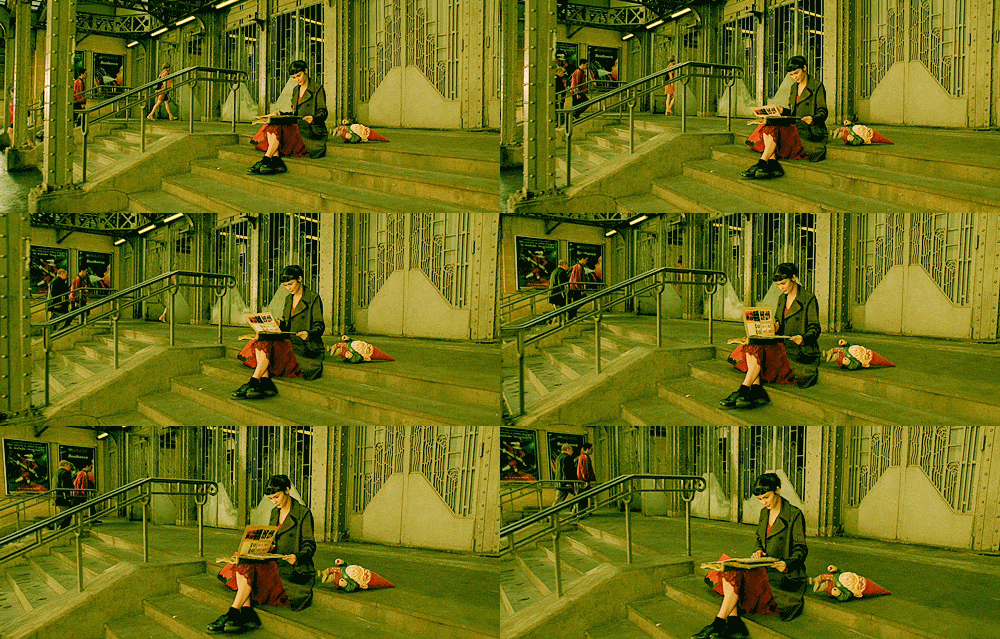
For her father, she fulfills his lifelong dream of travel (tough for a recluse) by stealing his treasured lawn gnome and sending it all over the world. This was inspired by true events – in fact, a rash of pranks perpetrated in the 1990s in England and France.

amelie

The traveling gnome was inspired by a rash of similar pranks played in England and France in the 1990s. In fact, the theft of garden gnomes is so pervasive it even has a name – “gnoming.” A gnome is taken from someone’s garden and released back “into the wild” (wherever that is for an inanimate object – the shelves of Walmart?). In 1997, a the leader of the Garden Gnome Liberation Front was convicted of stealing over 150 gnomes – his prison sentence was suspended, but he did pay a hefty fine.  (A couple of years later, there was a “mass suicide” of garden gnomes in a small town in France – residents woke up to find 11 gnomes hanging from a bridge, swinging from the nooses around their necks). At any rate, Amélie was responsible for bringing the whole garden gnome kidnapping thing to our attention, and the idea was later used by Travelocity in an ad campaign.

colignon

Although the movie is shot in a dreamy sort of way, with Paris polished, glowing, and blemish-free, some of the locations can actually be found in Montmartre. The cafe where Amélie works, for example, can be found on Rue Lepic (and is conveniently also named “Les Deux Moulins”). The fruit store run by M. Collignon is at 56 rue des Trois Frères. And of course the church where Amélie’s mother is crushed to death by a suicidal jumper is none other than the uber-famous Notre Dame  cathedral.

ameliegif

Amélie’s watchful neighbour paints the same painting yearly – he’s up to 40 copies of Renoir’s Luncheon of the Boating Party, and he still hasn’t got the girl-drinking-water’s expression quite right. Pierre-Auguste Renoir is a French artist of the impressionist variety and I’m looking forward to ogling his stuff at the Museé de l’Orangerie, but that particular painting can actually be found in The Phillipps Collection in Washington, DC.

If you haven’t seen this, you should, and if you  have, no time like the present for a re-watch!

ameliemetro