
It’s rude to ask Danny what he went to prison for. Instead let’s concentrate on the fact that he’s out, and he’s trying to put his life back together. He’s staying in a motel run by a single mother, and her daughter. He’s washing dishes in a Chinese restaurant. He’s seeing his parole officer every day. He’s getting by by keeping mostly to himself, which is how he prefers it. Too bad things just couldn’t stay quiet.
Clara, the daughter at the motel, is ripe for a new friend. Her own father is in jail and she hasn’t seen him in a long time. When she gets assaulted one night while her mother is away, Danny kind of gets pulled into a scrape that he can’t really afford to be involved in, but can’t seem to avoid either. Now the motel is not the refuge he was hoping for and  he’s awfully tempted to resort to his old methods for dealing with this kind of crap.
A Bluebird in My Heart, in many ways, is asking us whether a person’s nature can really change. Peace and violence will clash, as they must, in a movie that looks as dirty as it feels. Danny (Roland Møller) is an elusive character; a tough exterior shell with a vague interior and mysterious past. Our biggest and best clue to what makes him tick is the Charles Bukowski poem after which the movie is titled. “There’s a bluebird in my heart that wants to get out but I’m too tough for him, I say, stay in there, I’m not going to let anybody see you.” We never fully see Danny, but we do have a front seat for his actions, and the consequences of those actions. It’s not a pretty sight necessarily, but it’s a strength of the script that we don’t have to know him to know him. He’s got anger and pain and he tries really hard to bury them, perhaps in the bluebird’s nest, but once unleashed, well, he becomes a pretty powerful outlet. Danny wrestles with his innermost self, with his nature, with his destiny. For a movie about a violent, hardened criminal, it’s actually quite quiet and contemplative, but when the action ramps up, well, the outbursts are intense. So be prepared, and watch out for the little bird.
 and hopefully plot some revenge. Of course, Roy’s zero-fucks lifestyle is not quite as becoming now that he’s got a ready-made family, but forgiving-and-forgetting isn’t really in Roy’s repertoire, or his boss’s, for that matter.
 damning comment on today’s hyper competitive culture in which young adults liken abusing prescribed drugs to drinking a cup of coffee. Like I said, amphetamines aren’t new: The Beatles took them, Andy Warhol took them, Vietnam soldiers took them in order to go, go, go. And then they became horribly addicted, and the drugs became controlled. Except now students are seeking them out as performance-enhancers, faking ADHD to gain an edge while taking the SATs, and getting their hands on drugs whether prescribed or not.
 Someone wanting out of their relationship will contact them, and they’ll do what it takes to make a clean break – anything from singing telegrams, to pretend cheating scenarios, to even faking someone’s disappearance (which on paper sounds cruel, but this is all played for wide-brimmed comedy, and largely succeeds). It’s good money for them and quite entertaining for us, but we start to get an inkling that perhaps this line of work has stunted them – neither woman has a love life of her own to speak of. But when Mel starts to have a little too much sympathy for the wrong (ie, non-paying) end of the couples, what starts breaking up is their friendship, which is inconvenient when it’s the only relationship you’ve got.
 Billy’s head is about to explode with all the backwardness, he sees something out his bedroom window that leads him to believe that Lowell is a murderer. But everyone in town has had a lobotomy, ie, they all think Lowell is this stand up guy. What the heck? Even Billy’s own best bud thinks Lowell is a nice guy, so Billy’s got an uphill battle – against popular opinion, and his own less than stellar reputation.
 slightly before the festival began and continued, threats shutting down an event, and police dogs sniffing the larger venues for traces of explosives. The alleged bomber died days later, blowing himself up when the cops arrived to arrest him] But the festival always felt like a safe space and we’d seen lots of great movies and done some once-in-a-lifetime things, and were not just coasting until the closing movie Isle of Dogs later that night.
 Although neither knows what “sure” will feel like. They say you’ll “just know” and they don’t, so is this not love? Or not forever love, anyway? Mal’s parents are celebrating their 25th anniversary and they’re as randy as ever – apparently because they dabble in the ole menage a trois. So of course the night before the vow renewal, Mal and Cal decide to recruit a stranger into their bedroom (a “unicorn” if you will) and they realize that there’s a reason they call it menage (which means work!).
 symptoms of the caring sister who’s also sort of an enabler. Because instead of leaving him to get his shit together, she’s prepared to miss the party and spend the night driving around the dirtiest, sleaziest parts of L.A. to find her brother (Dave Franco) a detox facility, and barring that – well, something far worse.
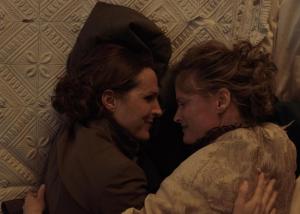 posthumously, a narrative was created about her that has ever since called her a recluse, a virgin, a socially awkward spinster, which are all words attributed to women who just didn’t fit the mold. In reality, Emily had a passionate love affair with her brother’s wife, Susan. Many of her fieriest poems are dedicated to her – and name her. Traces of their relationship were of course literally erased from history in order to sell her poems to a conservative market. Dickinson was a woman ahead of her time in so many ways and this movie’s ambition is to have us reconsider the things we think we know about her.
 ASSHOLES WATCHING MOVIES