Tag Archives: TIFF18

TIFF18: Viper Club

Helen’s son is a war photographer who’s been missing in the middle east for the past several weeks, perhaps months. Well, not so much missing as kidnapped and held for ransom.

The CIA and FBI are ‘helping’ Helen by telling her to keep this a secret, but a heart-pounding, nausea-inducing secret like this can really make triggers out of  literally everything and anything, and it’s hard to keep her ER colleagues in the dark when they know her so well.

The U.S. government doesn’t pay ransoms, and keeps reminding her it’s illegal for her to do it also. Not that she has any money. Selling her house would provide only a fraction of the demanded sum, and a real estate agent grimly informs her it’s a tear-down anyway. With few options and increasingly hostile communications from the kidnappers, Helen (Susan Sarandon) turns to the only person who can possibly help MV5BNjY5N2I2N2MtYmI0My00OGJiLTkwOTQtYWVlN2FlYTgwMGUxXkEyXkFqcGdeQXVyNzg3Mzc4MDQ@._V1_her – Charlotte, the mother of another kidnapped journalist who was successful in getting her son returned home. Off the record, Charlotte (Edie Falco) fund-raised the ransom among her wealthy friends and had someone walk it across the border for her in order to evade detection. They’re planning the same for Helen’s son, with a friend and colleague of his, Sam (Matt Bomer) willing to make the actual transaction. Helen can scarcely believe her son might actually come home, and isn’t sure what kind of broken man he’ll be if he does. But her focus remains on getting the work done, all of it underground, away from the unhelpful but watchful eyes of government agencies.

Director Maryam Keshavarz makes some choices that make the movie feel a little cold and distant. While I believe whole-heartedly that Helen was committed to getting her son back, we never see her cry, we never see her crack. Yes,  she’s hardened by her ER nursing, but she’s got a soft spot or two, so why no cracks in the facade? And why only drop us in on the action when the son’s been missing for several months? I feel we miss a vital part of the story by omitting Helen’s first contact with the kidnappers, or the moment she realizes she hasn’t heard from her son in too long a time. Instead we only meet her when she’s navigating bureaucracy, which is a bit dry and made me feel removed from any urgency.

There might be a bit of an awards push to get Sarandon a nomination but I’d be fine if it didn’t amount to anything. The story is upsetting but not nearly moving enough. It feels diluted. Viper Club delivers a small still where its title promised a deadly bite.

TIFF18: Gwen

It’s rainy, it’s dark, it’s 19th century Wales. There’s a noise outside. Gwen, a teenage girl, goes outside to investigate.

Don’t go out there, your gut yearns to shout. Years of horror movies have conditioned me. But out she goes.

MV5BN2Y0NDUyNTYtOWUyYi00ZmNlLWFjNmYtMWViNmIwYTVhZjMxXkEyXkFqcGdeQXVyMjAxODg3NzY@._V1_SY1000_CR0,0,681,1000_AL_Gwen lives with her mother and younger sister. They have next to nothing – their makeup bags legit comprising of a pointy stick with which to prick their fingers and use the blood as blusher. Her father is absent, away at war. Her mother is mysteriously ill. Her neighbours are disappearing, one by one, a mining company encroaching on the land. But there’s also a darkness that comes knocking. Strange things are happening, inexplicable things.

Their sheep all get disemboweled. A heart, pierced through with nails, is left at their front door. Gwen’s mother is getting weirder by the minute, up to strange rituals after dark, and the villagers are getting antsy. And so am I!

Tonally, this movie reminds me a lot of The Witch. Creeping, ominous shots do more to drum up suspense than jump scares or actual gore. But in the shadows, everything feels threatening. Candle light is the scariest light, isn’t it? But even the weather is threatening. Even the isolation of the landscape is threatening! Every darn thing is scaring me and thee’s nothing I can do.

Maxine Peake, as Gwen’s mother Elen, is excellent. She’s unreadable, sinister, cruel, but with flashes of maternal instinct that leave you breathless. You watch the smile leave her face and it’s like watching the sun slowly dip down below the horizon, so incremental, so mesmerizing.

But it’s Eleanor Worthington-Cox as Gwen who’s the break-out star, named as one of TIFF’s 2018 Rising Stars, and with good reason. She struggles to keep her family together even as she too begins to suspect her mother of dark and unforgivable things.

Gwen is an atmospheric and beautifully shot film by William McGregor. Check it out if you dare.


[Side note: this film reminds me how much Cinderella has misled me about feeding chickens. Apparently a fistful of seed in the pocket of my apron is not sufficient. I wonder how many innocent chickens might have starved to death due to this negligent film making by Disney? And yes, I did focus on that in order to not lose my shit while watching a scary movie BY MYSELF. So sue me.]

TIFF18: Jeremiah Terminator LeRoy

If you were present in the literary world of the early 2000’s and you have a sharp memory, you may remember JT (Jeremiah Terminator) LeRoy as the author of a New York Times best-seller, Sarah. That is a true thing that happened.

Now here’s where it immediately gets messy. JT LeRoy was a teenage truck stop prostitute who idolized his mother Sarah, also a hooker. Except JT wasn’t actually a real person, he was just an “avatar” used by the book’s real author, Laura Victoria Albert, who developed the pseudonym in the 90s while calling suicide hotlines. She found it easier to talk about her pain if she attributed it to someone else, and she MV5BZjI3NDk1NWUtMmQ4NS00MWMzLTljMmQtZjBhNWU0NWU0ZDFjXkEyXkFqcGdeQXVyNzI0MTEwNTY@._V1_SX1500_CR0,0,1500,999_AL_found male identities received more sympathy. Eventually she found a way to turn it into art, and several stories and books were published under the name. She wouldn’t be the first writer to write under an assumed name, but she might be the first to have gone to such great lengths to present a pseudonym as a real person. She recruited her boyfriend’s androgynous sister Savannah to “play” JT in person, granting interviews and posing for pictures as him – even signing the rights to a movie contract. Of course, when the truth comes out, as it nearly always does, the world was kind of mad about being duped, and there was a big backlash.

So that’s the true, and truly weird, story explored in the film, where Laura is played by Laura Dern and Savannah/JT is played by Kristen Stewart. Laura does all the talking over the phone (as a phone sex operator, she has a knack) and Savannah plays it cool and quiet in public. But both of them grow increasingly attached to the character and are possessive of him – particularly when a beautiful actress/director gets involved (Diane Kruger). Of course, the fun doesn’t stop there. Laura develops other personas, like Speedie, JT’s obnoxiously British manager who mysteriously and confoundingly does a lot of his talking for him during interviews.

Every year at TIFF, there are certain themes that pop up. This year it’s addictions, and also cops killing black kids. But a third, and quite odd theme, is literary hoaxes. Melissa McCarthy plays a forger in Can You Ever Forgive Me? and Aaron Taylor-Johnson plays controversial memoirist James Frey in A Million Little Pieces. Jeremiah Terminator LeRoy provides two very juicy roles for Dern and Stewart, and the tension it creates between them is pretty addictive in itself. Stewart is cast to perfection and in JT’s gender-neutral shoes, themes of sexism and identity leap out so easily. Laura Dern is similarly well-matched, and she somehow makes the juggling of personas look easy. We get the sense that Laura feels her limitations in the field keenly, while Savannah embraces this shadowy second life, perhaps feeling a bit freer in a wig and dark glasses.

I thought Laura deserved a bit more from the script, and the end in general needed a little more oomph in order to match the intensity that comes before it, but this is an interesting story you have to see to believe, with 2 out of this world performances. You should take all of your personalities to the cinema to see this one.

TIFF18: Quincy

Quincy Jones is an icon, a man who needs no introduction from the likes of me. He’s worked with the best because he is the best – not just at composing music or creating trends, but at transcending them, and transcending culture itself. If you listen closely, this movie is about a man who consistently allows his talent to break down barriers. He’s accumulated a lot of “firsts” in his life (the first African American to be nominated for an Academy Award for Best Original Song – and the first African American to be nominated twice in one year as he was also named in the Best Score category; the first African American to hold the position of vice president of a white-owned record company;  the first African American to be the musical director and conductor of the Academy Awards ceremony) but as far as I’m concerned, he’s also a man with a lot of “onlies” to his name – the first, and the only, because this man is a trail-blazer of incomparable talent and drive.

With his daughter Rashida Jones co-directing the film, they skate lightly over the more scandalous periods of his life and focus on his love of family and his impressive musical career. He composed for Frank Sinatra and for Sidney Lumet. He MV5BYzZhMTY1YjQtNWRjNi00YzVkLWEwODAtNzk1MjMzNzZiMWE1XkEyXkFqcGdeQXVyNTc5OTMwOTQ@._V1_wrote movie scores and TV theme songs. He traveled the world making music, and he’s given back to the community by mentoring young musicians and passing the baton, literally, to new composers. He met Michael Jackson while working on The Wiz, and went on to produce Off The Wall, Thriller, and Bad with him. Oprah credits him for ‘discovering’ her for The Color Purple, which he scored and produced. He also composed the music to Will Smith’s Fresh Prince theme song – he was a show producer, and Will Smith auditioned for and signed a contract at Quincy’s 57th birthday party.

Between his art and philanthropy, there isn’t a corner of culture the man hasn’t marked and this documentary offers an excellent overview of his accomplishments while also providing insight to the life he lives at home. I love the many Quincy-isms up for grabs in this doc. There aren’t many topics where he doesn’t offer some bit of wisdom. But neither he nor his daughters (he’s got 6 – it’s almost biblical) believe him to be without flaws, but perhaps at the age of 85, we can afford to concentrate more on his activism and artistry, and the terrific impact he’s had on music and pop culture. You can check Quincy out right now on Netflix.

TIFF18: The Most Beautiful Couple

Okay, I give up.

This is the TIFF review I least want to write, but one I am most compelled to. My discomfort with the subject matter should be irrelevant; The Most Beautiful Couple is a good film that deserves to be recognized. So I’m going to claim this site as a safe space, I’m going to write this review in peace, but with the understanding that you should click away if you want to\need to.

Liv and Malte are indeed a beautiful couple. That’s well-established in the very first scene which finds them fucking on the beach while on vacation. It’s a secluded spot but they’ve nevertheless got some appreciative viewers in the form of some teenage boys. That’s how I thought of them, boys, until they forced themselves into Liv and Malte’s vacation home later that night in order to rob them. But you know and I know that no one would bother to make a movie about it had they stopped there.

The “boys”, and one in particular, force them to perform for them again, so they can MV5BYTc1YWQzYzktNjc1OC00ZTA2LWIyZWMtOWFmNmVkNzU2YzI4XkEyXkFqcGdeQXVyMDA5NjIzMg@@._V1_SX1777_CR0,0,1777,999_AL_masturbate. Where the beach scene felt fun and carefree and only a little naughty, the act of repeating it under these circumstances is a violation neither Liv nor Malte can bear. When they aren’t quite up to the task demanded of them, ringleader Sascha decides to take a more direct approach. He rapes Liv while Malte watches, hog-tied and bleeding. It’s cruel and agonizing.
Cut to: two years later. Liv (Luise Heyer) and Malte (Maximilian Bruckner) have lived up to the title. This most beautiful couple has managed to stay together despite living through a trauma that would tear most couples apart. They have done the work, complete therapy, and seem to have maintained a loving relationship. It’s remarkable and hopeful. Until one night Malte happens to run into Sascha (Leonard Kunz) while out for shawarma. Gut punch. We see the air leak out of him as this kid finishes up the fast food he’s sharing with his girlfriend. His girlfriend. He’s just a regular guy living in Matle’s own city and this reality is so deeply disturbing to Malte he becomes obsessed. He practically lives at the subway station until he catches sight of him again, and the follows him home.

For what purpose, exactly? What good can come of this? It feels like Malte has no plan and no concept that this is a bad guy who only looks harmless. And here he is, bringing him back into his life again. And into his wife’s life, too, without her knowledge or consent. This is only the beginning of a deep and downward spiral that can’t end well for anyone.

I was so mad at Malte for so much of the movie – how dare he endanger his life, or his wife’s? But I had to consciously shake myself out of this misdirected rage. Malte is a victim. He may be coping in ways I don’t approve of, but it’s easy to judge when you’re not the one who is broken inside. He is healing, he is coping, and it’s not coming out right, but really it’s a miracle he’s kept it together at all. No matter how frustrating his choices are, there’s only one bad guy in this scenario, and this is a good reminder of how easy it can be to lose track of that.

And that’s why I think this film is so interesting, intellectually. It forces you to confront your own fears. Who can watch this and not put themselves in the shoes of the blissfully vacationing couple? But we never know how we’ll react until we’re in that very situation, and let’s hope like hell we never are. So I need to withhold my judgement of a character who is simply doing his best and think about why I went there in the first place. Is it easier to blame ourselves, the victims, when something bad happens? Because if we can just do something different, make different choices than the victim, we can keep ourselves safe? Bad guys make us feel helpless, and helplessness is the worst feeling in the world, so we push it away by finding some blame, some small thing someone could or should have done differently. And we focus on that. Director Sven Taddicken rubs our noses in that falsehood, and though he’s brave to do it, this is not an easy movie to watch.

TIFF18: Peterloo

2018 doesn’t need this movie. Arguably, the whole world at large doesn’t need another movie about angry white men emancipating themselves from tyranny while – without a trace of irony – refusing to bring anyone else along with them.

Director Mike Leigh, himself an old white man, clearly believes every florid word uttered by his forefathers is precious. Why else allow for so many agonizing extended speeches, spit-shoutingly reproduced at full length? Peterloo feels less like a movie and more like a scrap book that speechifying white men made as an ode to themselves. Not that there aren’t any women at all – someone needs to pour the water when all that edifying leaves the men cotton-mouthed.peterloo_0HERO

Peterloo is about that time in England’s history, after Napoleon is defeated at Waterloo, when nothing seems to have improved for its people. In fact, the poor are getting poorer, thanks to bread taxes, crop shortages, and insufficient wages. And not content to merely get richer, the rich oppress their countrymen, sentencing an old woman to whipping for being “loose and idle”, a man exiled to Australia for being too good at gambling, and another to the gallows for stealing a coat when he had none.

Though the people are starving and can hardly stand upright after a day’s back-breaking labour, the Reformers organize their best orators to rally the people toward rights and representation. Parliament is not only afraid to lose even an iota of power, they’re downright enraged that anyone should feel so entitled. So they make lengthy, impassioned speeches too. Mike Leigh throws in a scene of the women getting in on the action too, clearly meant to reassure us that the egregious sexism isn’t nearly so bad as we’re thinking, but in fact accomplishes just the opposite. The women’s meeting is full of illiterates and in-fighting. That can’t have been an exclusively female problem but that’s the way Mike remembers it.

I suppose Peterloo is technically well-made (though the opening Waterloo battle scene looks especially unconvincing – old wagon wheels and bugles just weren’t meant to be captured in such crisp detail). I have to believe this is why TIFF has invited so many more female and minority critics this year: so we can call crap when we see it. Of course, I’m going to keep it classy, unlike a male critic in Venice this year who called the festival’s only female director a whore when he didn’t like her movie.

Standing in line to pick up my press credentials, the guy in front of me told the guy behind me (both were bearded middle-aged white men, it probably goes without saying) that last year’s must-see film for him was the Louis C.K. one, with no embarrassment or chagrin. This is why diversity in criticism is important. While plenty of white male critics also manage to be human beings, many do not. And the obsolescent opinions are always the loudest, as this movie admirably (and unintentionally) proves. Loud and wrong, on the shitty side of history.

TIFF18: American Woman

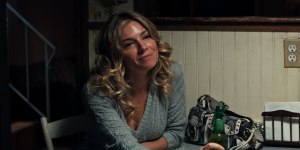
At first glance, Deb (Sienna Miller) is all-too-easily dismissed. She’s a former teen mom turned grandmother at 31. She’s a mistress whose hot date turns out to be a trip to a sleazy motel room, where she is handed a plastic bag containing either dollar store lingerie or a slutty devil halloween costume (same difference, really). The next morning, we see that she is waking up alone in her own bed, suggesting the motel room was paid by the hour.

At that point, we’re about five minutes into American Woman, and you’re ready to write Deb off.

But don’t. Don’t you dare.

AmericanWoman_02Because Deb is worth more than she even knows, which she stars to discover after her daughter fails to come home one night after a date with her basement-dwelling baby daddy.  A loved one’s disappearance must be life-shattering. Miller lets us see the dissapearance’s drastic effects on Deb in such a restrained and measured way that Deb’s resulting character growth is organic, believable, and most impressively, almost invisible at first. Deb’s evolution is captivating, and the Deb we know by the end of the movie is at once the same core character and a woman whose outlook and attitude have evolved beyond anything I could have ever expected.

I cannot overstate the magnificence of Sienna Miller’s performance in American Woman. She is magnetic and conveys a mix of strength and vulnerability that is as authentic a performance as I can remember. And while Miller is the standout, he excellence is almost always matched by the rest of the cast, including Christina Hendricks as Deb’s sister, Amy Madigan as Deb’s mom, and Mad TV’s Will Sasso as Deb’s brother-in-law. Deb is rightly the focal point but it’s great that the strong supporting characters each get the chance to shine.

The gauntlet thrown down by the cast’s fantastic performances is picked up by those behind the camera, and they are up to the task. Brad Ingelsby’s script is smarter than it has any right to be, discarding obvious answers on a regular basis, and showing off by giving effortless depth to secondary and tertiary characters (including turning an obvious villain into an earnest guy deserving of our sympathy). Director Jake Scott uses care and moderation rather than flash and sensationalism, particularly in a crucial scene at the film’s climax, proving beyond any doubt that less is more. Scott consistently makes brilliant choices even in small details, such as by using visuals and settings to indicate the passage of time, rather than title cards.

The result of all of this individual brilliance, naturally, is a standout character study that can hold its own against anything that TIFF18 has to offer (which I can say with certainty since I saw If Beale Street Could Talk and Roma on either side of it). American Woman is as smart, rewarding and satisfying a cinematic experience as anyone could ask for, making for a film that you absolutely do not want to miss.

TIFF18: What They Had

Ruth is confused a lot of the time, most of the time. Some days she wakes up not knowing who the old man in her bed is, determined to get home to her mother and father, who must be worried. The old man in her bed is Burt, her husband of many years. She’s his girl and he can’t stand being separated from her, so he keeps her at home despite it not being what’s best for either of them at this point.

One Christmas Eve, Bridget (Hilary Swank) gets a phone call from her brother Nick (Michael Shannon). Their mother (Blythe Danner) has left home in the middle of the night and their father (Robert Forster) can’t find her. Anywhere. In California, Bridget is dealing with her own empty nest, estranged daughter, and failing marriage, but she’s What They Had - Still 1been insulated from the problems with her father, who’s recently had a heart attack, and her mother, whose Alzheimer’s is only getting worse. It’s Nick who’s been dealing with them in Chicago and now he wants and needs her support in getting Ruth into a memory care facility – a suggestion he knows Ruth can’t consent to, and Burt will oppose vehemently.

What They Had is a tender movie about memory and family, and what it means to lose a loved one in increments. There’s no one in this family you can’t relate to, and it’s painful to watch them fail to unite, even in their grief. They are all, in fact, playing for the same time: each wants Ruth to be cared for. Burt think she should be cared for by the man who has spent a lifetime loving her, even though no single person can provide the round-the-clock care she requires. Nick worries that Burt caring for Ruth puts them both in danger, and is eager for professionals to take over and give him some respite. Bridget wants to avoid conflict and plays both sides, unwilling to see her mother neglected or her father alone. This is a choice that many families will face, and the film reflects our pain and reluctance so clearly it can be hard to watch.

Throuh it all, Blythe Danner shines her light. Ruth may not have her memory, or even a stable sense of self, but Danner always shows her humanity and her dignity, and even glimmers of humour and comfort. Robert Forster is wonderful, gruff and gentle, unwilling to let go of the love of his life. He is the movie’s anchor, and his family’s anchor, though not always a benevolent one. Is he a bit of a bully? Certainly he continues to treat his children like father knows best, and the dynamics are accordingly unhealthy. Bridget spins her wheels of indecision and Nick internalizes his anger. Shannon is terrific, as always, a kooky, rude, intemperate git who feels like everyone’s pain in the ass brother.

The film gives you permission to laugh. It feels uncharitable to do that with someone who has reduced capacity, but sometimes the jams Ruth gets herself into are quite funny. And sometimes they’re so egregious all you can do is laugh. Laugh or cry – and this movie will have you do both.

TIFF18: If Beale Street Could Talk

If this movie review could talk it would say: wow. And also: thank you.

How is it possible that Barry Jenkins is making GOAT movies right out of the gate? Is he for real?

If Beale Street Could Talk is about a love story, interrupted. Tish (KiKi Layne) and Alonzo (Stephan James) are young lovers and the world is theirs as they fall in love inside their bubble. He’s respectful, she’s adorable, they’re so in sync their clothes begin to match, the colours mirroring each other as they walk hand in hand in a highly-saturated stroll through the park, the perfect date that just happens to end at prison, where she drops him off. Alonzo is going away for rape – a crime he didn’t commit, not that the justice system particularly cares. Beale Street is both love story and tragedy at the same time.

The most powerful thing about this film, and indeed about James Baldwin’s original work, is how little shock we see from either family – and both families, and their community, rallies around them. And of course they’re upset, they’re devastated, and they should be angry and incredulous, but no one seems all that astonished that such a MV5BMjMxMWQ5MjctN2MwMC00ZGY1LWJkNWUtNmUwOWFmYzAyNWJjXkEyXkFqcGdeQXVyNTE4NTE0NjU@._V1_thing could happen, because of course they’ve seen it happen before. So they swing into action, because they know the drill. Though they have little money, they will fund-raise and do whatever it takes to work the case themselves because they know whatever lawyer’s appointed to them will be inadequate (though he’s actually not painted as a bad guy, interestingly), and that the system is rigged is against them. They aren’t wrong.

I said earlier that this was a love story, interrupted. Thanks to director Barry Jenkins’ genius, that’s true on more than one count. First, the literal one, where the two lovers are separated just as she’s discovering they’re pregnant and would have made a home together. Through flash backs we see their love story, and it’s beautiful in its simplicity, in its sweetness, but every scene is tainted by our knowledge of where it ends up. Jenkins obviously has a respect for the poetry of Baldwin’s prose. He uses it as a bridge between scenes, uniting flashbacks which almost seem dream-like with the harsh realities and razor-precision detail of their present day (1970s). The interruption is an opportunity for Jenkins to show how lyrically he can manipulate time as well as genre. Because for every pause he takes to explore a character and make note of some sweet detail, this story is also infused with a greater cry for social justice. This Beale Street could be any Beale Street. Alonzo could be any black man. And the system of oppression, which is not limited to crime and punishment, applies just as much today as it did then. This is a cry meant to be heard across generations.

James Laxton’s stunning cinematography helps establish not just breathtaking film, but black culture itself, the streets coming alive and vibrant under his lens. The way Jenkins plays with colour astonishes me, the virginal whites, the lust-drenched reds; somehow this movie is everything a movie can be. It’s everything. And this is only Jenkins’ third feature. The costumes are perfection. The set design is perfection. The way the camera talks to us, showing us where to linger, communicating hunger, or desperation, or separation. The emphasis is masterful but never gets in the way of itself.

Beale Street’s ensemble cast is the beating heart of this film, with James and Layne both claiming rights to future stardom. Their fathers (Colman Domingo and Michael Beach) are terrific as well, but for me Tish’s mom Sharon (Regina King) was the real standout. She is fierce and unwavering. The scene in which she confronts Alonzo’s accuser is deeply affecting, and it’s because of King, of the layers of emotion playing out on her face. I couldn’t look away. Notably, I also thought the mother in The Hate U Give (played by Regina Hall) was the best part of the movie, so I’m not sure if black moms are having a moment, or if it’s Reginas specifically, but watch out, they’re coming. Jenkins puts together a cast that becomes the fabric of his film. There is no detail too small to have escaped his love and attention. This is one of the better adaptations I’ve ever seen on film, and possibly the best. It works on so many levels at once you don’t even see the train coming until it hits you. It’s hard to outdo yourself when your last film won Best Picture, but Barry Jenkins is a director not to be fucked with.

TIFF18: The Front Runner

Jason Reitman has been busy lately. It’s been just four short months since the release of the bizarre but undeniably interesting Tully but the Oscar-nominated director was at the festival this year with a new movie and a very entertaining live read of the original Breakfast Club script to host.

Tully was the kind of movie that takes a couple of days to digest and decide how you feel about it. The Front Runner is a much more straightforward, Altmanesque look at three dramatic weeks during the doomed Presidential campaign of Gary Hart. I’m just young enough to be too young to remember Hart (played here by a fantastic Hugh Jackman) but even I know that his campaign was derailed after a story broke that he’d been cheating on his wife (Vera Farmiga).

When we first meet Hart, it’s 1987 and he’s the clear front runner for the Democratic nomination to run against George Bush. Hart just wants to talk about the issues and resists the distractions of talking about his private life and pandering to voters with cheap campaign stunts. His campaign manager (a rarely better JK Simmons) supports this approach and watching he and his staff debate strategy and plan campaign events while twelve things seem to happen onscreen at once is just a blast. Both Altman and Sorkin would be proud. Even as scandal begins to dampen everyone’s spirits, the pace rarely slows down. Intimate character moments of two people alone on screen tend to be so few and far between in this movie that it makes those moments resonate all the more.

I try not to read too many reviews before I post one but I can already see that critics have tended to respond to The Front Runner less enthusiastically than I have. On the one hand, I can understand why. It’s easy to get burnt out at this point on movies and conversations about how much political campaigns and political discourse has changed so much. Despite its clever dialogue, fast pace, and excellent acting, I can’t claim The Front Runner has much to add to the discussion nor does it give its audience much to debate or think about after.

I would argue that there is one very important subplot that keeps The Front Runner from being a classic case of all style and no substance. Hart’s scandal didn’t just affect Hart, his family, and his campaign. Young Donna Rice (Sara Paxton) was thrust into the public eye with little support from anyone except for one sympathetic Hart campaign volunteer (very well played by Molly Ephraim). A lesser movie wouldn’t have given Rice so much screen time (or at least have lost interest in her after the sex scenes).

Still, I’ll concede that maybe we didn’t need this movie. It’s less an Important movie than it is an impeccably made one. Which is really all I need. I plan on seeing again next chance I get.