Tag Archives: what to watch on Netflix

Dear Jack

Andrew McMahon was the front man of one of my favourite bands, Andrew McMahon Dear JackSomething Corporate, so I was a little miffed when he left to pursue a (solo) passion project called Jack’s Mannequin. Of course, that was before I heard the album and totally fell in love. McMahon is a crack song writer and his feverish piano playing is really exciting to watch live. His songs are energetic and poppy and if they didn’t quite reach the mainstream, they should have.

The successful release of Jack’s Mannequin’s first album, Everything In Transit, came when he was just 22 years old, and in the hospital battling leukemia. This movie is his cancer diary. It’s cheaply shot with home video cameras – truly nothing fancy. But it is very honest, and very grounding to watch a kid who is so full of life hear his new songs on the radio for the first time while also losing his hair and maybe even his hope. It’s sobering. At 22, his doctors are delaying chemo just long enough for him to freeze some sperm because although he’s never even considered whether he wants a family, now he has to prepare for the worst.

Spoiler alert: he survives, by the skin of his teeth, with love from his fans and support from his family and bone marrow from his brave sister. He survived to write a second Jack’s Mannequin album, the lyrics heavy with his hospital philosophy. That album, Glass Passenger, featured heavily on my mp3 player when I was in the hospital going through my own treatment. I think the music got into my veins through the IV drip and I’ve never really been able to shake it. So imagine  how miffed I was to learn that McMahon had ants in his pants once again and was disbanding my treasured Jack’s Mannequin.

But now he’s back, not just in documentary form, but with a new album that finally bears his name front and centre, just in time for6ef3aa1d6d8743d51e6f5c6161780fb8 another round of treatment for me. My favourite song off the album is about his darling daughter, a miracle baby after all her father had been through, a testament to his survival. And if you, or she, want to know a little more about how he made it through the dark days, Dear Jack offers some barrier-free insight.

Iris

Coco Chanel said “Before you leave the house, look in the mirror and remove one accessory.” Nobody needs to hear this more than I do, except I look in the mirror and go “Nah, it’s fabulous!” and maybe throw on a hat or a scarf before I leave.

My mother says I was always a fussy dresser. She abandoned the task to me when I was 2 because I complained about her lack of style. I knew which barrettes went with which dress, and when ruffled socks were appropriate, and when the tights with embroidered hearts would serve better. It was 1984: I was a material girl living in a material world.

Today I have a jewelry collection that’s taking over my house. I refer to it as “my sparkle wall” but only tradition keeps me from rightfully pluralizing it. Sean buys me diamonds and sapphires on birthdays and anniversaries and sometimes just on Tuesdays, but when I treat myself, it’s costume jewelry all the way, the bigger the better. I think Superbowl rings are modest. I think wrestling championship belts are understated. The dress doesn’t matter half as much as the height of the heels and the rhinestones on my cocktail ring. You know you have a problem when you’re at the store and the cashier asks “Are you a stylist?” It’s probably easier just nod yes and pretend these are for 20 models to wear in a magazine spread – maybe I’d even get a discount – but no, honey, these are all for me.

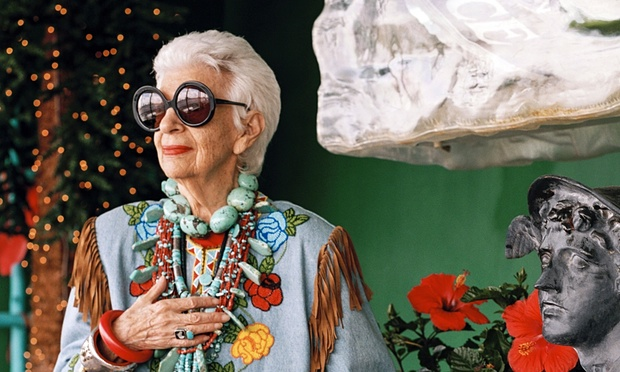
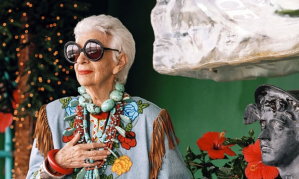
4e37cfaa-3606-11e5-_949112bI met my match – no, my better – recently when I watched a documentary entitled Iris. Iris Apfel is an American businesswoman, interior designer, and fashion icon. She and her husband Carl travelled the world to discover unique items and get inspiration for their textile business, and they did restoration work at the White House for 9 presidents, from Truman to Clinton (Jackie O. preferred the “Frenchie” stuff, disappointingly).

Iris is known on the streets of New York for her distinctive style. Always with a pair of 1068406oversized owlish eyeglasses, she layers on jewelry in a way I can only admire but never emulate. It’s amazing to me that her 90-something year old arms can support the weight of so many chunky bracelets.  The Costume Institute at the Metropolitan Museum of Art is so enamoured with her style, they put together an exhibition entitled Rare Bird: The Irreverent Iris Apfel. It was curated it with selections from her wardrobe and her accessories, and styled, of course, by Iris herself. Because Iris knows best. When the rest of the world is thinking “too much!” Iris is only getting started – and she’s right.

Iris isn’t just a fashion inspiration (or a  “geriatric starlet” as she would say) – she’s an boainspiration inspiration. The woman is 94 and still going strong. The documentary was done by Albert Maysles, who passed away earlier this year, just a month shy of the film’s release. And Carl sadly passed away in August, just three days shy of what would have been his 101st birthday. But these are all people living fully into their golden years, still being fabulous in whatever capacity they’re capable of. That really emboldens me. And I just like that she’s an outside the box thinker. And that her style reflects her upbeat personality. She looks different from everyone around her, and that takes courage.

She reminds me somewhat of Sean’s Granny, who is a fun and salty lady with her own unique style. Granny dresses exclusively in purple. I’m not even sure what store you go to for the purple pants, but she’s got em. How old do you have to be before you can just start doing that, I iriswonder? Granny is nearly 92 and as I’m new to the family, I’ve never known her any other way. She’s a great accessorizer to boot, and I know she sees a kindred spirit in me. Sean’s family is otherwise very traditional, they all look like they’ve stopped out of a Sears catalogue, and I’m just a very square peg to their very round holes. But both of his nonagenerian grandmothers have embraced me in ways no one else could. Granny has asked that I leave my jewelry collection to her in my will. Grandma likes to report back to her caregiver what outrageous hair colour I’m sporting on any given visit. Both will search me top to bottom for fresh ink. They were overjoyed when I sauntered down the aisle in black and fuchsia where there should only have been white. So maybe as you age, you become more yourself. More accepting of yourself, and less influenced by the opinions or judgements of others. And it’s that attitude that I like the best, in my adopted grandmothers, and in Iris Apfel, the star of a fascinating documentary you should look up on Netflix if you haven’t already, because they haven’t made one about Granny (yet).


Who’s the fashion plate in your family?

Weekend Round-Up

Project_Almanac_posterProject Almanac – I have mixed feelings about this one. I wasn’t bored by it, but the story is thin. I like the championing of the inventor, but I disliked the very trite time-travel routine, where the same costs and benefits are explored here as have been elsewhere a thousand times before. The kids are likeable enough but you know what? Enough with the “found footage” thing. It’s done. Let’s drop it.

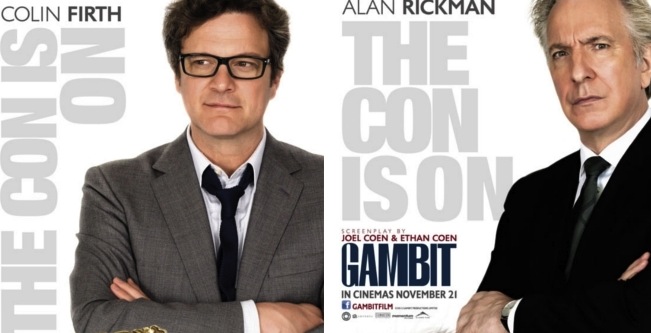
colin-firth-alan-rickman-and-a-lion-feature-in-first-posters-for-gambitGambit – A movie with Colin Firth and Alan Rickman AND Stanley Tucci you want to like. But can you? It’s a remake, written by the Coen brothers, about an art thief who recruits ditzy Cameron Diaz to pull  a fast one on his boss – and then dares to be surprised when it doesn’t quite get pulled off as planned. Firth is solid and has great comic timing but Diaz exists on a level so far beneath him it’s not fair to either. I have the feeling Firth was hoping for The Big Lebowski but ended up in The Ladykillers. Better luck next time, y’all.

San Andreas – The three Assholes who went to see this together are also the same three Assholes planning a trip to shitty, shaky San Francisco next month. Oh sure it seemed like a good idea at the time. Lots of wine, we heard, those weird, slopy streets, and just a beautiful coastal drive away from LA. San Andreas is not exactly a boon to tourism. Made it seem a little sanandreasreckless to travel there (let alone live there), in fact. But we survived the movie and as of this time have not cancelled our plane tickets, mostly because Sean couldn’t find the number. I watched this movie totally stressed out, from start to finish. Is there a plot to this thing? I have no idea. WATCH OUT FOR THAT FIRE! Is there good acting in this thing? I don’t know, does dodging debris count? WATCH OUT FOR THAT FLYING CRUISE SHIP! It was a disaster movie so jam-packed with disaster that some leaked out the sides. It keeps you so busy racing from one near-death experience to another that you never have time to question the holes in the movie, because every hole is filled with exploding glass – in 3D!

Dear Zachary: A Letter to his Son About his Father – In 2001, Andrew Bagby was brutally dearzacharymurdered. Soon after, his girlfriend, the prime suspect, announces she’s pregnant and Bagby’s bereaved parents have to interact with their son’s killer in order to gain any visitation with the grandson who looks just like him. This is a documentary Kurt Kuenne who isn’t a particularly talented documentarian, but who was Bagby’s best friend. This is a tribute to his friend, and also to the parents who went to great lengths to make a life for a grandchild born out of tragedy. I was prepared for this one to hurt my heart, but I wasn’t quite as prepared as I needed to be. Check it out on Netflix.

Aloha – Cameron Crowe’s greatest offense is being too successful too early in his career. Does this stand up to Almost Famous? No, it doesn’t. And not many movies would. But would people be giving Aloha as hard a time if it were written and directed by anyone else? This film is imperfect. It drags in places (but has flashes of brilliance to prop things up) and it tries to involve too many, which takes away from the central story, which is the one we’ve put our butts in the ALOHA-Movie-Reviewseats to see. Emma Stone plays Jennifer Lawrence opposite Bradley Cooper (what is it about Bradley Cooper, by the way, that his characters are constantly romancing women he could have fathered?). Anyway, he plays this deeply flawed individual and she plays so pert and perfect you want to punch her right in the googly eyes. But you’re supposed to root for them I think, even though Rachel McAdams makes a tantalizing (and age appropriate, while still being younger) alternative. They exchange some witty banter, some banal banter, look at an atrocious toe, and induce Billy Murray into a dance scene. It’s not a cohesive movie by a long shot, but nor is it as bad as the critics will tell you.  The story wants to be more than it is. The movie is beautiful but straight-forward. There’s very little art here. What we have in abundance is white people, puzzlingly, since it’s set in Hawaii, where the census tells us they’re relatively rare and Hollywood tells if you squint hard enough, George Clooney passes for Hawaiian.

goingclearGoing Clear – The more I learn, the less I understand. I didn’t learn anything new (in fact, nothing that’s not on the Wikipedia page), and I think they went a little soft on the former members they interviewed. Has anyone else seen this?

Virunga

I cried.

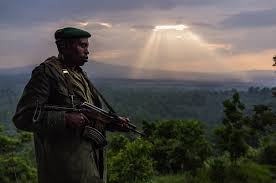
virunga3Virunga is a national conservation park in the Democratic Republic of Congo, which houses the world’s last mountain gorillas. The rangers who work there risk their lives to protect the park and its primates from poachers, war, and Big Oil.

Director Orlando von Einsiedel first travelled to the Congo in order to document the park’s positive impact on development and tourism, but within 3 weeks of arriving, M23 rebels were pushing into the area.

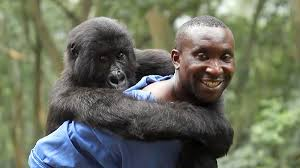
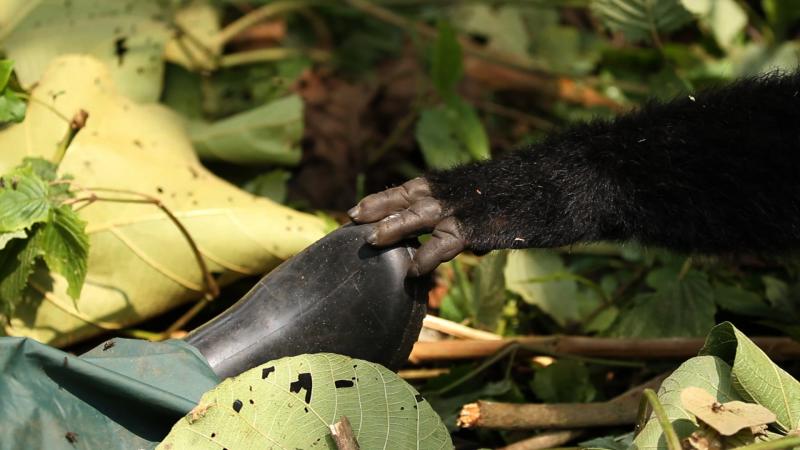
Within the park is a “gorilla orphanage”, two words I’d never put together before in my life, and 04_kabokowhich struck a really emotional core in me. One of the orphaned gorillas has only one hand; his stump is a reminder of the conflict in the region of which he has been victim. Am I so inured by images of war-wounded children that it now takes a maimed gorilla to give me pause?

One of the rangers talks about “une grand tristesse” – a great tragedy – of finding a pack of gorillas slaughtered in the jungle. It was thought that if there were no more gorillas, there’d be no more need for the park. But with so many threats to the park, who was the culprit? Soco International, a British oil company, certainly seems like a guilty party. But the rangers and villagers put aside the investigation to mourn the majestic creatures. If you’ve ever wondered how many pallbearers it takes to carry the corpse of a slain gorilla, this film has the answer.

virungaMeanwhile, it’s not just gorillas who are dying. 130 rangers have given their lives in the service of this park. To many, Virunga is a symbol of hope, a way to heal their “pays cassé”, their broken country, a positive contribution to a country’s questionable legacy. The four gorillas who live in the orphanage are given love, and a surrogate family. But when the rebel army moves closer and bombing can be heard, a gorilla curled up in the fetal position is such a pathetic sight, one that stands in for so many other images of tragedy, that you can’t help but be moved.

The film plays out urgently – the rebellion taking human lives as the Congolese army flees; Socovirunga1 bribing rangers to exploit a protected World Heritage Site, stealing yet more resources from an area that has nothing to spare. There is drama and tenderness in equal measure. I guess what got to me is that it shows quite starkly the best and worst of human nature, and it leaves it in our hands as to which side will ultimately win.


virunga4You can stream this Oscar-nominated documentary on Netflix. If you’d like to learn more about what you can do to help the park, please visit www.virungamovie.com.

From One Second to the Next

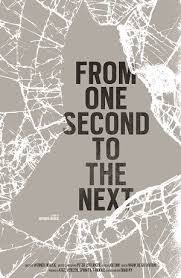
From legendary documentary film maker Werner Herzog comes Frome One Second to the Next, an unflinching look at the consequences of texting and driving.

This documentary is really about content. Herzog tries to jazz it up with some stylized shots of people kneeling thoughtfully beside crash sites, or the empty hand of someone who was once holding on to a child for safety, but these shots are glaringly unnecessary in a film that already has an impactful message.

Of course we hear from victims, or victims’ families, but these accounts are as predictable as they are tragic. It sounds like testimony, like victim impact statements. We find more connection in other moments, like a police officer choking up over an infant’s fatal injuries, or the blank stare of a woman so traumatized she registers no emotion hearing her sister list the extensive damages incurred to her both physically and financially, but suddenly engages when recalling her dog, also a victim in the acciddent, who flew violently threw the air before landing where he would ultimately die, but not before seeing his owner into an ambulance.

I was glad to hear from a couple of the perpetrators (and angry to not hear from all). Their regret is palpable even if their sentences are underwhelming. For the most part, the film keeps its focus appropriately on the victims, always with the distinct undercurrent of the complete preventability of their deaths.


from

This film is available on Netflix.

56 Up

I learned about this documentary through watching Life Itself , the ode to Robert Ebert.He was apparently quite a champion of this series and I was curious to find out why.

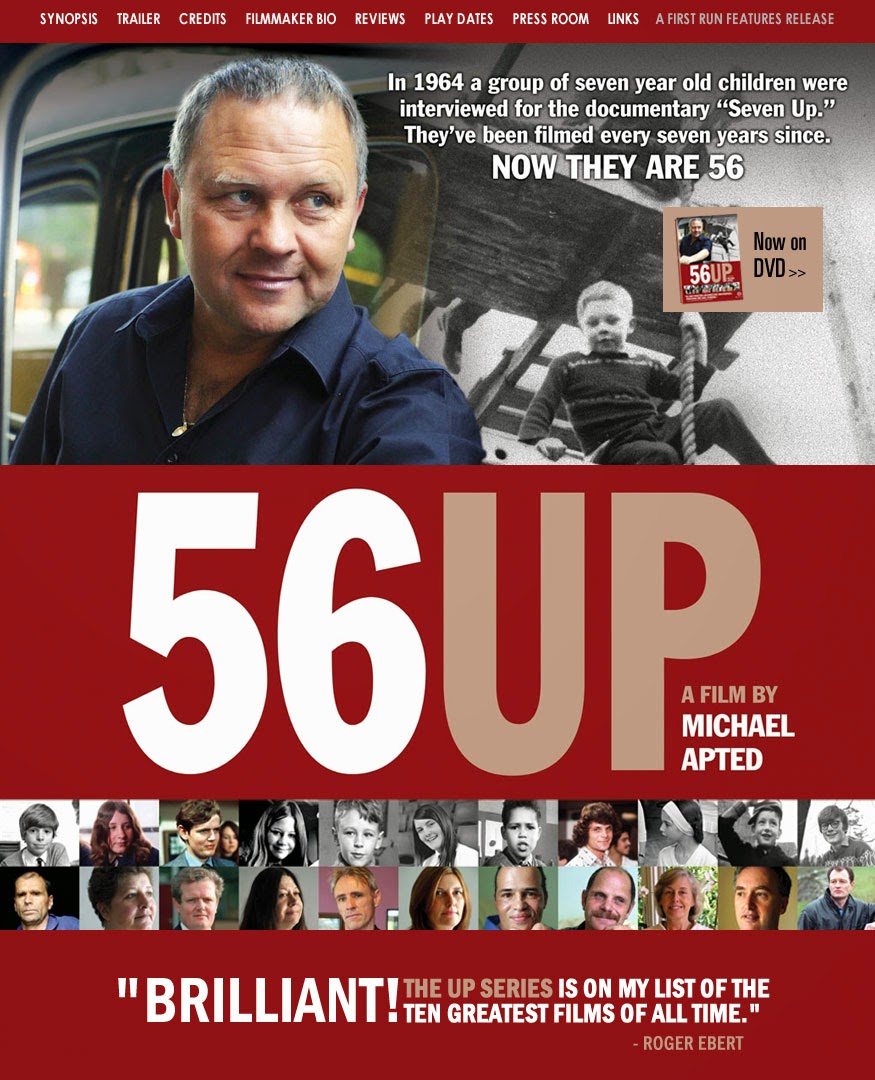
In 1964, the movie’s producers assembled 14 “diverse” (meaning 1 biracial kid, 4 girls, and 2 kids from the country) seven year olds and asked them a whole bunch of questions about what it was like being them, and what they saw for themselves in the future. The premise was taken from a Jesuit motto “Give me a child until he is seven and I will give you the man.” It was thought that at the time that these 7 year-olds would be heralding civilization into the next millennium (ie, they’d be grown up and leading us into the year 2000). The film has checked back in with the group every 7 years since, with this last installment, the group at age 56, filming in 2012 and airing in 2013.

What we get to watch is a decades-long social science experiment. These are very much ordinary people updating us on the minutiae of their lives. What have they become? Are they fullfilling their own prophecies? Living up to their potential? The director makes no bones about his original thesis – he assumed that each child’s social class would predetermine their future.The kids were apparently selected from different backgrounds (though like I said, they all seemed to come from the same end of the colour wheel). And the director himself admits that he didn’t anticipate “feminism” – he deliberately only followed 4 girls because it was sort of thought – who cares? They were never supposed to “become” anything anyway.The children were not held under contract so every 7 years since, they can volunteer (or not) to do the update. Though many express apprehension and sometimes even animosity toward the series, all but one have continued to make appearances.

Watching this, I wish I had started at the beginning. We see glimpses of previous interviews, we see the child, and the middle-aged adult, but I would have liked to have seen more. Each person presents us just a slice of their true picture, but we do pick up on divorce, unemployment, miscarriage, aging and ailing parents, the struggles of parenthood, and everyone’s changing (or static) politics.

The original hypothesis being that their life paths should have been set at birth has proven surprisingly (depressingly) true – most who started in the working class have remained there. But the interesting bit is not judging their success by the class which they inhabit, but rather by watching them judge it for themselves, over time. Are they happy? Satisfied? Do they feel they’ve wasted their lives? Contentment spreads over all the classes, as does doubt and regret.

I won’t summarize each of the subjects because that’s the point of the movie. One who really caught my eye though, I believe his name was Neil, was a sweet and charismatic little boy, not the one you might have guessed would grow up with mental health issues, only to battle thoughts of suicide, and spend time both jobless and homeless, but that’s what this film uncovers. These are not always pretty truths, but that’s exactly what we need to see. A little bit of reality before “reality TV” was ever a thing.

The exciting thing about watching this rather banal update is that it makes you question yourself. You wonder what you would have been telling the producer when you were 7. What job did you believe your future self would hold? I think when I was seven I wanted to be a teacher, which rather disgusts me now. My nephew (still a few years shy of 7) wants to be a green dragon when he grows up. Did your seven year old self think you’d ever get married? Or travel? See outerspace? Work a dead end job? Be a single parent? Are we failing our inner child’s dreams for us? Have we settled? Should we be happy with the compromises we’ve inevitably made? Are we learning from our mistakes? How do we really measure happiness, and what exactly is “success”?

Whatever experiment this started out as, it’s now become a question of existential proportions. And while I enjoyed watching this, I wished I was watching it with someone, maybe even some of you assholes, because I wanted to ask you these questions. Who did you think you would be when you were seven? Who do you think you’ll become in the next seven years? And at what point in your life can we really take stock, and declare it a success or a failure?

This movie is available to watch on Netflix.

Winter’s Bone

Ree is not your average high school student. With her mother semi-catatonic and her father in prison, she’s the one who cares for her mom and her younger siblings. But resources are scarce and times are hard – Ree (a young Jennifer Lawrence) is used to making do, but there’s very little you can make with nothing, and the doing’s getting thin. So things aren’t great and that’s BEFORE the law comes knocking on her door. Her father’s been released but is MIA and of course he’s put up their house and the little they own as bond. If he doesn’t show up to court, they’re out on the streets. And I don’t even begin to know what that means in the middle of rural, frigid, hostile Ozark Mountain.

So Ree takes it upon herself to go looking for him. The neighbours are vaguely MV5BMjIzNDI4NTc2MF5BMl5BanBnXkFtZTcwODU1MjM0Mw@@._V1_SX1500_CR0,0,1500,999_AL_threatening, heck the landscape is vaguely threatening, but her uncle Teardrop (John Hawkes) is outwardly threatening, and let’s take a moment to remember that it’s his SEVENTEEN year old niece we’re talking about. Everyone’s a little nervous about the specter of her father and nobody’s above slitting the throat of a teenage girl if it means upholding the code of silence that seems to permeate local culture.
Jennifer Lawrence was originally turned down for the role for being “too pretty.” She showed up unbidden to the next audition looking decidedly less so and won the part for her chutzpah. Most of her costars, however, were real locals with no prior acting experience. The costume designer exchanged new clothes for the locals’ own old pieces, and that’s what was worn during production. Shooting on location in Missouri, Lawrence got her hands dirty for the part, learning to skin squirrels and chop wood and shoot a gun. She received an Oscar nomination for her trouble (age 20 at the time, she was then the 2nd youngest to receive one). So did John Hawkes.

Ree seems to have sprung up out of nowhere, espousing values in a moral void. She is not your typical hero. She’s quiet and unassuming an wishes she could afford to disappear. Joining the army is the dream she abandons. It’s a pretty humble way to be a hero, but needs must, and director Debra Granik keeps the movie grounded among its people, never above.


Paris Is Burning

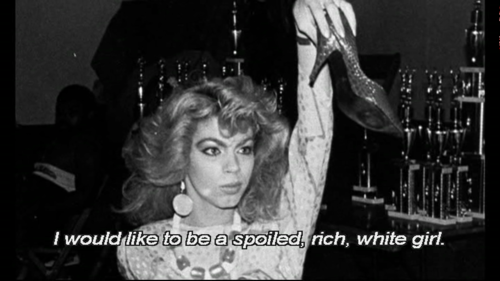
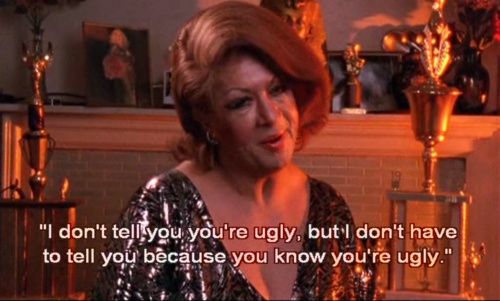
Shot between 1985 and 1989, Paris Is Burning is a documentary that explores the “ball culture” of New York City. These balls were beauty pageants of sorts, for drag queens certainly, but categories for competition tended to make room for black people, latino people, gay people, and transgendered. These categories and sub-categories are so structured that I could never explain them all to you, but people competed in “executive realness” (how well you can “pass” for a business person), for example, or showed off their catwalking skills, elaborate costumes, or dance moves.

Competitors grouped together in “houses” (like the House of Chanel), which were substitute families in a community that really needed them. Director Jennie Livingston spent years untitledinterviewing people and putting this thing together, and it’s given me insight into a world I never knew existed. Drag isn’t just a subculture here, it’s a complex thing of race and class and gender identity that allowed for a pretty wonderful self-expression.

The film brought voguing into the mainstream although it was actually just a small part of the movie. What I’ve gleaned is this:

First, reading: to get a good ‘read’ on someone, you find their flaw and you come up with a good insult about it. But the truer the flaw, the better the read. It’s not just about being mean, it’s about being shrewd I think.

Then, shade: to throw shade is to slyly insult someone. You disrespect them with trash talk.

ce88fc3c9f794ffee427b2d604b854d5And finally, voguing: which is the dance equivalent. I never knew that all these concepts were somehow interconnected, but yes, voguing is part of a dance battle where you freeze repeatedly in glamourous positions (as if you’re a model on the cover of Vogue magazine), trying to outdo each other. A few years later Madonna will bring this trend to the mainstream, white-washing it and losing its flavour, but it’s actually a pretty cool thing to watch the real stuff go down.

Escape From Tomorrow

The great thing about Netflix is that you get to watch free movies online. Okay, maybe not exactly free, but once you’ve paid your negligible monthly fee, there’s a whole buffet of movies just waiting for your fat ass to partake – and it’s all you can eat! Some movies are more salad bar, and some are more sundae bar, but if you take a little of each, you’ll end up with a nicely rounded meal.

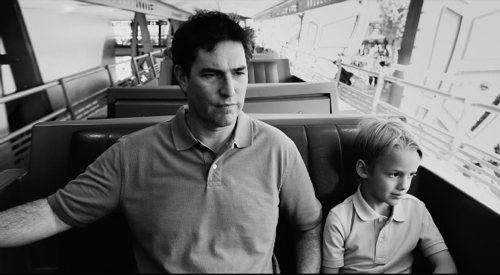
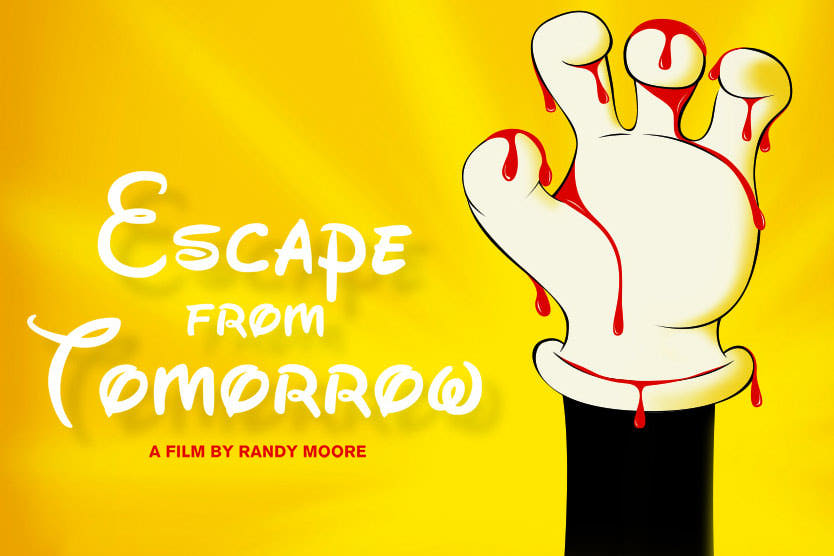
Escape-From-Tomorrow-PosterI happen to have a soft spot for independent film, but those are like the shrimps of an all you can eat buffet in Vegas. Tempting, but dicey. You never know if you’re going to score with cheap and delicious seafood, or win a free trip to the nearest toilet, where you’ll stay for the rest of your vacation. But since I like to live on the edge, I gave Escape From Tomorrow a go.

A debut for writer and director Randy Moore, it’s a black and white fantasy horror that recounts the last day of a family vacation where the father has just learned that he’s lost his job. It was shot guerrilla-style in the Disney World park without Disney’s knowledge or consent. They kept scripts eft2hidden on iPhones and used only handheld cameras that other tourists might use. They were never discovered.

The family vacation is not like a trip to Disney that I’ve ever been on. The rides and animatronics are familiar, they seem the same parades of characters, but poor unemployed dad starts to have some really disturbing visions. Like, super disturbing.

The film makers plotted the sun’s positioning weeks in advance since they knew they couldn’t bring it lighting, but chose to render it in black and white to help ease the issue. To avoid detection, Moore escape-from-tomorrowfelt he could risk 3 or 4 takes of any given scene at most, and he had his actors wear digital recorders taped to their bodies rather than have visible mics. The cast and crew bought season passes to both Disney World and Disney Land, and despite the fact that they rode It’s a Small World over and over wearing the exact same clothes, they never attracted attention from park staff.

Moore was so paranoid about Disney finding out, he took the film to South Korea for editing. It debuted at Sundance under shrouds of secrecy – and you can understand that a film that shot illegally in its parks and depicted the princess characters who pose endlessly for photos with your maxresdefaultkids as high-priced hookers for Asian businessmen might be frowned upon by the house of mouse. Reviewers encouraged people to “see it while they could” but a Disney lawsuit never materialized. They have widely ignored the film, choosing not to add to the hype machine that was quickly gaining steam.

At the end of the day though, I think this movie is more fun to discuss than to watch. Yes, it’s audacious and ballsy and possibly the future of film-making. But it’s only sometimes successful in its execution, and the surreal stuff pushes the boundaries a little too far. There’s an intermission an hour in (I could have sworn it was more like 3) – and I was ready to be done. Turns out, the worst was still to come. So did this little Netflix experiment turn out to be bad shrimp? It may have made me a little queasy, but I’m glad I gave it a chance.