Yearly Archives: 2017

CHIPS

CHIPS is an exercise in tempered expectations. One title card should be all the tempering you need: ‘written and directed by Dax Shepard.’ Dax Shepard isn’t exactly a visionary film maker. At best, he’s taking home a Participation ribbon from the He’s Trying His Best Awards. But why would you expect more from a guy who got his start on the prank show Punk’d? His whole career has been one big blinking caution sign: Hey guys, PLEASE don’t take me seriously, because I sure as hell don’t.

That said, CHIPS wasn’t nearly as bad as I was expecting – but then again, maybe that’s because I was expecting hot, runny garbage and what I got was a neat and tidy compost bin. You may hope for “HAHAHAHAHA!”, but count yourself lucky to get a few “hehs”.
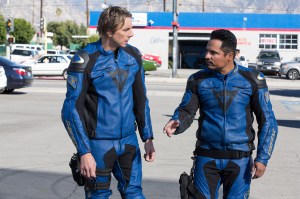
Chips-The-Movie-15I am much, MUCH too young (and beautiful, but that’s besides the point) to have grown up watching CHIPS so the movie didn’t do a damn thing to disillusion my childhood or anything near as serious. It’s a dumb movie written by a guy with a pretty juvenile sense of humour. What you see is what you get.

Shepard plays Jon Baker, a slob, a deadbeat, and a broken shell of an ex-motor cross rider, and he’s also the lowest-scoring guy to ever be pity-hired by California Highway Patrol. Baker’s about to be partnered with his polar opposite, the suave, well-groomed, cocky undercover agent Ponch (Michael Pena) who’s investigating the CHP for crooked cops. Somehow they have to overcome the deficiencies of their partnership (and the script) to take down some very bad dudes.

The movie has its moments: good moments, and hella-bad moments. I did enjoy seeing paparazzi get plowed, Adam Brody get shot multiple times, and Vincent D’Onofrio be described as a man who “never sent a mother’s day card” and maybe also “eats koala bears.”

There’s no mistaking this for a good movie but if you’re in the right kind of mood (read: loosey-goosey), it just might do. And the fact that the cast is rounded out by tonnes of people who have either worked with Shepard or his lovely wife Kristen Bell before to me speaks volumes: he must be a good dude with the comedy stylings of a brazen 12 year old at his first sleepover. Friends in the cast include Ryan Hansen (from Veronica Mars), Josh Duhamel (When In Rome), Maya Rudolph (Idiocracy), Jessica McNamee (Sirens), and Mae Whitman and Rosa Salazar, both from Parenthood. I’m not saying it makes for a good movie, because it doesn’t. But it must mean something, right? In this case, it means a 100-minute celebration of the brainless low-brow.

Blind

Alec Baldwin plays Bill, a writer and English professor who lost his sight and his wife in a terrible accident. Demi Moore plays Suzanne, the woman sentenced to read aloud to him. Sentenced in a court of law, by the way, by a judge who finds her guilty by association of the insider trading perpetrated by her husband (Dylan McDermott). Although Bill is cantankerous and spends his first encounter with Suzanne boldly insulting her, the two form a predictable romantic relationship.

But then BAZINGA! – the felonious Dylan McDermott is released from prison on a nasty technicality and Suzanne is faced with the age-old question that beleaguers only the women of a certain set: stay with the man who funds her lifestyle, or leave with the man hero_Blind-2017she actually loves. Oh to be rich and luxuriously useless!
If Blind was a martini, I’d send it back. The verdict: too weak. The writing ranges from bland to cheesy to downright embarrassing. It’s also not strong enough to write a character that we can distinguish from the real-life Alec Baldwin. Neither is Baldwin up to losing himself in a character. Bill’s epic rants are a little too familiar to anyone who has access to the internet, or late night television. But those are the only facets of the character that ring true; Bill’s conflicted, tragic side is limp, unfulfilled. Not to worry, though: in choosing Demi Moore to play opposite, the film has at least assured that no one will show Baldwin up. I’m not sure if Moore was ever capable of any great heights as an actress, but these days playing a wealthy socialite seems beyond her reach, even though I think that’s pretty much who she plays outside of work, all the time. Perhaps her ability to act began to dissipate around the time she lost the ability to move her face. Too many injections later, she can’t communicate anything beyond complete and utter passivity, which is inadequate for a woman wrongly accused, full of contempt, about to embark on a passionate affair after finding out her marriage is built upon lies and infidelity. Demi Moore: blank stare.

When you pair a man who is constantly dialed up to 10 with a woman who can barely achieve a 1.8, it makes for a strange combination. It’s hard to know whether to believe the love story being told in lifeless, monotone words, or the pained expressions on their faces that say otherwise. This melodrama is better suited to the Hallmark channel.

Logan Lucky

Jay-Z announced his retirement from the rap game in 2003 with his Black Album. He was back three years later. Barbara Streisand retired from public performance in 2000 but has since toured the world not once but twice. Clint Eastwood declared his intention to retire from acting after 2008’s Gran Torino “You always want to quit while you are ahead” — then appeared in the forgettable 2012 movie Trouble With the Curve. Alec Baldwin wrote “Goodbye, public life” in New York Magazine but made three movies the following year. Shia LaBeouf infamous marked his 2014 retirement with his “I’m not famous anymore” campaign, then signed up for a movie role 3 weeks later. Cher embarked on a 3-year farewell tour, then signed up for Las Vegas residency as soon as it ended. Michael Jordan retired from basketball, played a little baseball, then went back to basketball. Point being: fools keep retiring, then unretiring. Director Steven Soderbergh belongs on the list, after telling everyone in 2013 that he’d lost his passion for film making, and that was it for him. Logan Lucky is the movie that brought him out of “retirement” – was it worth it?

loganluckybros.0Having directed Ocean’s Eleven, Twelve AND Thirteen (and producing the upcoming Eight), Soderbergh is no stranger to heist movies, but considers this one to be their “anti-glam” cousin. Logan Lucky’s characters are gritty, the setting low-rent, the heist a lot less slick – but not uninteresting.

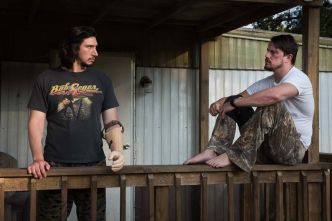
The Logan family consists of brothers Jimmy (Channing Tatum) and Clyde (Adam Driver), and little sister Mellie (Riley Keough). They’re known locally for the Logan family curse; Clyde believes the bad luck sets in just as things start to pick up for them. He recently lost an arm just as his deployment was ending in Iraq. Jimmy, meanwhile, has just lost his job at the mines where he uncovered a bunch of tubes that blast cash money from a NASCAR speedway to an underground bank vault. You can practically see the light bulb go BING! above his head. Soon he’s plotting an elaborate sting that will reverse the family’s fortunes. The one little hitch in is plan is that the heist requires the expertise of Joe Bang, bomb maker (Daniel Craig). And it just so happens that Joe Bang’s in prison. Which means to pull of the heist, they first have to break Joe out of (and then back into) prison.

The caper’s afoot! Logan Lucky has a fun ensemble cast that keep things spicy. The film works because Soderbergh reaches for his familiar bag of tricks: a zippy pace, an almost zany plot. These characters are perhaps not the cleverest, they’re reaching above their pay grade. Half the fun is watching things go wonky. Instead of plot twists, Logan Lucky is peppered with…shall we call them mishaps? Small calamities that keep you groaning, and guessing. It’s almost farcical, and to that end, it’s well-cast. The movie doesn’t take itself too seriously, and Daniel Craig is its shining, absurd beacon, stealing all the scenes he’s in and making you anticipate his next one when we’re following someone else.

Unfortunately, the movie really loses steam during its last act. Introducing Hilary Swank as the detective pursuing the case feels both rushed and drawn-out at the same time, somehow. Plus she’s kind of awful. But you know what? The film’s final 10 seconds save the whole damn thing, the cinematic equivalent of a smirk and a wink, and I fell for it.

Welcome back, Mr. Soderbergh.


Valerian and the City of a Thousand Planets

Long before I saw this movie, I was annoyed with its title. The trailer gave the impression of a crime-fighting intergalactic duo, and yet for some reason only the boy seemed to get credit. It’s based on the graphic novel Valerian and Laureline, which means the author himself thought of them as equal partners, it’s only Hollywood that’s decided to downgrade the woman’s presence while also prancing her about in a bikini at every opportunity.

Having seen it, I see there are way bigger problems. The casting, for instance, made no thumbnail_25961sense at all. Supposedly, Valerian and Laureline are capable, dependable galaxy-savers, but nothing about either of these two gives the impression of a even the remotest shred of competency. I wouldn’t trust them to house sit for me; if they were in charge of saving my world, I’d be biting down on my cyanide tooth. But this movie wants me to believe that not only are they upstanding employees, but ready for marriage, even though they look like perhaps they’re only just now discovering the growth of hair over various private body parts.

Cara Delevingne has only ever managed to be convincing as an underwear model, which is what she was before stumbling into “acting.” When a director casts her in a movie, it’s like they are putting a disclaimer on their movie “Yeah that’s right, this is going to suck. Style over substance!” Her acting technique consists of walking into a room eyebrows-first and saying the line, usually in the direction of the camera. She has the emotional range of a robot but none of a robot’s grace or fluidity. Dane DeHaan, on the other hand, looks like he should be bagging groceries at the Piggly Wiggly. Put these two chuckleheads together and what do you get? Just two dumb rocks in a potato sack. Or, in the case of Valerian and the City of a Thousand Planets, two dumb rocks in a tin can (aka, space ship). If that wasn’t enough to convince me of its utter superficiality, I guess the sight of Rihanna pole dancing would have pushed me over the edge. Though to be fair, I would have gladly watched her dance for a thousand days rather than see Ethan Hawke play a pimp with a nose ring.

The whole thing was so uncharismatic, the movie almost killed me of boredom. I was so numb I could barely follow the “plot” which, like too much sci-fi fare, consisted of: something’s in danger, someone has to save it, fight, fight, fight, special effects, special effects, the end.

It Had To Be You

It Had To Be You is an interesting gender-role reversal. For once it’s the boyfriend who’s the serious one, ready to make a commitment and put a ring on it, and it’s the girlfriend who is reluctant to do the whole marriage thing. Unfortunately, Sonia (Cristin Milioti) and Chris (Dan Soder) haven’t really talked about their differences, so when he blindsides her with a romantic proposal, he’s pretty hurt when she balks and can’t accept.

She doesn’t exactly say no, but the ‘time to think’ required stretches on into infinity and MV5BNzg0NzE3ODUzOF5BMl5BanBnXkFtZTgwMjY5OTgyMDI@._V1_SY1000_CR0,0,1776,1000_AL_pretty soon Chris is fed up with waiting. In the wake of their inevitable breakup, Sonia is inspired by a fellow subway rider’s thong (no I am not making that up, thankyouverymuch) to fly to Italy to find herself, and by herself, I mean some Italian guy’s dick.
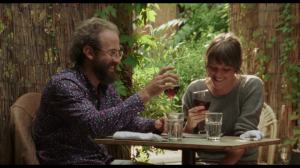
I won’t pretend this is a super great movie, but I gave it a try because I really like both Milioti and Soder (any other campers out there?) as comedians, and it turns out, worth the risk. The script is just clever enough to revive a genre that usually stinks like a four day old walleyed fish, and the two leads are un-actory and quirky enough to be likeable, relatable, and not quite predictable.

So there you have it: It Had To Be You is like a nice, refreshing glass of lemonade on a hot summer’s day. Sangria would have been better, but lemonade will do. 😉

Person To Person

the Best Western

the blue collar town where I grew up

guys who want to go dutch

tap water

prison-issued eyewear

hold music

vodka soda


You get it, right? What are: things that are completely & utterly devoid of charm or personality. Such as this movie.

Person To Person almost killed me with boredom. How to summarize a film totally bankrupt in plot? Well, see, there’s these people. Some of them know each other, some of MV5BOTVlZGRiN2QtZTJkMi00NjcxLWIzYTItMTY1MzQzMTBhYWVkXkEyXkFqcGdeQXVyNjU2NTMxOTg@._V1_them don’t. And they have these lives. And they spend the day going about them, just generally moping about, doing a lot of whining and talking. The end.

Person to Person is that balding guy in your office who wears khakis and polo shirts like they’re his uniform, who eats the same sandwich and celery every day for lunch, who has nothing to talk about except the weather, and who you once caught reading the phone book.  I see that Rotten Tomatoes got drunk, brought that guy home, and gave him a pity fuck (that’s my way of saying its score of 45%, while still rotten, is also completely unjustified – an overshot of at least 43%, I’d say). This movie was so dull I had to invent an all-new category for it on Assholes Watching Movies: Boring as Hell. But unlike Person to Person, at least hell is warm and peppered with interesting characters.


The Circle

The Circle is THE company you want to be working for. It’s a blatant stand-in for Google; the ‘The Circle’ campus and work space looks identical, comes with all the crazy perks we’ve been jealously-not-quite-believingly hearing about for years: sushi bars, yoga workshops, nap pods, etc, etc. Mae (Emma Watson) is ecstatic when she’s hired for an entry level position – the salary is generous, room and board are included, the health plan is fabulous – it’s more than any millennial has the right to expect these days. The only thing The Circle asks for in return is a complete lack of privacy.

And in fact, The Circle doesn’t just ask that of employees, but of everyone joining their network. The Circle is a platform that would link all of your online accounts. You’d have one account, one username (your own, your real one), one password that links to everything, all your aps, your bank, your email, your work, social media, etc, etc. The m-442_circle_11286fdrv1rdream come true starts to feel a little…invasive to Mae. There’s no turning off, no going off-grid. Everyone participates in everything all the time! Horray! So the dream is turning out to be a bit much, but with her father (Bill Paxton) suffering from MS, it’s extremely hard to turn down.

Most of her The Circle colleagues are drinking the kool-aid but she finds a kindred spirit in skeptical Ty (John Boyega). He’s worried about how every single piece of our lives are being accessed and stored, analyzed and monetized, by The Circle: personal data is being mined to make a few people very, very rich. And if you have any presence on the internet at all, there’s nothing you can do about it.

The Circle is a terrific book by Dave Eggers. It’s an urgently fascinating story because our reality is probably only about one and a half paces behind what’s depicted in The Circle, and that’s just what we know about. We’re creeping closer and closer every day. Unfortunately it seems that Eggers’ brilliant books are not that easily adapted into films; A Hologram for the King was also a bit of a flop and that’s too bad because there’s some really thoughtful and thought-provoking material in there that’s getting lost.

The film asks more questions than it answers. In truth, it sort of lets some of the issues it raises fall away without doing them any justice. So that’s unfortunate. I still thought the movie was compelling and watchable, and Tom Hanks is of course irreproachable. I think it’s worth your time. But the book is even more worthy of your time, and if you read it, you’ll see the changes that Hollywood makes to make a story more ‘palatable.’ But I’m pretty confident that you can handle the truth. Right?


This was Bill Paxton’s final film. He died before it was released; a dedication in the closing credits reads ‘For Bill.” Glenne Headley, who plays his wife, died in June. She’s got a couple more movies in post-production.

Snatched

This film was dismally received by critics but is not as terrible as you might think. A lot will depend on how you tolerate Amy Schumer. She’s not everyone’s cup of tea. I like her quite a bit, which makes me realize that she’s not anyone’s cup of tea, she’s more like a beloved Jaeger bomb. Some people don’t like or expect raunch from a female comedian but Amy Schumer’s proving that anyone can tell a gross-out joke. Score for feminism? Let’s say yes.

Of course Amy Schumer isn’t some new fangled-thing, she’s riding in on the backs of lots of incredibly funny women and Goldie Hawn is one of them. Hawn hasn’t appeared in a maxresdefaultmovie in 15 years and having her back is a blessing. Pairing these two together is great. It should have been better than great, I’ll grant you that. It should have been phenomenal. But Snatched isn’t ambitious. It’s pretty content to be a so-so movie with a bare-bones plot, some badly-drawn characters, and some overly convenient structures. It’s basically a vehicle for some jokes, and for some shining chemistry between Schumer and Hawn. If you can live with that, then you may just find something to chuckle about in Snatched.

As you may have gathered from the trailer, or heck, even just the poster, Emily (Schumer) gets broken up with right before an nonrefundable trip to Ecuador, and persuades her cautions mum Linda (Hawn) to travel with her. Emily meets a guy who’s too good to be true, and he is! He’s part of a kidnapping ring, and before you can say “maitai”, Emily and her Mom are hog-tied in a blood-splattered cell, begging for their lives, or at least their cell phones back.

The worst I’ll say about the movie is that there’s a lot of missed opportunity. It’s unfocused and flimsy. But Goldie Hawn is still magic. She sparkles up there on the big screen, and it’s kind of cool to see her taking her place as one of the matriarchs of comedy.

Girls Trip

Ugh. This kind of movie is just demeaning.

There’s a good idea in there somewhere: four friends reconnecting. That’s the dream, right? That for one weekend you can all make your schedules obey your will, find sitters for the kids, money for the trip, time off from work. And everything converges on one magical weekend during which you can let your hair down and party like you did when you first met your crew, back when you were single and carefree.

The four friends in Girls Trip haven’t gotten together in 5 years.  Ryan (Regina Hall) is an aspiring self-help guru\daytime TV star and she and her husband are about to get their big break – too bad she can’t stand his cheating ass. Sasha (Queen Latifah) is on the verge girlstrip0004.jpgof bankruptcy and the only thing that might save her is a whole bunch of hits to her celebrity gossip site…and it’s awfully tempting when your best friend is poised to become the next Oprah just as her marriage is imploding. Lisa (Jada Pinkett Smith) is a less important friend so we don’t know much about her except she’s a caring single mother who wears scrubs at work and is pretty high strung. And Dina (Tiffany Haddish) is hardly a character at all, she’s just there to provide the kind of lewd laughs the other ladies are too famous for, contractually. It’s hard to believe they were ever friends, or that a weekend away together wouldn’t result in murder since in the film’s exceedingly long but comparatively short running time (2 hours), I had the panicky urge to start stuffing people in dumpsters.

Anyway. The script is atrocious. It’s Hallmark-grade MAYBE, heavy-handed as hell. It wants to be a females in New Orleans version of The Hangover, and it even steals a lot of their jokes (substitute roofies for absinthe, for example), but it’s weak. Very, very weak. But there are a few things that Girls Trip provides that you are unlikely to find elsewhere: 1. A “grapefruiting” demo (it’s a sex thing, duh – basically a grapefruit turtleneck for excessively large penises to aid in the blow-jobbing of). 2. You’re not seriously going to insist on a second item after that first one, are you? 3. Okay, fine: Kate Walsh as the token white lady who can’t stop talking in Ebonics. 4. As the movie is set at the Essence Festival, the film bloats itself with clips from performing artists such as Puff Daddy, Faith Evans, Maxwell, Babyface, and Mariah Carey. And about two dozen more. 5. Someone urinates like they’re legit trying to put out a forest fire with it, only instead of trees they drench people. And this happens twice.

But wait! There’s more: the power of female friendships, never leaving your unfaithful husband until you’ve got another prospect lined up, drugging the people you love, sexually harassing people like there’s no tomorrow, and white people using words they have no earthy business thinking let alone saying. So much fun. Girls Trip is a low-budget movie that looks low budget and feels even worse. But it put up some big numbers at the box office because there’s a dearth of actually funny movies these days – too bad this one’s no exception.

Detroit

Detroit, 1967: a veritable race riot is boiling over the streets of the inner city. Buildings are on fire, stores are looted. Cops are on edge and are arresting any black person they see. The force is 93% white; 45% of those working in black neighbourhoods were considered to be “extremely anti-Negro” and an additional 34% were “prejudiced.” Charges of police brutality are abundant. Precincts overflow with black bodies.

On the night of July 25, police converge on the Algiers motel, allegedly because a sniper might be in or around the building. The motel’s 12 occupants are rounded up, interrogated, badly beaten, and humiliated by Detroit PD, Michigan State police, and the National Guard. At the end of the night, three black teenagers are left dead, killed by police.

Why? How?

Director Kathryn Bigelow presents a harrowing, claustrophobic rendition of these events, so tense and brutal that people walked out of the screening we attended. Other than Detroit being extremely difficult to watch, there are some problems with the film: 636345219515288776-detroit-3-rgb-2-Bigelow’s treatment of the subject is at a pretty cold remove, for example. And I for one felt it was just too long. The film could have ended when the last person leaves the motel, but instead it follows the white police officers who were charged with felonious assault, conspiracy, murder, and conspiracy to commit civil rights abuse. The courtroom scenes are a long, drawn-out denouement that don’t quite jibe with the first two thirds of the film. That said, I still feel like Detroit is an extremely effective film.

First, because it’s so timely. Watching those cops get off scot-free despite confessions, and then be congratulated for beating murder charges that were well-deserved, is infuriating, and familiar. This is not “history,” not when there are unarmed black children being gunned down by the people paid to protect them to this very day. It’s an uncomfortable reminder that in the past 50 years, we’ve done nothing to address the problem. Second, and maybe more importantly, is the way the movie made me feel. I’ve already said it was maybe a little void of emotion and that’s true; what I mean is how it made me evaluate my own filters. As sympathetic to the cause as I am, I’m still a white lady, and I experienced the film and the events depicted within it as a white person with all the privilege inherent in those words. The motel scenes are grueling and I had visceral reactions to them. Occasionally I caught myself frustrated with how the characters were responding to the cops, and I’d have to check myself. This is the fundamental takeaway of the film: my experience with police officers is essentially just very, very different. I wasn’t born with a historical fear of cops. My parents and grandparents didn’t raise me to be afraid of them. The colour of my skin protects me from the worst. My entitlement trusts in my human rights. My privilege demands that people in positions of authority will respect my unalienable civil liberties. The last interaction with a police officer I had was the guy directing pedestrians leaving a Cirque du Soleil show. The last time we were pulled over for speeding, there wasn’t so much as an apology uttered for being caught red-handed. These things don’t feel like privilege because they’re things we believe we’re owed, but it is privilege because not everyone gets to feel the same way.

Maybe it’s not perfect, but Detroit asks some difficult questions, which makes it an important film. It’s excruciating because it needs to be, and you need to watch it.