Yearly Archives: 2017

Bon Cop, Bad Cop

Good-Cop-Bon-CopAs someone who grew up in Ontario (mostly) and now lives in Quebec, I can say with authority that Bon Cop, Bad Cop is a fantastic send up of the occasionally pained relationship between the two provinces.  There’s a lot of history and a lot of angst to be found in that relationship, and somehow we now seem more distant from each other than do the English and French, whose historic animus is the basis for our long-standing conflict.

When I go shopping in Quebec, I do not speak French and neither does Jay even though she’s totally bilingual.  I am not bilingual but I know enough to order a Happy Meal in French if I wanted.  But I DON’T want to – I want Quebec McDonald’s to speak English to me.

That stubbornness goes both ways.  Not only do many frontline retail staff refuse to speak English back to me (especially older ones), Quebecers are consistently terrible drivers who poke along well below the speed limit in the fast lane and refuse to move over for my bright orange racecar no matter how close I get to their bumper.

And yet, we consistently have each other’s back when push comes to shove.  When it rained for what seemed like a month straight in April and May and the Ottawa River started overflowing its banks to the point that it came onto our backyard, those same French bastards from McDonald’s and the highway banded together to deliver sandbags to us (and thousands of other English speakers in our border city) at 10:30 p.m. on a Sunday and then helped us put those sandbags in place, with smiles on their faces as they asked in English whether they could do anything else to help.

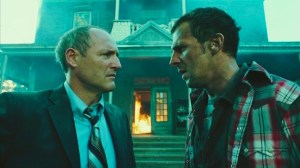
Bon Cop, Bad Cop nails that dynamic at every step, as two cops (Ontarian Colm Feore and Quebecer Patrick Huard) are forced to work together to solve a murder in which a body was found straddling the Ontario-Quebec border.  Of course they’re going to try to one-up the other, of course they’re going to set stupid and arbitrary rules about who does what and which language gets used when, and of course their petty squabbles are going to put everything in jeopardy.  Because that’s what we do.  But in the end, we accomplish what needs doing, and we share a grudging respect that binds us closer than geography alone ever could.

Bon Cop, Bad Cop captures our relationship perfectly and pokes fun at it at every opportunity.  That made Bon Cop, Bad Cop enjoyable in spite of its cliches, nonsensical plot, and cheap shots at Gary Bettman (okay, the last bit was enjoyable on its own).   But if you’re not from either province, you probably won’t get it, and truthfully we kind of like that you don’t.   We may argue over which of Ontario and Quebec is better but we agree that both are way better than wherever the hell you live.

All We Had

Katie Holmes directs herself in All We Had, and proves she isn’t afraid to paint herself in an unfavourable light. Rita Carmichael is good at loving men but terrible at picking them. When another loser reaches his expiration date, it’s her daughter Ruthie (Stefania Owen) that knows it’s time to cut ties and get the hell out of dodge. The problem is that Rita and Ruthie are chronically broke. Rita self-medicates for her crappy childhood with nullcheap booze. Between men they live out of their piece of shit car. They have almost nothing going for them but Rita makes keeping Ruthie out of child services her top priority, and so far, she’s always succeeded.

This time, though, it’s going to be extra difficult. Their car breaks down literally in front of the greasy spoon where they just dined-and-dashed and it looks like they’re stuck in whatever crummy small town this is.

All We Had is not a great movie, but it’s not bad. It’s just that Katie Holmes is so hellbent on making this an inspirational story of redemption, she leans heavily on tired formula schtick. Addictions, childhood trauma, financial crisis: this movie has it all, everything except focus. All We Had is the kind of movie you’ll make excuses for – “it means well” you’ll say, and mean  it. But that’s not quite enough. There’s not enough skill here to pull meaning from the good intentions. But if you’re willing to watch Katie Holmes try, All We Had is good for 1 hour and 45 minutes of trial and error and smudged eyeliner.

Handsome: A Netflix Mystery Movie

The first thing you need to know about this mystery movie is that it’s not much of a mystery. You’ll know who the killer is right away, and not just because of your excellent deductive skills. While it doesn’t keep you guessing in the traditional mystery way, it does keep you on your toes because it delights in being flat-out weird.

Jeff Garlin directs, co-writes and stars as Gene Handsome, an L.A. homicide detective _Z6A7088.CR2who will strike you as half bumbling fool, half savant. His partner Fleur (Natasha Lyonne) is more interested in getting laid and his superior (Amy Sedaris, playing delightfully against type) is a stranger case still. Not to mention the fact that Handsome is in charge of “detective school,” training up the new recruits, not all of whom are destined to become ace detectives. So he’s got his hands full when a decapitated body is found on the manicured lawns of a minor celebrity (Steven Weber), splayed out in the shape of a Star of David. Handsome tracks down all of the dead girl’s known associates, including his own beautiful new neighbour, in order to crack the case.
Like I said, the detecting is rather beside the point. This movie feels more like an exercise in the bizarre. I happen to like Jeff Garlin and find him watchable, but this movie may have set a new record in our house for number of arched eyebrows I shot at Sean. There’s little plot but quite a lot of satire in the police-procedural vein. If you’re up for some of Garlin’s trademark witticisms and you don’t mind if your movies exist outside the box, then this  might be a WTF way to spend some time with Netflix. At any rate I admire the experimentation and the improvisational feel; Netflix certainly has become home movies who would otherwise remain homeless. And even if they don’t always hit it out of the park, at least it’s not another super hero franchise!

Nina

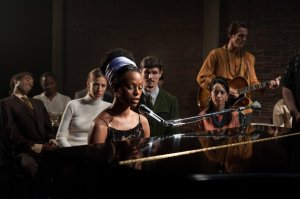
Nina Simone, born Eunice Kathleen Waymon, was a tour de force. She was a classically trained pianist who studied at Julliard. She applied at the prestigious Curtis Institute of Music in Philadelphia but was rejected despite an excellent audition because of the colour of her skin. Never intending to sing, she was forced to in order to make a living being a musician of the non-classical variety, the only option open to a woman of colour. She played a blend of jazz and blues, folk and gospel, and probably more besides. She changed her name to avoid embarrassing her family now that she played “the devil’s music.” And she became an activist, an outspoken proponent of the Civil Rights movement. Her music had always spoken to her roots, but soon she incorporated political themes there as well. A beautifully angry song “Mississippi Goddam” written in response to the bombing of the Baptist Church in Birmingham Alabama (that killed 4 little girls) particularly comes to mind, because how could it not? It’s spectacular and heart breaking. There was a great documentary made about her life not too long ago, but Nina is not a documentary, which means someone had to step into her shoes.

MV5BODk1NDY2MjcyN15BMl5BanBnXkFtZTgwNzkzNzM2ODE@._V1_SY1000_CR0,0,1502,1000_AL_Mary J Blige was originally cast but had to drop out. Nina herself had hoped that it would be Whoopi who’d portray her on screen. Instead director Cynthia Mort went with Zoe Saldana, and thus created a furor. With Dominican and Cuban ancestry, Saldana identifies as a black woman, but critics felt she was not black enough. Not black enough? The notion makes me queasy. But when Saldana said she was honoured to play Simone, the Nina Simone Foundation nastily replied “Dear Zoe, please keep Nina’s name out of your mouth for the rest of your life.”

Saldana’s talent is bigger than the criticism. She has a great voice, which you may have heard in The Book of Life, but no, she doesn’t sound like Simone. No one does. But she brings a lot of strength and dignity to the role, a mean feat considering the film focuses on the latter years of Simone’s life, which were turbulent to say the least. Mentally and financially unstable, Simone was committed to a psych ward, where she met a nurse she would later make her assistant, and then her manager. David Oyelowo plays the nurse. Biopics generally benefit from a narrow focus, but this one is perhaps unfair to her memory since Simone was so much more than just her struggles. See the documentary for a clearer picture of her life, but to see Saldana shine, this is one good role among many.


Two days before she died, the Curtis Institute of Music bestowed granted Simone an honorary degree.

One Week And A Day

When Eyal and Vicky Spivak finish the week of mourning for their son, their grief is a gulf between them. Vicky is ready to launch back into the comfort routine but Eyal seems lost, stuck, and unsure of how to proceed, or why. His stealthy rescue of a bag of medicinal pot from his son’s hospice room leads to a form of mourning unlike any other you’ve seen on the screen before.

In an odd way,  One Week And A Day is a comedy about grief. After a hilarious montage of Eyal’s inept failure to roll a proper joint, he recruits the young neighbour next door MV5BZmE0NGJjYzItOTExNy00ODI3LTljOWYtNWQ1NmMyN2NiZjU0XkEyXkFqcGdeQXVyNjA5NjAzMjI@._V1_SX1776_CR0,0,1776,960_AL_(an old friend of his son’s) and the two of them roll their way through grief and loss. Vicky is as disapproving as you might imagine, but she’s not exactly smoothly sailing through this period either. Her grief is just as bumbling, if more sober.

Turns out the neighbour, Zooler (Tomor Kapon), is an aspiring air guitarist, and his quirky, oddball demeanor is just what the doctor ordered, maybe not just for Eyal (Shai Avivi), but for all of us. The death of one’s child is a subject so sensitive, so awful to contemplate, that often we avoid it. Movies that dare to breach the topic are often morose and difficult to watch. In this case, writer-director Asaph Polonsky gives us reason, and permission, to smile through it. It’s a relief.

Which is not to say there isn’t something deeply emotional running under the surface. It bubbles up during a eulogy that comes late in the film, and it’s such a poignant moment that it stops you short. It gives balance to the film, and grounds us once again in reality.

Polonsky uses a wide lens to show the dynamic between Zooler, Eyal, and Vicky as the back and forth between them tends to be quite powerful. Everything in this movie feels casual and off-hand, allowing us to get closer to the subject, but this is due to careful orchestration behind the scenes. Afterward, recounting my favourite scene to Sean, tears sprung in my eyes. I hadn’t realized how moved I was by it because the movie doesn’t manipulate you into sadness. It very gently cradles you, but clearly even without the histrionics it’s capable of evoking feeling.

Hot Docs: Living the Game

The biggest change between grade 8 and grade 9 was that once I started high school I was allowed to leave school property on lunch. And leave I did. Every weekday from noon to 1, my friends and I walked to the nearest arcade. When I had quarters, I spent them, and when I was out, I watched others feed the machines. Many different games came and went during that year, but one of the mainstays was Street Fighter 2, in one flavour or another (it seemed every three months there was another version of it, from Champion Edition to Turbo to Super to Super Turbo). There was always a crowd around the Street Fighter console, and it seems that 20 years later, the crowd has only grown.

What is the appeal of watching others play video games? It’s hard to explain. The closest I can come is this:

Evo Moment #37, as it’s called, is an iconic moment in competitive gaming. If you have ever played Street Fighter, you know how insanely hard it is to parry one hit from a super move, let alone 15 in a row.  If even one of those kicks had landed then the match would have been over.  What a remarkable display of timing and hand-eye coordination!

The two players in that match were Daigo Umehara and Justin Wong. Living the Game is a documentary that follows them and a few other top players over the course of a pro gaming season. It’s fascinating to see this unique spectacle where two headset-wearing players look at a small screen while a thousand or more boisterous spectators watch on and cheer wildly.

These top players are doing well for themselves, earning sponsorships and salaries, supplemented by cash prizes of $100,000 or more for a big tournament win. Despite their success they are remarkably aware that this gravy train will not run forever and that their chosen profession is not well-regarded. That sort of honesty should make Living the Game an interesting watch even for those who are baffled by pro video gaming, elevating it beyond its subject matter. While there is no big revelation to be found within, it is interesting to get to know the players through this film, who as it turns out are not much different than you or me, except they happen to be ridiculously good at video games.

Living the Game screens as part of the Hot Docs Film Festival on May 2 at 8:30 p.m., May 4 at 8:45 p.m. and May 7 at 6:15 p.m.

Hobbyhorse Revolution

I was excited to review this film for Hot Docs because I’d heard of and was mystified by ‘hobbyhorsing’ and needed to know more about it.

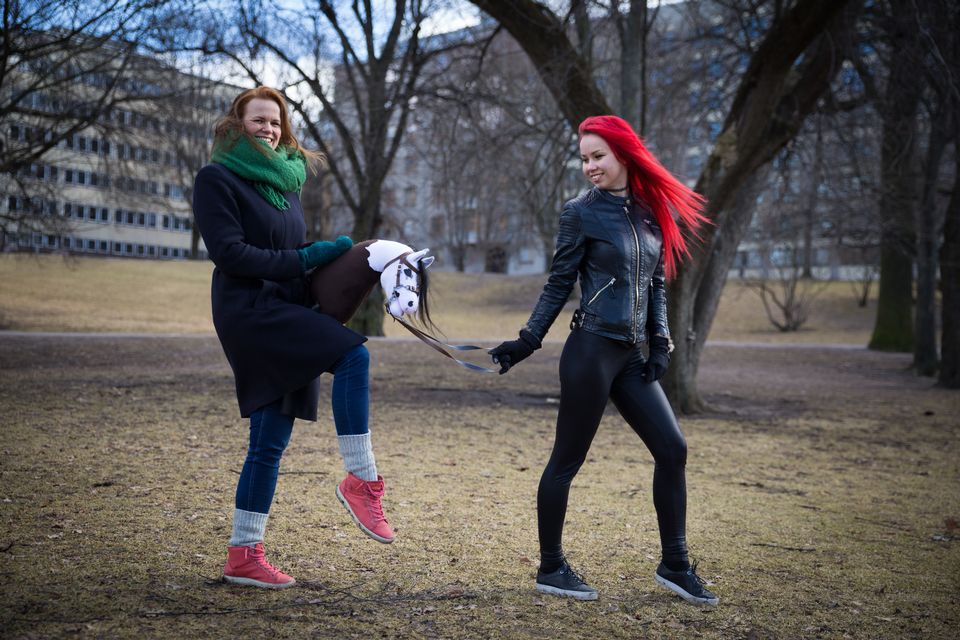
Hobbyhorsing is a lot like the horse competitions you’re used to seeing on TV, or in Olympic events.  Dressage, an equestrian sport, is the highest expression of horse training. In the events, you’ll watch horse and rider perform a sequence of events from memory, including piaffe (a special kind of trot), and pirouette (a 360 degree turn). In the obstacle event, the horses will jump over poles. Horse and rider are judged on how smoothly they go through the movements, and how willingly and with minimal cues the horse performs.

In hobbyhorsing, the competitions are similar, except – NO SHIT – performed with a fake horse. A hobbyhorse: those toys for small children which consist of a horse head on a broomstick.

Hobbyhorse Revolution is a documentary that sheds light on this burgeoning community, and on the people who compete (they’re older than you’d think).

Competitors “train” extensively, but don’t forget it’s their own two feet doing all the work. The ‘horses’ get off pretty lightly but are still given starring roles. Their ‘riders’ talk about them as though they are real: this one is ‘energetic’, this one ‘well-schooled.’ They are ridden with whips and put away with stable blankets. You know, in case they get fake cold.

The teen-aged girls interviewed for the film are almost all troubled in one way or another and I can’t believe that’s a coincidence. Playing make-believe with toy horses is a blatant extension of childhood. In this light, hobbyhorsing is perhaps not simply a curiosity but a disturbing trend – 10 000 “hobbyhorseists” in Finland and growing. Unfortunately, the film maker fails to answer that most obvious of questions: why? What is happening to these girls that they’ve left their peers and retreated to the safe but immature world of racing fake horses? Interesting but superficial, Hobbyhorse Revolution is a hollow look at a surprising new safety blanket.


[Between you and I, I can’t really watch a 17 year old young woman prancing around with a stick between her legs and not wonder if it’s somewhat sexual. Or entirely sexual. Either way, something here is messed up.]


Winding

A quick Internet search confirms that the Yarkon River is a river in central Israel, the largest coastal river in Israel at 27.5km in length. It’s mouth is in the Mediterranean Sea and when the Reading Power Station was built close by to supply electrical power to the Tel Aviv District, the Yarkon became heavily polluted.

Winding is a documentary about the Yarkon but it is not a regurgitation of already-available facts. It tells a history much more personal, the river’s journey from symbol of hope to curse bringing death. The documentary shares archival footage, personal recollections, and more recent interviews to establish the interplay between a people and its land, between nature and man. It’s actually a little bit sad to watch a beloved river decline and it feels natural to draw parallels between the Yarkon and much larger global issues.

This film by Avi Belkin plays at the Toronto Jewish Film Festival Tuesday 9 May, 3:30 PM at Cineplex Cinemas Empress Walk 9. If you are unable to attend this screening, never fear, there are lots of excellent movies to choose from. 30 Years of Garbage and Operation Wedding are personal favourites, but do check out the programming guide – there’s lots more to see.


Guardians of the Galaxy Vol. 2

Guardians-of-the-Galaxy-Vol-2-wallpaperI have avoided writing this review since Thursday.  Guardians of the Galaxy Vol. 2 left me entirely uninspired. Was it the mediocre 70s music? The laughable indestructibility of the heroes and villains that only disappeared when convenient to a plot point? That we have seen this movie before, a thousand times? Or that these heroes, who seemed so fresh the first time around, had nothing new to offer?  Whatever the reason, this movie was missing the spark that made the first Guardians of the Galaxy so much fun.
“More of the same” is generally something that necessarily is tied to a sequel; after all, the reason the sequel exists is because we liked the first one and asked for more. But the sequels I most enjoy are those that could stand alone if the first one was somehow wiped from memory. I don’t think Guardians Vol. 2 passes that test. It starts strongly (as Jay said to me afterward, she would have preferred it if Groot had danced his way through the whole movie) but loses its way, sacrificing action scenes and momentum to rehash the first movie’s tale of outcasts forced together to save the galaxy.

Strangely, for a movie that I don’t think could stand on its own, Guardians Vol. 2 also does not really do anything to advance things in the Marvel Cinematic Universe as a whole. If it had, I might have felt better about the movie as then it would have had a purpose. Without that, and without any real progress from the first film, Guardians Vol. 2 felt like a throwaway franchise episode, another The Fate of the Furious, another blockbuster that will have been forgotten in six months. In other words, the polar opposite of how I felt after seeing Guardians Vol. 1.

As always, my hopes were definitely too high for this sequel but I think the main reason I was so underwhelmed by this movie is because what I liked so much about the first film was its originality, and this is a carbon copy of #1 in practically every way.

Guardians of the Galaxy Vol. 2 gets a score of five dancing Groots out of ten.


Hot Docs: A Cambodian Spring

Land rights are a super contentious issue in Cambodia, where the communist Khmer Rouge regime banned private property in the 1970s, destroying tonnes of land documents in the process.

As a result, at least two thirds of Cambodians, most of them poor, of course, don’t have proper deeds for the land they live on. Over the last ten years or so, thousands have been evicted and forcibly removed from their homes in various land-grabbing schemes, mostly perpetrated by their own government, referred to in his film as a “fake democracy.”

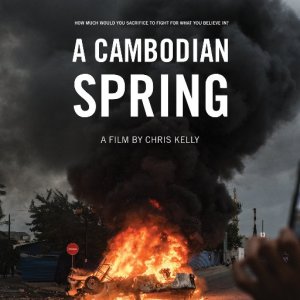
1L6PdFeXFilm maker Chris Kelly follows three people over the course of 6 years to get a grip on their experiences. Toul Srey Pov and Tep Vanny are two young mothers who allowed their land on the Boeung Kak Lake to be measured by the government, supposedly to receive accurate land titles. Instead, the government leased their land to a private company, Shukaku, which “happens” to have ties to the Prime  Minister. Shukaku is dumping sand into the lake, flooding the streets of Boeung Kak, forcing people from their homes. These women are too poor to abandon their homes. The compensation offered by Shukaku is laughable, insufficient to start over elsewhere. But those who stay risk their lives – already 3 have died by electrocution alone.

A Cambodian Spring shows how corruption and oppression still rule in Cambodia, but more than that, it highlights our own role in this: the failure of the World Bank to enforce its own resettlement policy, and the international complicity in allowing this to happen to regular people who believe they should be able to live in the homes they have purchased.

Although a bit overlong, A Cambodian Spring is an eye-opening and intimate portrait of citizens-turned-activists, and the cost, both personally and politically, that comes with fighting back.