
Violet sets her alarm extra early so she can sneak out of bed, fix her hair, and sneak back into bed so her boyfriend thinks she wakes up like this. She does not. An exacting mother made sure that Violent has spent her whole life hiding her true hair. But even with all the tools and chemicals and salon appointments in the world, Violet is still Cinderella waiting for the clock to strike midnight. When it rains, or is even humid, the magic disappears and her hair reverts back to its natural state. So her life revolves around monitoring the weather and keeping her boyfriend’s hands away from her head.
On her birthday, Violet’s hair is perfect (though not without some drama). She is 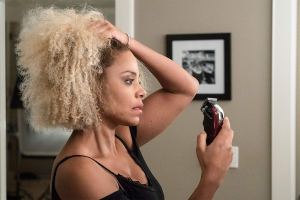 expecting a ring from her boyfriend of 2 years and instead gets a puppy. Boyfriend accuses her of being “too perfect” so a breakup tailspin ensues, including stops at ‘fuck you hair’ and ‘drunkenly buzzing it all off.’ But can Violet change her attitude and values to reflect her newly bald head?
So, okay. I’m white. Violet is black. I am not the best person to review this film. I mean, on some level, many if not most women will relate. So much of our identity is tied up in our hair. But it’s different for Violet, for women of colour. Black hair, for some unknowable reason, has been viewed as…inferior? Is that the right word? Even very young girls may feel that their hair is somehow ‘wrong.’ A black woman who wears her hair naturally may be viewed as unprofessional at work, unkempt at school, perhaps even viewed as her making a political statement to the world. Culturally, hair may serve as a bonding tool, a thing that unites black people (even black men – there’s a whole franchise of Barbershop movies) but it can be misunderstood outside the culture. Black women make up 70% of the hair care market, but the marketing always features white women with long, straight, glossy locks. As do TV shows and movies and magazine covers. So to attain white standards of beauty, black women blow through time, money, and PAIN to achieve the kind of hair that grows naturally out of white heads but not their own. They’ve felt the need to suppress the natural texture of their hair not just to look attractive but to be accepted at work and in the world. But it takes a toll. Viola Davis said in an interview recently how nice it was to wear her hair naturally in Widows (which had a black director, Steve McQueen). She’s used to wigs, weaves, and chemical relaxers just to present ‘the right kind of black’ to Hollywood and audiences. As you know, there’s still a huge gulf to be overcome in terms of media representing people of colour, but even when a film does hire a black actress, she will often arrive on set to find that the hair and makeup team have not thought through her particular needs. They may be unequipped, in terms of tools and experience, to deal with her hair. It is rare to see a black woman on screen rocking her own natural hair. And that’s okay if it’s a real choice. I don’t wear my hair natural either. But for me it’s a matter of style and personal preference. For a woman of colour it may not feel like any choice at all.
So yeah, Nappily Ever After is a romance, but it’s one tied into culture and identity and hair and femininity and acceptance. Sanaa Lathan is really terrific in it, and relatable too. Even though the script itself is very much about the black woman experience, there are universal themes of authenticity that anyone can appreciate. There’s something very powerful about having the courage to be yourself – but I think there’s something even more powerful about living in a world where that wouldn’t be discouraged in the first place, even if that doesn’t exist yet.
[Women of colour, feel free to correct me or to add to the conversation. And to anyone interested in the topic, Chris Rock (yes, THAT Chris Rock) has a cool documentary about it called Good Hair.]
 the village laws, and the robe says Smallfoots don’t exist. For once in his life, Migo disobeys the stone laws and gets cast out of town for sticking to his guns. Only the village crackpots\conspiracy theorists believe him, but they turn out to have a beautiful leader, Meechee (Zendaya), so Migo is persuaded to jump either to his death or his edification on behalf of the Smallfoot Evidentiary Society, over the mountain and through the clouds. Down, down he goes. He falls so far he can’t sustain his scream; it falters so he can rest his voice.
 her – Charlotte, the mother of another kidnapped journalist who was successful in getting her son returned home. Off the record, Charlotte (Edie Falco) fund-raised the ransom among her wealthy friends and had someone walk it across the border for her in order to evade detection. They’re planning the same for Helen’s son, with a friend and colleague of his, Sam (Matt Bomer) willing to make the actual transaction. Helen can scarcely believe her son might actually come home, and isn’t sure what kind of broken man he’ll be if he does. But her focus remains on getting the work done, all of it underground, away from the unhelpful but watchful eyes of government agencies.
 Gwen lives with her mother and younger sister. They have next to nothing – their makeup bags legit comprising of a pointy stick with which to prick their fingers and use the blood as blusher. Her father is absent, away at war. Her mother is mysteriously ill. Her neighbours are disappearing, one by one, a mining company encroaching on the land. But there’s also a darkness that comes knocking. Strange things are happening, inexplicable things.
 found male identities received more sympathy. Eventually she found a way to turn it into art, and several stories and books were published under the name. She wouldn’t be the first writer to write under an assumed name, but she might be the first to have gone to such great lengths to present a pseudonym as a real person. She recruited her boyfriend’s androgynous sister Savannah to “play” JT in person, granting interviews and posing for pictures as him – even signing the rights to a movie contract. Of course, when the truth comes out, as it nearly always does, the world was kind of mad about being duped, and there was a big backlash.
 wrote movie scores and TV theme songs. He traveled the world making music, and he’s given back to the community by mentoring young musicians and passing the baton, literally, to new composers. He met Michael Jackson while working on The Wiz, and went on to produce Off The Wall, Thriller, and Bad with him. Oprah credits him for ‘discovering’ her for The Color Purple, which he scored and produced. He also composed the music to Will Smith’s Fresh Prince theme song – he was a show producer, and Will Smith auditioned for and signed a contract at Quincy’s 57th birthday party.
 masturbate. Where the beach scene felt fun and carefree and only a little naughty, the act of repeating it under these circumstances is a violation neither Liv nor Malte can bear. When they aren’t quite up to the task demanded of them, ringleader Sascha decides to take a more direct approach. He rapes Liv while Malte watches, hog-tied and bleeding. It’s cruel and agonizing.
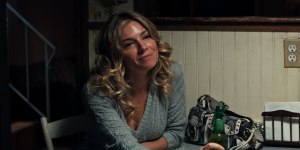 Because Deb is worth more than she even knows, which she stars to discover after her daughter fails to come home one night after a date with her basement-dwelling baby daddy. A loved one’s disappearance must be life-shattering. Miller lets us see the dissapearance’s drastic effects on Deb in such a restrained and measured way that Deb’s resulting character growth is organic, believable, and most impressively, almost invisible at first. Deb’s evolution is captivating, and the Deb we know by the end of the movie is at once the same core character and a woman whose outlook and attitude have evolved beyond anything I could have ever expected.
 been insulated from the problems with her father, who’s recently had a heart attack, and her mother, whose Alzheimer’s is only getting worse. It’s Nick who’s been dealing with them in Chicago and now he wants and needs her support in getting Ruth into a memory care facility – a suggestion he knows Ruth can’t consent to, and Burt will oppose vehemently.
 ASSHOLES WATCHING MOVIES