Yearly Archives: 2018

Life of the Party

Dumb but funny.

First off, happy mother’s day mother fuckers. I spent the earlier part of Saturday celebrating with my mom and sisters (who are mothers themselves) over drinks, and probably food, but definitely drinks, in the heart of Ottawa’s vibrant Byward Market – and we just happened to do that beside Matt Smith, who was in town for Comic Con. Jason Momoa was also in town but I guess someone else had already offered to braid his hair like he was a sweet, sweet pony.

Anyway. Did it help that I had consumed drinks literally marketed as “fishbowls”? Likely yes. Did it help that some of the jokes made in the movie were oddly similar to the jokes we’d been making at my mom’s expense all day long? You bet. Maybe I was just in the mood to laugh, but laugh I did, and so did the rest of a pretty packed theatre.

In Life of the Party, Melissa McCarthy plays Deanna, a woman who’s just been dumped by her jackass husband after a quarter decade of devotion and submission. She decides MV5BMjQ5MjM2OTY1M15BMl5BanBnXkFtZTgwNTQ2MzI0NTM@._V1_SY1000_CR0,0,1498,1000_AL_to capitalize on her freedom by finishing the degree she gave up in favour of pregnancy over twenty years ago – the only problem is, she’s now a classmate of her daughter Maddie, because of course she’s elected to go to the exact same college. And I should say: it’s a problem for her daughter, who thinks it’s less than fun to have her booze and sex parade rained out by her uncool mom, but it’s a dream come true for Deanna who can’t wait to spend every waking moment with her daughter, aka, the only good thing to come out of her crummy marriage. Things are further complicated when Maddie’s friends all fall maddeningly in love with Deanna’s endearing “down to clown” antics.

Here’s the thing. This movie is not really a good movie, and it’s not really trying to be. It’s not treading new ground, it’s not smart, it’s not edgy. It’s a a benign, somewhat ridiculous premise that merely exists in order to set up some fairly ludicrous jokes. But it does, quite frequently, knock them down with some punch. The script is less objectionable than most in McCarthy’s recent past, and her performance has got more zing and zeal than all the bedazzled sweatshirts in the movie combined (believe me, it’s substantial).

Do I recommend this movie? It’s hard to go that far. The cornball factor is high. But the truth is, Melissa McCarthy seems uniquely qualified to deal in cheese, and really, who doesn’t love cheese?

TJFF: Future ’38

How do I explain this? . Future ’38 was filmed last year but is pretending to have been filmed in 1938. It is set in 2018 but, remember, this is the 2018 as imagined by fictional filmmakers from the 1930s. Or present day filmmakers imaging what 1930s filmmakers would think 2018 would look like.

Film historians or whoever’s job it is to uncover lost screwball comedies about time travel from 1938 have recently uncovered a lost screwball comedy about time travel from 1938. After a brief introduction by a real life scientist who praises the scientific accuracy of all the time travel bits, the film begins in black and white in the height of World War II. Essex (Nick Westrate) is the most dependable GI this side of the Atlantic. His mission: Leap 80 years into the future in search of the powerful isotope Formica which, according to Dr. Elcourt from the Laboratory of Science, will be strong enough by 2018 to win the war for the Allies.

Essex wakes up (in Technicolor) in 2018. A version of 2018 you just have to see for yourself. On the one hand, it’s a startlingly accurate picture of 21st century life. On the other, it’s filtered through the limited imagination of a fictional 1930s science fiction writer. They have a 24 hour news cycle, for example. it’s just a guy on a unicycle though yelling “Extry Extry”.

In 2018, Essex almost immediately meets Banky (Betty Gilpin), a streetwise hotel manager who thinks he’s just “a little queer” because he’s from Pasadena. Once she agrees to show Essex around (“I could use a little fun and you’re Coney Island without the smell”), Future ’38 quickly finds its rhythm. The way they get the 21st century both right and wrong at the same time is funny enough. But Future ’38 is at its absolute funniest as a straight 30s style screwball comedy that mimics the fast-paced dialogue, slapstick, and romance more than it mocks it.

There’s a joke or two here that are maybe just a bit much. Most do land though even once the novelty of the outrageous style and concept has worn off and Gilpin and Westrate play off each other like true stars of the 30s. This could have easily been unwatchable had the writing, casting, and attention to detail not been so spot on. I think you’ll like it.

Are You Here

Ben Baker (Zach Galifianakis) is a bipolar man-child who dabbles in the consumption and dissemination of weed. His friend, Steve Dallas (Owen Wilson), a moderately successful local weather reporter, is outwardly more put together but his womanizing makes for a pretty superficial life. It’s hard to say why these two are still friends, but their shared childhood has clearly bonded them, and when Ben learns his estranged father has died, Steve makes the trip home with him.

There are two problems with waiting for Ben at home: 1. his ambitious, uptight sister Terri (Amy Poehler) and 2. his hippie “step-mom” Angela (Laura Ramsey) who’s the same age they are. Terri and Angela don’t get along and Ben hasn’t seen either of them in quite some time. So yeah, it’s a bit of a problem when the will is read and almost everything, including the family business, is left to him, a known loser and eternal fuck up.

MV5BMTY0OTE2ODg2OF5BMl5BanBnXkFtZTgwMjUxMDI0MjE@._V1_SY1000_SX1500_AL_First off, I sort of hate this title. Actually, I definitely hate this title. It’s too vague and it doesn’t mean anything, and without a question mark, it’s a question that doesn’t even ask itself let alone demand an answer.

I don’t know what this movie was really about, and I am confident that writer-director Matthew Weiner doesn’t either. I’m not 100% sure this movie wasn’t accidentally made from 2 or more disparate scripts. It kind of feels like a few rough-draft ideas were quilted into a half-baked script that never should have seen the light of day. And though there are a few good moments, mostly thanks to a talented cast, Are You Here is a forgettable mess. So I guess in that way, the title is actually quite representative of the film – and it should have been enough to warn me the hell away.

Barbra Streisand, Becoming An Icon

Barbra Streisand is a woman who needs no introduction. Movie stars were not generally cut from her mold but her talent was so sweeping and undeniable that it couldn’t help but be recognized.

Barbra Streisand, Becoming An Icon doesn’t delve deep into her background or her psyche. The only words we hear from her are recycled from previous interviews. But all stacked up together, the archival footage and rich performance history will be a delight to fans and a fantastic reminder of her incredible artistry.

But talent aside, Streisand was always cut from a different cloth. She was a proud w-barbra-is-the-best-012215-1425553757feminist and “uncompromisingly Jewish”, inspiring a generation of women and showing America her own brand of stardom. Unapologetically ambitious, aggressive, and outspoken, she started a new wave of female businesswomen in Hollywood, blazing her own path and doing it with style, elegance, and dignity.

This documentary offers to critique, no shade, no bombshells. It’s just a straight-up love letter to a woman who’s been earning it for 5 decades.


Barbra Streisand, Becoming An Icon screens as part of the Toronto Jewish Film Festival. You can attend a screening May 10, 3:30pm at Cineplex Cinemas Empress Walk 9, or make it a mother’s day event on Sunday May 13, 2:30pm at Hot Docs Ted Rogers Cinema.

TJFF: Another Planet

Over 70 years later, we’re still trying to make sense of the horrors of Auschwitz. Architects, historians, game designers, and prosecutors have started using 21st century virtual reality technology to help see history in new ways but, to paraphrase the great prophet Jeff Goldblum, just because you can do something doesn’t mean that you should.

I’m not necessarily saying that you shouldn’t. I am saying that it’s unnerving to see VR Auschwitz. We begin with a tasteful black and white recreation designed by an architect and a historian for a VR museum exhibit. They mention that the museum wanted it to be in black and white so that it doesn’t look like a comic book.

Cut to an unsettling full-colour model designed to aid in the prosecution of a Nazi war criminal. The defendant claims, as many apparently do, that he didn’t actually know what was going on at the camp and that he worked as a cook. Using this fancy new technology, forensic experts can estimate what he was likely to be able to witness from his position in the kitchen. They say that they are sure to make sure that their model doesn’t fall into the wrong  hands. What if, for example, someone were to want to make a game using their replica? Wouldn’t that be in bad taste.

Cut to an actual escape from Auschwitz virtual reality game. And this is where things get really weird.

To be fair, everyone interviewed in the film, including the video game designer, has an explanation for how their work is respectful to victims of the Holocaust and none of them are unconvincing. It’s just a little jarring. And it’s fascinating to think of technological advances can change the way we look at the past. It’s a great subject for a documentary that is sure to start some lively conversations.

The Cakemaker

One day, a handsome man named Oren walks into Thomas’s German bakery, looking for cake and coffee, and possibly a gift suggestion for his  young son. By the end of the day, Oren and Thomas are lovers, but their affair must be put on hold as Oren returns to Jerusalem to see his son and wife. A month, he tells Thomas as he walks reluctantly out the door, trying to make it sound insubstantial. One month.

Only Oren never does return, and Thomas’s calls go unanswered. There’s been an accident in Jerusalem, and Oren was killed. He isn’t coming back, to Thomas or to anyone. Grief-stricken, Thomas travels to Israel to feel close again to his ex-lover, MV5BZWRjODFhZGYtYzI4NC00M2M0LWI4MmQtZjQ4ODk5ZWIwNjQzXkEyXkFqcGdeQXVyNTUwNDQ4NQ@@._V1_SX1777_CR0,0,1777,744_AL_wrapping himself up in the city where he last knew he was alive, and he finds himself in the cafe of Oren’s widow, Anat. Thomas (Tim Kalkhof) takes solace by inhabiting different aspects of his dead lover’s life, and it’s not long before he’s helping out in Anat’s cafe, and erm, doing other things for Anat (Sarah Adler) besides. Of course, Anat is unaware of the relationship her husband had with Thomas, so it’s only her grief pushing her into Thomas’s strong but unfamiliar arms.

The Cakemaker is slow and deliberate. It feels a bit like a recipe, with ingredients lovingly chosen and carefully measured, and everything kneaded together with slow, sensuous strokes. There are no surprise ingredients, but the way they’re blended makes for a very interesting movie, equal parts delicate and passionate. Writer-director Ofir Raul Graizer stirs his creation in a way which suggests that our identities, religious, political, sexual, whatever, they’re fluid. And grief is complicated. It’s sad of course, because love is inevitably sad, but it’s the journey more than the destination, the story of survival, the getting there, and the rest is just cake crumbs.


The Cakemaker screens as part of the Toronto Jewish Film Festival and if you’re lucky, you can catch it tonight, May 9, 8:30pm, at the Cineplex Cinemas Empress Walk 9.

Humor Me

Nate, a prize-winning playwright, has been writing his most recent play for the last four years. When his wife leaves him, taking his adorable son and his ability to pay rent with her, he’s forced to do the thing he’s always sworn he’d never do – move in with his father, who lives in a retirement community called Cranberry Bog.

Of course, Bob (Elliott Gould) thinks his son is a lazy, stagnant fool who’s wasting his Harvard education, so he puts him to work fluffing and folding towels in the Cranberry Bog laundry. And Nate’s talents are further wasted by producing a portion of a musical number with the local community players, ie, old ladies who are unequal parts cranky humor-me-stilland horny. Nate (Jemaine Clement) would like to reconnect with his father, but the two have been distant since the death of Nate’s mother – and he was always closest to her. Other people think Bob is very funny, but since his answers to all of Nate’s very serious questions are always jokes, the two men remain separate in their grief.
I have loved Clement since his days on Flight of the Conchords. His performance in Humor Me is more grounded in reality than usual, infusing this sad-sack with some quirks and personality tics that give Nate some real warmth. Of course, I have loved Elliott Gould for much, much longer, and his diverse professional background is evident in every line, not all of which are truly worthy of him, but he never lets them down. In fact, I’d say the casting and performances in this film are its greatest asset. Ingrid Michaelson, Maria Dizzia, Priscilla Lopez, Joey Slotnick, Willie Carpenter, Le Clanché du Rant, Rosemary Prinz, Annie Potts, and Bebe Neuwirth fill in the gaps between Bob and Nate, creating a living, breathing community not easily conveyed through film.

Humor Me manages a delicate balance that often errs on the side of comedy. It’s light, and if it’s not exactly fresh, it has a lot of talent backing up the retreads.


Humor Me is screening at the Toronto Jewish Film Festival tonight, 8pm, at the Cineplex Cinemas Empress Walk 5, and May 10, 9pm, at Hot Docs Ted Rogers Cinema. Check it out, and bring your dad.


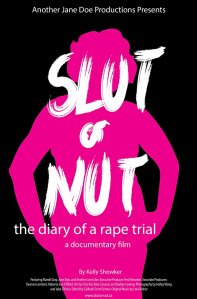
Slut or Nut: The Diary of a Rape Trial

Mandi Gray was raped. She is one of the very rare few to speak up, to pursue criminal charges, to undergo a brutalizing justice system process that seems built for the benefit of perpetrators, not victims. I want to call Ms. Gray strong and courageous for doing so, but I don’t want to imply that women who do not are not. I think Ms. Gray knows better than anyone why women choose to stay silent, or are silenced, and this documentary puts us squarely in her shoes, so we can understand it too.

Only 3 of 1000 sex assaults result in conviction. Most go unreported because even in the era of #metoo, women are categorically not believed. But for the small percentage who do bring an accusation to the police, one fifth will be dismissed as MV5BNzJiY2ZmMWItOGI4My00ZGVlLTljOWMtZGZjNjZhZjBiNjUyXkEyXkFqcGdeQXVyNzQ3MjI5NzM@._V1_SY1000_CR0,0,658,1000_AL_“unfounded” which seems to be a fancy word for the police not believing her, which is hard not to take personally when ‘unfounded’ is used exponentially more often in sex assault cases than for any other crime. If you’re a woman of colour, disabled, or a sex worker, your word is all but meaningless. But if you’re one of the small sliver of people not dissuaded yet, you may find, as Gray did, that your body is now a crime scene. A rape kit is a must for conviction, yet there aren’t enough rape kit nurses to go around. You’ll have to offer yourself, body and soul, as evidence, because for some reason it’s your responsibility to help catch the rapist. But the fun doesn’t stop there: next you’ll be revictimized in court in a discouraging, dehumanizing procedure that never grants any real justice because it’s the victim who seems to be on trial.

This is the reality in which we live, and there’s no dearth of documentaries, well-made, well-researched, passionate, rally-cry, stoke-the-fire documentaries, that point out the inadequacies of this oppressive system. And yet we need another. And another. Because as often as women have said it before, it’s clearly still not sunk in. The system is broken.

Kelly Showker puts together a documentary that doesn’t just plead for social change and justice, it shows us quite plainly just how badly it’s needed. Ms. Gray could be your roommate or your sister or your friend. Stand beside her as she relives the worst night of her life, followed by the worst year. This documentary doesn’t preach, because it doesn’t need to. It shows you the callous reality of a rape trial, and watching it, there’s really only one conclusion you can draw. Seek out this documentary. Watch it, share it, talk about it. Change only happens when we unite, and a documentary such as this has the power to make advocates of us all.


This documentary screens as part of the Hot Docs film festival; this review was first published at Cinema Axis.


Cornered in Molenbeek

Few things are more ubiquitous than a group of old men chatting about life in a local barbershop.  Cornered in Molenbeek starts innocently enough as it drops us, seemingly randomly, into one of those barbershops.  Sure, the customers are speaking Arabic, but they are also speaking about things that I might talk about with my barber (sorry, stylist).

The shop closes for the day and then, in an instant, everything changes.  News breaks of a terrorist attack on Paris.  It’s November 13, 2015 and when the cornered_in_molenbeek_1dust settles, 130 people are dead and 413 more are injured in a series of coordinated attacks at a number of locations throughout the city.  The investigation quickly determines that the attackers are from Molenbeek, Brussels, the very neighbourhood where this barbershop is located.  Of course, the attack becomes the main topic of conversation here, just like it was everywhere else.

Not surprisingly, this barbershop collective has no real answers as to what made the attackers do what they did.  Because guess what?  I have no real answers either.  The lack of answers here is revealing, though, particularly as the collective’s attempt to find an explanation weaves through a wide variety of possible causes, often looking for someone or something to blame, such as government, poverty, and the attackers themselves, with one notable exception: these people do not try to place blame Muslims as a group for these attacks, because they are Muslims themselves.  Contrary to the torrent of right-wing nationalist propaganda that is so often shouted at me online by a host of faceless idiots (oh, and also by the President of the United States), this group of Muslim acquaintances in this barbershop are just as innocent, just as angry and just as confused about the attacks as the rest of the world, and maybe more so because their religious and geographical association with the attackers draws them personally into the aftermath, exposing them to significant consequences that most people don’t have to worry about.

The phenomenon of terrorism is worthy of examination, and it was a refreshing approach to do so through the familiar lens of this barbershop, which otherwise would be functionally closed to me as a uni-lingual white Canadian (Arabic and French are the only two languages being used in these conversations).  The film’s structure serves to enhance the fly-on-the-wall feeling by letting us experience the barbershop’s normal environment before the attack happens.  The stark contrast in what is being discussed before the attack as opposed to afterward clearly shows that these types of attacks affect everyone regardless of their religion or native language, and really, we all need to be involved in this discussion on terrorism in order to stop it.  Cornered in Molenbeek does its part to start the conversation, and it’s up to us to keep it going.

Chef Flynn

Flynn McGarry, 15 in the documentary, has been “cheffing” since he was 10. I’m not talking about peanut butter toast, this kid is the real deal, sourcing ingredients most people wouldn’t recognize as food, preparing it in ambitious ways, plating it with finicky precision to detail. His mother Megan, once a film documentarian herself, has no shortage of home video of his meteoric rise to culinary stardom, and this film uses that footage liberally. We see him hosting a 12-course “supper club” for family friends in his home at age 13, with a kitchen full of children to do his bidding, and transitioning to professional pop-up restaurants in New York, with trained staff underneath him, just a few short years later.

Chef Flynn is replete with food porn sure to make foodies happy, but this documentary doesn’t exactly focus on the culinary side of things. Instead, director article-2269130-1733455C000005DC-923_634x422Cameron Yates focuses on the unusual relationship between mother and son. Meg McGarry allowed her son to drop out of school to focus on his passion. Now, nearing 16, he’s ready to move away to pursue his career. As a mother, we see helicoptering, permissiveness, indulgence, and an incredible amount of creative nurturing. But we also find a woman who has lost herself in her son’s shadow. Pursuant of her son’s great passions, she’s forgotten hers, and now that he’s ready to leave her behind, what will become of her?

Yates shows a little of the familial friction but that’s as far as he’s willing to go. This is otherwise about as thoughtful as any home video: with almost no input from outside the family, it’s hard to judge how good Flynn really is, or what place he has among top chefs. Plenty of pro chefs balk about even calling him a chef, but we never get to hear from the opposition. I think his talent and enthusiasm are in earnest, but the truth is, this is a privileged white kid whose parents indulged his whims and bought him his biggest dreams. His childhood bedroom housed more high-end appliances than my grown-up kitchen. He hasn’t paid any dues. He didn’t have to work for this. Chef Flynn is interesting, but it’s a one-sided story, all sweet with no salt, which any chef should know makes for a boring meal.