
Poop. Everybody does it; polite people don’t talk about it. Poop Talk features very few polite people. Make no mistake, Poop Talk is a documentary but it will not enlighten you or educate you. Instead it assembles dozens of your favourite comedians and asks them to relate their best bits about poop. Whether or not this documentary will entertain you depends entirely on your tolerance for scatological humour.
Personally, I have likely never laughed at a poop joke. I believe there’s a reason that we build sacred rooms in our homes devoted to just one thing: pooping. Bodily functions are private. Why bother doing them behind closed doors if we then fling the door open and 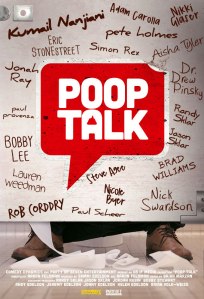 proudly boast about our most disgusting feats? Having recently spent quite a lot of time with nephews aged 3,4, and 6, the phrase “no toilet talk” has left my lips more times than I can count. And now I realize I’m happy to do my part in teaching the future generation what’s appropriate to talk about in public and what’s not if it means no one has to sit through such a “frank” documentary every again.
Nicole Byer, Eric Stonestreet, Rob Coddry, Pete Holmes, Aisha Tyler, the Sklar Brothers, Nick Swardson, Paul Scheer, and Kumail Nanjiani are among the film’s culprits. Each brings a poop story to the table: airplane poops, public restrooms, bidets, sullied pants, ruined Passovers. Nothing is off-limits for this documentary, though it exists in a world where poop is still probably our favourite taboo. We may all be responsible for approximately 365 pounds of it per year, but most of us prefer to do it behind closed doors. Comedians, however, are not normal people. Emancipated from shame, they lay bare their most intimate poop details, and you can choose whether or not to laugh and commiserate. Eric Stonestreet is a notable exception: his list of places he won’t poop is extensive, and almost as long as mine. Thank you, sir, for being the single voice of reason.
Using almost exclusively talking head interviews, director Aaron Feldman keeps things simple and straight-forward, and never in my life have I been more grateful for a lack of illustrative graphics. I was one cutesy animation away from losing my shit. If we truly must do this, then let’s get in and get out as quickly as possible. A tight 75 minute running time is a blessing. The film’s philosophy is elemental: the more we share openly about these things, the more united we’ll be in our human experience. Around the globe and across all cultures, everybody poops. And some rare specimens have learned to turn shit into comedy gold.
 intimidated. Is this civilized, or insanity? Eve’s granddaughter Mackenzie is making a documentary, “what does love mean to you?,” and the lineup of family members covered is immediately confusing. With so many spouses, are any of these people related?
 he’s found the culprit. 696 000 caucasian male inmates in American prisons every year; if you look at 1906 faces every night, you can cycle through the entire population in a year. Ray has done this for 13 years and finally has a bite. That’s just to let you know that it may be Jess’s kid who died, but it’s haunted Ray too. They haven’t kept in touch but Ray has never stopped looking. Jess isn’t sure she has the strength to follow the legal channels, but Ray convinces her that under Claire’s direction, things will be different.
 when Melissa loses her job and she and Richie get evicted from their home, the good days are clearly behind them. The cycle of poverty’s got a pretty nasty pull on them, and in many ways this feels like a companion piece to The Florida Project, though this one’s already five years old.
 goes wrong, and I suppose I’m feeling exactly that during Lovesick. His best friend is less a character in the movie and more of a narrative device. The screenwriter seems to think if he uses him to constantly point out that yeah, his friends and family should maybe have intervened, we’ll forgive them for not doing so. But there’s no way Charlie’s behaviour would go unchecked for so long and through such serious ups and downs in real life. He does stuff he should get fired for, maybe even go to prison for, but the movie treats them like cute foibles on the road to love.
 else. He got friend-zoned then but he’s sure if he can just repeat that day enough times, he’ll eventually get it right, and she’ll realize that he’s her true soul mate.
 be tested when social pressure doesn’t care how many lives are saved if it’s black hands doing the saving. Alan Rickman and Yasiin Bey (credited as Mos Def) star in the lead roles, and their chemistry is appropriately strained and tetchy. Arrogance, subservience, and expectations make such an interesting dynamic (for those of us watching anyway – I’m assuming much less so for those living it). This movie made me miss Rickman and admire Bey for how restrained and humble he could be in a role that must have been difficult.
 Now, I can tell you in no uncertain terms that no dead girlfriend is worth growing that kind of tragic beard for. I can also tell you that this guy’s a doofus. I mean, a) his name is Mitch. Case closed. He’s played by that dude who’s in the Maze Runner movies, which is possibly why he believes he can just become a spy, and then does. He looks up terrorist on the internet, and then just shows up at their door. It’s just that easy. I mean, it doesn’t go well and he has to be emergency extracted by the CIA or whatever, but who’s counting? Revenge, baby! And then for some totally inexplicable reason, the CIA takes a liking to this renegade with pubic hair on his chin, and they decide to train him up so his spy game’s a little more on point. Cut to: Michael Keaton, who plays Stan, a tough as nails ex-NAVY seal who takes young Mitch under his grizzled old wing. They decide to become a lame crime fighting duo, and the bad guy is none other than Stan’s former protege, who coincidentally owns an atom bomb and holds a grudge, and together they put the ass back in assassin.
 The Marvel Cinematic Universe is so bloated at this point that Marvel usually crams as many superheroes as possible into the “solo” movies in between Avengers instalments. For example, Iron Man pops up in
  ess the same movie. Clearly, that’s Marvel’s goal with a shared universe as that way, we movie-loving rubes have to see them all, and throw even more cash into Disney’s money bin (which by now must be bigger than Scrooge McDuck’s).
 ty disputes in Black Panther are resolved through lots of punching and kicking (which, for all its flaws, is clearly a more efficient political system than the one the USA is currently using).
 ASSHOLES WATCHING MOVIES